


Abstract
Résumé
Introduction
Materials and methods
Results
Discussion
Conclusion
References
E.E. Massae¹ and L.A. Mtenga²
¹ Regional Agriculture and Livestock Development Office
P.O. Box 3084
Arusha, Tanzania
²Sokoine University of Agriculture
Morogoro, Tanzania.
A study was undertaken to investigate the effect of plane of nutrition on growth performance and carcass composition of lambs. Some animals were on low (L) and high (H) planes of nutrition throughout the experimental period of 112 days. One other group started on a low plane of nutrition for 56 days (LH) and changed to a high plane of nutrition for 56 days (LH) while another group started on a high plane of nutrition for 56 days and changed over to a low plane of nutrition for the remaining 56 days (HL).
During the first 56 days, lambs on H regime grew faster and consumed less feed per unit gain than those on L regime. In the last 56 days lambs on LH regime showed compensatory growth by growing faster than those on the HH regime. In the same period lambs on the LL regime grew faster than those on the HL regime. When the whole 112 days were considered, the lambs on LH regime were almost as efficient as those on the HH regime in growth rate and feed utilisation.
Carcass weight as a percentage of empty body weight was lowest for lambs on L and LL regimes. Carcass quality was, in terms of lean, fat, lean-to-fat and lean-to-bone ratios best for LL followed by HL, LH and HH regimes.
Dans le cadre d'une étude entreprise pour examiner les effets du niveau alimentaire sur les performances de croissance des agneaux et sur la composition de leur carcasse, des rations hautement (H) et faiblement (L) nutritives ont été servies à un certain nombre d'animaux pendant une période expérimentale de 112 jours. Un autre lot d'animaux avait été soumis à un régime alimentaire faiblement nutritif pendant les 56 premiers jours de l'expérience et à un régime alimentaire hautement nutritif pendant les 56 derniers jours de l'expérience (LH), alors qu'un dernier lot avait d'abord été soumis au régime hautement nutritif, puis au régime faiblement nutritif (HL).
Au cours des 56 premiers jours de l'expérience, les agneaux bénéficiant du régime H affichaient une croissance plus rapide que celle enregistrée pour les animaux soumis au régime L, et consommaient moins d'aliments par unité de gain de poids. Au cours des 56 derniers jours, les agneaux soumis au régime LH manifestaient une croissance compensatrice et augmentaient plus rapidement de poids que les animaux bénéficiant du régime HH. Au cours de la même période, la croissance des agneaux soumis au régime LL était supérieure à celle des animaux bénéficiant du régime HL. Sur l'ensemble de la période des 112 jours, les performances des agneaux soumis au régime LH étaient presque aussi bonnes que celles des agneaux bénéficiant du régime HH pour ce qui est du taux de croissance et de l'utilisation digestive.
Le poids de la carcasse exprimé en pourcentage du poids mort était le plus faible chez les agneaux soumis aux régimes L et LL. Exprimée en fonction de critères d'engraissement (maigre, gras, rapports maigregras et maigre-os), la qualité de la carcasse la meilleure s'observait chez les agneaux soumis au régime LL, suivis de ceux soumis aux régimes HL, puis LH et enfin HH.
The aim of the sheep producer is to get his lambs to slaughter weight in a short time with maximum amount of lean meat, minimum bone and an amount of fat which is desired by the market. Among the many factors which contribute to variation in growth performance and carcass composition in sheep, plane of nutrition plays the major role. A high plane of nutrition improves performance and carcass composition of lambs (Owen, 1976; Andrew and Speedy, 1980; Mtenga and Nyaky, 1985). This is associated with increased intake of dietary energy and protein.
It has also been observed that undernutrition disturbs the normal relationship between chronological and physiological ages in such a way that in case of animals on a low plane of nutrition, physiological ageing proceeds at a slower rate. When such retarded animals are given liberal amount of feed, they tend to grow at a rate appropriate to their physiological age rather than their chronological age. Osborne and Mendel (1915) noted this biological phenomenon which was characterised by faster than average growth rate and it was later termed "compensatory growth" by Bohman (1955).
The phenomenon of compensatory growth has been a subject of great interest to researchers as reviewed by Allden (1968), Keenan and MacManus (1969) and Goodchild and Mtenga (1982). This is because proper utilisation of compensatory growth can result into economic benefits as producers are interested to keep their animals alive at the lowest cost possible in the dry season. Strategic supplementation of expensive concentrates can be beneficially used in feeding underfed animals at the end of the dry season in feedlot operations. Carcass composition of the underfed-refed sheep have also been observed to vary from those of continuously growing animals (Goodchild and Mtenga, 1982).
Sheep which are mostly found in Tanzania include Red Maasai and Black Head Persian (BHP). BHP is considered superior in growth rate and carcass composition (French, 1944; Mtenga and Nyaky, 1985) and has been used to upgrade local sheep. There has been little research work carried out on the ability of these animals to survive during periods of less feed supply and compensate sufficiently during periods of liberal feed supply taking into account the existence of interbreed difference in the magnitude of response (Goodchild and Mtenga, 1982). The aim of this study was therefore to investigate the effect of plane on nutrition on growth rate and carcass composition of lambs.
Twenty-eight male Black Head Persian (BHP) and Red Maasai lambs were used. The lambs had a mean initial liveweight of 14.6 2.3 kg and ranged between 10-14 months of age. Four animals were randomly selected and slaughtered to form a base line. The remaining 24 animals were randomly allocated to two treatments (H and L), each treatment having 12 lambs. Lambs on treatment L were fed the hay ad libitum plus 100 g of concentrate (basal diet) and was referred to as low plane of nutrition. Animals on treatment H were fed high plane of nutrition which consisted of hay ad libitum plus 400 g concentrate.
After eight weeks, four animals were randomly selected from each treatment and were slaughtered. The remaining eight sheep on treatment L were randomly allocated to two groups. One group of animals continued with the low plane of nutrition (LL) while the other was put on high plane of nutrition (LH). Similarly the eight lambs on treatment H were randomly allocated to the two dietary treatments (HL and HH). Animals in the four treatments were slaughtered at the end of the 6th week to determine slaughter characteristics and carcass composition. Daily feed intake and weekly liveweights of animals were recorded.
Chloris gayana hay was obtained from the university farm from two cuttings done in October, 1982 and January, 1983. The concentrate consisted of 71% maize bran, 27% cottonseed cake and 2% mineral mixture (Maclik). The mineral mixture consisted in percentage of Ca (18.61), P (3.5), Na (13.0), Cl (20.0), Cu (0.12), Co (0.03), Fe (0.31),1 (0.01), Mg (0.44) and S (0.18).
At the stated slaughter points animals were slaughtered and weight of warm carcass was taken excluding kidney and kidney fat. Non-carcass components were also obtained. The left half carcass was dissected into lean, fat and bone. Losses during dissection were assumed to come mainly from the lean meat and therefore lost weight was added to lean weight. The dissected components were thoroughly mixed together, frozen and then minced through a 2.5- mm sieve.
Samples of feeds and carcasses were analysed according to the AOAC (1975) method. Analysis of variance was used for most of the parameters studied and treatment means were compared using least significant differences (Steel and Torrie, 1980).
Health of animals
Diarrhoea was the only disease problem noted in four cases which occurred in the 9th week of the study. This problem was observed in lambs which were changed from low to high plane of nutrition and was probably due to initial high concentrate intake.
Chemical composition of feeds
Table 1 shows the chemical composition of Rhodes grass at two cuttings. There was an increase in crude fibre and a decrease in crude protein with the second cutting as a result of maturity and high lignification. The chemical composition of the other ingredients is also shown in Table 1 and the concentrate had about 18.0% crude protein. The concentration of energy in these diets, derived from a digestibility study was 9, 8, 9.7, 10.8, 10.3 MJ/kg DM digestible energy and 7.9, 7.8,8.7,8.4 MJ/kg DM metabolisable energy for treatments LL, HL, LH and HH, respectively.
Table 1. Chemical composition of Rhodes grass hay and concentrate feeds (means and standard deviation in g/kg DM). ¹
|
|
Hay (Rhodes grass) |
Maize bran |
Cottonseed cake |
concentrate |
|
|
1st cutting |
2nd cutting |
||||
|
Dry matter(DM) |
920.7±19.8 |
929.5±12.7 |
925.6±6.1 |
945.6±11.5 |
944.0±26.0 |
|
Crude protein (CP) |
54.0±8 3 |
44.2±8.5 |
104.6±2.9 |
411.1±1.5 |
1827±15 9 |
|
Crude fibre(CF) |
365.0±34.4 |
378.0±17.6 |
121.0±3.5 |
133.4±3.6 |
65.3±4.2 |
|
Ether extract (EE) |
15.2±2.3 |
12.3±3.3 |
108.4±1 8 |
48.3±32.4 |
86.2±4.8 |
|
Ash |
90.1±8.8 |
89.2±35.1 |
28.1±6.3 |
74.1±1.9 |
44.2±4.1 |
|
Nitrogen-free extract (NFE) |
395.8+30.6 |
476.9+47.5 |
636.9+22.3 |
332.1+30.7 |
621.7+22.2 |
¹Concentrate contained 12.3 MJDE and 133 CP g/kg DM.
Growth rate and feed intake
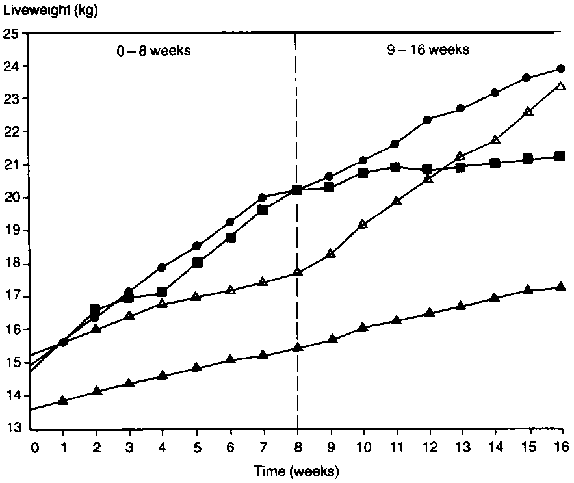
Lambs on treatment H grow faster (P<0.001) than those on treatment L during the first eight weeks of the experiment (Table 2). Between weeks 9 and 16, there was also a highly significant (P<0.001) difference between treatments in daily gains. Lambs on treatment LH grew the fastest, gaining 41,71 and 84 g/day more than those on treatments HH, LL and HL, respectively. Changing from a high to a low plane of nutrition adversely affected growth rate of lambs (LL vs HL). Considering the whole experimental period, lambs on HH treatment had the highest gain followed by those on treatments LH, HL, and LL in decreasing order. Differences between HH and LH were, however, not significant (P<0.001).
Liveweight of lambs as influenced by treatment with time is shown in Figure 1. It is clear that lambs on LH are compensating and compensation is more pronounced in the first few weeks following change from low to high plane of nutrition. No covariance analysis was undertaken to correct for differences in liveweight gain brought about by the initial liveweight of the animals as there were little and insignificant differences in initial weights between treatments.
Table 2. Effect of feeding regime on growth performance.
|
Period |
Liveweight (kg) |
Gain (kg/day) |
Intake (g DM/day) |
FCR |
||||
|
Initial |
Final |
Hay |
Total |
g/kg W0.75 |
||||
|
Start-8th week (12) |
||||||||
|
|
L |
14.4 |
16.3a |
34a |
498 |
558a |
66a |
17.7a |
|
|
H |
14.9 |
20.5b |
98 |
503 |
765b |
87b |
7.8b |
|
|
F-value |
0.13NS |
19.3 *** |
436 *** |
5.1 NS |
43 *** |
11.8** |
15.3*** |
|
9th-16th week (4) |
||||||||
|
|
LL |
13.8 |
17.3a |
33a |
534a |
612a |
56a |
19.6ac |
|
|
HL |
14.9 |
21.2ab |
20a |
451b |
514a |
53b |
263a |
|
|
LH |
15.3 |
23 4b |
104b |
477b |
837b |
90c |
8.3b |
|
|
HH |
14.8 |
24.2b |
63c |
428b |
788b |
76a |
13.7bc |
|
|
F-value |
0.3 NS |
5.0 * |
13*** |
15*** |
52*** |
17*** |
11.4*** |
|
Start-16th week |
||||||||
|
|
LL |
13.7 |
17.3 |
33a |
496a |
564a |
74 |
17.4a |
|
|
HL |
14.9 |
21.2ab |
56b |
446b |
660b |
76 |
11.8b |
|
|
LH |
15.3 |
23.4b |
73c |
491a |
705b |
77 |
9.9c |
|
|
HH |
14.8 |
24.2b |
83c |
407c |
767c |
83 |
9.4c |
|
|
F-value |
0.3 NS |
5.0 * |
27*** |
5* |
5* |
3 NS |
24.8*** |
¹In this and subsequent tables:
(a) means within the same column/row bearing different superscripts are significantly different at P < 0.05
(b) NS = not significant (P > 0.05)
(c) *, **, *** = significant at P < 0.05, P < 0.01 and P < 0.001 respectively.
Compared to lambs on treatment L, lambs on treatment H ate significantly more food in total (765 vs 558 g/day; P<0.001) and per unit metabolised weight (87 vs 66 g/kg W0.75; P<0.01) during the first eight weeks of the study (Table 2). This was expected as lambs on H were given more concentrates. During the last eight weeks of the experiment, there was also a highly significant difference (P<0.001) between treatments in hay and total dry-matter consumption. Hay consumption was highest in animals on LL, followed by animals on LH, HL and HH in a decreasing order. DM intake expressed as total g/day and kg metabolic body weight was highest for LH animals, followed by HH, LL and HL in decreasing order (Table 2) and differences between treatments were significant (P<0.001). Feed conversion ratio (DM intake/g liveweight gain) was lowest in animals on treatment LH and highest in animals on treatment HL.
Figure 1. Liveweight-time relationship as affected by plane of nutrition.
When the whole experimental period is considered, animals on treatment HH consumed more dry matter (767 g/day and 83 g/kg W0.75) followed by LH (.705 g/day and 77 g/kg W0.75), HL (600 g/day and 76 g/kg 0.75) and LL (564 g/day and 74 g/kg W0.75). However, differences in feed intake per metabolic body size were small and insignificant (P>0.05). On average, animals on LH and HH were superior in feed utilisation (9.7 vs 14.6 FRC) compared to animals on LL and HL. Feed utilisation efficiency (reciprocal of FRC) was highest in animals on HH and lowest on animals on LL but the difference in FRC between LH and HH animals was insignificant (P>0.05).
Slaughter characteristics
Table 3 shows the effect of dietary treatment on slaughter characteristics. Animals on treatment H slaughtered at the end of the first eight weeks weighed and dressed higher (P<0.05) than the animals on treatment L. Percentage gut fill, kidney and kidney fat were about equal for animals on both dietary treatments. Gut fat was, however, significantly (P<0.01) higher in lambs on the high plane of nutrition.
Table 3. Effect of feeding regime on killing-out characteristics.
|
|
Liveweight at slaughter (kg) |
Per cent of empty body weight |
||||
|
Carcass wt |
Gut fat |
Gut fill |
Kidney and kidney fat |
|||
|
End of 8th week |
||||||
|
|
L |
15.55a |
45.21a |
0.55a |
35.19 |
0.36 |
|
|
H |
20.68b |
61.49b |
4.34b |
28.38 |
0.38 |
|
|
F-value |
6.18 |
7.49 |
54.10 |
2.62 NS |
0.65 NS |
|
End of 16th week |
||||||
|
|
LL |
17.33a |
44.98a |
1.74a |
36.24b |
0.68a |
|
|
HL |
21.18ab |
50.03b |
4.28c |
32.94a |
0.60a |
|
|
LH |
23.40b |
51.60b |
13.68b |
29.15a |
0.76a |
|
|
HH |
24.25 |
53.16b |
N/A |
N/A |
N/A |
|
|
F-value |
5.03* |
7.85** |
8.03** |
9.80** |
4.00* |
At the last slaughter weight (16 weeks; Table 3), animals in treatment HH weighed more (P<0.01) at slaughter than the others with the differences between these lambs and those on treatments LH, HL and LL being 0.85, 3.07 and 6.92 kg respectively. The differences percentage between lambs on treatment LH and those on HL and HH of 1.57 and 1.56 were not significant whereas the difference between lambs on LH and LL of 6.6291 was significant (P<0.01). Animals on LL treatment had the lowest proportions of gut fat (P<0.01) and kidney plus kidney fat (P<O.OS) and the highest (P<0.01) proportion of gut fill.
Carcass composition (physical and chemical)
There were significant (P<0.001) differences in carcass weight between treatments (Table 4) and these mainly reflected differences in slaughter weight of these animals. These differences were also reflected in absolute weights of carcass components. Weights of carcass tissues in Table 4 are therefore expressed as percentage of carcass weights to partly correct for carcass weight effects.
Table 4. Effect of feeding regime on carcass composition.
|
Treatment |
Carcass wt (kg) |
Per cent carcass wt |
Ratios |
||||
|
Lean |
Fat |
Bone |
Lean to fat |
Lean to bone |
|||
|
End of am week |
|
|
|
|
|
|
|
|
|
L |
5.14a |
67.8 |
5.0a |
25.6a |
15.4a |
2.7a |
|
|
H |
8.12b |
64.0 |
18.1b |
17.9b |
3.6b |
3.6b |
|
|
F-value |
18.65*** |
3.2 NS |
79.4*** |
51.8*** |
28.2** |
18.1 |
|
End of 16 th week |
|
|
|
|
|
|
|
|
|
LL |
5.49a |
62.2a |
14.0a |
23.8a |
5.3 |
2.9 |
|
|
HL |
7.78b |
65.5b |
13.6b |
20.9b |
4 9 |
3.1 |
|
|
LH |
9.00b |
60.7c |
19.2b |
20.1b |
3.4 |
3.1 |
|
|
HH |
9.65b |
57.0d |
26.0c |
17.0c |
2.0 |
3.4 |
|
|
F-value |
14.59*** |
13.5* |
15.5** |
56.6*** |
2.7 NS |
0.7 NS |
By the eighth week, animals on treatment H had significantly (P<0.001) higher proportions of fat and lower proportions of bone but the superiority of 3.8% of lean in animals on L was not significant (P>0.05). Lambs on treatment L had 11.8% more lean to fat ratio but 0.996 less lean-to-bone ratio than lambs on treatment H. Chemical composition data in Table 5 show that carcasses of animals on H were superior to those of animals on L in dry matter and ether extract but inferior in crude protein and ash.
Table 5. Effect of feeding regime on chemical composition of the carcass of lambs.
|
|
Chemical composition (%, fresh weight) |
||||
|
DM |
CP |
EE |
ASH |
||
|
End of 8th week |
|
|
|
|
|
|
|
L |
31.1a |
18 6a |
4 2a |
13.4 |
|
|
H |
40.4b |
16.8b |
90.3b |
12.1 |
|
|
F-value |
140.1*** |
27.8*** |
48.1*** |
3.8 NS |
|
End of 16th week |
|
|
|
|
|
|
|
LL |
36.4a |
16.3 |
15 8a |
10.4 |
|
|
HL |
39.8a |
17.8 |
18.1b |
11.0 |
|
|
LH |
41.5a |
16.1 |
19.5b |
13.4 |
|
|
HH |
45.8b |
14.4 |
27.1 c |
11.2 |
|
|
F-value |
9.4** |
1.86 NS |
17.3** |
1.02NS |
At the end of the 16th week, lambs on treatment HL had the highest percentage of lean meet followed by iambs on LL, LH, and HH (P<0.05) in descending order. Percentage carcass fat in lambs on HH treatment was higher (P <0.01) than that in lambs on LH, LL and HL by 6.8, 12.0 and 12.4 units, respectively, while proportions of bone was highest (P<0.001) in lambs on treatment LL followed by those on treatments HL, LH and HH in decreasing order (Table 4). Treatment effects on lean:fat and lean:bone ratio were small and insignificant (P>0.05). Tables shows that the plane of nutrition significantly (P<0.01) influenced the dry matter and ether extract composition of the carcasses, with the highest value being observed in animals on HH treatment.
Changes in carcass lean and fat
Table 6 shows that both the increases in carcass lean and fat were highest in lambs on treatment H during the first 8 weeks. Increase in lean from the 9th to the 16th weeks in lambs on LH was 3.8 times that of animals on HH (31.1 vs 8.3 g/day), but lambs on HH were slightly superior in the rate of fat deposition. When the whole experimental period is considered, increase in lean in LH and HH lambs were very similar but fat increase rate was 1.5 times more in lambs on HH. Fat and lean increase rates were also higher in HL compared to LL lambs during this period.
Table 6. Effect of feeding regime on change in carcass lean and fat (g/day).
|
|
L |
H |
LL |
HL |
LH |
HH | |
|
Lean |
|
|
|
|
|
| |
|
|
Start-8th week |
4.1 |
32.6 |
- |
- |
- |
- |
|
|
9th week-16th week |
- |
- |
0.2 |
7.5 |
31.1 |
8.3 |
|
|
Start-16th week |
- |
- |
2.1 |
17.6 |
20.0 |
20.4 |
|
Fat |
|
|
|
|
|
| |
|
|
Start-8th week |
0.8 |
9.8 |
- |
- |
- |
- |
|
|
9th week-16th week |
- |
- |
9.8 |
5.3 |
14.9 |
18.3 |
|
|
Start-16th week |
- |
- |
5.3 |
9.6 |
13.6 |
20.3 |
Efficiency and economic returns
High efficiency of lean meat production is always desirable. Efficiency is sometimes defined as the ratio of total lean tissue to total food consumed during the period under evaluation but under practical situations carcass rather than lean weight is used. In this study, efficiency of carcass deposition was 0.02, 0.4, 0.6 and 0.06 kg of carcass per kg of food (hay and concentrate combined) for the LL, HL.
Table 7 shows the economics of treatments imposed in this study. The highest profit margin per carcass sold was obtained from animals on LH, followed by those on HH, HL and LL.
Table 7. Effect of feeding regimes on profitability of lamb production.
|
|
LL |
HL |
LH |
HH |
|
Concentrate consumed (kg /animal) |
8.4 |
26.6 |
26.6 |
44.8 |
|
Cost of concentrate consumed (T.shs./animal) |
58.8 |
186.2 |
186.2 |
313.6 |
|
Gain in carcass weight (kg/animal) |
0 94 |
3.23 |
4.45 |
5.10 |
|
Revenue from carcass gain/animal (T.shs. 150/kg) |
141.0 |
484.5 |
667.5 |
765.0 |
|
(823.5) |
(1167.0) |
(1350.0) |
(1147.5) |
|
|
Marginal profit (T.shs./carcass) |
82.2 |
298.3 |
483.3 |
451.4 |
Performance response of animals to low and high plane of nutrition during the first eight weeks of the experiment was as expected and was mainly due to higher concentrate intake, which resulted in increased growth rate, higher slaughter weight, dressing percentage and proportion of carcass fat, and lower proportion of lean, (Owen, 1976).
During the growth period between the 9th and 16th week, lambs on treatment LH were superior in growth rate (104 g/day) to those on treatment HH (63 g/day) despite the fact that they were on the same plane of nutrition. This is likely due to the phenomenon of compensatory growth (Osbourn and Wilson, 1960; Keenan and MacManus, 1969; Keenan, et al, 1970; Goodchild and Mtenga, 1982). In this period, animals on treatment LH consumed more feed per unit metabolic body weight and utilised it more efficiently than their counterparts on treatment HH. This partly accounts for their superiority in growth rate. In a concurrent study, digestibility coefficients for dry matter, crude protein and crude fibre were 59.1, 59.3, 67.0, 65.0, 71.2, 70.2, 77.6, 76.5%, and 63.5, 60.3, 65.3 and 85.3%, respectively, for animals on treatments LL, HL, LH and HH. Similar observations have been reported by other workers with sheep (Allden and Young, 1964; Allden, 1970; Graham and Searle, 1979). The reason for lower daily gains for lambs on HH at 9th-16th week period compared to H lambs at 0-8-week period was not clear but possibly the lambs had passed the phase of accelerated growth rate, Orskov et al (1976) observed that when lambs change from high to low dietary regime, they tend to eat less and grow slower than lambs on low plane of nutrition. The results of this study confirm their observation.
Winchester and Ellis (1957) commented that the refed animal tends to grow at a rate appropriate to its physiological age rather than its chronological age. The present study confirms this statement in that lambs on low plane of nutrition were physiologically younger as measured by live-weight, and lean and fat contents. On changing from a low to a high plane of nutrition, these animals grew faster and almost caught up with animals maintained continuously on a high plane of nutrition.
Dressing percentage is both a yield- and value-determining factor and is therefore an important parameter in assessing performance of meat-producing animals. Lambs on H treatment dressed higher than lambs on L treatment in accordance with findings reviewed by Owen (1976). Mukhtar and El-Hag (1978) found that tropical sheep fed roughage diet only dressed 10% units lower than those fed 3:1 concentrate to roughage ratios. In this study, differences in liveweight, age and level of fatness in the carcass could have accounted for variation in dressing percentage (Berg and Butterfield, 1976; Owen, 1976) which was 35% for L lambs and 28% for H lambs. The percentage gut fill was 36, 32, 29 and 20 for LL, HL, LH and HH lambs, respectively.
Berg and Butterfield (1976) reported that fat is the most labile tissue in the animal's body and can easily be manipulated by nutrition and management. The treatment effects on gut, kidney and carcass fat in the present study can be attributed to energy and protein in the diets of these animals. In accordance with the views of Berg and Butterfield (1976), lambs on a low plane of nutrition were leaner and had less carcass dry matter, fat and energy contents but higher crude protein, bone and ash.
It was shown that compensatory growth was partly due to the deposition of more lean and hence more protein and less fat and therefore less energy (Sheehy and Senior, 1942). Recent studies have also supported this hypothesis (Butterfield, 1966; Keenan and McManus, 1969; Drew and Reid, 1975). This hypothesis is also supported in this study (Tables 4, 5 and 6).
Some workers have reported a similar body composition for both realimented and continuously grown lambs (Graham and Searle, 1975; 1979; O'Donovan, 1974). Others have reported increased fat and reduced protein percentage in realimented sheep. The phenomenon of compensatory growth has been reviewed in detail by Goodchild and Mtenga (1982). Factors such as age at the onset of restriction, severity of undernutrition, body weight at slaughter, sex and breed may singly or in combination cause disparity in results between workers.
This study shows clearly that Tanzanian lambs have the ability to compensate in terms of growth if switched from a low to a high plane of nutrition and this seems to be brought about by a number of factors such as increased food intake, greater digestibility of the diets and higher protein deposition. It appears that the merits of supplementation are the prevention of mortality, improved growth rates and the production of better carcasses. The phenomenon of compensatory growth can be exploited through strategic supplementation to produce enough and good quality but relatively cheap meat at a time of relative scarcity. However, more research work is needed on the applicability of this phenomenon in field situation taking into account all factors associated with it, including the availability of supplements. More data are also required on the economics of feeding manipulation in diferent parts of Tanzania.
Allden W G. 1968. Undernutrition of the merino sheep and its sequelae. 1. The growth and development of lambs following periods of nutritional stress. Australian Journal of Agricultural Research 19:621 638.
Allden W G. 1970. The effects of nutritional deprivation on subsequent productivity of sheep and cattle. Nutrition Abstracts and Reviews 40:1167-1184.
Allden W G and Young R S. 1964. The summer nutrition of weaner sheep: Herbage intake following periods of differential nutrition. Australian Journal of Agricultural Research 15:9891000.
AOAC (Association of Official Analytical Chemists). 1975. Official methods of analysis. 12th edition. AOAC, Washington, DC, USA.
Berg R T and Bunerfield R M. 1976. New concepts of cattle growth. Sydney University Press, Sidney, Australia. 240 pp.
Bohman V R. 1955. Compensatory growth of beef cattle. The effect of hay maturity. Journal of Animal Science 14:249 255.
Butterfield R M. 1966. The effect of nutritional stress and recovery on the body composition of cattle Research in Veterinary Science 7:168-179.
Drew K and Reid J T. 1975. Compensatory growth in immature sheep. l. The effects of weight loss and realimentation on the whole body composition; II. Some changes in the physical and chemical composition of sheep half-carcass following feed restriction and realimentation; III. Feed utilization by sheep subjected to feed deprivation following by realimentation. Journal of Agricultural Science (Cambridge) 85:193-220.
El Hag G A and Mukhtar A M S. 1978. Varying levels of concentrates in the rations of Sudan Desert sheep. World Review of Animal Production 14(4):73-79.
French M H. 1944. Development of livestock in Tanganyika Territory. IV. The development of mutton qualities in Masai and Grade Block Head. Persian sheep. Empire Journal of Experimental Agriculture 12:207-218.
Goodchild A V and Mtenga L A. 1982. Compensatory growth in ruminants. Proceedings of the Tanzanian Society of Animal Production 9:176-195.
Graham N McC and Searle T W. 1975. Studies of weaner sheep during and after a period of weight stasis. l. Energy and nitrogen utilization. Australian Journal of Agricultural Research 26:343-353.
Graham N McC and Searle T W. 1979. Studies of weaned lamb before, during and after a period of weight loss. Australian Journal of Agricultural Research 30:513-531.
Keenan D M and McManus W R. 1969. Changes in the body composition and efficiency of mature sheep during loss and regain of live weight. Journal of Agricultural Science (Cambridge) 72:139-147.
Keenan D M, McManus W R and Freer M. 1970. Voluntary intake of food by mature sheep following restricted feeding. Journal of Agricultural Science (Cambridge) 74:477-485.
Mtenga L A and Nyaky F P. 1985. Effect of supplementation on performance of Black Head Persian and Red Masai lambs. Bulletin of Animal Health and Production in Africa 33:4349.
O'Donovan W M. 1974. Developmental changes in the bodies of Dorper sheep. lilt Effects of different patterns of growth on live body-mass and body composition of weaned Dorper lambs. Rhodesian Journal of Agricultural Research 12:99-111.
Orskov E R. McDonald I, Grubb D A and Pennie K. 1976. The nutrition of early weaned lamb. IV. Effects on growth rate, food utilization and body composition of changing from a low to a high protein diet. Journal of Agricultural Science (Cambridge) 86:411-423.
Osborne J B and Mendel L B. 1915. The resumption of growth after long continued failure to grow. J. Biol. Chem. 23:439-446.
Osbourn O F and Wilson P N. 1960. Effects of restricted food upon growth and development of cockerels. Journal of Agricultural Science (Cambridge) 54:278-289.
Owen J B. 1976. Sheep production. Bailliere Trindall, London, UK. 436 pp.
Searle T W and Graham N McC. 1975. Studies of weaner sheep during and after a period of weight stasis. II. Body composition. Australian Journal of Agricultural Research 26:355 361.
Sheehy E J and Senior E J. 1942. Storing cattle at different levels of nutrition. J. Dept. Agric. Eri. 39:245-254.
Speedy A W. 1980. Sheep production: Science into practice. Longman Group Ltd. London, UK. 195 pp.
Steel R G D and Torrie J H. 1980. Principles and procedures of a biometrical approach. McGraw-Hill Book Company, New York, USA. 633 pp.
Winchester C F and Ellis N R. 1957. Delayed growth of beef cattle. Technical Bulletin 1159. USDA (United States Department of Agriculture), Washington, DC, USA.
