


Abstract
Résumé
Introduction
Materials and methods
Results and discussion
Acknowledgements
References
A.K. Tuah1, M.K. Buadu1, F.Y. Obese1 and K. Brew2
¹Department of Animal Science, Faculty of Agriculture
University of Science and Technology
Kumasi, Ghana
2Cocoa Research Institute of Ghana
P O Box 8, Tafo E/R, Ghana
Production records (1970-1989) for a flock of West African Dwarf (WAD) goats kept on the farm of the University of Science and Technology, Kumasi, in the forest belt of Ghana were analysed. The mean age at first kidding and the mean kidding interval were 543.18 and 284.26 days, respectively. The month of kidding did not (P < 0.05) affect kidding interval. The prolificacy of the does was 185.5%. Type of birth affected (P<0.01) birthweight (1.207, 1.145, 1.008 and 0.847 kg for singles, twins, triples and quadruplets, respectively) and weaning weight(5.49, 5.30, 4.86 and 4.34 kg for singles, twins, triplets and quadruplets, respectively). Pre-weaning growth rate (39.6,33.1,31.6 and 29.0 g/day for singles, twins, triplets and quadruplets, respectively) was not (P<0.05) affected by type of birth. Pre-weaning mortality rate was affected (P<0.01) by type of birth (34.92, 34.78, 36.25 and 55.56% for singles, twins, triplets and quadruplets, respectively).
The breed has good qualities such as adaptation to the environment, trypanotolerance, high prolificacy and good kidding interval but growth rate is low.
Des données de production rassemblées de 1970 à 1989 sur un troupeau de chèvres naines d'Afrique de l'Ouest élevé à l'University of Science and Technology de Kumassi, dans la zone forestière du Ghana, ont été analysées. L'âge moyen à la première mise-bas et l'intervalle moyen entre parturitions ont été respectivement de 543,18 et 284,26 jours. Le mois de la mise-bas n'a pas eu d'effet significatif (P<0,05) sur l'intervalle entre parturitions. Le taux de prolificité des femelles était de 185,5%. Le type de naissance, qui avait une influence significative (P<0,01) sur le poids des chevreaux à la naissance (1,207,1,145,1,008 et 0, 847 kg respectivement pour les naissances simples, les jumeaux, les triplets et les quadruplets), n'avait en revanche aucun effet significatif (P < 0, 05) sur le rythme de croissance avant le sevrage (39,6, 33,1, 31,6 et 29,0 g/jour respectivement pour les naissances simples, les jumeaux, les triplets et les quadruplets). Le type de naissance avait un effet significatif (P<0,01) sur la mortalité avant sevrage (34,92, 34,78,36,25 et 55,56 respectivement pour les naissances simples, les jumeaux jumeaux, les triplets et les quadruplets).
Dotée de qualités telles que l'adaptation au milieu, la trypanotolérance, une prolificité élevée, un faible intervalle entre parturitions, cette race de chèvres est en revanche limitée par un faible taux de croissance.
Chevon is the meat used most for preparing food in public restaurants (popularly known as "chop bars") in Ghana. The West African Dwarf goat (WAD), the commonest breed in Ghana, is known for its prolificacy and trypanotolerance. Its small size (15-21 kg; Devendra and McLeroy, 1982) makes it suitable for butchering in small communities where there are no cold-storage facilities. It is therefore not surprising that the government intends to encourage farmers to increase the production of goats during the implementation of its medium-term agricultural development programme (Ministry of Agriculture, 1988). The expected increase in the population of goats (1 901 000 in 1987 to 9 172 000 by the year 2000) is greater than the expected increase in the populations of sheep (1 989 000 in 1987 to 6 319 000 by the year 2000) and cattle (1 170 000 in 1987 to 1 853 000 by the year 2000). Since the population of goats is expected to increase about ninefold, it is necessary to assess the performance of the dominant breed in all the ecological zones of the country so as to know its potentialities and limitations. This will help the policy makers to decide whether new genes should be introduced or not.
The aim of this paper therefore is to assess the performance of the WAD goat on the farm of the University of Science and Technology, Kumasi, which is located in the humid forest zone of Ghana.
Location, climate and management of the flock
The data used in this study were obtained from the production records of the flock of WAD goats belonging to the University of Science and Technology, Kumasi. The study covered the period January 1969 to December 1970. The location, climate and vegetation of the University farm have been described by Tuah and Baah (1985).
Kiddings were recorded and kids were weighed within 24 h after birth. The kids were eartagged for identification and were weaned when they were four months old. The males not needed for breeding were castrated using the burdizzo at the time of weaning. The breeding males ran with the females throughout the year, thus there was no controlled seasonal breeding. Routine drenching against endoparasites was carried out fortnightly. Dipping was also carried out fortnightly to control ectoparasites. The goats were kept under a semiintensive system throughout the year as described by Tuah and Baah (1985). They were housed in pens at night and allowed to graze during the day. Straw or wood shaving bedding was provided in the pens.
The animals grazed mainly Cynodon spp interspersed with Centrosema pubescens from morning up to 1700 h GMT. They were supplemented with wet brewer's spent grains.
Methods of parameter computation and statistical analysis
Age at first kidding was computed as the difference (in days) between birth and first kidding dates of does.
Kidding interval was calculated as the difference (in days) between two successive kiddings for all does with more than than one kidding record.
Prolificacy was calculated as the percentage of kids dropped of does kidding. Percentage incidence of twins, triplets and quadruplets was also calculated as
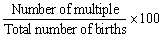
Secondary sex ratio was calculated as the ratio of the total number of male kids dropped to the total number of female kids dropped. The chi-square test was used to test for the significance of the observed ratio from the expected (Snedecor and Cochran, 1967).
The effects of type of birth and sex on birthweight, weaning weight and preweaning growth rates were analysed separately using the completely randomised design (CRD) and Tukey's Honestly Significant Test (Steel and Torrie, 1980). The effect of month of kidding on kidding interval was analysed using completely randomised design (Steel and Torrie, 1980).
Mortality rate was calculated as follows

The effects of type of birth on mortality rate was determined using chi-square with the mortality rate of singles used as expected (Steel and Torrie, 1980).
Age at first kidding and kidding interval is shown in Table 1. The mean age at first kidding was less than two years (543.18 + 192.10 days). Goats on the University farm are more precocious than the sheep kept on the same farm. Tuah and Baah (1985) reported the mean age at first lambing on the same farm to be 638 days with a range of 338 to 1542 days. The mean kidding interval (284.26+ 100 days) was, however, greater than the mean lambing interval (264 days) reported by Tuah and Baah (1985) and the mean kidding interval reported for the same breed (258 days) by Vohradsky and Sada (1973) on the Accra Savanna plains. The minimum kidding interval is similar to that reported by Ali et al (1973; 151 days) for Black Bengal goats. The month of kidding did not significantly affect the length of the kidding interval (Table 4; SE 7.33). This is an indirect evidence showing that on the farm, kidding interval is not affected by changes in quantity and quality of forages which occur during the various seasons of the year as these forages form the staple diet of these animals. It is also possible that the practice of feeding wet brewers' spent grains ameliorated the effects of nutritional stresses, hence the no significant effect of the month of kidding on kidding interval. It must also be noted that in the forest belt the dry seasons are not as severe as in the savanna areas of the country and feed shortage is not very great. The prolificacy of the goats was 185.5%. On the same farm, goats were more prolific than the Djallonke sheep (Tuah and Baah, 1985; 130.3%). The incidences of single births and births of twins, triplets and quadruplets were 35.69, 45.61, 16.15 and 2.55%, respectively. It is not desirable to have a prolificacy value of more than 200% as kid mortality is increased with an increase in prolificacy (Table 2). In this country, artificial milk replacers are not fed to the extra kids which cannot get access to teats. In an earlier study covering a ten-year period (1969-1978), Tuah (1989) reported that prolificacy in goats on the same farm was affected (P<0.01) by the age of dam. The values for the various age groups involving 234 kids were 124.1, 196.8,182.8,206.7,277.8 and 233.3% for does aged one, two, three, four, five and six years, respectively.
Table 1. Reproductive performance traits of the West African Dwarf goat
|
|
No. of records |
Range(days) |
Mean (days) |
Standard deviation |
|
Age at first kidding |
56 |
323-1061 |
543.18 |
192.10 |
|
Kidding interval |
207 |
152-731 |
284.26 |
100 |
Table 2. The effect of month Of kidding on kidding interval.
|
Month of kidding |
No. of records |
Kidding interval (days) |
Range (days) |
Standard deviation |
|
January |
27 |
257.37±5.47 |
166-431 |
67.82 |
|
February |
9 |
347.38±9.47 |
186-510 |
106.37 |
|
March |
27 |
276.19±5.47 |
163-521 |
90.31 |
|
April |
19 |
252.42±6.52 |
167-404 |
73.28 |
|
May |
14 |
323.93±7.59 |
169-731 |
151.51 |
|
June |
16 |
258.25±7.10 |
167-470 |
90.02 |
|
July |
9 |
291.67±9.47 |
192-391 |
75.24 |
|
August |
14 |
280.07±7.59 |
202-435 |
73.59 |
|
September |
13 |
255.85±7.88 |
152-477 |
110.91 |
|
October |
26 |
245.04±5.57 |
154-486 |
70.42 |
|
November |
12 |
315.50±8.20 |
205-715 |
149.91 |
|
December |
21 |
249.76±6.20 |
196 358 |
43.70 |
The effects of type of birth on birthweight, weaning weight and pre-weaning growth rate are shown in Table 3. Birthweight was affected (P<0.01) by type of birth. Generally birthweight decreased with increase in litter size. Robinson et al (1977) reported that, for lambs in utero, as the number of foetuses increases, the number of caruncles attached to each foetus decreases thus reducing the feed supply to the foetus and hence the birthweight of the lambs. Pre-weaning growth was not affected by the type of birth perhaps because most of the kids were raised as singles and twins (Table 4). Hunter (1957) observed that each twin lamb suckling its mother obtained 68% of the milk obtained by a single lamb, hence the differences in the pre-weaning growth rates of single-born lambs and twin-born lambs. The overall mean pre-weaning growth rate (32.88/day) falls just outside range reported by Reynolds (1989) for kids kept in Nigeria (17.4 g/day to 31.9 g/day).
Weaning weight was affected (P<0.01) by type of birth, decreasing with increase in litter size. Sidwell et al (1962) reported that type of birth had the greatest influence on weaning weight. In an earlier study Tuah (1989) reported that birthweight and weaning weights of kid were not affected by sex, season of birth, age and parity of dam. The mean overall post-weaning (4-12 months) growth rate (24.04/day) was less than the mean overall pre-weaning growth rate (32.8 g/day) but well within the range reported by Reynolds (1989; 14-28.3 g/day) for the same breed in Nigeria.
Table 4 contains the pre-weaning mortality rate of kids. Mortality rate increased as litter size increased but only the mortality rate of quadruplets was significantly (P<0.01) different from that of the other birth types. The overall mortality rate of 36.3% was higher than the rate (20.95%) reported by Tuah and Baah (1985) for lambs on the same farm. The rate is, however, similar to the rates reported by Wilson et al (1985; 30%) and Vallerand and Branckaert (1975; 35%) for unweaned lambs. The major causes of pre-weaning deaths in kids on the same farm according to Tuah (1989) were starvation (24.27%), pneumonia (16.50%), helminthiasis (20.38%), bacterial infection (6.80%), diarrhoea (5.8%) and heartwater (4.85%). About 21% of the mortalities occurred during the neonatal period (0-7 days). These causes of mortality can be controlled if proper management practices are instituted.
Potentialities and limitations of the breed for meat production
The breed is prolific (185.6%) and this trait needs no improvement since mortality rates of kids can be high with prolificacy values exceeding 200%, especially when kids which have no access to teats are not artificially fed in this country. Mortality rates of kids are high (36.34%) but this source of wastage can be reduced with proper management practices. Kidding interval is greater than the ideal of 240 days. It must be observed here that there is no culling of poor producers on the university farm. Perhaps if culling of poor producers is carried out, the kidding interval could be shortened. The mean age at first kidding (543.18 days; 18.1 months) is higher than the value reported for Katjang goats in Malaysia (15-16 months) by Devendra (1966).
Table 3. The effect of type of birth on birthweight and growth performance to weaning (0 -4 months)*.
|
Type of birth |
Mean birthweight (kg) |
Range |
Mean weaning weight (kg) |
Range |
Mean pre-weaning growth rate |
Range (g/day) |
|
Single |
1.207±0.031 (126)a |
0.500-2.000 |
5.49±0.149 (82)a |
3.00-10.00 |
39.6±1.23(82) |
15.00 70.00 |
|
Twin |
1.145±0.02 (322)ab |
0.500-2.500 |
5.30±0.093 (210)a |
3.00 9.00 |
33.1±0.767(210) |
15.00-61.00 |
|
Triplet |
1.008±0.027 (171)bc |
0.500-2.000 |
4.86±0.13 (109)ab |
3.00-8.00 |
31.6± 1.065 (109) |
16.00 71.00 |
|
Quadruplet |
0.847±0.059 (36)c |
0.450-1.500 |
4.34±0.338 (16)b |
2.50-7.50 |
29.0±2.78 (16) |
14.00-56.00 |
|
Overall |
1.105±0.038(655) |
0.450-2.50 |
5.185±0.20(417) |
2.50-10.00 |
32.8±1.66(417) |
14.00-71.00 |
* Figures in parenthesis indicate the number of observations. Means carrying different superscripts are different (P < 0.01).
Table 4. Effect of type of birth on pre-weaning mortality and weaning rates of kids.
|
|
Type of birth |
||||
|
Singles |
Twins |
Triplets |
Quadruplets |
Total |
|
|
Total No. born |
126 |
322 |
171 |
36 |
655 |
|
No. dead before weaning |
44 |
112 |
62 |
20 |
238 |
|
Mortality rate(%) |
34.92b |
34.78b |
36.25b |
55.56a |
36.34 |
|
No raised to weaning |
141 |
212 |
60 |
4 |
417 |
|
Kids raised to wearing (%) |
33.81 |
50.84 |
14.39 |
0.96 |
63.66 |
Means carrying different superscripts are different (P<0.01).
The greatest limitation of the breed is its slow growth rate. There is the need to carry out selection within the breed or to introduce new genes to improve the trait. Introduction of new genes should be done with caution SO as not to adversely affect the good characteristics Of the breed. The feed conversion efficiency of the breed should also be studied.
The authors are grateful to all the workers on the livestock farm of the University of Science and Technology for keeping the records on the animals. The Head of the Department of Animal Science is thanked for allowing the publication of the data. Ms. Gladys A. Ndziba is thanked for typing the script.
Ali S Z. Hoque M M and Hasnath M A. 1973. A study on the growth and reproductive performance of Black Bengal goats under farm conditions. Indian Veterinary Journal 50:438 440.
Devendra C. 1966. Goat breeds of Malaysia. The Malaysian Agricultural Journal 45:268274.
Devendra C and McLeroy G B. 1982. Goat and sheep production in the tropics. Intermediate Tropical Agricultural Series. Longman Group Ltd. Harlow, Essex, UK. 271 pp.
Hunter G L. 1957. The maternal influence on size in sheep. Journal of Agricultural Science 48:36-59.
Ministry of Agriculture. 1988. Medium-term agricultural development programme. Working paper 4. Livestock Subsector. Ministry of Agriculture, Accra, Ghana.
Reynolds L. 1989. The integration of livestock in alley farming. Paper presented at the inaugural meeting of the Alley Farming Network for Tropical Africa (AFNETA), 1-3 August 1989, IITA, Ibadan, Nigeria.
Robinson J J. McDonald I, Fraser C and Crafts R M J. 1977. Studies on reproduction in prolific ewes. l. Growth of the products of conception. Journal of Agricultural Science (Cambridge) 88:539-552.
Sidwell G M, Everson D O and Terrill C E. 1962. Fertility, prolificacy and lamb livability of some pure breeds and their crosses. Journal of Animal Science 21 :875-879.
Snedecor G W and Cochran W G. 1967. Statistical methods. 6th edition. Iowa State University Press, Ames, lowa, USA. 593 pp.
Steel R G D and Torrie J H. 1980. Principles and procedures of statistics - a biometrical approach. Second edition. McGraw-Hill Book Company, New York, USA. 633 pp.
Tush A K. 1989. The causes of high mortality rates in immature small ruminants management in West and central Africa. In: Adeniji K O (ed), Improvement of small ruminants. Proceedings of the Workshop on the Improvement of Small Ruminants in West and Central Africa held in Ibadan, Nigeria, 21-25 November 1988. OAU (Organization of African Unity), Nairobi, Kenya. pp. 137-148.
Tuah A K. 1989. Ruminant livestock production in Ghana. Invited paper presented at the Second Annual General Meeting of the Ghana Society of Animal Production held at Legon, Ghana, 5-6 July, 1989.
Tuah A K and Bash J. 1985. Reproductive performance, pre-weaning growth rate and pre-weaning lamb mortality of Djallonke sheep in Ghana. Tropical Animal Health and Production 17:107-113.
Vallerand F and Branckaert R. 1975. La race ovine Djalionké au Cameroun. Potentialités, zootechniques, conditions d'élevage, avenir. (West African Dwarf sheep breed in Cameroon. Breeding potentialities, husbandry conditions, future). Revue d'Elevage et de Médecine Vétérinaire des Pays Tropicaux 28(4):523-545.
Vohradsky F and Sada I. 1973. West African goat in Ghana. l. Reproduction and death rate of kids. Sbornik Vyosoke Skolyo Zemedelske V Praze (Czechoslovakia) 6:161-172. Institut Tropickeho a Subtropickeho Zemedelstvi.
Wilson R T. Traore A, Peacock C P. Mack S and Agyemang K. 1985. Early mortality of lambs in African traditional livestock production systems. Veterinary Research Communications 9(4):295-301.
