


Abstract
Résumé
Introduction
Materials and methods
Results
Discussion
Acknowledgements
References
S.M. Das and D.S. Sendalo
Zonal Research and Training Centre, Central Zone, Livestock Production
Research Institute, P O Box 202, Mpwapwa, Tanzania
Records on liveweight, growth and reproductive performance of Blended (BLD), Blendedx Galla (BG) and Kamoraix indigenous goats for a period of over 10 years (1970-1980) were analysed. For BLD, BG and Kl goat kids, birthweight averaged 2.9,2.9 and 2.7 kg (P<0.01), respectively, averaged 13.4, 12.1 and 12.7 kg (P<0.05), and liveweight at 72 weeks of age averaged at 29.8, 27.1 and 29.3 kg (P<0.05), respectively. Sex and birth type had significant effects on all liveweight measures while year of birth did not
Mean litter size for six parities for BLD, BG and Kl does were 1.35, 1.21 and 1.43, respectively. It was concluded that BLD goats with higher liveweights and efficient reproductive performance compared to BG and Kl goats should be used for crossbreeding purposes to improve the meat production from goats in the rural areas.
Des données rassemblées pendant 10 ens (1970-1980) sur le poids vif, la croissance et les performances de reproduction de caprins Blended (BLD), Blended x Galla (BG) et kamorai x race locale (KL) ont été analysees. Le poids à la naissance moyen des BLD, BG et de KL fut respectivement de 2,9,2,9 et 2,7 kg (P<0,01) pour un poids moyen au sevrage de 13,4,12,1 et 12,7 kg (P<0,05) et un poids vif de 29,8, 27,1 et 29,3 kg (P<0, 05) a l'age de 72 semaines.
Contrairement à l'année de la naissance, le sexe du chevreau et et type de naissance eurent des effetes significatifs sur tous ces paramètres. L'âge a la premiere parturition fut respectivement pour des BLD, des BG et des KL de 780,3 ±8,5, 766,8±17,3 et 757,0±24,7 jours . Evalué pour six parturitions, l'intervalle moyen entre mises-bas fut respectivement de 379, 6± 12, 5, 388,2± 13,2 et 373,5± 1 1,6 jours, pour une taille de la portée moyenne de 1,35, 1,21 et 1,43 chevreaux. Compte tenu de leur poids vif plus élevé et de leurs meilleures performances de reproduction, les BLD devraient être préférés aux BG et aux KL dans les programmes de croisements destines a améliorer la production de viande des caprins en milieu rural.
Small ruminants have been frequently used as a source of meat in both rural and urban areas of Tanzania, although meat from goats is both scarce and expensive. The high demand for goat meat led to the improvement of indigenous goats through crossbreeding with bigger breeds so as to increase the per capita animal protein consumption levels of Tanzanians. A breeding programme to develop a meat goat breed based on indigenous goat was started in the early 1960s. The indigenous goats termed as "Small East African goat" by Devendra and Burns (1983) was crossed with Kamorai and Boer breeds to develop the Blended goat.
The present study reports on growth and reproductive performance of Blended goats at the Livestock Research Centre, Malya. Progeny crosses between Blended x Galla and Kamorai x Small East African goat (SEA) genotypes were used for comparative purposes. The results in this study would indicate the benefits of using the meat goat genotypes developed to be used in improving the indigenous goat population.
The study was undertaken at the Livestock Research Centre (LRC), Malya, situated near Lake Victoria at an altitude of 1250 m above sea level. The mean precipitation at the Centre ranges from 640 mm to 1020 mm extending from late October to early May. The natural pasture is dominated by Hyparrhenia spp with isolated patches of Setaria sphacelata, Cynodon dactylon and Chloris gayana. The main browse plant was Acacia tortilis.
Records for this study were obtained from LRC, Malya and the National Livestock Registry at Mpwapwa. A total of 4824 records on liveweights and 1258 kidding records covering over a 10-year period (1970-1980) of Blended (BLD), Blended x Galla (BG) and Kamorai x SEA (Kl) were used in the present study. Computation of the genetic constitution of BLD goat showed the following proportions:
Kamorai 55%, Boer 30% and indigenous 15%. Blended x Galla goats considered in this study were 50% Blended and 50% Galla, while Kl goats were 50% Kamorai and 50% indigenous. The schematic evolution of blended goats, BG and Kl is shown in Figure 1.
Figure 1. Evolution of Blended, Blended x Galla and Kamorai x indigenous goats.
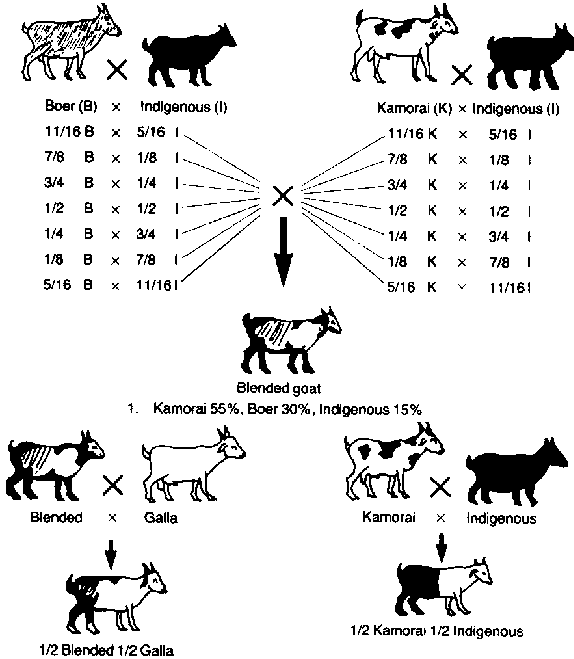
Managerial practices of goats at LRC, Malya did not vary during the period of study, whereby kids weaned at 16 weeks of age were subjected to grazing on natural pasture. At the age of 72 weeks, maiden does were mated for the first time, and mating period extending for 50 days (mid-July to early September) was conducted once per annum. The ratio of buck to does during mating was about 1:40.
Kids at birth were ear-tagged for identification and weights were recorded at birth, and at ages of 16 weeks (wearing), 24 weeks (post-weaning) ,48 weeks (puberty) and at 72 weeks (maturity). Weights were also recorded at mating and kidding for females and at yearly interval for males. Main diseases of goats encountered at the centre included tapeworm infestation, pneumonia and foot-rot. Routine treatment and disease control measures (deworming and dipping) was regularly done for all goats at the Centre.
Traits investigated in this study included birthweight, weaning weight, weights at 24, 48 and 72 weeks of age and growth rate. Reproductive traits investigated included size of litter, percentage of birth with twins and sex ratio of kids born. The liveweight data were analysed by a least-squares method.
Mean liveweights of kids from birth to 72 weeks of age by genotype, sex and birthtype are shown in Table 1.
Blended kids having 2.9 kg birthweight, 13.4 kg weaning and 29.8 kg at 72 weeks of age were observed to have significantly higher liveweights than BG and Kl kids. At 48 weeks of age Kl kids were significantly heavier than BG kids. Male kids exhibited higher liveweights (P<0.05) than females, while single-born kids were heavier than twins at all ages of weight recording.
Growth rates from birth to weaning' 24, 48 and 72 weeks of age are shown in Table 2. Blended kids showed higher growth rates from birth to weaning and from birth to 72 weeks of age. Single-born kids exhibited higher growth than the twins from birth to weaning and to 24 weeks of age, while at higher ages their growth rates were not significantly different.
Blended does showed higher incidence multiple births with twinning rate of 40.9%, overall for six parities compared to BG does, whereas Kl does had higher twinning rates compared to both BLD and B does (Table 3).
Litter size computed by dividing the total number of kids born by the total number does kidded showed a tendency to increase from first parity to fifth parity and a reduction in sixth parity. Sex ratios for kids born were observed to be slightly less males than females but were not significantly different across parities and genotypes in the study.
Table 1. Mean liveweights of kids at the Livestock Research Centre, Malya, by genotype, sex and birth-type.
|
|
Age in weeks |
|||||
|
Birth |
16 |
24 |
48 |
72 |
||
|
Mean liveweight (kg) |
||||||
|
Overall |
2.6 |
12.7 |
14.4 |
19.8 |
28.7 |
|
|
Breed¹: BLD |
2.9a |
13.4a |
14.8a |
19.9a |
29.8a |
|
|
|
BG |
2.6b |
12.1b |
14.3b |
19.6b |
27.2b |
|
|
Kl |
2.7b |
12.7c |
14.5b |
20.4a |
29.3a |
|
Average SE |
0.01 |
0.13 |
0.17 |
0.21 |
0.33 |
|
|
Sex: male |
2.7a |
13.5a |
15.5a |
20.9a |
30.2a |
|
|
female |
2.5b |
11.3b |
13,3b |
19.1a |
20.4b |
|
|
Average SE |
0.01 |
0.15 |
0.19 |
0.25 |
0.38 |
|
|
Birth-type |
|
|
|
|
|
|
|
|
Single |
2.9a |
13.3a |
15.6a |
20.6a |
29.3a |
|
|
Twin |
2.4b |
11.6b |
13.4b |
19.4 |
27.2b |
|
Average SE |
0.03 |
0.14 |
0.19 |
0.23 |
0.36 |
|
Means within a column of class with different letters differ significantly (P < 0.05).
1. BLD = Blended; BG = Blended x Galla; Kl = Kamorai x Small East African.
Liveweights at birth and weaning of BLD, BG and Kl kids in the present study are lower from those reported for BLD kids at Malya and Kongwa by Das (1989). It was also observed that weights at birth, weaning and at 72 weeks age of goat kids in this study were lower than those reported for Boer goats by De Haas (1978), Malawi goats by Ayoade and Butterworth (1982) and Tsana goats (APRU, 1984). Blended goat kids showed higher liveweight and average daily gain compared to BG and Kl kids. These parameters were also higher than that of Black Bengal goats reported by Singh et al (1983) and Black Bengal x Beetal crossbred goats reported by Kanaujia et al (1986).
At birth, males were only 0.2 kg heavier than females, which was smaller than the 0.3 kg reported by Kyomo (1978) for Small East African goats. Singles were heavier than twins and grew faster from birth to 24 weeks of age. Similar observations were reported by Nath and Chawla (1978) for Beetal, Alpine and their crossbred kids. The pre-weaning daily gain of BLD kids of 94.3 g/day exceeded that of BG and Kl kids by 6.4 and 12.8, respectively. Similar observations were made by Kassuk (1974) who attributed lower pre-weaning average daily gain of BG and Kl kids to lower milk yields of their dams.
Table 2. Mean daily gain of goat kids at the Livestock Research Centre, Malya, by genotypes, sex and birth-type.
|
|
Age in weeks |
||||
|
0-16 |
0-24 |
0-48 |
0-72 |
||
|
Mean daily gain (g) |
|||||
|
Overall |
88.5 |
71.3 |
52.8 |
52.6 |
|
|
Genotype1: BLD |
94.3a |
72.1 |
52.3 |
54.6a |
|
|
|
BG |
88.7b |
70 4 |
52.3 |
50.2b |
|
|
KI |
82.7b |
71.3 |
53.5 |
53.4a |
|
Average SE |
0.83 |
0.94 |
0.44 |
037 |
|
|
Sex: male |
94.1 a |
76.0a |
53.1a |
54.7a |
|
|
|
female |
81.4b |
67.1b |
51.0b |
50.3b |
|
Average SE |
0.85 |
1.02 |
0.47 |
0.45 |
|
|
Birth-type |
|
|
|
|
|
|
|
single |
95.4a |
76.3a |
52.2 |
53.8 |
|
|
twin |
80.5b |
65.9b |
51.5 |
51.4 |
|
Average SE |
0.91 |
1.06 |
0.35 |
0.31 |
|
ab = Means within a column of a class with different letters differ significantly (P<0.05).
1 BLD = Blended; BG = Blended x Galla; Kl = Kamorai x Small East African.
Weaning weight would reflect mothering ability of dam as well as the inherent growth potential. Thereafter growth potential would predominate. In this study, males were significantly heavier and grew faster from weaning onwards (P<0.05). Their differences increased from 16 to 72 weeks of age implying that sex effects are more pronounced with age after puberty.
Blended and Kl does showed higher multiple births than BG does. The incidence of multiple births tended to increase from first parity to fifth parity. Twinning per cent of does in the present study were lower than that reported for Black Bengal and Beetal x Black Bengal does in India by Kanaujia et al (1986). The sex ratio of kids born are similar to that reported by Sinha and Sahni (1981) for Indian goats.
Table 3. Kidding performance of goats at the Livestock Research Centre, Malya.
|
Parity |
n |
Parameter |
|||
|
Twinning % |
Litter size |
Sex ratio (% males) |
|||
|
Overall |
|
|
|
|
|
|
|
BLD1 |
799 |
40.9 |
1.44 |
49.8 |
|
|
BG |
248 |
34 3 |
1.39 |
47.5 |
|
|
Kl |
193 |
43.5 |
1.46 |
47.8 |
|
I BLD |
279 |
19.4 |
1.19 |
52.9 |
|
|
|
BG |
92 |
7.6 |
1.08 |
52.5 |
|
|
Kl |
52 |
36.5 |
1.41 |
49 3 |
|
II BLD |
204 |
35.3 |
1.38 |
55.3 |
|
|
|
BG |
53 |
32.1 |
1.32 |
48.6 |
|
|
Kl |
34 |
36.5 |
1.41 |
49.3 |
|
III BLD |
155 |
47.1 |
1.48 |
50.7 |
|
|
|
BG |
38 |
44.7 |
1.45 |
43.6 |
|
|
Kl |
34 |
50.0 |
1.52 |
48.1 |
|
IV BLD |
60 |
41.6 |
1.45 |
46.8 |
|
|
|
BG |
27 |
40.7 |
1.41 |
47.4 |
|
|
Kl |
19 |
57.9 |
1.58 |
46.7 |
|
V BLD |
60 |
56.7 |
1.57 |
46.7 |
|
|
|
BG |
27 |
44.4 |
1.44 |
45.5 |
|
|
Kl |
18 |
50.0 |
1.50 |
48.5 |
|
Vl BLD |
41 |
46.3 |
1.46 |
46.7 |
|
|
|
BG |
11 |
36.5 |
1.35 |
47.1 |
|
|
Kl |
10 |
46.0 |
1.40 |
47.0 |
n denotes number of does kidded.
1. BLD = Blended; BG = Blended x Galla; Kamorai I = Small East African
The results of this study indicate that BLD goats, given proper management and nutrition, have a potential as a meat-producing goat. The mean age at kidding could be lowered by mating goats immediately after puberty. The superiority of BLD goats over BG for both growth rate and reproductive performance suggests that there is little point in crossing Blended goats with Galla goats.
We wish to thank the International Foundation for Science (IFS) for sponsoring this study. We are also grateful to the Commissioner for Research and Training (MALD) for granting permission to present this paper at the First Small Ruminant Network Conference in Nairobi.
APRU (Animal Production Research Unit). 1984. Goats, livestock and range research in Botswana 1981-1982, Report. APRU, Botswana. pp. 100-204.
Ayoade J A and Butterworth M H. 1982. The relationship between birth and weaning weights in kids of Malawian local goats, Boer and their crosses. Tropical Animal Production 7(2):113-115.
Das S M. 1989. Preliminary results on evaluation and breeding of Blended dairy goats in Tanzania. In: Wilson R T and Azeb Melaku (eds), African small ruminant research and development. Proceedings of a conference held at Bamenda, Cameroon, 18-25 January 1989. ILCA (International Livestock Centre for Africa), Addis Ababa, Ethiopia. pp. 536545.
Devendra C and Burns M. 1983. Goat production in the tropics. 2nd edition. Commonwealth Agricultural Bureau, Slough, UK. 183 pp.
De Hass H J. 1978. Growth of Boer goat crosses in comparison indigenous Small East African goat in Kenya. Der Tropenlandwint 79 (April):7-12.
Kanaujia A S. Pander B L, Vinayak A K and Kalra S. 1986. Seasonal variation in reproductive parameters of does: a note. Indian Journal of Animal Production and Management 2(4):168-170.
Kassuk A A. 1974. Development of improved meat goats. Annual Research Report, Livestock Research Centre, Malya, Tanzania. pp. 5-6.
Kyomo M L. 1978. Meat from goats in Tanzania. PhD thesis, University of Dar-es-Salaam, Dar-es-Salaam, Tanzania. 272 pp.
Nath I and Chawla D S. 1978. A study of birth weights of Beetal, Alpine and Beetal x exotic crossbred kids. Indian Veterinary Journal 55(4):306-309.
Singh C S P. Singh D K, Singh S. Nath S and Mishra R H. 1983. Growth rate in crossbred and purebred Black Bengal goats. Tropical Veterinary and Animal Science Research 1 (1):63-68.
Sinha N K and Sahni K L. 1981. Secondary sex ratio in goats. Veterinary Research Journal 4(2):157-159.
