


Any computer simulation model, however general, is restricted by its design to specific classes of problems. To use a model to help solve real-life problems, they must be formulated to fit into the set of problems accounted for by the existing model. If this is not possible, the model will have to be altered, the problem at hand restated, or perhaps even a new model constructed.
The first and most difficult stage in the simulation process is to construct a clear definition of a problem and to formulate explicit objectives of the simulation experiments to give answers to the problem. These objectives usually take the form of hypotheses to be tested or effects to be estimated. The second stage is to determine whether the specific problem to be solved falls within the set of problems accounted for by an existing model. Application of an existing model may be straightforward, but, more usually, it would require some revision of the problem definition or the model or both.
If an existing model is judged appropriate for the type of problem at hand, the third stage in the simulation process is the derivation of data on the particular production system under study to validate and run the model. Every simulation model requires a certain amount of data of adequate quality to operate. If the data requirements of a particular model cannot be met, then a less demanding model may be identified or a different approach to the research problem selected. Validation of the model for the particular system under study is the fourth stage in the simulation process. At this point specific parameters in the computer model may need to be altered to replicate the processes of the real system. The fifth and last stage in the simulation process is experimentation with the model, leading to the testing of stated hypotheses and the derivation of measures of the effects to be estimated.
Experimentation with a herd simulation model consists of a quantitative description of the productivity of the livestock system under study, evolving over a finite time horizon. Figure 4.1 is a schematic representation of the livestock production process in an input/output framework. The production process starts at the beginning of the simulated period with an initial herd (specified as given in the example of Appendix Table F6) which evolves over simulated time into the final herd at the end of the run. The intermediate inputs and outputs during this period are the feeds of various types consumed and the milk and meat produced.
Figure 4.1 An input/output configuration of a livestock production system.
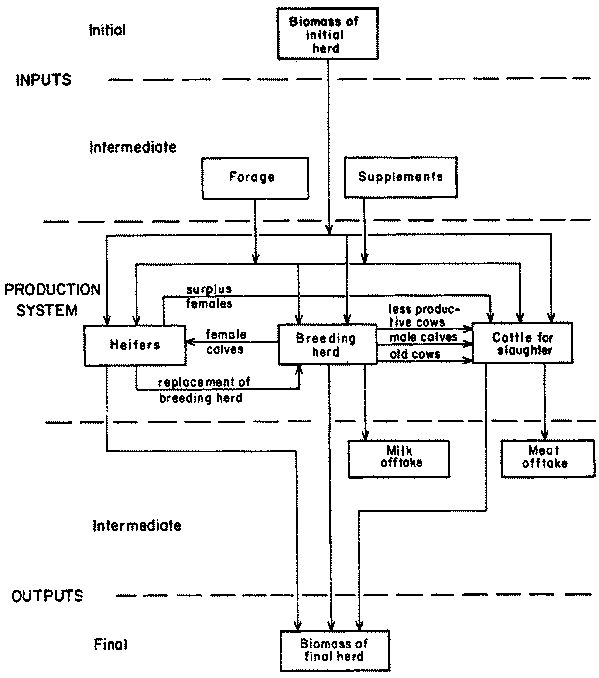
The production process specified in this model is stochastic. Starting with the same initial conditions and management regime, an infinite number of different outcomes may result over a finite simulated time period. The variety of possible outcomes occurs because of the variability in the forage regime from year to year and in the animal-level processes of conception, sex of calves and mortality. Alternative production strategies can be compared and evaluated by generating a sufficient number of realizations from each strategy, or replications, to permit the calculation of statistically significant probability distributions for each of the critical variables. Less than 20 replications are usually adequate to identify significant differences between alternative production strategies. A larger number of replications results in progressively higher computational requirements.
This model has been applied successfully in the comparison and evaluation of Tswana and Simmental x Tswana cows in Botswana as milk producers under alternative milking and supplementation regimes (Konandreas et al, 1981). Other applications to traditional herding situations in different environments of Nigeria and Mali have also been initiated.
The computer model is written in standard FORTRAN language and is operational on a Hewlett-Packard 3000 series m mini-computer. The model is highly modularized so that it is readily transferable to other systems. Changes in the FORTRAN code to account for peculiarities in particular production systems can be done without major changes in the programmers overall structure. The data required to drive the model are entered interactively. Consistency checks are made on much of the data as they are entered. A complete description of the structure of the computer model, the input data interactive dialogue, and the output of the model as currently formulated is available on request.
