Sufficient data are not always available to estimate statistically the average liveweight evolution from birth to maturity of animals in a herd. A procedure is described here to allow estimation of liveweight evolution from a minimum of data.
In general, assume that the average liveweight at age t for each sex is expressed by the functional form:
= f (t) ... (A.1)
where: t = age (months).
This relationship is presented graphically in Figure A.1. Point B on the curve is the inflection point, corresponding to that point in the animal's development when maximum liveweight gains occur. Before the liveweight curve can be estimated, however, its mathematical properties must be formally established.
Figure A.1 Average liveweight (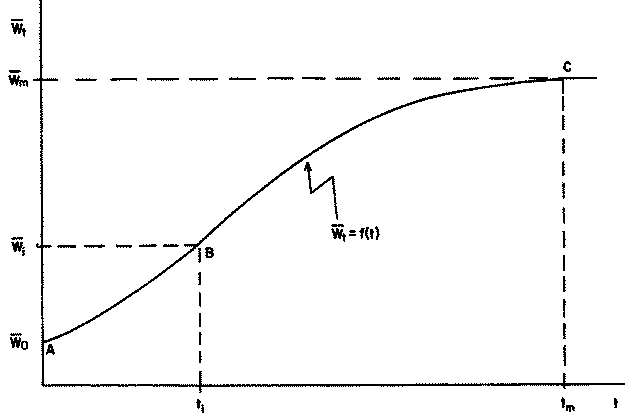 )
growth curve
)
growth curve
Define:
= average liveweight at birth (kg)
ti = age (months) of maximum liveweight gains, i. e. age at the point of inflection
= average liveweight (kg) at the time of maximum weight gain, i. e. at age ti
tm = age at maturity (months)
Wm = average liveweight at maturity (kg).
A liveweight evolution curve must have the following properties:
1. The curve must pass through point ( , 0), corresponding to average liveweight at birth.
2. The curve must increase monotonically:
for all t
3. The curve must be concave from below. up to the point of inflection:
for t £ ti.
4. The curve must be convex from below after the point of inflection:
for t ³ ti .
5. The slope of the curve at the age of maturity must equal zero:
for t = tm.
6. A curve satisfying conditions 1 to 5 can be approximated by two curvilinear segments (AB) and (BC) with the same slope at point B:
for t = ti.
Assume that quadratic functions give adequate representations of these two segments. Then the functional forms of segments (AB) and (BC) are:
for segment (AB), where t £ ti
for segment (BC), where t £ ti.
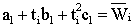
Application of properties 1, 5 and 6 yields the following equations:
These can be solved for a1, b1, c1 and a2, b2, c2, yielding equations (A.2), (A.3) and (A.4) as follows:
for t £ ti ... (A.2)

for ti < t £ tm ... (A.3)
for t > tm. ... (A.4)
The requirement of a convex curve after the point of inflection (property 4) is always met, as shown by taking the second derivative of equation (A.3). Additionally, for the curve to be concave from below up to the point of inflection and monotonically increasing (properties 3 and 2), the following relationship must also hold true:
... (A.5)
In equation A.5 the left side of the inequality guarantees a monotonically increasing function, while the right side guarantees concavity up to the point of inflection. Equality on the right side implies a curve degenerated to a straight line up to the point of inflection. If the inequality on the right side is reversed, then the liveweight growth curve is convex from below throughout.
Preliminary applications of known situations failed to pass the test for concavity. In most cases, growth up to the point of inflection can be approximated by a straight line and in some cases a convex growth curve results. Thus, compelled by evidence from field situations, the usually accepted concave property of the liveweight growth curve up to the point of inflection is not enforced in the model.
As an example, consider females in a particular system which have an average weight at birth of 25 kg ( = 25) and reach their maximum rate of weight gain at 18 months (ti = 18), weighing at this age on average 200 kg (
 = 200). They mature at 4.5 years (tm = 54) with an average mature weight of 350 kg (
 = 350). Substitution of these values into the inequalities (A.5) satisfies the left side, implying a monotonically increasing function, but not the right side, implying a convex curve throughout. The estimated equations (A.2), (A.3) and (A.4) are:
for t £ 18
for 18 < t £ 54
for t > 54