It is assumed in the model that the average monthly milk yield is constant over the first 2 months of lactation and declines linearly thereafter. This pattern is depicted in Figure C.1.
Figure C.1 Distribution of milk yield (hn) over the lactation period (n)

Lactation yield for the n'th month post-partum can be expressed as a fraction of the potential yield for the whole lactation:
hn = h(n) ... (C.1)
such that:
hn = h1,2/2 for n = 1, 2 ... (C.2)h = a + bn for n ³ 2 ... (C.3)
where:
h = fraction of milk produced during the n'th month post-partum
h1,2 = fraction of milk produced during the first 2 months post-partum.
For a given breed and production system under a normal feeding regime, the fraction of milk yield produced during the first 2 months is approximately constant (a typical value of this fraction is about 0.35). Assuming that this fraction and the length of lactation (N) are known, then it is possible to estimate a simplified specification of a lactation curve comprised of two linear segments as in Figure C.1.
Equation (C.3) applied for n = 2 gives the known fraction of milk yield during the 2nd month of lactation:
a+2b= h2 = h1,2/2 ... (C.4)
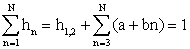
In addition, the sum of hn's for all months of the lactation period equals unity:
which yields: a(N - 2) + b(N(N + 1) - 6)/2 = 1 - h1,2 ... (C.5)
Equations (C.4) and (C.5) solved for the unknowns a and b yield the lactation curve for n ³ 2:
... (C.6)
For hn to be positive throughout and monotonically decreasing, the following relationship between h1,2 and N must also hold:
2/N £ h1,2 £ (4N - 8)/(N2 - N - 2). ... (C.7)
For example, consider a lactation lasting 9 months (N = 9) and a yield for the first 2 months post-partum equal to 35% of the total lactation (h1,2 = 0 35). Relationship (C.7) holds true and the lactation curve in this case is:
hn = h1,2/2 = 0.175 for n = 1,2 ... (C.8)hn = 0.216 - 0.0205n for n = 3, 4,..., 9 ... (C.9)
Equations (C.8) and (C.9) imply that of the total milk produced per lactation, 17.5% is produced during each of the 1st and 2nd months post-partum, and this fraction drops to 15.5% in the 3rd month, 11.4% in the 5th, 7.3% in the 7th, and 3.2% in the 9th month.