Introduction
Age at first lambing
Conception rate by month
Lambing interval
Litter size
Annual reproduction rate
Length of ewe productive life
Reproductive performance is a trait of outstanding importance in sheep production enterprises, especially when meat production from young animals is the chief aim. In general the more intensive the meat production system, the more desirable the production of large numbers of young per breeding female. Under harsher conditions optimal production levels are achieved by maintaining reasonable levels of performance in the young, while limiting the drain on the resources of the breeding female. The most important components of reproductive performance in sheep are age at first lambing, length of lambing interval, litter size, and length of ewe productive life.
The mean age at first lambing for 115 females born on the station from 1974 to 1980 was 18.8 ± 0.8 months. The significance of environmental influences on age at first lambing over this period is indicated in Table 3.
Table 3. Analysis of variance of age at first lambing
|
Source |
d.f. |
Mean squares |
|
Year of birth |
6 |
33912 |
|
Month of birth |
11 |
19460 |
|
Type of birth |
1 |
30382 |
|
Remainder |
96 |
18746 |
Year of birth, month of birth and type of birth had no significant effects on age at first lambing. The estimated least squares means for age at first lambing are laid out in Table 4. The coefficient of variation was 24.4%.
Table 4. Estimated least squares means for age at first lambing (days)
|
Variable |
Number |
Age at first lambing |
|
Overall mean |
115 |
575 |
|
Year of birth | ||
|
1974 |
4 |
545 |
|
1975 |
16 |
572 |
|
1976 |
16 |
624 |
|
1977 |
31 |
546 |
|
1978 |
20 |
638 |
|
1979 |
21 |
622 |
|
1980 |
7 |
473 |
|
Month of birth | ||
|
January |
11 |
615 |
|
February |
8 |
603 |
|
March |
12 |
608 |
|
April |
6 |
527 |
|
May |
11 |
568 |
|
June |
4 |
630 |
|
July |
5 |
625 |
|
August |
4 |
515 |
|
September |
5 |
620 |
|
October |
10 |
546 |
|
November |
18 |
479 |
|
December |
21 |
560 |
|
Type of birth | ||
|
Single |
96 |
551 |
|
Twin |
19 |
598 |
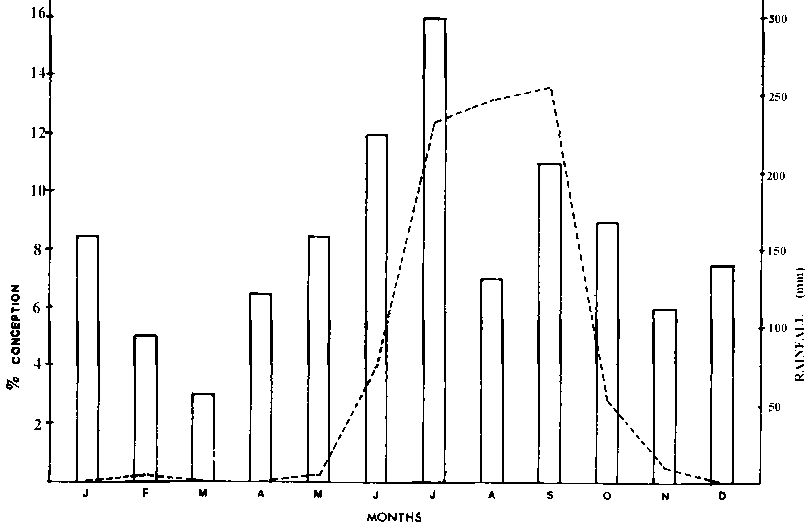
The distribution of 663 conceptions calculated from the recorded lambing dates from 1975 to 1980 are indicated in Figure 2. The mean monthly rainfall over these 6 years is also shown.
Figure 2. Effect of month on conception rate.
55% of conceptions, or 11% per month, occurred during the main five month wet season from June to October, the remaining 45% or 6. 5% per month during the other seven months of the year.
The mean lambing interval for 663 records from 1975 to 1980 was 307 ± 14 days. The significance of environmental and genetic influences on lambing interval over this 6 year period is indicated in Table 5.
The effects of origin of ewe, individual ewes, month of lambing and in the case of foundation ewes only, the lambing number, were significant. The estimated least squares means for lambing interval are laid out in Table 6.
Table 5. Analysis of variance of lambing interval
|
Source |
d. f. |
Mean squares |
|
Origin |
1 |
48441* |
|
Ewes |
190 |
7706** |
|
Year of lambing |
5 |
7409 |
|
Month of lambing |
11 |
27767** |
|
Type of lambing |
1 |
1110 |
|
Number of lambing/foundation |
1 |
43841** |
|
Number of lambing/born on centre |
2 |
5469 |
|
Remainder |
451 |
5485 |
* = P< 0.05; ** = P< 0.01.
The effects of year of lambing were not important, but month of lambing had a significant effect on lambing interval. Females lambing in December, January, February and March had longer than average lambing intervals, while those lambing in all other months had shorter than average lambing intervals.
The monthly rainfall from 1975 to 1980 is illustrated in Table 1, the period December to April constituting the major dry season. The correlation between lambing interval and rainfall from one month before previous lambing date to one month before conception was - 0.51, while there was a 0.04 day decrease in lambing interval for each additional 1 mm rainfall.
In the case of foundation purchased ewes whose age was unknown, lambing intervals following their first four parturitions on the station were significantly shorter than those following their fifth and subsequent parturitions. In the case of ewes born on the centre the effect of parturition number was not significant.
The repeatability of lambing interval (i. e. the correlation between an individual's successive records) was obtained from the between and within ewes components of variance. The value of 0.11 ± 0.04 is within the range usually reported for this trait.
Table 6. Estimated least squares means for lambing interval (days)
|
Variable |
Number |
Lambing interval |
|
Overall mean |
663 |
307 |
|
Origin | ||
|
Foundation (1) |
474 |
296 |
|
Born on centre (2) |
189 |
318 |
|
Year of lambing | ||
|
1975 |
66 |
318 |
|
1976 |
122 |
319 |
|
1977 |
123 |
305 |
|
1978 |
146 |
313 |
|
1979 |
107 |
304 |
|
1980 |
99 |
280 |
|
Month of lambing | ||
|
January |
45 |
330 |
|
February |
73 |
351 |
|
March |
59 |
324 |
|
April |
40 |
264 |
|
May |
51 |
301 |
|
June |
57 |
306 |
|
July |
32 |
301 |
|
August |
21 |
296 |
|
September |
42 |
280 |
|
October |
58 |
287 |
|
November |
80 |
297 |
|
December |
105 |
343 |
|
Type of lambing | ||
|
Single |
583 |
304 |
|
Twin |
80 |
309 |
|
Number of lambing/origin 1 | ||
|
1-4 |
353 |
274 |
|
5+ |
121 |
316 |
|
Number of lambing/origin 2 | ||
|
1 |
77 |
305 |
|
2 |
55 |
313 |
|
3+ |
57 |
333 |
Table 6 shows that the 663 parturitions recorded from 1975 to 1980 were made up of 583 singles and 80 twins, the mean litter size being 1.12.
The annual reproduction rate is calculated as the mean litter size × 365 ÷ lambing interval. Overall this was 1.33 lambs per breeding ewe per year.
As the first records of ewes produced on the station start with animals born in November 1974, it is yet too early to assess this trait. In August 1981, the first 40 ewes born between November 1974 and January 1977 had completed an average of 3.7 parturitions, with 17 or 42% still in production. The remaining 23 or 58% had died, been culled or lost. Thus until more information is collected it might be tentatively suggested with the present information that an average of 5 parturitions would be achieved per ewe. Using the mean lambing interval of 307 days, ewes would thus remain for an average of 4.2 years in productive life. This complete replacement of the ewe flock each 4. 2 years would represent a turnover of 24%. When age at first lambing is added to the productive life, the average ewe age on completion of productive life would be 5.8 years.