Lamb mortality
Mortality rates in relation to genetic improvement
Breeding ewe mortality
Causes of death
Mortality data based on 897 lambs born over a six year period were available. The significance of environmental and genetic influences on pre-weaning mortality, (subdivided into two periods, birth to 3 days and 3 days to 4 months) and post-weaning mortality (4 months to 12 months of age) are indicated in Table 7.
Table 7. Analyses of variance of mortality rates
|
Source |
d.f. |
Mean squares |
|||
|
Birth - 3 d |
3 d - 4 m |
Birth - 4 m |
4 m - 12 m |
||
|
×104 |
×103 |
×103 |
×103 |
||
|
Origin |
1 |
80 |
596 |
468 |
11 |
|
Ewes |
227 |
504** |
174 |
185 |
158 |
|
Year of birth |
5 |
452 |
1688** |
2023** |
1173** |
|
Month of birth |
11 |
373 |
387** |
426** |
311* |
|
Type of lambing |
1 |
2976** |
151 |
906* |
23 |
|
Sex |
1 |
85 |
26 |
1 |
759* |
|
Number of lambing/foundation |
1 |
227 |
87 |
192 |
69 |
|
Number of lambing/born on centre |
2 |
190 |
1386** |
1198** |
19 |
|
Remainder |
647 |
279 |
164 |
179 |
146 |
* = P< 0.05; ** = P< 0.01.
The estimated least squares means for mortalities over these periods are laid out in Table 8.
Pre-weaning mortality. The mean mortality rate from birth to weaning at 4 months was 33%. The effects of year of birth, month of birth, single or twin, and parturition number of dam were significant (Table 7).
Table 8. Estimated least squares means for mortality rates
|
Variable |
No. |
Mortality rates (%) |
|||
|
Birth - 3 days |
3 days - weaning |
Birth - weaning |
Weaning - 12 m |
||
|
Overall mean |
897 |
5.14 |
28.08 |
33.09 |
19.39 |
|
Origin |
|||||
|
Foundation (1) |
652 |
5.52 |
24.84 |
30.22 |
18.96 |
|
Born on centre (2) |
245 |
4.77 |
31.31 |
35.96 |
19.86 |
|
Year of birth |
|||||
|
1975 |
86 |
1.38 |
13.96 |
14.98 |
15.73 |
|
1976 |
170 |
6.49 |
28.15 |
43.69 |
40.46 |
|
1977 |
154 |
5.31 |
26.56 |
31.49 |
13.41 |
|
1978 |
189 |
7.10 |
46.89 |
54.07 |
23.22 |
|
1979 |
145 |
3.47 |
28.83 |
32.53 |
18.62 |
|
1980 |
153 |
7.12 |
14.28 |
21.79 |
4.91 |
|
Month of birth |
|||||
|
January |
73 |
0.07 |
20.77 |
20.96 |
26.32 |
|
February |
92 |
3.79 |
13.41 |
17.48 |
31.16 |
|
March |
86 |
9.62 |
25.75 |
35.16 |
20.31 |
|
April |
56 |
5.26 |
19.83 |
22.75 |
32.92 |
|
May |
58 |
4.95 |
15.11 |
20.25 |
25.23 |
|
June |
73 |
2.63 |
41. 07 |
43.45 |
24.41 |
|
July |
41 |
9.96 |
29.62 |
39.73 |
9.45 |
|
August |
24 |
5.86 |
45.78 |
51.79 |
7.03 |
|
September |
51 |
3.43 |
33.48 |
36.70 |
18.37 |
|
October |
72 |
4.99 |
35.41 |
40.60 |
10.45 |
|
November |
123 |
5.14 |
31.99 |
37.17 |
14.34 |
|
December |
148 |
6.17 |
24.70 |
31.05 |
12.69 |
|
Type of lambing |
|||||
|
Single |
691 |
2.04 |
25.87 |
27.67 |
18.52 |
|
Twin |
206 |
8.25 |
30.29 |
38.51 |
20.26 |
|
Sex |
|||||
|
Male |
456 |
5.51 |
27.44 |
32.96 |
22.84 |
|
Female |
441 |
4.78 |
28.72 |
33.22 |
15.94 |
|
Number of lambing/origin 1 |
|||||
|
1-4 |
464 |
4.25 |
22.36 |
26.54 |
21.17 |
|
5+ |
188 |
6.79 |
27.32 |
33.91 |
16.75 |
|
Number of lambing/origin 2 |
|||||
|
1 |
93 |
2.79 |
51.57 |
54.48 |
19.56 |
|
2 |
71 |
6.38 |
27.57 |
34.05 |
21.79 |
|
3+ |
81 |
5.13 |
14.80 |
19.34 |
18.11 |
There were marked year of birth effects on pre-weaning mortality rate ranging from 15% in 1975 to 54% in 1978.
Month of birth had a significant effect, lambs born in March, June, July, August, September, October and November having above-average mortality rates, those born in the remaining five months below-average rates. The correlation between pre-weaning mortality and rainfall over the relevant 4 months was 0.42, there being a 0.014% increase in mortality for each additional 1 mm of rainfall.
Mortality in twin lambs was 38.5%, compared to 27.7% in singles.
There was a 54.5% mortality rate in lambs from first parturition dams, 34.1% from second parturition dams and 19.3% from third and later parturition dams.
When pre-weaning mortality was separated into that occurring from birth to 3 days and from 3 days to weaning, a very contrasting picture emerged. Table 7 indicates that year and month of birth had no effect on mortality from birth to 3 days, but major effects from 3 days to weaning. Single or twin status had major effects on mortality in the first 3 days, but no effect from 3 days to weaning. Parturition number of dam had no effect on mortality from birth to 3 days, but major effects from 3 days to weaning. Finally there were highly significant differences between individual ewes in lamb mortality from birth to 3 days, but not from 3 days to weaning.
Thus lamb mortality in the first three days of life (mean 5.1%) was affected by single or twin status, 2% of single lambs dying compared with 8% of twins. The significant difference between individual ewes gave a repeatability estimate for this early mortality of 0.18 ± 0.04. The parturition number of the dam, reflecting its age, and the year and month of lamb birth, reflecting environmental and climatic conditions, had no effect.
In contrast lamb mortality from 3 days to weaning (mean 28.1%) was not significantly affected by single or twin status and there was no significant repeatability estimate for this trait (0.02 ± 0.10). The parturition number of ewes born on the centre had a major effect; 51.6% mortality in lambs from first parturition ewes, 27.6% from second and 14.8% from third or later. Both year and month of birth had major effects, lambs born in the wet season months of June to November all having above mortality rates (mean 36%), those born in the drier season December to May having below average mortality rates (mean 20%). The correlation between mortality from 3 days to weaning and the rainfall over the relevant 4 months was 0.40, there being a 0.013% increase in mortality for each additional 1 mm of rainfall.
Post-weaning mortality. The mean mortality rate from 4 months to 12 months of age was 19.4%. Year and month of birth, reflecting environmental and climatic conditions, had highly significant effects. The very low post-weaning mortality for 1980 was biased in that when the data were prepared for analysis a proportion of the animals born in late 1980 had not yet reached 12 months of age. Males had a significantly higher (P<.05) mortality than females. The maternally associated influences such as single or twin status, ewe parturition number and individual ewe had, as expected, no effects on post-weaning mortality.
An appropriate definition of mortality rate in the context of genetic progress is the percentage of females that die before lambing. Here, taking account of the actual proportion of singles and twins, it is approximately 51% (43% to 12 months, 8% from 12 months to 18.8 months). The rearing proportion is the proportion of births that produce a female that survives and is fertile. The rearing proportion here is about 0.27. This means that only once in 3.6 lambings does a ewe produce a female lamb that will reproduce in the flock. The average length of reproductive life is tentatively taken as 5 lambings: therefore, approximately 72% of the females born are required as replacements to maintain flock size. High mortality rates are inconsistent with genetic progress, and when they can be reduced, a higher intensity of selection can be achieved.
Genetic improvement per unit of time is more important than per animal generation, and high mortality rates have a marked effect on generation interval. The average age at first lambing is 18. 8 months, and the average lambing interval 10 months. To replace herself, a ewe must lamb about 3.6 times; thus, the average generation interval is 54.8 months or 4.5 years.
Data on ewe mortality over the 6 years from 1975 to 1980 are presented in Table 9. The overall mortality rate was 14.8% per year.
Table 9. Ewe mortality
|
Year |
Number of ewes |
Number of deaths |
Ewe mortality (%) |
|
1975 |
89 |
5 |
5.6 |
|
1976 |
139 |
19 |
13.7 |
|
1977 |
122 |
12 |
9.8 |
|
1978 |
110 |
21 |
19.1 |
|
1979 |
120 |
19 |
15.8 |
|
1980 |
123 |
28 |
22.8 |
|
Overall |
703 |
104 |
14.8 |
The causes of mortality have been grouped into five classes: - diseases of the alimentary tract; diseases of the respiratory system; other diseases (e.g. nutritional, reproductive); accidents, abscesses, etc; and unidentified.
The percentages of animals dying were examined within the two age groups recorded; young (0-8 months) and adult (over 8 months). The mortality rates related to each of the five classes are shown in Table 10.
Thus 30.5% of mortality is due to problems connected with the alimentary tract; 27.5% to respiratory problems, 12% to other diseases; 6.3% to accidents, abcesses and skin diseases; and the remaining 23.7% undiagnosed.
Table 10. Mortality rate related to cause
|
Class |
0-8 months |
> 8 months |
Overall |
||
|
No. of deaths |
% |
No. of deaths |
% |
% |
|
|
Alimentary |
129 |
28.5 |
35 |
32.5 |
30.50 |
|
Respiratory |
123 |
27 |
30 |
28 |
27.50 |
|
Other diseases |
64 |
14 |
11 |
10 |
12.00 |
|
Accidents, abcesses, etc. |
19 |
4 |
9 |
8.5 |
6.25 |
|
Unidentified causes |
119 |
26.5 |
23 |
21 |
23.75 |
|
Total |
454 |
100 |
108 |
100 |
|
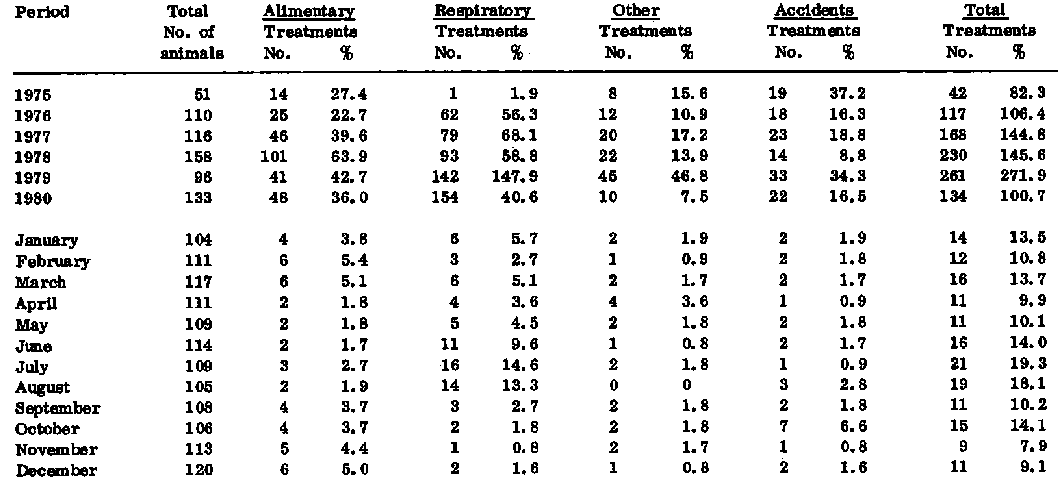
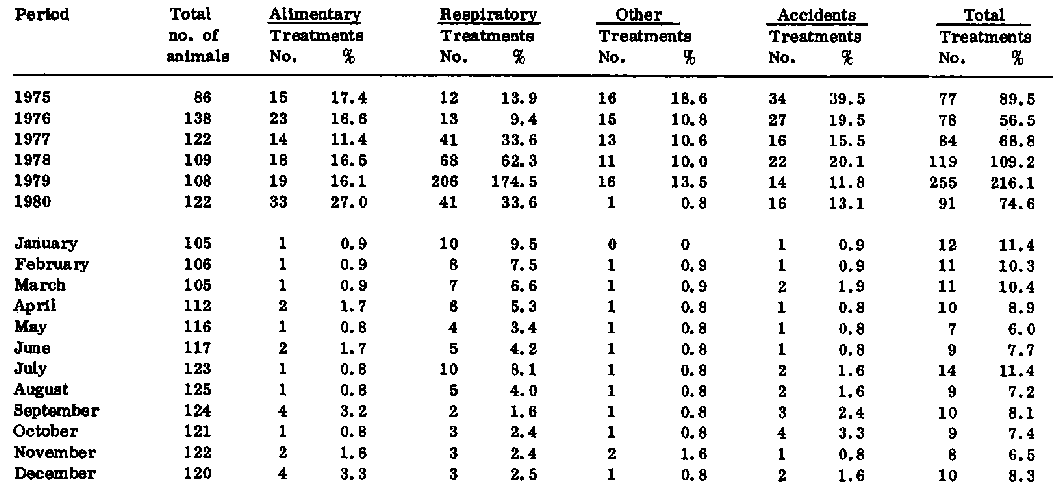
Tables 11 and 12 show the total numbers of animals, the numbers treated and the percentage of animals treated for each of the disease classes within the two different age groups, by year and month.
Table 11. Treatments in each disease class by year and month (animals 0- 8 months)
Table 12. Treatments in each disease class by year and month (animals over 8 months)