Introduction
General pattern and reasons for exits
Mortality
Culling
Discussion
High survival rates are important in dairy enterprises not only to ensure a continuing supply of replacement heifers for the milking herd but also to provide a flow of males for subsidiary beef enterprises and for sale as improver bulls. Low survival rates reduce the possibilities of high intensities of selection for desired production characteristics and, by increasing the generation interval, lead to slower rates of genetic gain.
Reasons for exit of 3767 animals from Um Banein were noted in the period 1958-84 and have been used in these analyses.
The data were classed into six principal reasons for exit. The overall numbers and percentages for these are shown in Table 26. It appears that most animals have been culled in recent years, this probably resulting in part from the policy of destocking carried out on the station. Most animals sold for breeding were disposed of during the late 1970s and in the 1980s. Sales for meat in the 1980s are also consonant with the destocking policy.
Abortions were more common in the early years after the establishment of the station. In the ten years 1976-85 there were only six abortions (7.8% of exits for this reason), three of which occurred in 1984. The small number of stillbirths recorded does not show any particular temporal pattern. Highest mortalities were recorded soon after the establishment of the station and again in the early 1970s.
In general, it would appear that Um Banein has achieved some success in one of its stated aims, by making available a total of almost 1000 animals for breeding off the station. Males were disposed of when young, the majority before 2 years old (Figure 21). The principal reason for sale of males was under the rubric "meat", but as 72.5% of males were sold at under 2 years old and weighing less than 100 kg, most were apparently sold for growing on. Most females left the station at 4 to 5 years old, corresponding to sales of in-calf heifers. Culling for low productivity after the first lactation also accounted for some sales at this age and for most of the offtake of 5- to 6-year-old cows. Some females were also culled for infertility at these youngish ages.
Figure 21. Patterns of offtake (sales and culling) related to sex and age for Kenana cattle at Um Banein.
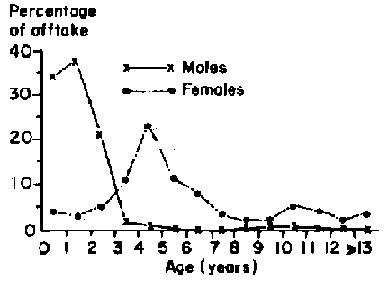
Table 26. Reasons for exit of cattle from the Um Banein herd.
|
|
Reason for exit | |||||
|
|
Sold for meat |
Sold for breeding |
Culled |
Abortions |
Stillbirths |
Death |
|
Number |
756 |
969 |
1230 |
77 |
16 |
719 |
|
Percentage |
20.1 |
25.7 |
32.7 |
2.0 |
0.4 |
19.1 |
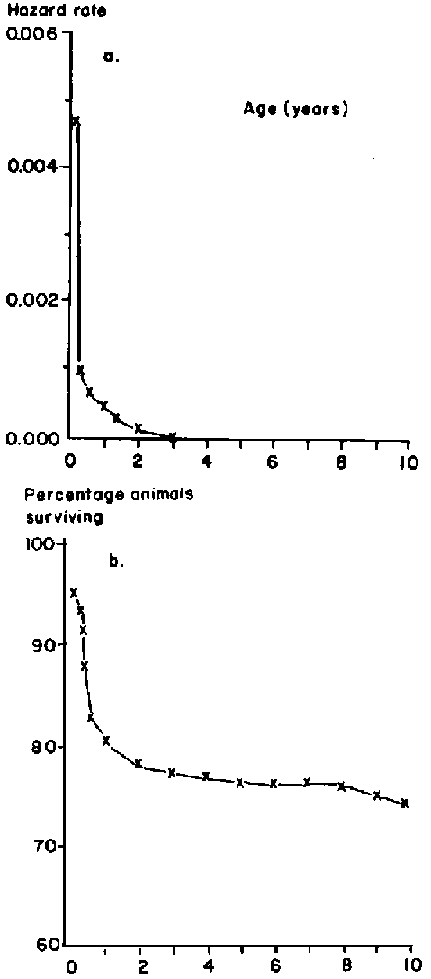
Figure 22 shows the age-specific hazard rates for Kenana cattle at Um Banein and the percentage of animals surviving at a given age. The risk of dying is greatest during the neonatal period (including abortions and stillbirths) and up to the age of 1 week. From 1 week old to weaning at 120 days the mortality rate was considerably lower. After weaning, calves were again at risk and there was a slight increase in the mortality rates in the two periods 91 to 180 and 181 to 270 days of age. Survival rates were in general quite high once these crisis periods had been passed.
The overall mortality rate to 1 year was about 16.6%. For animals more than 1 year old, mortality levels were much reduced, such that 75.6% of all animals born survived to 10 years of age (animals sold or culled are, of course, not included in calculations of mortality rates).
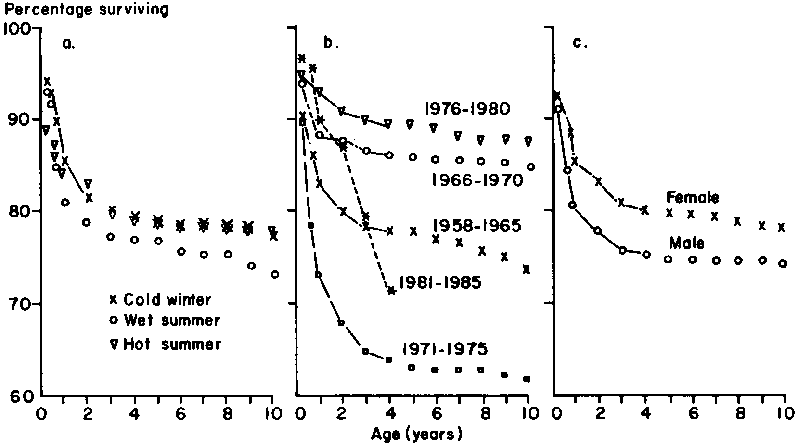
The effects of environmental influences on the mortality rate are shown in Figure 23. There were significant differences in mortality rates due to the effects of season of birth (P<0.01), the period of birth in relation to station establishment (P<0.001) and to the sex of the calf (P<0.001).
More calves born in the wet summer died than those born in the cold winter and hot summer seasons. Highest levels of mortality after the neonatal period were evident in calves born in the wet summer in the age ranges 181 to 270 and 271 to 365 days. These periods correspond with the late winter and the whole of the hot summer.
High levels of mortality were evident in the early years after station establishment and again in the early 1970s. The mortality rate for all five groups of years followed the general trend, irrespective of total within-group levels, in that the highest mortality risk was met within the first year of life. Quite high levels of risk did, however, occur in cattle born in the period 1971-75 well into their third year of life, and there was a similar although less pronounced pattern in animals born prior to 1965. The group of animals born since 1981 shows a constant high level of mortality through 1985 due, undoubtedly, to the low and poorly distributed rainfall in this last period.
Females had higher survival rates than males at all stages of life except for animals in excess of 8 years old: there were, of course, very few males of this age in the herd at any one time and these would all be breeding bulls.
Deaths (other than abortions and stillbirths) were assigned to five principal causes. Three of these poor nutrition, disease and digestive problems were responsible for more than 97% of all losses. An analysis of the losses by year grouping is shown in Table 27.
Figure 22. Overall age-specific hazard rates (a) and cumulative percentage of animals surviving (a) at different ages for Kenana cattle at Um Banein.
A total of 1230 animals was recorded as culled. The principal reasons were similar to those recorded for deaths but with the addition of low production (i.e. milk) and infertility. These two causes together accounted for 65.2% of au animals culled, while mastitis and old age together accounted for a further 19.0%. A full breakdown of reasons for culling by time period is given in Table 28.
The culling policy has been partially effective in removing from the herd low-yielding cows and those with poor reproductive performance. Several cows were, however, culled for disease (with contagious bovine pleuro-pneumonia being the principal one) and for "digestive problems" as wed as for low inherent productivity. There is evidence that in recent years disease and digestive problems have been largely overcome and that at the same time culling on performance has become more rigorous. In fact, about 25% of au cows culled for low milk production in the history of the station were removed from the herd in 1985.
Table 27. Causes of mortality (except abortion and stillbirth) in Kenana cattle at Um Banein (n = 719).
|
Year group |
Cause of mortality (%) |
Total |
|||||
|
Poor nutrition |
Old age |
Diseasea |
Digestive problems |
Calving difficulty |
Other |
||
|
1958-1965 |
1.1 |
0.0 |
14.6 |
14.6 |
0.3 |
0.1 |
30.7 |
|
1966-1970 |
0.1 |
0.0 |
4.0 |
4.2 |
0.1 |
0.1 |
8.5 |
|
1971-1975 |
20.0 |
0.1 |
13.1 |
6.3 |
0.4 |
0.6 |
40.5 |
|
1976-1980 |
6.1 |
0.1 |
1.4 |
3.2 |
0.0 |
0.2 |
11.0 |
|
1981-1985 |
5.4 |
0.0 |
0.0 |
2.1 |
0.3 |
0.4 |
8.2 |
|
Not recorded |
0.7 |
0.0 |
0.3 |
0.1 |
0.0 |
0.0 |
1.1 |
|
Total |
33.4 |
0.2 |
33.4 |
30.5 |
1.1 |
1.3 |
100.0 |
a Estimated 88% due to contagious bovine pleuro-pneumonia.
Table 28. Reasons for culling of animals from the Um Banein herd (A = 1252).
|
Year group |
Reason for culling (per cent) |
Total |
||||||
|
Poor nutrition |
Low production |
Infertility |
Old age |
Mastitis |
Diseasea |
Otherb |
||
|
1961-1965 |
0.6 |
2.8 |
10.8 |
0.0 |
0.0 |
1.1 |
0.2 |
15.5 |
|
1966-1970 |
0.3 |
4.0 |
7.4 |
1.1 |
1.9 |
0.4 |
0.7 |
15.8 |
|
1971-1975 |
1.5 |
1.5 |
8.6 |
1.0 |
1.3 |
1.6 |
0.1 |
15.6 |
|
1976-1980 |
1.9 |
3.2 |
14.3 |
2.9 |
3.7 |
0.7 |
0.5 |
27.2 |
|
1981-1985 |
1.5 |
7.3 |
5.2 |
4.6 |
2.4 |
2.9 |
0.5 |
24.4 |
|
Not recorded |
1.1 |
0.0 |
0.1 |
0.1 |
0.0 |
0.2 |
0.0 |
1.5 |
|
Total |
6.9 |
18.8 |
46.4 |
9.7 |
9.3 |
6.9 |
2.0 |
100.0 |
a Mainly brucellosis; b Includes digestive problems, lameness, calving difficulty and injuries.
The policy of early sale of males or their transfer to places in which feed conditions are better should be pursued vigorously in conjunction with attention to culling females on productivity. The aim should be to reduce as much as possible the number of non-productive animals on the station in order that the proportion of breeding cows in the herd approaches or exceeds 50°%.
Mortality rates to 1 year of age are comparable to or even higher than those found in traditional systems (Wilson and Clarke, 1976), which do not have the same theoretical access to supplementary feed supplies and veterinary care. Special attention should be paid to reducing the neonatal death rate and to increasing survival in the immediate post-weaning period. Not all the weaned animals, however, encounter the same risks. Calves born in the wet summer have a higher mortality rate than other young animals, largely as a result of heavy post-weaning mortality. Winter and hot summer management of these animals should aim at giving them preferential access to feed resources during this period in order to increase their survival rate.
The dangers of high stocking densities and concomitant poor nutrition at any time are amply demonstrated by this analysis. These effects persist even when, as has happened in the 1980s, stocking rates are reduced. The high death rate in older stock in this last period probably results in part from the earlier overgrazing which has reduced primary production from the station over the medium term.