Intervention policies
Methodology
Data sources
Results
One major task of policy analysis is to measure the effects of alternative policies in ways that are useful for decision-making. This chapter quantifies the costs and benefits resulting from price intervention policies in the study countries. Specifically, changes in production and consumption brought about by price distortions are estimated for three distinct periods between 1970 and 1986. Changes in the welfare of producers and consumers, as well as in the foreign exchange bill and government revenues are also estimated and compared with other key economic variables. The chapter begins with a description of the theoretical model on which the analysis is based and then continues by detailing the data sources. Results of the study are presented next, followed by some concluding thoughts.
The results presented in this chapter are derived using the standard partial equilibrium framework based on the Marshallian concept of economic surplus (see Currie et al, 1971; Lutz and Scandizzo, 1980; Bale and Lutz, 1981). In this approach, current policy interventions such as tariffs, export taxes, quotas and subsidies are analysed in relation to a policy without any distortions. The method permits the estimation of the real (i.e. volume) and monetary gains that could be obtained if the major commodity markets in a country were fully and simultaneously liberalised. Each commodity market is considered separately and the estimates of gains and losses in each market are aggregated country by country. This single market approach implicitly ignores linkages between commodity markets and this represents a major limitation of the method used here. Nonetheless, the assessment of efficiency and welfare effects using the partial equilibrium framework may provide reasonably good first approximations of the order of magnitude of the impact of distortions caused by livestock policy interventions (see Lutz and Saadat, 1988).
Graphical representation of the partial equilibrium model is presented in Figure 10 using the case of an export tax as an example of a distortionary policy. SS' represents the domestic supply function and DD' the domestic demand schedule. To keep the analysis simple no distinction is made between producer and consumer price. The export tax is Pw - Pd. As a result of this distortion, producers only obtain a price Pd as compared to Pw. They produce Qd instead of Qw and incur a producers' welfare loss of ACDH. However, consumers benefit from the lower price; they increase consumption from Cw to Cd and obtain a consumers' surplus gain of ABGH. Under this policy, exports fall from Qw - Cw to Qd - Cd and foreign exchange earnings for the country drop from Pw (Qw - Cw) to Pw (Qd - Cd) while the government obtains export tax revenues of BCEF.
This basic analytical structure of the partial equilibrium model can also be represented by a set of equations as shown below. The formulae allow for differentiation between producer and consumer prices:
|
Change in production, |
| ||
|
|
dQi = EsidPiQi/Pi |
(1) | |
|
Change in consumption, |
| ||
|
|
dCi = EdidPiCi/Pi |
(2) | |
|
Net social loss in production, |
| ||
|
|
NSLp = 1/2 dQidPi |
(3) | |
|
Net social loss in consumption, |
| ||
|
|
NSLc = 1/2 dCidPi |
(4) | |
|
Welfare gain of producers, |
| ||
|
|
Gp = dPiQi - NSLp |
(5) | |
|
Welfare gain of consumers, |
| ||
|
|
Gc=dPiCi - NSLc |
(6) | |
|
Change in foreign exchange earnings, |
| ||
|
|
dF = Pwi (dQi - dCi) |
(7) | |
|
Change in government revenue, |
| ||
|
|
dRg = dPi (Qi - Di) |
(8) | |
|
where: |
| ||
|
|
Esi = own-price supply elasticity of commodity i, | ||
|
|
Edi = own-price demand elasticity of commodity i, | ||
|
|
dPi = impact of distortion on price, | ||
|
|
Qi = domestic production of commodity i, | ||
|
|
Pi = domestic producer (or consumer) price of commodity i, | ||
|
|
Ci = domestic consumption of commodity i, and | ||
|
|
Pwi = border equivalent producer (or consumer) price of commodity i. | ||
Equations 1 and 2 measure the changes in production and consumption as a result of a price distortion. Equations 3 to 6 quantify the typical efficiency and welfare changes associated with price policy interventions. Equations 3 and 4 represent the net efficiency losses in production and consumption to society as a whole. 20 In evaluating these equations, if domestic prices move toward border equivalent prices (i.e. a shift toward free trade), then NSLp and NSLc are benefits (gains) to society. If, as in the case of the imposition of an export or import duty, the trend is away from free trade, then the values reflect costs (losses) to society Equations 5 and 6 measure the welfare changes or the extent of monetary gains and losses of producers and consumers. They give an indication of the "redistribution" of income, between producers and consumers, caused by the instituted price policies Equation 7 measures the change in the foreign exchange bill due to government intervention in the pricing of the commodity in question. It is the difference between the actual bill and what it would have been without intervention. Equation 8 is interpreted analogously.
20. NSLp and NSLc are, in theory, net efficiency (i.e. economic) losses in production and consumption, respectively. However, the literature generally refers to them as net social losses Therefore, in order to avoid confusion the terminology normally used in the literature is retained here.
The welfare gains and losses expressed in equations 3 to 7 can be related to the corresponding areas in Figure 10 as follows:
Eq. 3 = CDE; Eq. 4 = BFG; Eq. 5 = ACDH (loss); Eq. 6 = ABGH;
Eq. 7 = CwCdFG + QdQwDE (loss); and Eq. 8 = BCEF.
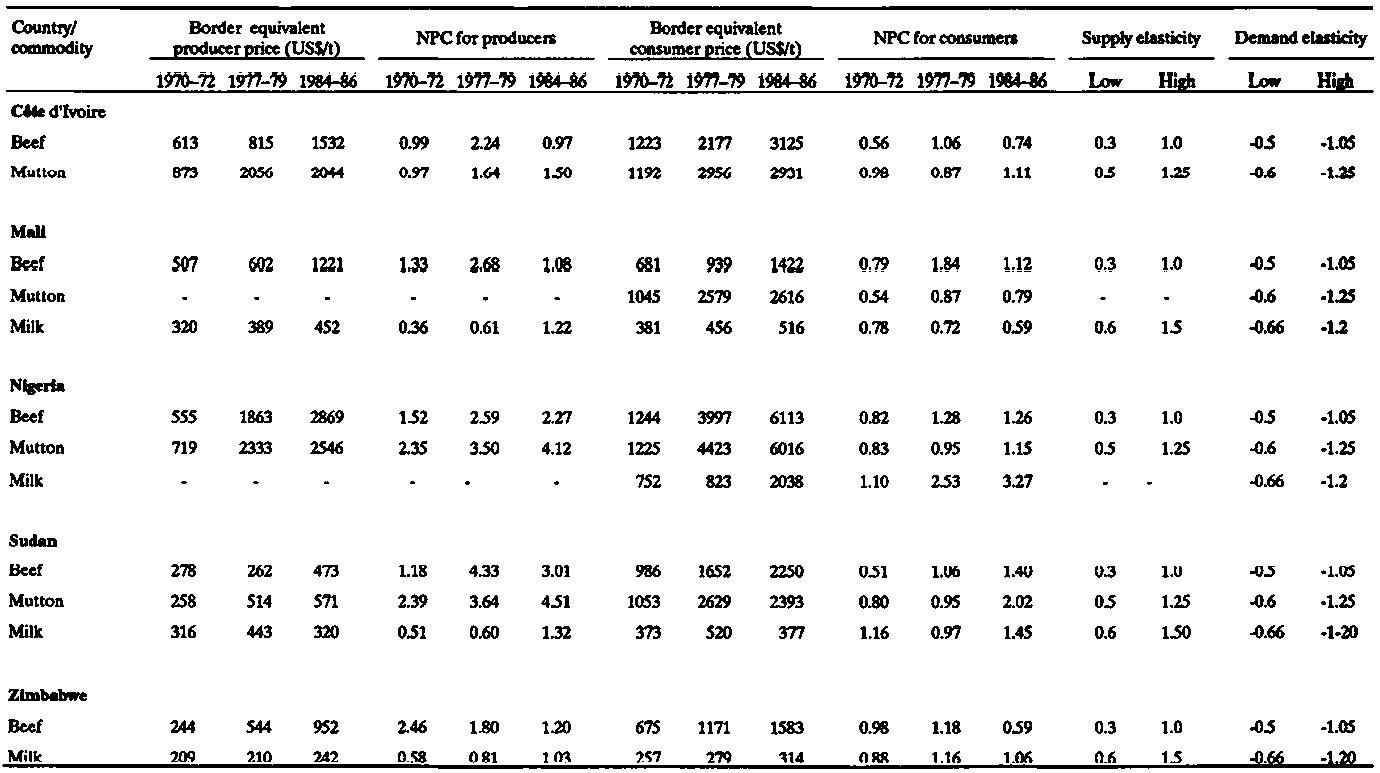
Apart from the summary measures of distortion, i.e. the nominal protection coefficients presented in the previous chapter, other basic parameters required for the evaluation of welfare effects are the elasticities of supply and demand. Although a few studies have attempted to estimate demand and supply elasticities for livestock products in sub-Saharan Africa, serious methodological and data problems tend to make the reported estimates to be numerous and diverse (see Rodriguez, 1986 and 1987; Khalifa and Simpson, 1972; Olayide and Oni, 1969 and 1972; Doran et al, 1979). Because elasticity estimates can differ widely, a range of plausible elasticities has been assumed for the analysis reported here. The elasticity ranges assumed were largely based on a careful review of the empirical estimates provided in the sources cited above and also in Braverman et al (1985) and Askari and Cummings (1976: Table B1, pp. 405-407). In all cases, long-term supply elasticities were assumed to range from 0.3 to 1.0 for beef, from 0.5 to 1.25 for mutton and 0.6 to 1.50 for milk. 21 Long-term demand elasticities were from 0.5 to -1.05 for beet - 0.6 to -1.25 for mutton and -0.66 to -1.2 for milk.
21. Available evidence from some of the studies cited above suggests a negative price elasticity of supply for beef in the short run. In the long run, all studies agree that the price elasticity of supply is positive. In the analysis reported here positive supply elasticities are used. However, it should be noted that if negative supply elasticities are assumed, the results may be different from those reported here.
The other basic data used for the calculations are presented in Table 20 and parts of Tables 21, 22 and 23. Three periods 1970-72, 1977-79 and 1984-86 were chosen in order to show changes resulting from price intervention policies over time. Thus, the data and the empirical results presented later on represent the average annual values for the periods specified.
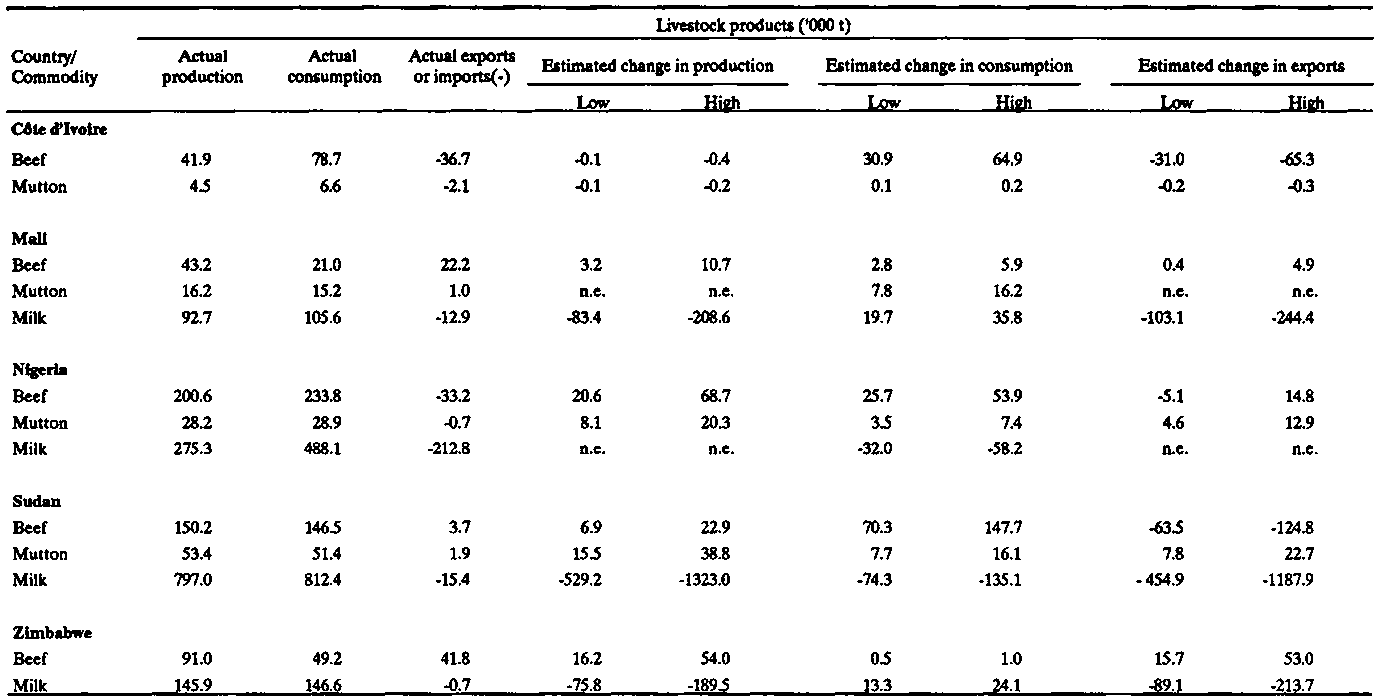
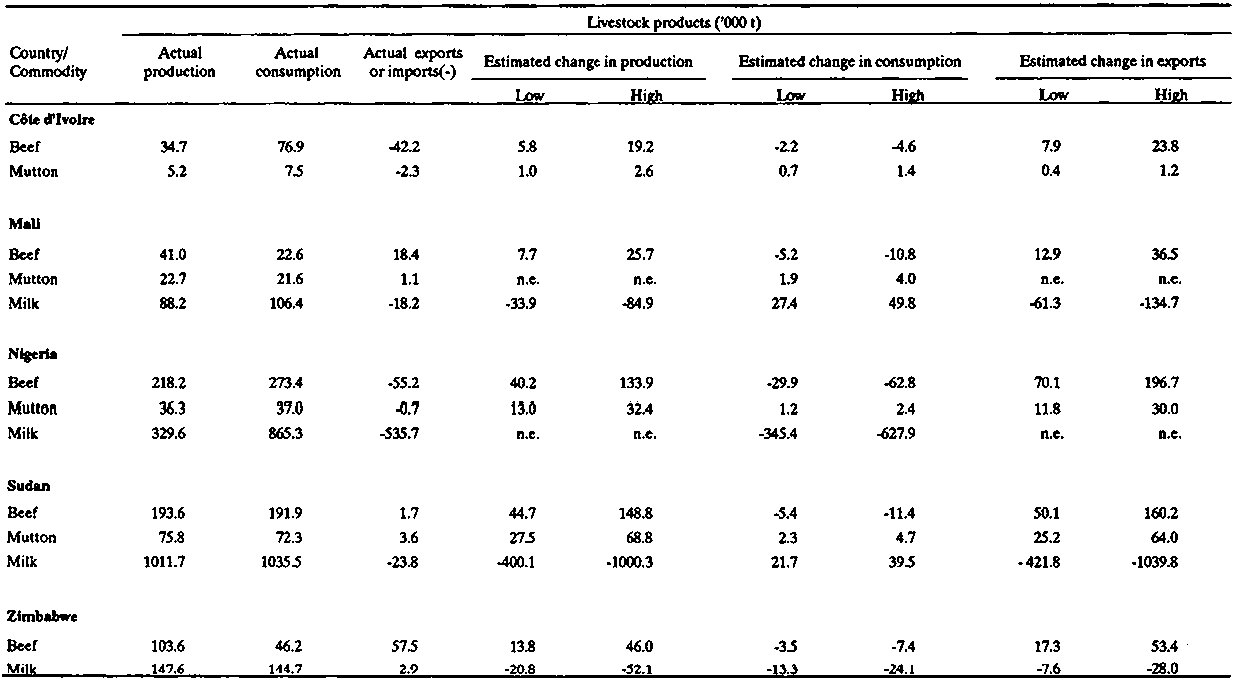
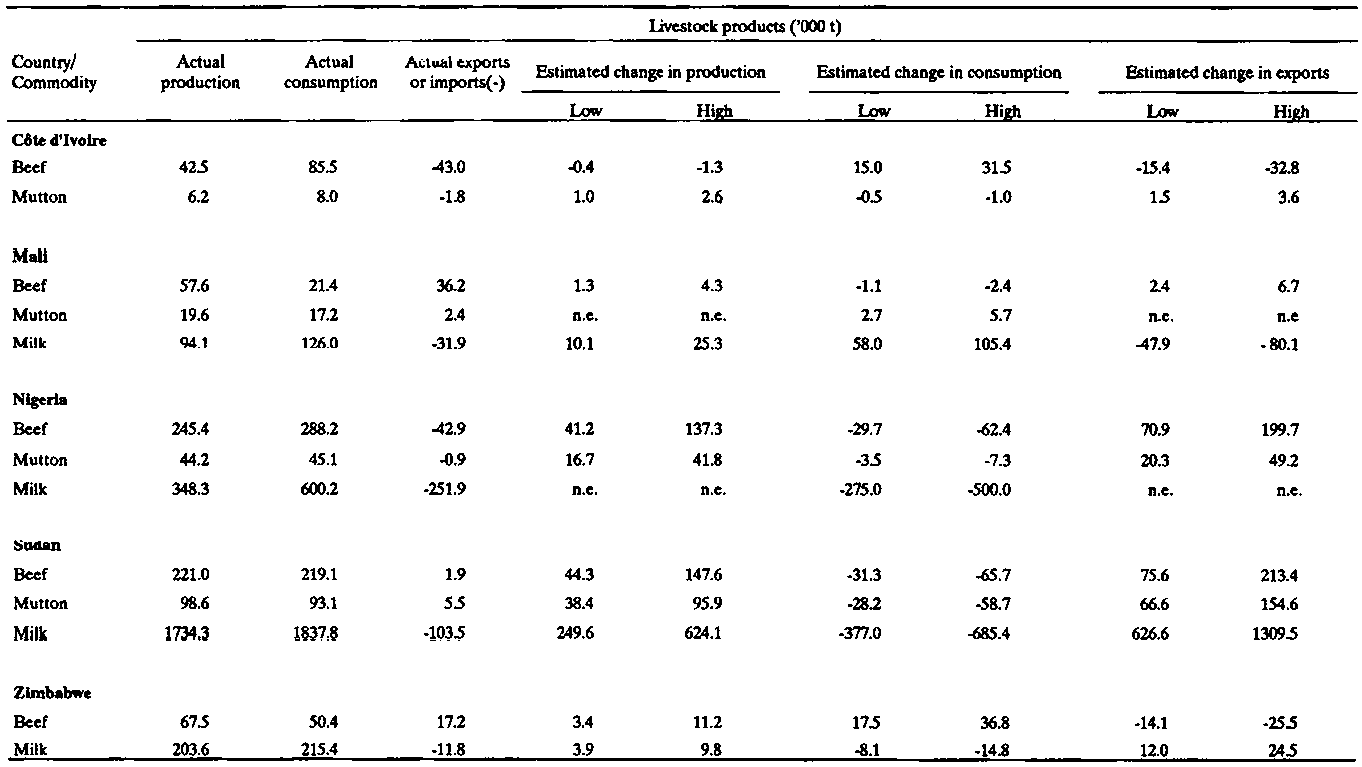
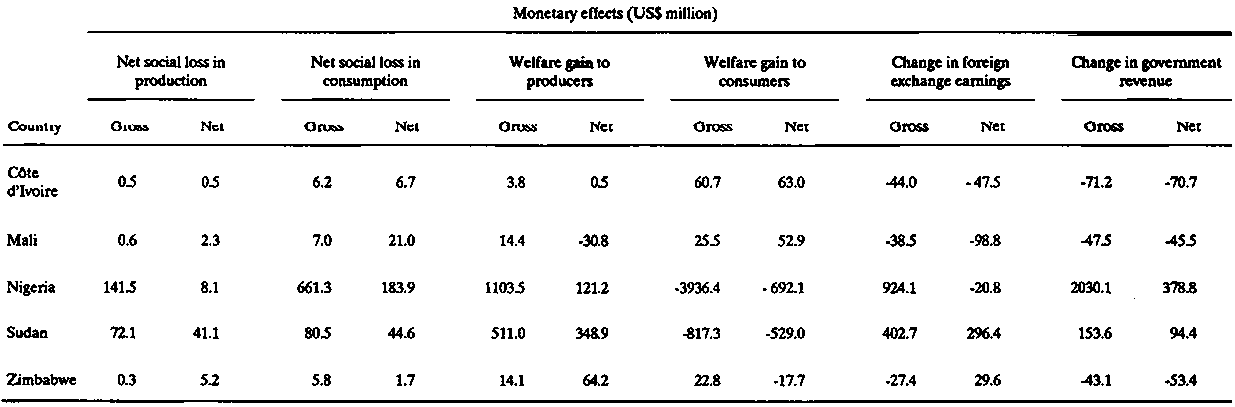
Tables 21, 22 and 23 present the gross effects of price distortions on real variables. A summary of gross monetary effects by country, obtained by aggregating the estimate of gains and losses for all the commodities considered in each country, is shown in Table 24. In these base results, no attempt has been made to correct for the effects of exchange rate distortions. However, in order to separate the effects of currency overvaluation from that of specific tariffs or equivalent interventions, nominal protection coefficients were re-estimated using adjusted exchange rates 22. The recalculated NPCs were then used to estimate the net real and monetary effects of price distortions for the period 1984-86 only. These net estimates (i.e. net of exchange rate distortions) are presented and compared with gross estimates in Tables 26 and 27.
22. The adjusted exchange rates are meant to correct for distortions in the official exchange rates. In each case, the extent of overvaluation of the official exchange rate was estimated using the differential inflation rate between domestic prices (approximated by the consumer price index) and foreign prices (based on the consumer price index of the United States of America). The base period for the adjustment reported here was 1970.
In general, the results depend on the magnitude of the price distortions as measured by the gross (or net) nominal protection coefficients, the responsiveness of supply and demand as measured by the supply and demand elasticities and on the absolute levels of demand and supply of the commodities in question.
As Tables 21-23 show, the gross real effects of the price distortions are often sizeable. This is evident in the case of beef in Zimbabwe and milk in Mali. These two cases will be used to explain the results reported in Table 23 for 1984-86.
The discussion in Chapter 3 and the NPCs presented in Table 20 indicate that in the period 1984-86, the Zimbabwean government pursued beef pricing policies that implicitly subsidised producers and consumers. The magnitude of impact of these price interventions on production, consumption, human welfare and trade depends on the elasticities of supply and demand. If we use the low supply and demand elasticities given in Table 20, we see that the pricing policies pursued in Zimbabwe, in 1984-86, which gave positive protection to producers, increased beef output by 3400 t (Table 23). However, the implicit subsidy to consumers at the same time increased consumption by 17 500 t, eventually reducing exports by 14 100 t.
The case of milk in Mali is quite similar. The milk pricing policies pursued in 1984-86 also implicitly subsidised both producers and consumers. Using the low elasticities, we see that milk production increased by 10 100 t, but consumption also increased by 58 000 t. Thus, compared with a situation not influenced by price distortions, imports increased by 47 900 t. Since, in reality, total imports during this period amounted to about 32 000 t, a policy of non-intervention in pricing decisions would have made Mali more than self-sufficient in milk production. However, the level of milk imports into Mali due to price policy interventions was less in 198486 than in 1972-73 (47 900 t vs 103 100 t; see Table 21). This suggests some improvement in milk pricing policies between the two periods considered here.
With respect to the gross monetary effects of price distortions, the total net social losses in production (i.e. losses in production efficiency that society as a whole has to bear) aggregated for the commodities studied in each country, ranged from US$ 0.3 million for Zimbabwe to US$ 141.5 million for Nigeria in 198486, using the low elasticity assumption (Table 24, panel A, column 2). The total net social losses in consumption (i.e. economic losses that society has to bear due to consumption changes caused by price intervention) ranged from US$ 5.8 million in Zimbabwe to about US$ 660 million in Nigeria (Table 24, panel A, column 3). Compared to the efficiency-type losses, the welfare-type gains (losses) for producers and consumers were larger. For example, using the low elasticity assumption, the welfare gains to producers in 1984-86 were from seven times Côte d'Ivoire, Nigeria and Sudan) to 40 times (Zimbabwe) as large as the net social losses in production during the same period (compare columns 2 and 4 in panel A, Table 24). On the face of it, this suggests a gradual shift away from discrimination against producers. On the other hand, consumers appeared to have gained even more than producers from pricing policy interventions in Côte d'Ivoire, Mali and Zimbabwe during the same period (compare Columns 4 and 5 in Table 24). In these three countries, foreign exchange earnings appeared to have been negatively affected by the particular policies pursued. For mast of the period covered, Nigeria and Sudan obtained net revenues from the interventions, whereas the policies of the other three countries were such that the government incurred a deficit. This implies that taxes, if any, were more than fully offset by subsidies.
Aggregating the gross monetary effects of intervention conceals one important point: that for commodities with negative protection (e.g. beef in Côte d'Ivoire in 1984-86), the (monetary) welfare losses to producers will always be much larger than the efficiency losses. 23 Thus, on both welfare (i.e. equity) and efficiency grounds, there are cogent reasons in advocating for a move away from negative protection of livestock commodities.
23. Relevant figures in Table 20 can be used to solve the equations specified earlier in this chapter to verify this assertion.
Comparison of the gross monetary effects of price distortions with some key economic indicators (Table 25) shows that producers' monetary gains in relation to agricultural GDP very from 0.1% in Côte d'Ivoire to 17.4% in Sudan in 1984-86. The changes in government revenues due to pricing policy interventions compared to official development assistance (ODA) were relatively small for those countries which receive large foreign aid flows (e.g. Sudan and Mali) and very large for Nigeria which obtains little aid. The changes in foreign exchange earnings in relation to ODA were quite large for all the countries studied. The above comparisons and the ratios obtained appear to justify continued attention to pricing policies, along with other macro-economic policies, in order to ensure a more efficient incentive system for livestock production in the study countries.
Thus far, the analysis has been conducted without adjusting for exchange rate distortions. However, it is widely known that for part of the period covered in this study, governments in all the study countries intervened in the foreign exchange markets either directly, through exchange rate restrictions (as in Nigeria, Sudan and Zimbabwe), or indirectly through import tariffs and licences (as in Côte d'Ivoire, Mali, Nigeria, Sudan and Zimbabwe), with the result that their currencies were typically overvalued. Currency overvaluation acts like a tax on exports and like a subsidy on imports. These distortions are in addition to those created by direct pricing policy instruments such as import duties and export taxes. Therefore, as previously explained, an attempt was made to correct for exchange rate distortions by using adjusted exchange rates (instead of official exchange rates) to convert border prices into domestic currencies. The adjusted exchange rate as estimated here is the official exchange rate in a base year adjusted by the ratio of domestic to international rates of inflation (see footnote 22, page 41). The estimated adjusted exchange rates are presented together with the official exchange rates in Table 28 of Appendix 4.
Based on the adjustments and relative to the base year (1970), it appeared that the official exchange rate in all the study countries, except Zimbabwe, was overvalued in 1984-86. By contrast, the official exchange rate was undervalued in Zimbabwe during the same period.
In principle, if the official exchange rate is overvalued (undervalued), the use of an adjusted exchange rate in computing NPCs would make the latter smaller (higher) in absolute terms. Thus, if we consider the NPC for a producer, the use of an adjusted exchange rate in place of an overvalued exchange rate would reveal a larger negative distortion against commodities with initial negative protection or a reduced positive distortion for goods with initial positive rates of protection. The magnitude of the changes in NPCs would depend on the degree of currency overvaluation. The results obtained by using revised NPCs, based on adjusted exchange rates, are presented in Tables 26 and 27 where they are also compared with the results obtained using official exchange rates.
Before looking at the results, a few comments are in order at this point. First, the method used to adjust the exchange rates assumes that they were in equilibrium (i.e. neither over- or undervalued) in the base year, 1970. If this assumption does not hold, the adjusted exchange rates will not fully reflect the extent of distortions in official exchange rates, but will still give an indication of the level of distortions relative to whatever the situation was in the base year. Second, in theory, the adjustment of exchange rates should also have significant impact on domestic prices and, possibly, on the elasticities of demand and supply of the commodities under consideration. However, these other effects were not considered in the analysis reported here. Despite this limitation, the results obtained are quite interesting.
In Table 26, the gross estimates were obtained by using NPCs calculated with official exchange rates, while the net estimates were derived by using revised NPCs based on adjusted exchange rates. A comparison of the gross and net volume figures indicates that, for those countries with overvalued exchange rates in 1984-86 (e.g. Mali, Nigeria, Sudan and Côte d'Ivoire), there would be greater reductions in exports and/or greater increases in imports if adjusted (i.e. undistorted) exchange rates were used in the analysis in place of the official exchange rates. Thus for a beef exporting country like Sudan, Table 26 shows that exports of beef would be 19 200 tonnes lower if NPCs based on adjusted exchange rates were used. Similarly, for a (...)
(...)
Table 20. Data for the calculation of gross real and monetary effects of price distortions. 1
1. For milk the periods considered were 1972/73, 1977/79 and 1984/86. Nominal protection coefficients (NPCs) were estimated using the official exchange rates.
Source: Border equivalent prices and NPCs were calculated based on data in Appendix 4.
a. Gross effects include changes due to direct price distortions and distortions arising from the use of the official exchange rate when it is over- or undervalued. For milk the period considered was 1972/73. The 'low' and 'high' refer to the low and high elasticity assumptions and do not necessarily correspond to the absolute levels of the real effects. 'Low' and 'high' in the remaining tables should be interpreted analogously.
Notes: (1) n.e. means not estimated; (2) Negative values under the column representing estimated change in exports imply imports.
Source: Production: FAO (1989); consumption was derived as the difference between production (col. 1) and exports (col. 3); exports/imports: FAO (1988); changes in production, consumption and exports were calculated using equations in the text and data in Table 20 and first three columns of this table.
Notes: (1) n.e. = not estimated; (2) Negative values under the column representing estimated change in exports imply imports.
Source: Production: FAO (1989); consumption was derived as the difference between production (col. 1) and exports (col. 3); exports/imports: FAO (1988); changes in production, consumption and exports were calculated using equations in the text and data in Table 20 and first three columns of this table.
Notes: (1) n.e. = not estimated; (2) Negative values under the column representing estimated change in exports imply imports.
Source: Production: FAO (1989); consumption was derived as the difference between production (col. 1) and exports (col. 3); exports/imports: FAO (1988); changes in production, consumption and exports were calculated using equations in the text and data in Table 20 and first three columns of this table.
Table 24. Summary of gross monetary effects of price distortions by country, 1984-86.
|
Monetary effects (US$ million) | ||||||
|
Country |
Net social loss in production |
Net social loss in consumption |
Welfare gain to producers |
Welfare gain to consumers |
Change in foreign exchange earnings |
Change in gov't revenue |
|
(1) |
(2) |
(3) |
(4) |
(5) |
(6) |
(7) |
|
Panel A | ||||||
|
Côte d'Ivoire |
0.5 |
6.2 |
3.8 |
60.7 |
-44.0 |
-71.2 |
|
Mali |
0.6 |
7.0 |
14.4 |
25.5 |
-38.5 |
-47.5 |
|
Nigeria |
141.5 |
661.3 |
1103.5 |
-3936.4 |
924.1 |
2030.1 |
|
Sudan |
72.1 |
80.5 |
511.0 |
-817.3 |
402.7 |
153.6 |
|
Zimbabwe |
0.3 |
5.8 |
14.1 |
22.8 |
-27.4 |
-43.1 |
|
Panel B | ||||||
|
Côte d'Ivoire |
1.4 |
13.0 |
3.0 |
53.9 |
-92.3 |
-71.2 |
|
Mali |
1.5 |
13.0 |
13.5 |
19.6 |
-72.2 |
-47.5 |
|
Nigeria |
416.2 |
1209.4 |
828.8 |
-4484.5 |
1945.1 |
2030.1 |
|
Sudan |
197.9 |
159.5 |
385.2 |
-896.2 |
871.1 |
153.6 |
|
Zimbabwe |
1.1 |
12.1 |
13.4 |
16.5 |
-61.9 |
-43.1 |
Notes:
1. Monetary estimates were derived by aggregating the estimate of gains and losses for all the commodities considered in each country. The estimates reported here were obtained by using NPCs estimated at the official exchange rates.2. Panels A and B refer to the low and high elasticity assumptions, respectively.
Table 25. Comparison of gross monetary effects of price distortions with some key economic indicators, 1984-86. a
|
Country |
Agricultural GDP (US$ million) |
Producer gain/agricultural GDP(%) |
Official development assistance (ODA) (US$ million) |
Change in government revenue/ODA (%) |
Change in foreign exchange earnings/ODA (%) |
|
Côte d'Ivoire |
2129.2 |
0.1 |
146.3 |
-48.7 |
-63.1 |
|
Mali |
608.6 |
2.2 |
357.3 |
-13.3 |
-20.2 |
|
Nigeria |
22 358.2 |
3.7 |
41.7 |
4868.4 |
4664.5 |
|
Sudan |
2212.4 |
17.4 |
898.3 |
17.1 |
97.0 |
|
Zimbabwe |
591.2 |
2.3 |
253.3 |
-17.0 |
-24.4 |
a. Monetary estimates used here are those obtained using the high elasticity assumption (see Table 24).
Source: Agricultural GDP and official development assistance from the World development report of the World Bank (various issues).
Table 26. Comparison of gross and net effects of price distortions on production, consumption and trade of livestock products, 1984-86.
|
|
Livestock products ('000 t) | |||||
|
|
Estimated change in production |
Estimated change in consumption |
Estimated change in export/imports (-) | |||
|
Country |
Gross |
Net |
Gross |
Net |
Gross |
Net |
|
Côte d'Ivoire | ||||||
|
Beef |
-0.4 |
-1.0 |
15.0 |
15.8 |
-15.4 |
-16.8 |
|
Mutton |
1.0 |
0.9 |
-0.5 |
-0.4 |
1.5 |
1.3 |
|
Mali | ||||||
|
Beef |
1.3 |
-9.3 |
-1.1 |
12.1 |
2.4 |
-21.4 |
|
Mutton |
n.e. |
n.e. |
2.7 |
7.8 |
n.e. |
n.e. |
|
Milk |
10.1 |
0.6 |
58.0 |
82.8 |
-47.9 |
-82.2 |
|
Nigeria | ||||||
|
Beef |
41.2 |
6.7 |
-29.7 |
48.0 |
70.9 |
-41.3 |
|
Mutton |
16.7 |
8.9 |
-3.5 |
11.6 |
20.3 |
-2.7 |
|
Milk |
n.e. |
n.e. |
-275.0 |
-217.7 |
n.e. |
n.e. |
|
Sudan | ||||||
|
Beef |
44.3 |
35.9 |
-31.3 |
-205 |
75.6 |
56.4 |
|
Mutton |
38.4 |
33.2 |
-28.2 |
-25.2 |
66.6 |
58.4 |
|
Milk |
249.6 |
166.6 |
-377.0 |
-294.0 |
626.6 |
460.6 |
|
Zimbabwe | ||||||
|
Beef |
3.4 |
10.2 |
17.5 |
2.2 |
-14.1 |
8.0 |
|
Milk |
3.9 |
29.6 |
-8.1 |
-31.1 |
12.0 |
60.7 |
Notes: 1. Gross estimates were obtained by using NPCs estimated at official exchange rates, while net estimates were obtained by using revised NPCs based on adjusted exchange rates.
2. The estimates reported here were obtained using the low elasticity assumption.3. n.e. = not estimated.
Table 27. Comparison of gross and net monetary effects of price distortions by country, 1984-86.
Notes: 1. Gross estimates were obtained by using NPCs estimated at official exchange rates, while net estimates were obtained by using revised NPCs based on adjusted exchange rates.
2. The estimates reported here were obtained using the low elasticity assumption.