M.K. Karachi*
National Dryland Farming Research Centre,
Katumani
P. O. Box 340
Machakos, Kenya
* Present address, International Coucil for Research in Agroforestry (ICRAF), P. O. Box 30677. Nairobi, Kenya
B.H. Dzowela
ILCA
P.O. Box 46847
Nairobi, Kenya
Abstract
Introduction
Materials and methods
Results and discussion
References
The potential of sweet potatoes (Ipomea batatas (L.) Lamb) for use as a dual purpose crop in crop/livestock systems of semi-arid Kenya was studied on twelve accessions. Root initiation (fibrous and fresh roots), vine growth and nutritional quality and effects of supplementing vines and cottonseed cake (CSC) on growth of Boran weaner male calves were investigated.
Time to fibrous root initiation was not significantly different (P<0.05) but significant differences (P<0.05) were observed in mean root numbers and lengths after 10 days of growth. Accessions differed significantly (P<0.05) in time to freshy tuber initiation, enlarged tuber numbers and tuber weight. Trends in vine components (stem and leaves) yields showed a decline after 120 or 150 days from transplanting. A significant (P<0.05) time × vine dry matter (DM) accumulation rate interaction was obtained. Percent protein (CP), cell contents (CC), cell wall constituents (CWC) and acid detergent lignin (ADL) differed significantly (P<0.05) among the accessions while acid detergent fiber (ADF) and ash were not significantly different (P>0.05).
Supplemental vines and cottonseed cake significantly improved (P<0.01) intake of Rhodes grass hay, calf growth rates and feed conversion efficiencies.
The data suggests that sweet potato vines could replace CSC as a livestock feed supplement.
Implications on the use of vines as livestock feed supplements are discussed. The variation exhibited in the attributes measured indicate that selections that optimise tuber and vine yields are possible.
Crops and livestock form integral components in providing for the human population in semi-arid Kenya. This has necessitated re-orientations in developing technical packages that integrate the two production systems. Several studies have reported on dry matter production and distribution in sweet potato (Ipomea batatas (L.) Lamb) during growth and development (Austin, 1973; Huett and O'Neill, 1976; Karachi, 1982a and Bourke, 1984). Attempts were further made (Karachi, 1982b) to broadly classify Kenyan materials into dual purpose tuber and vine producing types based on tops: tuber yield ratios.
The dual purpose types have a potential role in the development of production technologies that aim at integrating crops and livestock commodity factors into an integral production system. The following investigations were initiated to study production characteristics, forage quality and animal production potential of some selected Kenyan sweet potato accessions for inclusion into crop/livestock production systems.
Experiment 1: Fibrous root development
Experiment 2: Tuber development and vine quality
Experiment 3: Effect of supplement sweet potato vines and cottonseed cake (SCS) on growth of weaned Boran calves.
Twelve accessions, Mania, Namala, Mkizumu, 3011, Kiganda, Munyoka (R), Calorine Lee, Musinya, Widowi, Mulenjet, Opiemo and Lunyulule were used in each experiment.
The experiment was conducted in an open grasshouse at National Dryland Farming Research Centre, Katumani. The aim was to determine whether there were differences in fibrous root initiation and growth between the accessions under adequate moisture conditions.
Five 30 cm long apical vines from each accession were cut at a node, tied loosely together with cotton thread and put in 10 cm diameter, 20 cm long polythene bags. The cut vine tips were bedded into 3 cm depth of water. The experiment was a randomised complete block design with three replications. Indications of root initiation were recorded on each vine daily as swellings at the nodes. Mean root lengths and numbers were recorded 10 days from root initiation for each accession. Water in polythene bags was not changed during the experimental period.
Two experiments involving yearly replanting were conducted under rainfed conditions at Beef Research Station, Nakuru. Each experiment was established after 30 mm establishment rainfall was received; a total of 610 mm (year 1) and 590 mm (year 2) was received during the growth periods.
Plot sizes were 6 m × 3.6 m. The design was a split-plot with accessions as main plots and sampling dates as sub-plots. There were three replicates. Vine cuttings, 30 cm long, were planted on flats at 60 cm within row spacing and 30 cm between row spacing. Fertilizers at the rates of 20 kg P/ha, 15 kg K/ha and 10 kg N/ha as single superphosphate, muriate of potash and calcium ammonium nitrate, respectively, were placed in small furrows about 3 cm depth and width adjacent to vine rows and immediately covered. The plots were clean weeded throughout the experiment.
Trends in tuberisation and dry-matter accumulation were monitored over four harvest dates ranging from 120, 150, 180 and 210 days after planting. Six randomly selected adjacent plants were harvested by hand digging leaving the border plants. On each harvest date, total number and fresh weight of enlarged tubers, >3 cm diameter, clean of soil and total fresh weight of vines were recorded. Subsamples, on replicate basis, of enlarged tubers (sliced) and vines were dried in a forced draft oven (105°C for 24 h) for dry matter (DM) determination. Another set of subsamples was dried at 60°C for 24 h, ground to pass through 2 mm sieve and stored in airtight plastic bottles for chemical analysis. Crude protein (CP) was determined by microkjedahl method and ash content as described by AOAC (1970). The fibre fractions were determined according to Goering and Van Soest (1970).
Bulking plots of the same accessions were established at the same time for a feeding trial.
The experiments were conducted aimed at comparing growth rates of penned Boran calves fed on chopped (approximately 3 cm length) Rhodes grass hay as basal roughage supplemented with either sweet potato vines (mean CP, 13% on DM basis) or cottonseed cake (mean CP, 33% on DM basis). Sweet potato vines were 210 days old from transplanting. The vines were harvested, air dried and chopped (approximately 3 cm length) before commencement of the trials. All weaners were dewormed before the start of the experiment using Ranzole (Merk, Sharp and Dohme B.V. Netherlands Commercial) mineral supplement 'stock lick', from Unga Feeds Ltd. Nairobi and water were provided ad libitum
Calves, 131±5, 134±7 and 140±4 kg (experiment 3a) and 132±6, 129±3 and 126± kg (experiment 3b) initial mean fasted liveweights (16h without water or feed) were either fed hay (ad lib), hay + 500 g vines DM and hay + 200 g DM cottonseed cake head/day. The supplements provided additional 65 and 66 g crude protein/head/day respectively. In experiment 3b the weaners were supplemented with additional 100g urea/molasses, (4% CP) head/day to improve forage intake. Each experiment consisted o a preliminary period of 14 days to allow adjustment of weaners diets and facilities. Calves were randomly allocated to treatments in groups of nine per pen. Half of the estimated has intake (established during the adjustment period) was mixed witl the supplements and offered at 09.00 h. The remaining forage component was offered at 14.00 h allowing 15% more forage than that consumed the previous day. The experimental design was a randomised complete block with two replications.
Records were kept of feed offered, less refusals, to obtain intake data. The dry matter intake was calculated on a basis of 7 day totals of dietary components offered, less refusals. At the start of each experiment and after every 15 days during the feeding period, starved weaner liveweights were taken.
Chemical composition of feeds on offer was determined as described in experiment 2. In vitro dry matter digestibility was estimated by Tilley and Terry (1963) procedures. Statistical analyses of all data was done according to Steel and Torrie (1980). Means were subjected to Duncan's multiple range test for determination of significant differences.
Fibrous Roots
Freshy roots
Tops dry weight
Chemical composition of tops
Calf responses
Practical implications
Time to fibrous root initiation was not significantly different (P<0.05) between the cultivars but significant differences (P<0.05) were observed with fibrous root numbers and root length (Table 1). However, relationships between these rooting characters are not apparent. This experiment should be conducted under field situation to examine whether the accessions exhibit similar growth trends under limited moisture conditions.
Time to production of thickened tubers as measured by roots >3 cm diameter (Table 2) differed significantly (P<0.05) among accessions. Generally, accessions Mania, 3011 and Muyoka (R) could be classified as early tuber initiators (<than 150 days from transplanting) while the others (except Namala, Mulenjeti and Lunyulule) which did not produce tubers are late tuber initiators. The late tuber initiators also tended to have significantly higher (P<0.05) root tuber numbers. Root tuber numbers and tuber weight varied among accessions confirming the results of Karachi (1982b) and Randle (1987). Accession 3011 had the highest and significant (P<0.01) mean tuber weight (21.4±2.29) while Muyoka (R) had the lowest and significant (P<0.01, 3.3±0.49). Accession Opiemo had the highest and significant (P<0.01) mean tuber numbers (13.3±1.5g) and Muyoka (R) the lowest and significant (1.7±0.19). No apparent relationship between root tuber numbers, tuber weight or time to tuber initiation was evident.
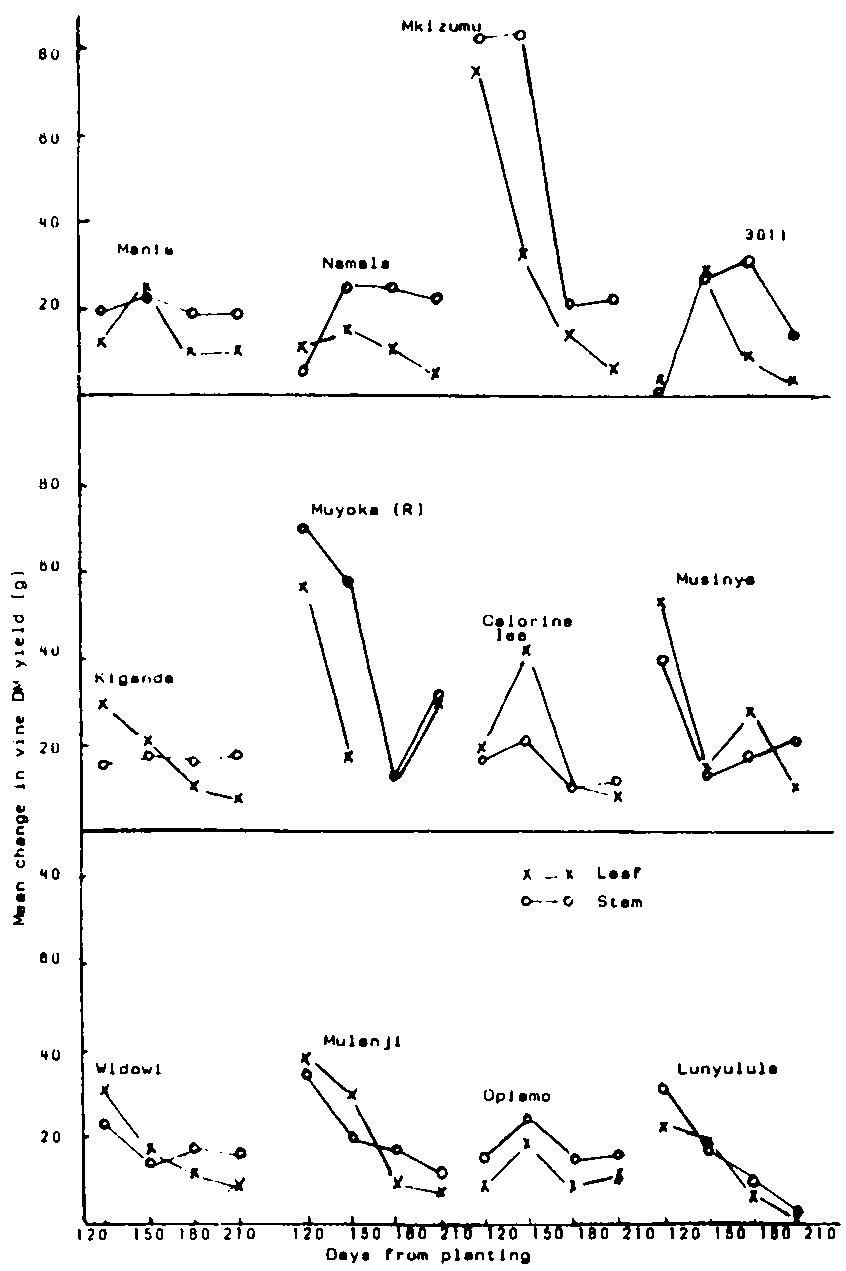
Changes in dry weights of tops components are shown in Figure 1. A significant (P<0.05) harvest time × species interraction was detected. Accessions showed declined trends in leaf and stem DM accumulation after day 120 from transplanting but at different rates. The leaf component declined at a higher rate than that of the stem fraction leading to a reduction in leaf contribution to total DM with maturity which conforms with Randle (1987). This could eventually result in reduction of the nutritive value of the vines (Karachi 1982a). The declining trends were most marked hen enlarged root tubers were recorded suggesting most assimilates were directed to tuber development (Austin, 1973 and Bhagsari and Harmon, 1982).
Table 1. Fibrous root initiation, number of roots (mean ± S.E) and root lengths (cm, mean ± S.E)
|
Accession |
Days to root initiation |
Number of roots |
Root lengths (cm) (10 days from initiation) |
|
Mania |
4 |
8.9 ± 1.2 |
11.5 ± 0.5 |
|
Namala |
3 |
15.3 ± 2.9 |
15.5 ± 1.3 |
|
Mkizumu |
5 |
6.5 ± 0.8 |
5.0 ± 0.6 |
|
3011 |
4 |
7.8 ± 1.2 |
5.0 ± 0.2 |
|
Kiganda |
4 |
3.3 ± 0.2 |
8.0 ± 1.2 |
|
Muyoka (R) |
3 |
9.4 ± 1.1 |
6.0 ± 0.3 |
|
Calorine Lee |
3 |
6.6 ± 0.5 |
10.5 ± 1.1 |
|
Musinya |
3 |
6.4 ± 0.3 |
12.5 ± 1.7 |
|
Widowi |
3 |
4.7 ± 0.2 |
10.0 ± 0.7 |
|
Mulenjeti |
4 |
9.2 ± 0.7 |
8.2 ± 0.3 |
|
Opiemo |
3 |
7.3 ± 0.4 |
10.1 ± 0.9 |
|
Lunjulule |
6 |
8.8 ± 0.4 |
4.0 ± 0.1 |
|
LSD (P<.05) |
NS |
4.3 |
3.5 |
Table 2. Number of tubers (Mean ± S.E) and tuber weighta (g, mean ± S.E) per vinea
|
|
DAYS FROM PLANTING | |||||||
|
Accession |
120 |
150 |
180 |
210 | ||||
|
|
Number of tubers |
Tuber weight |
Number of tubers |
Tuber weight |
Number of tubers |
Tuber weight |
Number of tubers |
Tuber weight |
|
Mania |
|
|
5.5 ± 1.3 |
6.5 ± 1.4 |
|
|
|
|
|
Namalab |
|
|
|
|
|
|
|
|
|
Mkizumu |
|
|
|
|
4.1 ± 1.2 |
12.1 ± 1.2 |
|
|
|
3011 |
3.6 ± 0.2 |
21.4 ± 2.2 |
|
|
|
|
|
|
|
Kiganda |
|
|
|
|
|
|
2.2 ± 0.1 |
8.2 ± 2.0 |
|
Muyoka (R) |
1.7 ± 0.1 |
3.3 ± 0.4 |
|
|
|
|
|
|
|
Calorie Lee |
|
|
|
|
|
|
2.4 ± 0.3 |
6.6 ± 1.3 |
|
Musinya |
|
|
|
|
|
|
7.4 ± 0.8 |
14.4 ± 1.6 |
|
Widowi |
|
|
|
|
3.1 ± 0.8 |
8.8 ± 0.7 |
|
|
|
Mulenjetib |
|
|
|
|
|
|
|
|
|
Opiemo |
|
|
|
|
13.3 ± 1.5 |
17.7 ± 0.9 |
|
|
|
Lunyululeb |
|
|
|
|
|
|
|
|
a Tubers with middle portion >3 cm diameter
b Accessions did not tuber within the experiment period LSD (P<.05)
Tuber numbers 3.2
Tuber weight 4.6
Figure 1: Trends in vine components dry matter production
Chemical composition of tops (Table 3) showed significant (P<0.05) differences in protein content (CP%), cell contents (CC%), cell wall constituents (CWC%) and acid detergent lignin (ADL%). Acid detergent fibre (ADF%) and ash contents were not significantly different (P>0.05). The content of these attributes ranged by approximately 5, 13, 11, 4, 6 and 2 percentage units respectively between the accessions indicating that selections could be made that optimises vine nutritional qualities. Overall, the materials show protein levels are adequate to meet animal requirements for beef production (Church, 1980). However, the lignin levels are high which is characteristic of fortes (Van Soest, 1982). A.N. Said (unpublished data) recorded low water intake and high urination rates by sheep fad sweet potato vines. Fractionating the mineral content in the ash and the DM content in the forage may assist in explaining this observation.
Chemical composition of rations offered (Table 4) indicate protein content was slightly above levels that intake is depreseed (6-8% CP, Van Soest 1982). In vitro dry matter digestibility (IVDMD%) show that the feeds were of medium quality and generally improved with supplementation.
Table 3. Chemical composition (Mean ± S.E) of vines after 210 days from planting.
|
Accession |
CP% |
CC% |
CWC% |
ADF% |
ADL% |
ASH% |
|
Mania |
11.1 ± 1.2 |
46.5 ± 3.4 |
53.6 ± 1.6 |
46.2 ± 0.2 |
14.2 ± 0.2 |
10.6 ± 0.6 |
|
Namala |
13.9 ± 1.9 |
47.0 ± 5.8 |
53.7 ± 0.7 |
42.0 ± 0.2 |
13.2 ± 1.2 |
12.2 ± 1.1 |
|
Mkizumu |
12.1 ± 1.3 |
45.5 ± 1.3 |
54.5 ± 2.4 |
39.0 ± 2.2 |
14.4 ± 0.4 |
11.3 ± 0.3 |
|
3011 |
14.0 ± 0.5 |
44.6 ± 5.9 |
55.1 ± 0.3 |
37.6 ± 1.3 |
13.1 ± 0.7 |
11.6 ± 0.3 |
|
Kiganda (K) |
10.6 ± 0.6 |
45.4 ± 2.6 |
52.2 ± 4.2 |
43.6 ± 1.2 |
14.6 ± 0.9 |
11.2 ± 1.6 |
|
Muyoka (R) |
12.8 ± 0.6 |
54.4 ± 1.8 |
52.0 ± 0.1 |
42.8 ± 3.4 |
14.0 ± 0.5 |
10.0 ± 0.5 |
|
Calorine Lee |
12.6 ± 0.1 |
49.2 ± 1.3 |
51.0 ± 2.3 |
40.4 ± 1.8 |
13.5 ± 1.3 |
10.0 ± 0.8 |
|
Musinya |
12.2 ± 0.2 |
47.8 ± 4.1 |
47.9 ± 1.7 |
38.2 ± 2.1 |
12.1 ± 0.3 |
11.5 ± 0.4 |
|
Widowi |
9.6 ± 0.8 |
43.8 ± 3.9 |
56.2 ± 1.9 |
41.8 ± 1.7 |
14.4 ± 0.6 |
9.9 ± 1.3 |
|
Mulenjeti |
13.8 ± 1.1 |
45.3 ± 2.8 |
53.6 ± 3.3 |
41.1 ± 0.5 |
15.8 ± 1.1 |
11.5 ± 1.9 |
|
Opiemo |
12.8 ± 0.3 |
41.4 ± 3.5 |
58.6 ± 1.8 |
42.4 ± 1.9 |
16.2 ± 1.3 |
11.5 ± 1.0 |
|
Lunyulule |
15.1 ± 0.9 |
50.1 ± 1.4 |
48.6 ± 1.7 |
37.8 ± 1.8 |
12.8 ± 0.8 |
10.0 ± 1.2 |
|
LSD (P<.05) |
2.8 |
6.3 |
6.5 |
NS |
3.4 |
NS |
Table 4: Chemical composition and in vitro dry matter digestibility of rations.
|
Experiment 1 | |||||
|
Ration |
CP% |
ADF% |
ADL% |
ASH% |
IVDMD% |
|
hay alone |
6.1 |
53.9 |
5.6 |
10.4 |
40.1 |
|
hay + vines |
6.8 |
51.3 |
6.1 |
12.3 |
47.3 |
|
hay + CSC |
7.2 |
51.7 |
6.4 |
11.8 |
48.8 |
|
Experiment 2 | |||||
|
hay alone |
6.5 |
52.6 |
5.2 |
10.6 |
43.6 |
|
hay + vines |
7.1 |
47.8 |
5.6 |
13.6 |
50.7 |
|
hay + CSC |
7.4 |
50.2 |
6.2 |
12.6 |
46.2 |
Table 5: Effect of vines and cottonseed cake (CSC) supplementation on DM intake and calf growth rates
|
Treatments | ||||
|
Experiments | ||||
|
Total DM intake |
hay |
hay + vines |
Hay + CSC |
S.E. |
|
(kg/day) |
2.7a |
3.5b |
4.1c |
.25 |
|
Growth rate (kg/day) |
.11a |
.28b |
.37c |
.03 |
|
Feed conversion ratio (feed/gain) |
24.5b |
12.5a |
11.1a |
1.37 |
|
Experiment 2 | ||||
|
Total DM intake kg/day |
3.4a |
4.2b |
4.6b |
.21 |
|
Growth rate (kg/day |
.18a |
.34b |
.39b |
.05 |
|
Feed conversion ratio (few/gain) |
18.9b |
11.8a |
11.8a |
1.12 |
S.E. - Standard error
abc - means within a row followed by different superscripts differ (P<.01)
Weaners supplemented with vines and cottonseed cake consumed 30 and 50% more (P<0.01) total DM respectively than those fed on grass alone (Table 5 experiment 3a). The improved feed intake was associated with 2.5 to 3.4 times (P<0.01) gain in calf liveweights and 49 to 55% improved (P<0.01) efficiencies in utilising the feed above that of calves fed on grass alone. Inclusion of urea/molasses (experiment 3b) increased (P<0.01) total DM intake, liveweight gains and feed utilisation efficiencies. The magnitude of gain was 1.9 and 2.2 times (P<0.01) and feed efficiency, 38% (P<0.01) above that of control calves. Molasses was probably associated with overcoming dietary energy deficits since liveweight gains were similar among the supplemented groups. Cottonseed cake contains substantial levels of energy.
Inherent climatic constraints in semi-arid bimodal rainfall zones with <120 growing days, entail that the cultivars/accessions should initiate fibrous and fresh root growth and the partitioning of assimilates between tops and root tubers within relatively short growth periods. Although no differences were exhibited on time to fibrous root initiation, data on root numbers and lengths suggest that differences may exist in the ability of the accessions to exploit the available moisture. This could be a critical determinant of successful establishment under unreliable and limited moisture conditions typical in semiarid environments. Freshy root initiation by accessions 3011 and Muyoka (R) indicate their ability to produce tubers within the period effective moisture is expected (in Machakos). The other accessions appear suitable for semi-arid unimodal rainfall high altitude areas, 150-180 growing days (in Nakuru) while accessions Namala, Mulenjeti and Opiemo are essentially vine producing types under these growth conditions.
Sweet potato tubers are used as dry season human food security. Prolonged storage of tubers in the soil leads to leaf shed and increased synthesis of fibre fractions in the stem which are antiquality characteristics. Vine DM accumulation rates declined within 120-150 days from transplanting but showed minimal change at 210 days suggesting this would be the optimal feeding period. Therefore the use of sweet potato vines as feed supplement in the dry season may require selection of materials with capacity to retain leaves. Another possibility would be to cut vines before leafshed for storage. However information on effects of cutting vines on tuber storability is lacking.
Supplementing weaners with 500 g/head/day of vines effected growth equivalent to that of calves fed 200 g cottonseed cake head/day. At the current price of KShs. 7.00 (USD 0.35)/kg high grade cottonseed cake it is apparent that compounding feeds based on vines rather than cottonseed cake would be an attractive venture. Greater value would further be obtained from supplementing vines to dairy stock or replacement heifers than beef-animals. Nevertheless, the DM content of fresh vines is usually <30%, necessitating feeding substantial amounts.
A.O.A.C. 1970. Official methods of analysis Ass. of Off. Analytical. Chem., Washington, D.C.
Austin, M.E. 1973. Patterns of dry matter distribution during development of sweet potato (Ipomea batatas). Hort. Sci. 48:11-17.
Bhagsari, A.S. and Harmon, S.A. 1982. Photosynthesis and photosynthate partitioning in sweet potato genotypes J. Amer. Soc. Hort. Sci. 107:506-510.
Bourke, R.M. 1984. Growth analysis of four sweet potato (Ipomea batatas) cultivars in Papua New Guinea. Trop. Agric. (Trin) 61:177-181.
Church, D.C. 1980. Digestive physiology and nutrition of ruminants. O and B Books Inc., Corvallis, Ore., U.S.A.
Goering, H.K. and Van Soest, P.J. 1970. Forage fiber analyses (apparatus, reagents, procedures and some applications), USDA Agri. Handbook. 379, Washington, DC.
Huett, D.O. and O'Neill, G.H. 1976. Growth and development of short and long season sweet potatoes in sub-tropical Australia. Exp. Agric. 12:9-16.
Karachi, M.K. 1982. The performance of sweet potato Ipomea batatas (L)Lamb) in Western Kenya, I. Effect of nitrogen and phosphorus combinations on yield. E.Afr. Agric. for J. 47:55-59.
Karachi, M.K. 1982b. The performance of sweet potato (Ipomea batatas (L)Lamb.) in Western Kenya. II. Yield of 31 cultivars. E Afr. Agric. for J. 47:60-67.
Randle, W.M. 1987. Freshy root growth and development and localized dry weight changes of four sweet potato cultivars. Trop. Agric. (Trin) 64:333-339.
Steel, R.G. and Torrie, J.H. 1980. Principles and procedures of statistics: A biometrical approach. 2nd ed. McGraw-Hill Book Co., New York.
Tilley, J.M.A. and Terry, R.A. 1963. A 2-stage technique for the in vitro digestion of forage crops. J. Brit. Grassl. Soc. 18:104-111.
Van Soest, P.J. 1982. Nutritional ecology of the ruminant: ruminant metabolism, nutritional strategies, the cellulolytic fermentation and the chemistry of forages and plant fibres. O and B Books, Inc., Corvallis, Oregon, U.S.A.