J.C. Kahurananga
ILCA
P. O. Box 5689
Addis Ababa, Ethiopia
Abstract
Introduction
Materials and methods
Results
Discussion
Acknowledgements
References
In May/June 1987 two annual Ethiopian clovers, Trifolium decorum and T. quartinianum were intercropped in wheat, Triticum aestivum on a vertisol at Shola, Addis Ababa (2380 m, 9° 02'N), and on a Nitosol at Holetta 40 km West of Addis Ababa in single or double alternate rows or by broadcast. The intercropped wheat received 30 kg N/ha and the clovers 0, 20, 40, 0r 80 kg P/ha. Control wheat plots received split-applications of 0, 30, 60, 90 kg N/ha. There were no significant grain yield reduction by intercropping from which 1075-1992 kg grain/ha were obtained. Broadcasting significantly gave less yield than row planting. P had a linear effect on legume yield which varied from 471-5766 kg/ha. Holleta had higher yields due to better drainage and sufficient rains during the growing season. Shola had lower yields mainly due to some water logging in wheat and low rainfall for the clovers as there were insufficient rains in many parts of Ethiopia.
Previous evaluation of annual native Trifolium spp. showed that they can produce up to 6 t DM/ha thus indicating potential for livestock feed under highland conditions (Kahurananga and Tsehay, 1984). This potential can be realised if these legumes are used under mixed crop/livestock farmer conditions. Usually smallholder farmers do not readily adopt the cultivation of forages as they devote both land and labour to crop production. The forages can only be adopted if they are introduced into cropping systems. One way of achieving this is through intercropping. This provides nutritious feed for livestock while at the same time improving soils fertility through biological N fixation which in turn sustains crop production. Therefore, the purpose of this study carried out in 1987 was to develop methodologies for intercropping annual Trifolium spp. into wheat, suitable for smallholder farmer conditions.
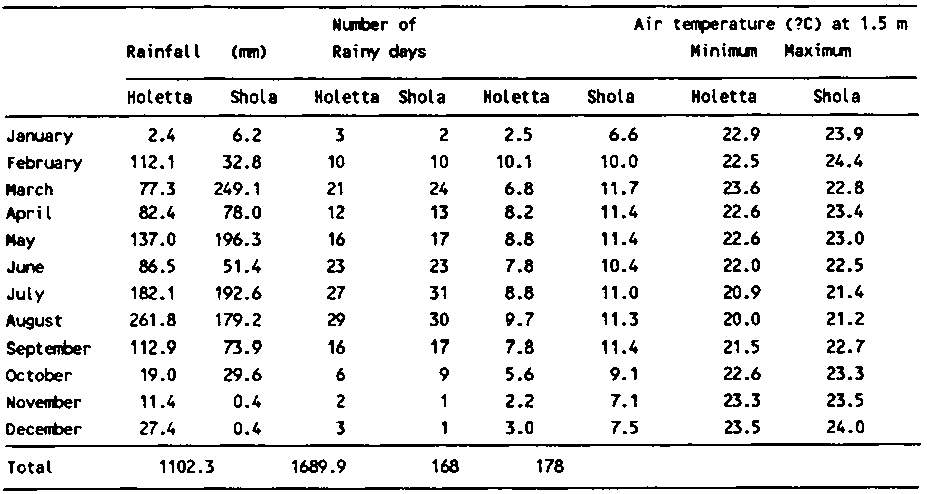
The trial was conducted at two sites. The first one was at ILCA Headquarters, Shola, Addis Ababa (9°02'N, 38°4'E) at an elevation of 2380 m on gently slopping ground with seasonally water-logged black clay, Vertisol. The soil was slightly acidic (pH 5.8) and very deficient in both total N (0.19%) and available P (8.68 ppm). Total annual rainfall in 1987 was 1090 mm with 723 mm falling during the growing season from May to October (Shoamare, 1988). Average maximum and minimum temperatures during the growing season were 22°C and 11°C respectively. See Table 1 for details.
The second site was at the Institute of Agricultural Research (JAR) station at Holleta, 40 km West of Addis (9°03N, 38°30E) at an elevation of 2400 m on gently slopping ground with well drained red brown clay loam soil, Nitosol. The soil was acidic (pH 5.5) and deficient in total available N (0.12%) and available P(9.00 ppm). Total annual rainfall was 1102 mm with 797 mm falling during the rainy season from May to October. Average maximum and minimum temperatures during the growing season were 21°C and 8°C respectively. (Gebre Hiwot et al 1987). See Table 1 for details.
The experiment was a randomized split-plot design with three replicates. Two clovers, Trifolium decorum and T. quartinianum were intercropped in wheat, variety Enkoy at 3 spatial designs plus wheat alone and 4 sub-plot fertilizer treatments of 0, 20, 40, 80 kg P/ha. Urea was applied at a rate of 30 kg N/ha in all wheat rows. There was an extra sole wheat control with 4 split-plot treatments of 0, 30, 60, 90 kg N/ha. In all there were 8 main plots and 32 sub-plots in three replicates.
The main plots were 5 m × 2.4 m with 1 m paths and the subplots were 15 kg of clover/ha. The first spatial design consisted of alternate rows of wheat and clover at 20 cm rows and the clover also 20 cm apart. The third consisted of wheat in 20 cm rows and the clover broadcast. A row woker was used to make shallow rows (1 cm) for clover and deeper ones (5 cm) for wheat into which fertilizer was applied and mixed with soil before the seeds were planted. Clover seeds were scarified with sand-paper prior to planting. The planting dates were 25 May at Holetta and 2 June at Shola.
Observations taken included emergence date, percentage germination, first and full flowering dates for clovers and tillering and heading dates for wheat. The clovers were harvested at 50% flowering and the wheat at full maturity. The legumes were harvested at Holetta on 23 October and the wheat on 6th November. The harvesting dates for wheat and legumes at Shola were 22 October and 7 November respectively. Two 50 cm × 50 cm random quadrats were cut at 2 cm stubble height from each sub-plot using sheep shears. Material from each sub-plot was bulked, weighed and a 250 gm sample taken and dried in the oven at 65° for 24 hrs for estimation of dry matter. In the case of wheat, the seed heads were removed before the straw was oven-dried. The wheat heads were dried in the sun and then threshed and the seed weighted. After samples were taken all the wheat was harvested and the remaining stubble and clover left for cattle which ate it to the ground level.
Table 1. Rainfall and temperature data for Holetta and Shola Ethiopia 1987
Sources: Adapted from Gebre Hiwot et al; (1987); Shoamare; (1988).
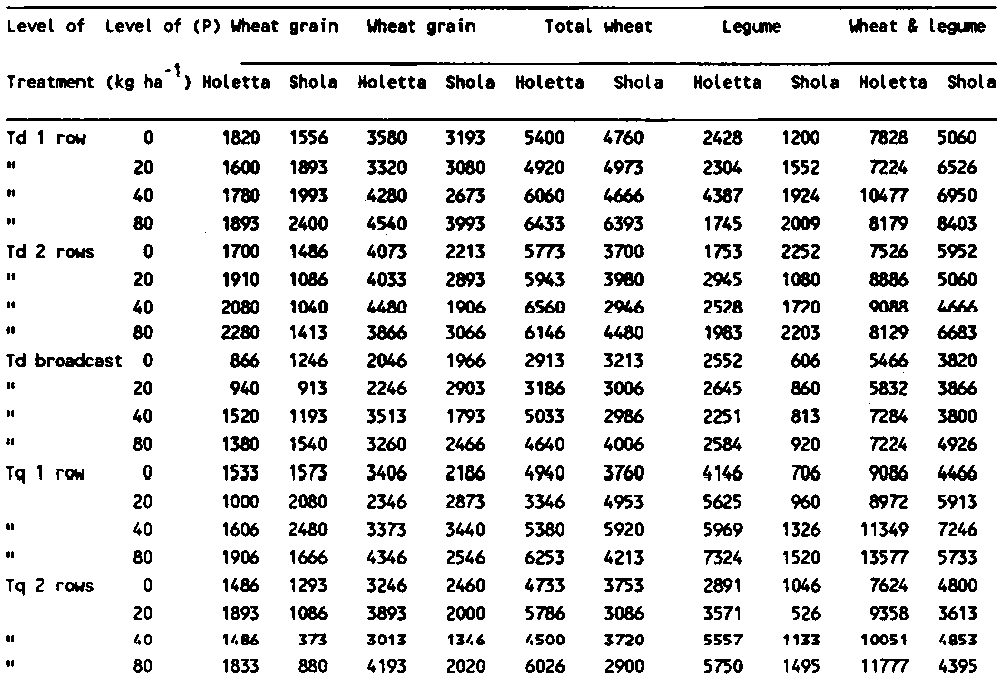
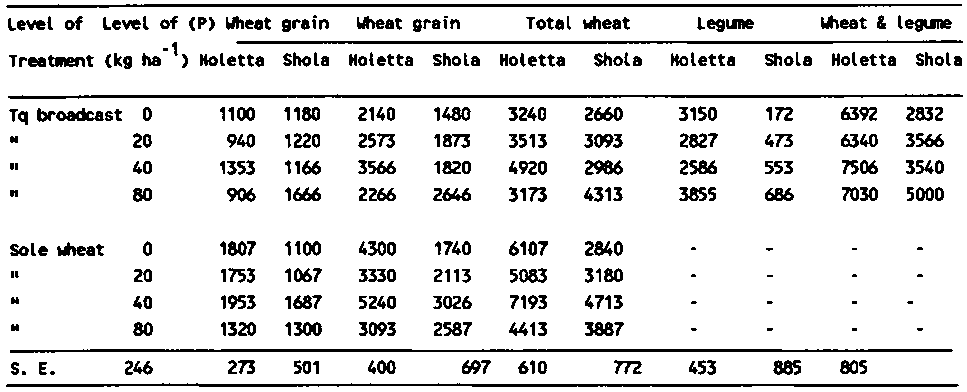
The data were subjected to analysis of variance and the results are given in Table 2. Data from the sole wheat with N fertilizer only were analysed separately (Table 4).
Grain yields varied from 906 kg/DM/ha in broadcast plots to 2280 kg/DM/ha in row plots at Holetta. There were no significant yield differences between single or double rows but there were significant differences between rows and broadcast plots (P<0.01). Broadcast plots gave lower yields. Straw yield varied from 2140 kg DM/ha to 5240 kg/DM/ha. Once again the broadcast plots gave lower yields. Average legume yields varied from 471 to 5766 kg DM/ha. Legume yields followed similar trends with T. quartinianum significantly out yielding T. decorum without much detrimental effect on wheat yield P<0.01). Fertilizer P had a linear effect on legume yield. There was no significant P effect on wheat yield which also had received 30 kg N/ha like all intercropped wheat. Fertilizer N did not significantly affect yield on sole wheat which did not significantly differ with that of intercropped wheat (P<0.05). In the intercropped plots total DM production significantly exceeded wheat alone (P<0.01).
The results at Shola followed a similar pattern with some exceptions. Wheat yields were slightly, though not significantly lower than at Holetta. However, the clover yields were very significantly lower (P<0.001). Also, single row plots significantly exceeded double row plots but still broadcast plots had the lowest yields (P<0.01). Fertilizer N had a significant effect on wheat yield (P<0.05). In all, the yields at Shola were lower than at Holetta.
Intercropped methodology
Effect of soil and climatic factors
Factors affecting adoption
The most significant outcome of this trial was the successful intercropping of the annual Ethiopia Trifolium spp. in wheat without any significant reduction in wheat yield. This confirms other research in the highlands in 1987 whereby Trifolium spp. were interplanted in wheat on Vertisol sites without reducing wheat yield (Tedla et al, 1988). The clovers can therefore be integrated into smallholder farming systems for producing high quality feed within the cropping enterprise.
The developed methodology consists of planting wheat at the normal seeding rate of 150 kg/ha and one and half times the normal seeding rate of clover or 15 kg ha in single alternate rows 20 cm apart. The usual P fertilizer rate of 40 kg/ha used for clover is suitable. However, since the clover yields obtained were about half those obtained when grown alone it is important to test production at 20 kg P/ha. A rate of 30 kg/ha seems to be suitable for wheat. The usual recommended fertilizer is 100 kg/DAP ha with 18 kg N/ha and 21 kg P/ha (Wolde Mariam, 1971).
The wheat and clover were planted at the same time and the clovers were planted at the same time as the wheat at Holetta and later at Shola. The ideal situation is for the clover to mature after wheat. It is therefore still necessary to look at different planting dates or relay intercropping of the clovers. Also several accessions of all the potential clover species need to be tested in order to select late flowering ones as only 2 species were used in this trial. Previous trials showed significant interspecific and intraspecific variations among the Ethiopian clovers (Akundabweni, 1984; Kahurananga and Tsehay, 1984).
There were significant differences in production between the two sites. One contributing factor was drainage. Holetta which was well drained had better wheat yields than Shola which was waterlogged. Wheat prefers reasonable drainage (Purseglove, 1972). Another factor affecting the trial was rainfall distribution during the growing season. There was heavy above average rainfall in May (206% at Shola) which necessitated the rather early planting in May. Wheat is usually planted in the Ethiopian highlands in June/July (Wesphal, 1975). Unfortunately the rainfall in June at Shola was only 51 mm which was 18% of the average for that month (Shoamare, 1988). This severely retarded the growth of clovers which were at the seedling stage although the wheat fared better. Similar observations were reported from Degollo, one of the vertisol project sites (Abate et al, 1988)Similarly the subsequent months had below average rainfall. This reflected the pattern in most of Ethiopia as there were insufficient rains in June and July in most places (National Meteorological Services Agency, 1987).
The rainfall distribution at Holetta was much better and both the wheat and clovers grew well. This means that intercropping is suitable in areas with long growing seasons. In the United States, intercropping of small grains including wheat and soybeans has been successful in areas which have sufficiently long and moist growing seasons (Kaplan and Brinkman, 1984).
The most important aim in crop production is crop yield. No smallholder would adopt a technology which reduces yield. Intercropping clovers in wheat did not reduce grain yield. There was the added bonus of high quality feed which could be harvested as hay or grazed with stubble. Another factor which affects adoption is labour requirements at harvesting. This favours late maturity species such as T. decorum which would mature after the wheat is harvested. The alternative is to use early flowering species such as I. steudneri for providing green-feed to livestock. Short maturing wheat varieties ready for harvest immediately after the end of the rains would also be at a later date after the wheat is established. There is therefore need for fine-tuning of the intercropping package for on-farm testing. A crucial prerequisite will be production of large amounts of seeds sufficient for such testing.
Td = Trifolium decorum; Tq = T. quartinianum; S.E. = Standard error.
Table 3: Levels of significance of treatment effects on DM yields of intercropped wheat and Trifolium spp. at Holetta and Shola, Ethiopia, 1987.
|
|
Wheat grain |
Wheat straw |
Total wheat |
Legume |
Wheat legume | |||||
|
Treatment |
Holetta |
Shola |
Holetta |
Shola |
Holetta |
Shola |
Holetta |
Shola |
Holetta |
Shola |
|
Planting method |
0.02765NS |
0.0236* |
0.2887NS |
0.049* |
0.2764NS |
0.0202* |
0.0019** |
0.700NS |
0.524NS |
0.0039** |
|
P linear |
0.0209* |
0.1359NS |
0.0088** |
0.0395* |
0.0073** |
0.0395* |
0.0213* |
0.0352* |
0.0001*** |
0.0072** |
|
Trifolium spp. |
0.3605NS |
0.953NS |
0.3605NS |
0.1880NS |
0.3694NS |
0.3456NS |
0.0004*** |
0.0496* |
0.1036NS |
0.0392* |
|
1 row vs 2 rows |
0.5245NS |
0.0020** |
0.7697NS |
0.0366* |
0.6709NS |
0.0050** |
0.859NS |
0.9160NS |
0.5751NS |
0.0122* |
|
1,2 rows vs broadcast |
0.350* |
0.0706NS |
0.0327* |
0.0156* |
0.0320* |
0.0152* |
0.0298* |
0.0130* |
0.0067** |
0.0010*** |
NS = not significant P<0.05
* Significant P<0.05.
** Highly significant P<0.01.
*** Very highly significant P<0.001.
Table 4: Effect of N on DM yields (kg/ha) of wheat at Holetta and Shola, Ethiopia, 1987.
|
|
kg N/ha | |||||||||
|
|
0 |
30 |
60 |
90 |
LSD (P<0.05) | |||||
|
|
Holetta |
Shola |
Holetta |
Shola |
Holetta |
Shola |
Holetta |
Shola |
Holetta |
Shola |
|
Wheat grain |
1300 |
1073 |
1693 |
1400 |
1567 |
1653 |
1327 |
1987 |
388 |
788 |
|
Wheat straw |
3667 |
1620 |
3686 |
2273 |
3873 |
2340 |
3673 |
3173 |
202 |
1256 |
|
Total |
4967 |
2693 |
5379 |
3673 |
5440 |
3993 |
5000 |
5160 |
503 |
2073 |
This research -as done with the assistance of Ato Abdulkadir Ahmed, Field Assistant and field workers Fikade Lake, Zeray Yithun, Gedey Bahare and Solomon Wechafo to whom I am most grateful. I am thankful to Mr. Robin Sayers, biometrician of the Computer Unit of ILCA for all the statistical analysis. Permission to publish and present this paper was kindly given by Dr. J. Walsh, ILCA's Director General and Dr. K. Peters, Deputy Director General Research.
Akundabweni, L. 1984. Forage potential of some annual native Trifolium species in the Ethiopian highlands. Ph.D. thesis, South Dakota State University, South Dakota, USA.
Gebre Hiwot, L., Tekle Tsadik, T., Hagos, G.M. and Mekonnen, T., 1987. FNE highland replicated grass/legume mixture trial results, Holetta. Forage Network in Ethiopia Newsletter No. 18:3-7.
Kahurananga, J. and Tsehay, A. 1984. Preliminary assessment of some annual Ethiopian Trifolium species for hay production. Tropical Grasslands. 18:215-217.
Kaplan, S.L. and Brinkman, M.A. 1984. Multiple cropping systems with oats and barley. Agronomy Journal. 76:851-854.
National Meteorological Services Agency. 1987. Agro-meteorological report, July 1987. Farming Weather Bulletin Monthly Publication No. 290/87. national Meteorological Services Agency, Addis Ababa, Ethiopia.
Purseglove, V.W. 1972. Tropical Crops. Monocotyledons. Longmans, London.
Shoamare, M. 1978. Climatic records for ILCA research sites 1987. ILCA, Addis Ababa.
Tedla, A., Jutzi, S., Kahurananga, J. and Tothill, J. 1988. Results of undersowing clovers mixture in bread wheat on improved vertisols in the Ethiopian highlands. ILCA, Addis Ababa.
Westphal, E. 1975. Agricultural systems in Ethiopia. Centre for Agricultural Publishing and Documentation, Wageningen.
Wolde-Mariam, K. 1971. Plant husbandry. CADU (Chilalo Agricultural Development Unit), Asella, Ethiopia.