F.P. Wadera1, D.M.G Njarui1, S. Tessema2, J.M. Kavoi1, M. Nderito1
1 National Dryland Farming Research Centre, Katumani, P. O. Box 340, Machakos, Kenya.
2 Formerly with Dryland Farming Research and Development Project, FAO, Katumani, Kenya.
Summary
Introduction
Pre-extension 'component' technology testing approach
Results
The 'whole-farm' package approach
Discussion and conclusion
Reference
A comparison of two techniques (approaches) adopted by National Dryland Farming Research Centre (Katumani) Kenya, is discussed.
The "pre-extension" trial which introduced components of livestock production system, attempted to alleviate feed shortages especially during the dry seasons by providing farmers with forage planting material and encouraging them to adjust their livestock numbers to available feed resources. However, this approach came up with discouraging results as these component technologies were poorly adopted (Ockwell et al, 1987).
The "whole-farm" approach which involved an introduction of a "package" of technologies for improvement of livestock production and which recognises the importance of systems concept to farming has given indicators of success in evaluating the suitability of developed technologies on farmers' fields.
Indications of replacement of lower yielding indigenous livestock breeds with higher yielding crossbreds is seen, higher milk production (about 2000 kg/fact) and higher growth rates (325 g/day for heifers) are realised on the farms.
Thus for successful testing and/or adoption of livestock pasture production research results by farmers' an understanding of the functions and functioning of the system is essential. Secondly, an appreciation of the need to introduce a package (feed, management, health care and possibly change of breeds), which will convincingly improve farmers return to labour and land could lead to higher rates of adoption of livestock/pasture developed technologies.
Developed technologies through agricultural research for better management of livestock and crop production, have not been easily accessible to the farmers, in the semiarid areas of Kenya. This has been due to poor linkage between researchers/extension services and farmers, an assumption by scientists that components within a farming system operate in isolation and are not interlinked, and that external factors to the farm unit e.g. communication, availability of credit facilities and marketing, among other factors, do not affect the farmers' ability to adopt technologies.
Thus in formulating research programmes no due consideration is normally given to these factors, with consequent results of limited adoption of the developed technologies.
The farming systems approach to research and development adopted by Katumani, first described the physical environment and farming systems of the semi-arid areas of eastern Kenya and identified constraints to the livestock production faced by the farmers, as follows:
1. The dryland areas cover an estimated 46 million hectares (80.8% of total land mass) ranging from agroecological zones 4 to 6. 16% of this is under what is termed as the semi-arid lands (zones 4 and 5).2. The semi-arid area is characterised by a bimodal pattern of rainfall with annual average of 500-800 mm, with two peaks in April and November. Two pronounced dry seasons are experienced (Jan. 15 to March 6 and again July l to Nov. 3) (Dennet et al, 1982).
3. A freehold land ownership system is prevalent with farmers owning between 1 and >20 hectares, with a mean of 7.5 ha out of which 2.5 is cropped and 5 ha left for livestock production (Tessema et al, 1985).
4. Farmers avert risks by practicing mixed cropping and livestock production.
5. Cattle, sheep and goats ore kept by almost all farmers and normally under stocking rates which many times exceed the carrying capacities of the farms (Tessema et al, 1985; Ockwell et al, 1987).
6. Periodic short-fall in feed availability during the dry seasons and droughts imposes severe nutritional stresses to the animals with resultant low productivity (i.e. meat, milk and draught power) and even pre-disposes the animals to a number of diseases that frequently lead to high rates of mortality.
7. Livestock culture rather than livestock economy forms the main reason for livestock keeping. However farmers are forced to sell some of their livestock only during food shortages and when cash is required e.g. school fees for their children.
8. Availability of credit to the small-scale farmers for livestock improvement programmes is inadequate or in most cases, non-existent. This is because of the lack of economic data on proven technologies to support loans for livestock enterprises (Tessema et al, 1985; Ockwell et al, 1987).
Having defined the farming system and the attendant problems and constraints, the second stage was designing the research programmes and experimentation. This generated a package of technologies that could possibly alleviate the identified constraints.
Tessema et al (1987) outlined the improved package as follows:
1. adjustment of livestock numbers to the available feed supply
2. improvement of natural grazing area by selective bush clearing, reseeding, burning, etc.,
3. improved use of crop residues,
4. conservation of excess forage for dry season feeding,
5. Maintenance of a systematic disease control schedule,
6. improvement of the stock through use of crossbred cows and/or dairy goats and
7. improvement of management - semi-zero-grazing, provision of stock shed, watering, manure collection etc.
In the third stage, testing of the developed technologies under on-farm situations is undertaken. Two approaches have been attempted. First a "pre-extension" trial in which component technologies were extended. Later a new approach was muted mainly due to experiences gained in the pre-extension trial. This approach introduced a "package" of technologies to the farmers, in full appreciation of the main factors that limit implementation of developed livestock technologies on farms.
The initial diagnostic survey (Rukandema et al, 1984) indicated that the rough unimproved natural pasture, supplemented with poor quality maize stover during the dry season, resulted in poor livestock responses (e.g. too weak oxen at the end of a dry season to plough effectively.
This prompted a feed resource improvement component to be formulated for testing on the farms. Together with this, a policy of destocking to adjust livestock numbers to available feed resources was encouraged for adoption by the participating farmers.
The two components were tested together with crop production technologies on 18 selected farmers throughout the mandate region.
The selection criteria (Bakhtri et al, 1984) were as follows;
1. The person selected should be a full-time average farmer2. He/she should have both crop and livestock
3. He/she should be willing to participate in the research activity, be able to accept and implement advice given, and be willing and able to collect simple data and share experience with other farmers.
4. His/her farm should be located near a road for easy access to enable frequent visits to be made by both research and extension workers.
Planting materials (root splits for Napier grass, Leucaena seedlings and seeds for Rhodes grass/Makueni guinea grass/stylo/siratro mixtures) were provided to the farmers and advice for planting given. Farmers were also encouraged to adjust their livestock numbers.
Although the farmers appreciated the problem of feed shortages, priority for labour use was given to cropping activities (planting and weeding) and it was only after weeding that the forage material was planted. This late planting generally resulted in poor establishments due to inadequate moisture and loss of viability of vegetative propagules.
Whenever there was successful establishment, farmers did not utilise the material to feed their indigenous animals and left the material to grow old. Traditionally farmers in this area did not plant forage for their indigenous stock and felt that the planted forage should be utilised by a more productive grade animal in order to realise profitable returns to labour and land used.
Farmers did not respond completely to advice to adjust their stock numbers. Thus in a nutshell, the pre-extension farmers did not adopt any of the introduced livestock improvement technologies.
This necessitated a serious assessment of the approach and a realisation that a new approach must be worked out: the whole farm as a production system.
Before formulating technological packages under this approach, an attempt was made to thoroughly understand the existing system. While more 'one-visit' data collection surveys were carried out (Kenya marginal/semi-arid lands pre-investment inventory 1982, Rukandema et al, 1984) a detailed case-study of the traditional livestock production system was undertaken (Tessema et al, 1985; and Ockwell et al, 1987).
From these studies farms could be classified in three different farm sizes (Table 1a): small, medium and large (average size of 3.3 ha, 7.6 ha and 12.8 ha respectively). Farm sizes do not conform to the agro-ecological zones and the cropped area is hardly more than 3.5 ha whatever the size of the farm.
Livestock numbers do not conform to the carrying capacity of the area (Table 1b) and there is more serious overstocking problem in the drier than in wetter areas (stocking rates being 2, 4. and 5.4 times the carrying capacity of UM4, LM4 and LM5 respectively). More goats are kept than sheep due to the preference for goat meat in the region. However the number of goats is more in drier areas and cattle in wetter areas (Table 1b).
Table 1a. Farms size characteristics in the areas in the Study area of eastern Kenya.
|
Farm Classification |
AEZ |
Farm size (ha) |
Crop area (ha) |
Grazing areas (ha) |
|
Large |
UM4 |
15.2 |
4.9 |
10.3 |
|
LM4 |
10.4 |
2.0 |
8.4 |
|
|
LM5 |
12.7 |
3.5 |
9.2 |
|
|
Medium |
UM4 |
8.8 |
3.7 |
5.7 |
|
LM4 |
5.0 |
1.5 |
3.5 |
|
|
LM5 |
9.0 |
3.0 |
6.0 |
|
|
Small |
UM4 |
3.2 |
1.9 |
1.3 |
|
LM4 |
2.3 |
1.5 |
0.8 |
|
|
LM5 |
4.5 |
1.7 |
2.8 |
Notes:
1. Agro-ecological zones are derived from Jaetzold and Schmidt (1983)
2. Farm sizes are compiled from Tessema et al (1985)
Table 1 (b). Livestock ownership in study area of eastern Kenya.
|
AEZ |
Cattle |
Sheep |
Goats |
LSU |
LSU/ha |
Tech. |
Cap./ha |
|
UM4 |
14.66 |
2.33 |
10.67 |
10.13 |
1.67 |
0.5 |
1.00 |
|
LM4 |
8.13 |
1.13 |
11.37 |
7.79 |
2.60 |
0.39 |
0.76 |
|
LM5 |
7.72 |
6.71 |
22.43 |
10.13 |
1.53 |
0.21 |
0.37 |
Notes:
1. Livestock numbers are derived from Ockwell et al (1987)
2. Technical carrying capacity is estimated from Jaetzold and Schmidt (1983)
Livestock production levels, Table 2, are relatively low mainly due to feed shortages and low genetic potential of the breeds kept.
Table 2. Production levels under unimproved system.
a) Milk yield
|
Mean daily yield (kg) |
1.55 |
|
Mean lactation length (days) |
286 |
|
Mean lactation yield (kg) |
443 |
b) Growth rates (g/day)
|
Cattle |
Goats |
Sheep | |||
|
Calves |
205 |
Kids |
44 |
Lambs |
29 |
|
Weaners |
212 |
Yearlings |
30 |
Yearlings |
18 |
|
Heifers/young | |||||
|
bulls |
64 |
Does |
17 |
Young rams |
24 |
|
Cows |
17 |
Breeding bucks |
6 |
Ewes |
4 |
|
Breeding bulls |
15 |
|
|
Breeding rams |
11 |
Source: Tessema et al (1985).
Although most improved technologies for livestock production are deemed labour intensive, Table 3 shows that there is likely to be adequate labour especially during lax cropping activity periods to carry out required livestock activities and in a sense provide more return to labour at that time.
Thus against this background, a new 'whole-farm' approach technique of testing livestock developed technologies was muted.
The design and the implementation of the on-farm research based on this approach, is clearly outlined by Tessema et al (1987). Farmers are selected on the basis of agro-ecological zones:
1. UM4 - 700-800 mm rainfall
2. LM4 - 600-700 mm rainfall
3. LM5 - 500-600 mm rainfall
and three farm sizes: 1) <5 ha, 2) 5-10 ha, 3) > 10 ha. Two farms from each farm size class in each agro-ecological zone are selected. Thus a total of 18 farms is formed. To assess the performance of the introduced technologies a second group of farmers (18) is selected where data is collected on the existing systems.
Table 3. Family labour supply and demand for livestock activities
|
Average labour |
Milking |
Health |
Feeding |
Herding add |
Boma |
Total livestock |
|
supply |
(min) |
care |
(Min) |
watering |
cleaning |
demand on |
|
*AAMME (hrs/day) |
|
(Min) |
|
(Min) |
(Min) |
labour (Hrs) |
|
62.87 |
41 |
14 |
75 |
770 |
5 |
15 hrs 5 min |
*AAME Average Adult Male Equivalent
Computer modelling and simulation are used to assess the potential applicability, input requirements, constraints and outputs.
Budgeting and sensitivity analysis techniques are used to determine optional farm plans. The farm plans developed are finally discussed with the farmers and modified to reflect their preferences and willingness to test the techniques.
The developed technologies are introduced step by step starting with feed resource base improvement (Table 4), then housing and introduction of the animals.
The introductions into the farms are under express management of the farmers. Therefore, to make the farmers feel responsible inputs are not provided free of charge but are to be repaid to the research station. However this is on condition that the innovation contributes substantially to the net income. Otherwise inputs are written off as research expenditure.
Two weekly data collections on livestock/pasture production parameters are done and analyses made by regression equations, variance analysis and cost benefit analyses to test the economic feasibility.
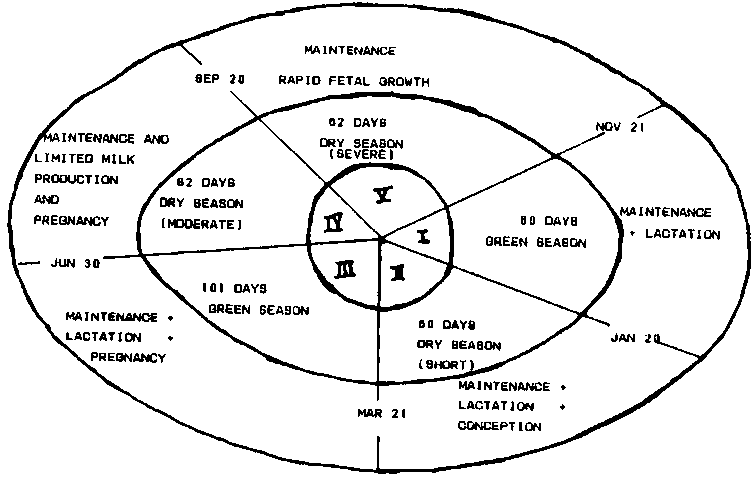
An integrated system of feeding, utilising the available feed resources is likely to ease the fluctuations of the feed availability and quality especially when conservation is incorporated into the production system. Figure 1 shows the distribution of dry and green seasons as far as feed availability is concerned and indicates the physiological status that a dairy cow could follow.
An integrated feeding regime thus should follow the physiological demand of the cow as follows:
Period I and III - growing season
graze natural pasture, give fodder grass ad lib and restricted fodder legume
Period II - Growing season/dry season (short)
Natural pasture grazing, restricted fodder crop residue and fodder legumes (higher intakes)
Period IV - Dry season (moderate)
Poor quality pasture grazing, crop residue (treated) plus fodder legumes, hay/silage feeding.
Although the outlined feeding regime has not yet fully been incorporated into the participating farmers, the response of what is already being practiced by the farmers is seen in the improved production of milk, from 448 kg/lactation to 1471 kg/lactation and improved growth rates of their stock (calves growing at a rate of 800 g/day, heifer at 325 g/day, cows at 120 g and steers and bulls at 146 g and 169 g respectively).
Table 4. Feed resources on selected farms.
|
|
DM yield |
Nutrient |
Composition |
In vitro | |||
|
Feed description |
in tons/ha |
Ash % |
CP % |
NDF % |
ADL % |
DM digestibility | |
|
Natural pasture |
2.15 |
8.32 |
7. 73 |
72.36 |
6.41 |
44.52 | |
|
Stover | |||||||
|
|
Maize |
2.54 |
11.92 |
2.59 |
69.55 |
9.32 |
41.83 |
|
|
Sorghum |
1.00 |
6.80 |
6.53 |
52.97 |
3.26 |
50.06 |
|
Fodders: | |||||||
|
|
Bana |
6.80 |
15.54 |
9.08 |
63.37 |
3.93 |
59.08 |
|
|
Bajra |
7.30 |
14.89 |
11.79 |
58.12 |
5.15 |
62.36 |
|
|
Panicum |
5.10 |
13.16 |
12.98 |
60.28 |
5.32 |
56.62 |
|
Pasture grasses: | |||||||
|
|
Rhodes |
3.00 |
9.95 |
11.15 |
73.88 |
6.28 |
54.76 |
|
|
Guinea grass |
4.00 |
12.12 |
10.41 |
66.32 |
5.88 |
50.88 |
|
|
Cenchrus |
2.60 |
7.73 |
8.21 |
71.10 |
4.94 |
50.22 |
|
Legumes: | |||||||
|
|
Leucaena |
4.00 |
7.93 |
27.28 |
38.13 |
9.80 |
64.78 |
|
|
Pigeon peas |
- |
6.81 |
13.90 |
59.88 |
14.83 |
55.16 |
|
|
Dolichos |
- |
6.87 |
15.54 |
43.90 |
6.46 |
63.17 |
Notes:
(1) Natural pasture figures are averages from 20-210 days old herbage while planted pasture figures are average from 20-80 days old.(2) Maize and sorghum stover yields based on 1/3 of recommended populations commonly found in the area.
Source: Ministry of Livestock Development, 1983 annual report.
Other indicators of success of this package approach are:
1. Improved grade animals are now replacing the local breeds. One farmer out of six on whose farms innovations have been implemented has already replaced all of his indigenous livestock with grade ones.2. Farmers have expressed the intention of payment for their livestock rather than return the initial cow to the centre.
3. Although initially the centre was providing for drugs and accaricides, now the farmers are buying these with money from the sale of milk.
4. Fodders introduced are well cared for.
5. Manure is regularly collected and applied to cropped area, other farmers have been extending manure application to fodders.
Thus although the study is not yet complete, indications are that this approach has been more acceptable to the farmers than the former 'component' approach. The main incentive here is the realisation of improved livestock production especially milk production, without which other components of the package might not have been adopted.
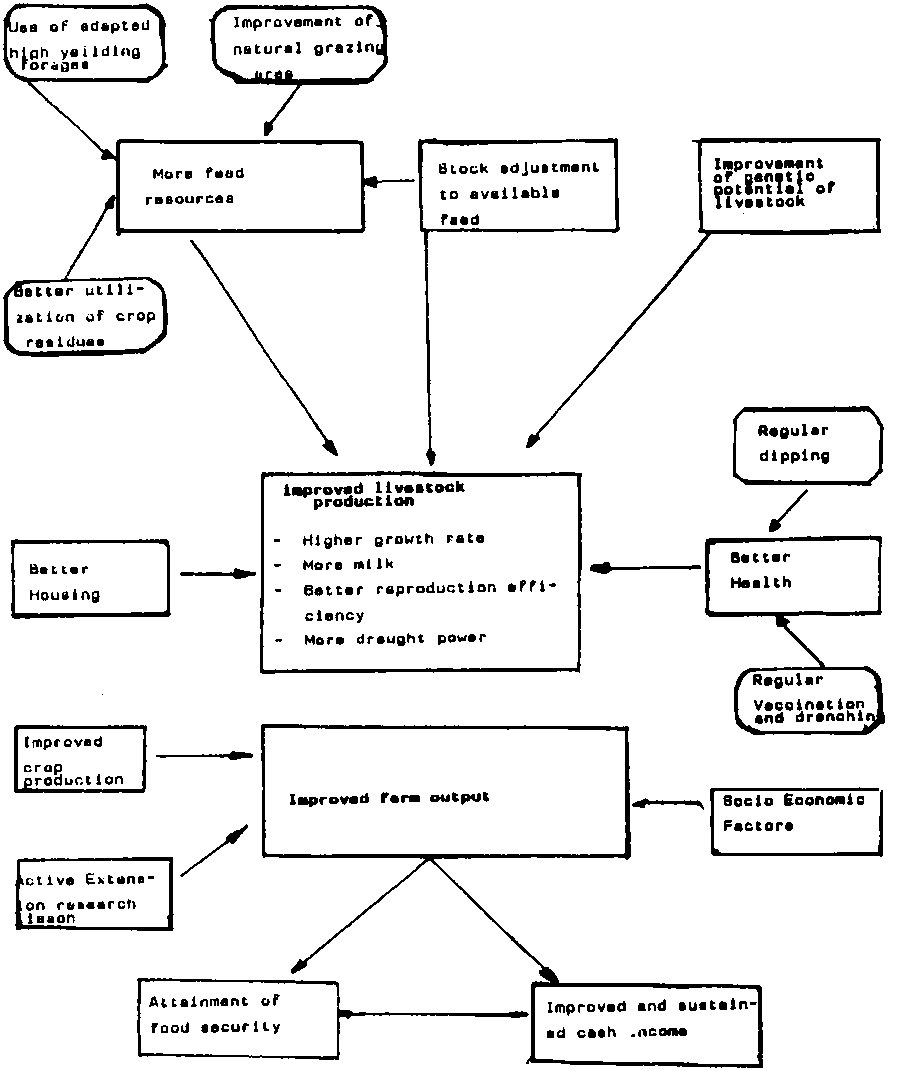
The system concept as applied to the mixed farming situation in the dryland can be diagramatically represented as in Figure 2.
The major sub-systems are represented, the crops and the livestock subsectors. Within the livestock sub-system, about four major components are conceptualised; feed resources, health, animal and housing.
All the four components work towards achieving the same goal (output) which in this case is improved growth rates, more milk, more draught power and better reproductive efficiency. However under the concept of systems approach, change in any of these components is seen as an improvement only when the whose system is improved.
Thus before any technology is tested or extended at farm level, it is important to thoroughly define the system into which the technology will be injected, stating clearly the component(s) that is/are targeted for improvement.
The second important factor is to understand the managerial skills and factors that affect the decision-making process of farmers and their aspirations.
Pre-extension component approach was not successful because of inadequate understanding of the farmer's utilisation of his resource base (Ockwell et al, 1987). A detailed case-study approach was found to be more effective in gathering the information that led to a better understanding of factors that interplay in a livestock production sub-system (Tessema et al, 1985).
From this study it was envisaged that livestock and pasture production technologies required a system approach even much more than the crops since forages alone are not outputs on the farm and animals require a feed base establishment among other factors. Thus a 'whole-farm' approach package was adopted as a testing tool.
It was also envisaged that packages should be tailored to ecology and farm size: Dairy goats in drier ecologies and on small farms and dairy cows in wetter areas and on large farms.
When testing and/or extending a feed resource component, its success on farm will be seen through increased levels of animal products. However this increased productivity might only be realised when animals that can respond to improved feeding and management are used. At certain times this might lead to scientists going out of their way to provide for other components of the system (e.g. introduction of dairy cow, housing and better health care facilities) in order to test the viability of the technology(ies).
Audi, P.O. 1985. Training and visits (T & V) and development of small-scale subsistent agriculture in the semi-arid areas of Kenya - A Katumani experience. In: W. Mututa and G.E. Okwach (eds), proceedings of agricultural research and extension for the drylands of Kenya workshop. Embu, Kenya pp. 12-20.
Bakhtri, M.N., Gavotti, S., and Kimemia, J.K. 1984. On-farm research at Katumani: The pre-extension trials experience (with special reference to semi-arid areas of Eastern Province of Kenya) E. Agric. and For. J. Special vol. issue No. 44:437-443.
Dennet, D.M., Rogers, J.A. and Stern, R.D. 1982. Rainfall at Kampi ya Mawe and Katumani in 1982. Tropical Agricultural Meteorology Group, Departments of Agricultural Botany and Applied Statistics, University of Reading, Reading, U.K.
Jaetzold, R. and Schmidt, M. 1983. Natural conditions and farming management information. Farm management handbook of Kenya. Vol. II. Part C East Kenya. Ministry of Agriculture, Kenya-German Agency for Technical Cooperation Rossdorf, West Germany.
Kusewa, P.K. (1985). Pasture and Fodder Crops for Dryland Areas. In: W. Mututa, and G.E. Okwach. (eds). Proceedings of a workshop on agricultural research and extension for Drylands of Kenya, held at Embu, Kenya, 2nd-6th, December, 1985. pp. 180-189. Ministry of Livestock Development, Kenya.
Mohammed, L. and Jeza, A. 1985. Some characteristics of farmers and the farming environment in the semi-arid regions of Machakos, Kitui, Embu and Meru districts of Kenya. In: W. Mututa and G.E. Okwach (eds): proceedings of agricultural research and extension for the drylands of Kenya. Workshop, Embu, Kenya. pp. 26-28.
Ockwell, A.P., Mohammed, l. and Ngulu, S. 1987. Farming systems of the semi-arid tropics of Eastern Kenya: A case study of 18 farms: In improvement of dryland crop and forage production in African semi-arid tropics ACIAR/CSIRO Project No. 8326. Machakos. Annual report 1986-87.
Rukandema, M. 1984. Farming Systems of semi-arid Kenya, a comparison. E. Afr. Agric. and For J. Special issue Vol. No. 44.
Tessema, S. 1988. Improving ruminant livestock production on small farm systems under semi-arid farming conditions of Eastern Kenya (end of assignment report) UNDP/FAO - Dryland Farming research and Development Project KEN/74/017, KEN/81/011 and KEN/86/028, Machakos, Kenya.
Tessema, S., Emojong, E.E., Maluti, M. 1988. Strategy of livestock research adopted to semi-arid small-scale mixed farming system. The Katumani experience. In: B.H. Dzowela (ed), African forage plant genetic resources. evaluation of forage germplasm and extensive livestock production systems. Tanzania, 27-30 April, 1987. ILCA, Addis Ababa, Ethiopia. pp. 388-401.
Tessema, S., Emojong, E.E., Wandera, F.P. and Nderito, M. 1985. Features of traditional farming systems. A case of study of 18 small-scale farms in the dryland areas of the Eastern Province of Kenya. Dryland Farming Research and Development Project KEN/81/011, Machakos, Kenya. Document No. 6.