1. Background
2. Livestock numbers and distribution
3. Cattle
4. Sheep and goats
5. Research and development activities
6. Selected bibliography
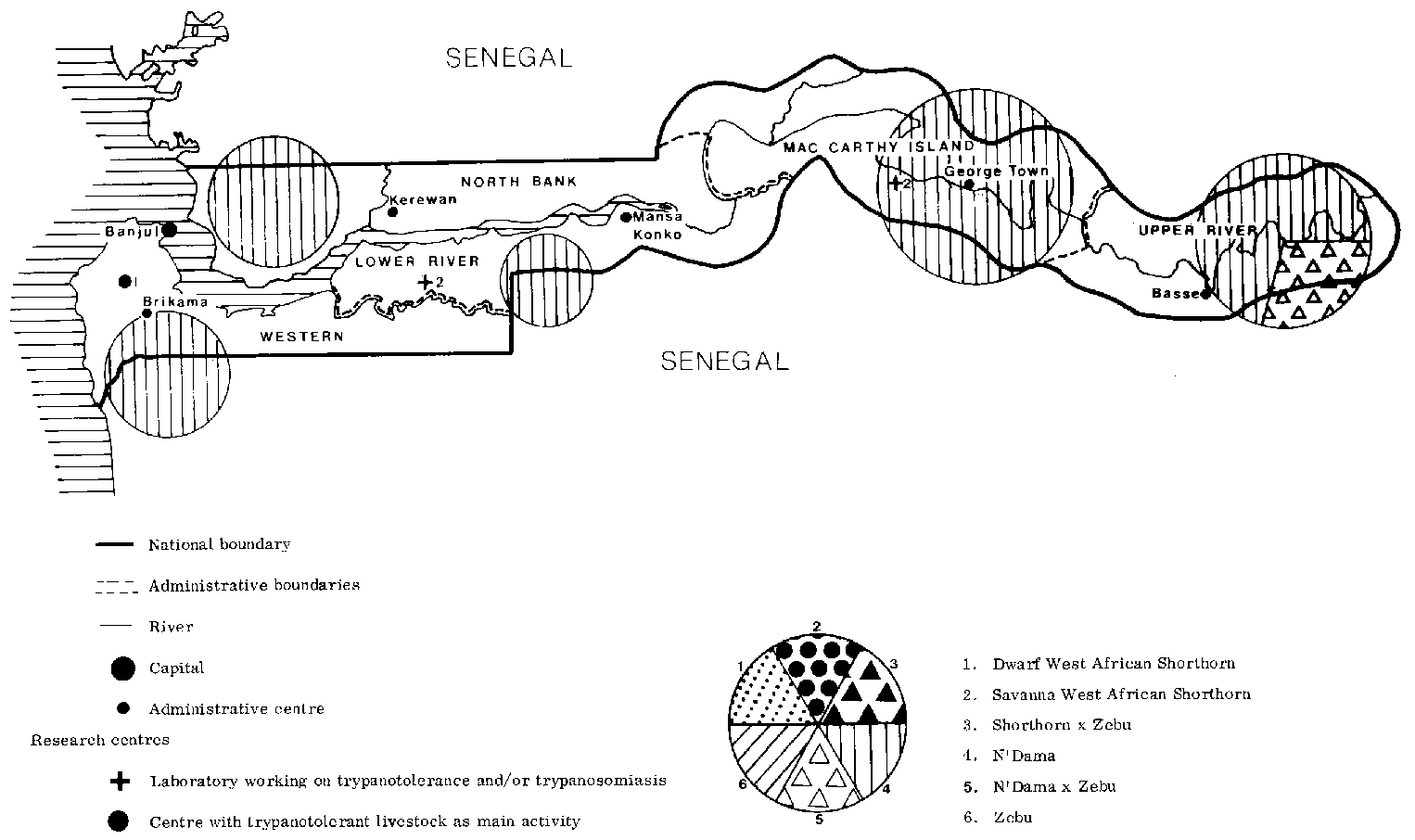
The Republic of The Gambia is a narrow strip of land in West Africa on either side of the River Gambia surrounded on three sides by Senegal. The country, with its capital at Banjul, is divided into five divisions - Western, Lower River, McCarthy Island, Upper River and North Bank (see Figure 1).
The Ministry of Agriculture and Natural Resources is made up of five departments, including the Animal Health and Production Department (AHPD) composed of four sections - the Directorate, the Animal Health Division, the Animal Husbandry and Production Division and the Animal Industries Division. The AHPD maintains five livestock field stations and 26 satellite substations distributed throughout the five administrative divisions.
In order to increase the effectiveness of government field work in the livestock sector and to give local stock raisers a greater sense of participation in planning and decision-making, the AHPD has recently begun organizing Livestock Owner's Associations around the country. The basic objective of these associations is to facilitate the communication of information and advice from government agencies to the stock raisers and to allow them in turn to feed back information to the AHPD on specific local problems and their aspirations for future development.
Basic data for the country are given in Table 1. The Gambia has a Sudano-Guinean climate with one rainy season from June to October. Annual rainfall averages 1 000 to 1 200 mm. According to the OAU/STRC tsetse distribution map (1977), G. palpalis is found throughout the country and G. morsitans everywhere except the extreme western region near Banjul. There are also a few areas in Senegal and The Gambia where G. longipalpis is indicated on the map, but Touré (1971) claims that this species is no longer present.
Snow produced maps in 1972 of the distribution of G. morsitans submorsitans and G. palpalis gambiensis. He concluded that G. morsitans was present throughout the country except in Western Division and in a small area of the town of Basse, and that G. palpalis could be found near the coast and over a few kilometres on either side of the river. In general, the tsetse challenge decreases from west to east.
Table 1. Background data for The Gambia.
|
Area |
11 300 km² |
|
|
Latitude |
13°-14° N |
|
|
Longitude |
14°-17° W |
|
|
Population |
||
|
|
number |
540 000 |
|
|
density |
47.8/km² |
|
Livestock numbers |
||
|
|
cattle |
296 000 |
|
|
sheep |
113 000 |
|
|
goats |
187 000 |
Sources: For population, OAU, 1978; for livestock numbers, national census, 1978.
A national livestock census was carried out in 1978 during a contagious bovine pleuropneumonia (CBPP) vaccination campaign. Table 2 shows the cattle population by geographic division and cattle numbers per square kilometre and per inhabitant.
Table 2. Cattle numbers and distribution in The Gambia, 1978.
|
Administrative Division |
Cattle Population |
Cattle per km² |
Cattle per Inhabitant |
|
Western |
42 221 |
22.9 |
0.24 |
|
Lower River |
24 444 |
16.1 |
0.59 |
|
McCarthy |
101 010 |
35.6 |
0.99 |
|
Upper River |
81 517 |
40.7 |
0.93 |
|
North Bank |
45 732 |
20.9 |
0.48 |
|
Total |
295 924 |
26.2 |
0.59 |
Source: National census, 1978.
This table reveals that The Gambia has one of the densest stocking rates in Africa Cattle numbers seem fairly stabile - the stocking rate was 25.5/km² in 1973, 27/km² in 1975 and 26.2/km² in 1978.
No precise census of sheep and goats has been carried out. FAO (1978a) estimated a population of 95 000 sheep and 92 000 goats in 1977, but the government reports approximately 113 000 sheep and 187 000 goats, giving a ratio of about 3 to 5.
Almost the whole cattle population of The Gambia is of the N'Dama type. Some Zebu and crossbreds (Gobra Zebu x N'Dama) are found in the eastern part of the country, but no exact report of their numbers is available. They probably account for less than 10% of the national herd. The crossbreds look exactly like the Djakore of Senegal (see chapter 4, volume 1). There is no information on their productivity.
3.1 N'Dama BREED DESCRIPTION
The Gambian N'Dama (see Figures 3.7 and 3.12, volume 1) is slightly taller than the typical Guinean type. Its coat is generally lighter, with white and grey fairly common.
Some production data under village conditions have been obtained, mainly from surveys undertaken by Clifford (1977), while figures on the productivity of the breed under improved management are available from the Yundum Experimental Station.
3.1.1 Performance Traits
Dunsmore et al. (1975) give countrywide data on N'Dama reproductive performance. They found an age at first calving between 34 and 40 months and a calving interval of 29 months, giving a calving percentage of 41%. Clifford (1977) has recorded calving rates of 35% in 1974-75 and 42% in 1975-76 in a high tsetse challenge area, compared with 50 and 60% for the same two years in a low challenge area. At Yundum Experimental Station, under no tsetse challenge or a very slight challenge, the age at first calving ranges from 28 to 40 months, with an average of 35 months, and the calving interval averages 13 months.
Under traditional management, the mortality rate for calves to one year is about 30%, from one to two years about 12% and for adults about 3% (IBRD, 1976). Clifford (1977) indicates that total annual mortality in a high tsetse challenge area averages 20%, compared with 10% in a low challenge area. Corresponding calf mortality figures are 35 to 45% under high challenge and 5 to 10% under low challenge.
During a field survey body weights were determined under traditional management conditions. 2 302 animals were weighed using a weighband (Clifford, 1977). The following results were obtained:
|
Age in years |
0-1 |
1-2 |
2-3 |
3-4 |
4-5 |
5-over |
|
Female |
40.4 |
98 |
141 |
187 |
200 |
221 |
|
Male |
46.3 |
101 |
153 |
188 |
244 |
310 |
|
Castrate |
|
154 |
182 |
191 |
283 |
310 |
In the same study, Clifford observes that one- and two-year-old animals weight on average about 10 kg less under high challenge than under low challenge. He records average adult female weights of 237 kg under low challenge and 222 kg under high challenge.
In development project plans, average adult liveweights under traditional management are estimated at 295 kg for bulls, 227 kg for cows, 340 kg for oxen, 113 kg for one-year-old steers, 181 kg for two- to three-year-old steers, 227 kg for three- to four-year-old steers and 259 kg for four- to five-year-old steers.
Body weights obtained under improved management conditions from a random sample at Yundum Experimental Station in 1976 were as follows (kg):
|
Age in Months |
Birth |
6 |
12 |
18 |
24 |
|
Females (n:30) |
20.4 |
97.5 |
130 |
172 |
190 |
|
Males (n:30) |
20.4 |
92.4 |
140 |
181 |
206 |
During a draught power trial, a pair of oxen ploughing paddy fields achieved a rate of 0.03 to 0.04 ha/hour (a person can plough by hand at a rate of 0.002 to 0.005 ha/hour). The oxen harrowed the same fields at a rate of 0.065 to 0.099 ha/hour and levelled at a rate of 0.052 to 0.100 ha/hour.
3.1.2 Index of Productivity
Table 3 summarizes the estimates of major production traits required to build up a productivity index based on the total weight of one-year-old calf plus the liveweight equivalent of milk produced per 100 kg of cow maintained per year. This productivity index has been derived for three basic production environments, meat and milk production under village conditions in a high tsetse challenge area and in a low challenge area and meat production only under improved ranching conditions with no or very light tsetse challenge.
3.2 DISEASES
Annual vaccination campaigns are carried out against rinderpest and CBPP. The other chief infectious diseases are anthrax, blackquarter and haemorrhagic septicaemia. An important activity of veterinary posts is spraying for lice, ticks and mangemites with portable hand-pump sprayers. The major disease problem of N'Dama cattle in The Gambia is anaemia caused by trypanosomes (McIntyre et al., 1975). The most common trypanosome found in N'Dama cattle is T. congolense, rather than T. vivax, but it appears that T. brucei is more common than was suspected. This trypanosome was found in approximately 50% of the cases diagnosed as positive on microscopic examination for other trypanosomes (McIntyre et al., 1975).
Table 3. N'Dama productivity estimates.
|
Parameter
|
Production Environment |
||
|
Village/high tsetse challenge/meat and milk |
Village/low tsetse challenge/meat and milk |
Station/low tsetse challenge/meat |
|
|
Cow viability (%) |
96.0 |
98.0 |
98.0b |
|
Calving percentage |
38.5 |
55.0 |
92.4 |
|
Calf viability to one year (%) |
60.0 |
92.0 |
92.5b |
|
Calf weight at one year (kg) |
95.0 |
105.0 |
135.0 |
|
Annual milked out yield (kg) |
69.3b |
98.9b |
- |
|
Productivity indexa per cow per year (kg) |
30.1 |
64.9 |
116.6 |
|
Cow weight (kg) |
222 |
237 |
255 |
|
Productivity indexa per 100 kg cow maintained per year (kg) |
13.6 |
27.4 |
45.7 |
a. Total weight of one-year-old calf plus liveweight equivalent of milk produced
b. Estimate.
Source: Clifford, 1977 and country visits.
An experiment comparing the responses of Zebu and N'Dama cattle exposed to an artificial challenge (inoculation with T. brucei at three levels) was carried out by Murray et al. (1977). Cattle were maintained under village husbandry conditions, tethered at night and grazing during the day. No supplementary feed was given and they were investigated carefully prior to inoculation for evidence of pre-existing disease. In all, 120 cattle were involved, with 48 slaughtered in the course of the experiment for sequential pathological studies. Of the remaining 72, 29 of the 39 Zebu died from the infection, but none of the N'Dama died.
3.3 HERD MANAGEMENT AND COMPOSITION
A description of cattle herd ownership and management patterns in The Gambia will be quoted here from USAID (1977):
With regard to cattle in The Gambia, there are two basic systems of herd management. In one, the ownership and herd management functions are combined in the same person or group of persons. In the other, the ownership of the cattle is in the hands of a single person or group of people who do not have any direct, daily managerial supervision over them. Herd management is the responsibility of one or more herders, usually Fula [Fulani] men who are paid by the owners.In general terms, one is likely to find that ownership and direct management of a herd are correlated with ethnic group and herd size. The Fula who are concentrated geographically in the eastern half of the country, are primarily herders by preference and training. They tend to have managerial control of the majority of the cattle in the country either through direct management of their own cattle or hired herding of cattle belonging to other ethnic groups. Chief among these other ethnic groups are the Mandinka, the Wolof and the Serahuli. These groups are primarily sedentary agriculturalists concerned with cash and food crop production or, as in the case of the Serahuli, heavily engaged in commercial activities. While they own cattle for a variety of reasons, they are not generally noted for their stock-handling abilities or knowledge and thus generally depend on hired herders for stock maintenance.
Slightly more than half of the herds in The Gambia, which commonly number from 50 to 150 animals, are owned by a principal owner and several other unrelated individuals. The former will often own more than half of the animals in the composite herd. A quarter of the herds are owned either by a single person or jointly by a single family unit, usually Fula. Slightly less than a quarter of all herds are owned by several unrelated owners with each having approximately the same number of animals. Owners of fewer than 30 animals are said to have a great inducement to join with others in forming these composite herds since they find it individually infeasible to support a hired herder from the produce of their own animals. In the absence of such arrangements, these smaller herds are likely to be owner-managed.
The interest taken by cattle owners in their stock varies from an almost total preoccupation in the case of the owner/manager [see Figure 3.10, volume 1]; to daily owner inspection when the herder brings the herd conveniently close to the village; to weekly, monthly or even yearly visits when the owner and herder are not in close proximity to each other. In some extreme cases owners may never see their animals but depend wholly on reports from the herder as to their location and state of wellbeing. It seems presently the custom in non-owner-managed herds that the hired herder has the primary responsibility for daily management decisions regarding herd welfare with the owner intervening only on major items like cattle sales and/or decisions about purchases of production inputs and services.
When hired herdsman are employed, they always receive part of their remuneration in kind - namely milk - but many also receive accommodation and food. An increasing number are paid an agreed sum of between US$0.60 and $0.90 per animal per year.
The same report (USAID, 1977) gives a description of typical cattle husbandry practices under village conditions:
The calves do not graze with the main herd but are kept tethered in the mornings until the herd is out of sight - and then released. They remain in the proximity of the tethering site with little or no supervision or care. Little or no water, mineral salt, and/or supplementary feeds are supplied to the calves on a routine basis. Apparently some substantial number of calves also suffer from a local belief that mutilation by slashing on the flanks is beneficial for unthrifty animals. Immature and adult animals are often tethered without feed, water or other supplements for upwards of fifteen hours of each day [see Figure 3.5, volume 1]. This practice is said to reduce productivity by denying the individual animal sufficient time for grazing during the best times of the day - early morning and late evening - and to reduce reproductive efficiency by limiting sire access to cows in season to short periods during daylight hours when the herd is released.During the rainy season according to Dunsmore et al. (1976) there is an abundance of natural forage. However, herdsmen often complain that not only is dryland farming increasingly encroaching on their traditional grazing areas but that cropped fields frequently are so close together as to prevent access to what good grazing exists. Disputes and litigation over damage to growing crops are said to be increasingly frequent. During the dry season, the cattle and other livestock maintain themselves on the standing straws, crop residues, floodplain and swamp grazing, and woody browse...
The net result of the variable and inadequate feed supply in The Gambia is that animals grow at a very slow rate by modern standards and probably never reach their full genetic potential. Periods of satisfactory growth during the rainy season each year are followed by several months of inadequate nutrition when the animals, at best, maintain previous weight gains and generally lose weight.
Turning to management of breeding herds, there seems to be considerable variation in calving seasons in different parts of The Gambia. 'In some districts, the calf drop occurs during the early months of the dry season (November - December); whereas in other districts calving occurs during the rainy season. Both periods would seem to have distinct disadvantages from the point of view of calf survival and growth' (USAID, 1977). Blair Rains (1975) emphasizes another important problem affecting both the development of calves and the reproductive efficiency of the dams the extended suckling period allowed by the herders: 'The objective seems to be to keep the dam in lactation for as long as possible to sustain milk supply for the herder and his family [see Figure 3.14, volume 1]. Few calves are weaned earlier than 12 months of age and many are still suckling at 18 to 24 months, when the calf is often nearly as big as its mother.'
The management of draught oxen differs in some respects from that of the rest of the herd. Peasant farmers are increasingly renting draught oxen for land preparation at the beginning of the planting season, and during the dry season cattle herds composed of as many as 40% oxen can be observed. Ox ploughing costs about D 5.7 (US $ 3.60) per acre (0.4 ha), with one pair of oxen generally ploughing about 4 acres (1.6 ha) a day. The period of field preparation is very short - about three weeks - and the oxen must he in good condition at this time. Although they are herded with the other animals at the beginning of the dry season, but with bells attached to their necks, as the critical ploughing season approaches they are given some supplementary feed and are even sometimes kept in the owner's compound to be in peak condition at the beginning of the rains.
There have been a number of estimates of herd composition in The Gambia. The most recent work based on actual field samples is that of Clifford (1975), showing marked differences in herd structures in different parts of the country. These findings are shown in Table 4. The principal differences are higher retention of females in some herds, a higher percentage of castrates in others, and some evidence of different mortality rates, particularly among calves and yearlings.
Table 4. Herd composition in two areas of The Gambia, 1974 (%).
|
Age in Years
|
Sapu Area (n: 2032) |
Keneba Area (n: 276) |
||||
|
Females |
Males |
Castrates |
Females |
Males |
Castrates |
|
|
0-1 |
8.7 |
7.8 |
0 |
2.5 |
5.1 |
0 |
|
1-2 |
10.0 |
8.5 |
0 |
7.2 |
8.3 |
0 |
|
2-3 |
4.5 |
4.3 |
0 |
5.1 |
4.7 |
0 |
|
3-4 |
4.8 |
3.0 |
1.3 |
3.6 |
4.4 |
0.7 |
|
4-5 |
12.1 |
2.7 |
2.5 |
7.2 |
4.0 |
3.3 |
|
5-10 |
17.4 |
0.8 |
2.2 |
18.5 |
2.9 |
13.0 |
|
over 10 |
9.1 |
0.0 |
0 |
8.7 |
0.0 |
0.7 |
|
Total |
66.6 |
27.1 |
6.3 |
52.9 |
29.4 |
17.7 |
Source: Clifford, 1975.
At the division level, estimates of herd structure are all very similar, except for Upper River Division. The typical herd structure is 70% females, 25% males and 5% castrates, except in Upper River where herds are typically composed of 63% females, 25% males and 12% castrates (drawn from Dunsmore et al., 1975).
4.1 BREED DESCRIPTION
The typical West African Dwarf sheep and goats are found in The Gambia (see Figure 3.71, volume 1). Coat colours vary from white to tan to black in various combinations - quite often the animals are black in front and white in back.
Macadam (1974) inspected many flocks in the western part of Western Division in 1973, weighing and examining sheep. Mortality rates appeared to be high, with lamb mortality possibly at about 50%. The body weights he recorded are presented in Table 5. Clifford (personal communication) found low prolificacy among sheep in The Gambia, with twinning particularly rare in areas under medium to high tsetse challenge.
Table 5. Body weights of sheep in Western Division (kg).
|
Number of Permanent Teeth
|
Adult Females |
Adult Rams |
Adult Castrates |
||||||
|
n |
Mean |
Range |
n |
Mean |
Range |
n |
Mean |
Range |
|
|
2 |
48 |
21.3 |
11.8-33.1 |
31 |
24.5 |
16.8-41.7 |
17 |
25.9 |
17.7-36.7 |
|
4 |
45 |
25.9 |
17.2-32.7 |
9 |
30.8 |
25.4-46.5 |
16 |
30.8 |
24.5-41.7 |
|
6 |
54 |
24.5 |
15.4-33.1 |
2 |
34.5 |
34.4-44.0 |
14 |
31.8 |
23.1-43.5 |
|
8 |
92 |
26.8 |
15.4-44.5 |
1 |
|
40.8 |
13 |
37.6 |
29.0-19.9 |
|
Total |
244 |
24.9 |
11.8-44.5 |
43 |
27.2 |
16.8-46.5 |
60 |
31.3 |
17.7-49.9 |
Source: Macadam, 1974.
4.2 DISEASES
A report published by the Animal Husbandry and Production Division in July 1976 identifies the major disease problems of sheep and goats in The Gambia as peste des petits ruminants (PPR) originating in Senegal, which causes heavy losses among both species, sheep pox (Dermatophilus) and heartwater. Streptothricosis is widespread only among sheep (Bremaud et al., 1976). Internal parasites are present which do not cause mortality by themselves, but lower the resistance of animals to other diseases. Clifford (personal communication) has never identified any trypanosome in the blood smears of sheep or goats, even after inoculation. However, anaemic sheep and goats are found in the field
4.3 FLOCK MANAGEMENT
The 1976 report of the Animal Husbandry and Production Division indicates that sheep are generally herded with cattle in The Gambia, especially during the rainy season. One family typically owns three to six sheep, which are taken out by the children to graze during the day, possibly tethered in the fields, and collected in the evening. Macadam (1974) reports that sheep are usually crowded into small pens at night near the farmer's house, occasionally floored with cut palm beams. According to the Animal Husbandry and Production Division report, families from one village sometimes combine their animals into a large flock which is usually tended by a young boy or a shepherd hired from outside the village In such a situation, the village goats are usually herded with the sheep and the flock is brought back to the village in the evening.
During the rains, sheep are tethered in a fallow area or herded on the fallow or on uncleared land. Once the crops are harvested, the flocks move freely in the stubble during the day and return to the village or family compound at night. As the dry season advances, sheep tend to move closer to the village areas where they are fed household waste.
Goats appear to receive less attention than sheep. Even when sheep and goats are herded together, the goats usually separate to graze and browse. It is felt that goats are more prolific than sheep, but that their numbers are kept down because they are more often slaughtered for meat.
There are some differences among tribes in the preference for mutton or goat meat. It is generally believed that the Mandinka traditionally prefer goat meat, while the Wollof prefer mutton because they believe it is unhealthy to eat goat meat, but this difference is not absolute.
People in The Gambia generally give four reasons for keeping sheep and goats: for the tabaski (Moslem feast) celebrations; as a means of saving, possibly to buy cattle (six to ten chickens have the same value as one sheep or goat, and four to eight sheep or goats have the same value as one bovine); to slaughter for guests; and to comply with the custom of keeping a 'charity sheep'. This is a white castrated male, kept in the compound and given special food until about four years old and then slaughtered for tabaski, but only if a replacement is available.
Sheep and goats are sometimes milked to pay the shepherd or for home consumption. Goat's milk is believed to have special medicinal properties or it may be consumed simply because no cow's milk is available. Small ruminants may also be milked by the owner's children who consume the milk on the spot. This milk is never sold.
5.1 RESEARCH CENTRES
Three research programmes underway in The Gambia are concerned with N'Dama cattle. These are described in Table 6.
5.2 MULTIPLICATION HERDS
An N'Dama Multiplication and Improvement Project has been submitted for financing. The planned annual output would be about 800 young heifers for export, a number of selected young bulls for distribution to village herds and for export, and young oxen to be trained under the Oxen Training Scheme.
Table 6. Research centres and programmes in The Gambia.
|
Name |
Yundum Experimental Station |
Trypanosomiasis Research in The Gambia |
Milk Recording Schemes |
|
Location (and reference in Figure 1) |
Yundum, 25 km from Banjul |
Two areas: Keneba in the west of Lower River Division, 160 km west of Manga Kanko with a high tsetse challenge and Sapu in McCarthy Island Division, 70 km west of Georgetown, under light tsetse challenge. + 2 |
13 areas in different divisions |
|
Organization responsible |
Animal Health and Production Department (AHPD), Banjul |
AHPD |
AHPD with the participation of the Livestock Owners' Associations |
|
Size |
200 ha |
|
|
|
Breeds and numbers |
210 N'Dama (85 breeding females) |
N'Dama and some Zebu |
N'Dama lactating cows (10 cows eartagged randomly in each of the 13 areas) |
|
Objectives and Activities |
Improvement of the N'Dama breed. Castration trials and study of the effect of dicalcium phosphate. Identification, breeding performance since 1965 and weights at monthly intervals since 1968. |
Comparison of artificial trypanosome infection in N'Dama and Zebu cattle. Epidemiology of natural trypanosome infections in village cattle. Comparative studies in early 1976 of 60 N'Dama and 60 Zebus; since late 1974, blood samples from village herds are clinically examined at regular intervals. Data have been collected on about 2 000 animals. |
Evaluation of the milk production of N'Dama cows under traditional management. |
|
External aid |
|
Continuation of The Gambia Government/Glasgow University collaborative trypanosomiasis research work. Participation of ILRAD and FAO. |
|
|
Project period |
|
|
August 1978 to February 1979 |
5.3 DEVELOPMENT PROJECTS
The Ministry of Agriculture and Natural Resources at Banjul is in charge of a rural development project aimed at strengthening the agricultural extension services, improving animal health and livestock services, supplying credit to farmers and improving crop and livestock marketing.
A second project, The Gambia Mixed Farming and Resource Management Project will be carried out with financing from USAID. The Final Project Paper has already been written.
Blair Rains, A (1975). 'Report on surveys of cattle owners and herdsmen in The Gambia'. Miscellaneous Report 180. London, Ministry of Overseas Development.
Bremaud, O, Beck K, Nissen N and Vindrinet, R (1976). 'Animal health in The Gambia'. Eschborn and Paris, GTZ/SEDES.
Clifford, D (1977). 'An epidemiological study of trypanosomiasis in N'Dama cattle in The Gambia'. Report presented at the Fifteenth OAU/STRC Meeting, held in Banjul, 25-29 April.
Dunsmore, et al. (1975). 'The land resources of The Gambia and their development'. London, Ministry of Overseas Development.
IBRD (1976). 'The Gambia: Appraisal of a rural development project'. Washington, D. C.
Macadam, I (1974). 'Information bulletin on Gambian sheep project'. VS/LAB/2A/(38). Abuko, Veterinary Department.
McIntyre, I, Urquhart, G. Jennings, F. Greig, W. Murray, P and Clifford, D (1975). 'Report to the Rockfeller Foundation on trypanosomiasis research in The Gambia and Glasgow'. New York.
Murray, P K, Murray, M, Morrison, W I, Wallace, M and McIntyre, W I M (1977). 'Trypanosomiasis in N'Dama and Zebu cattle: An experimental investigation'. Report presented at the Fifteenth OAU/STRC Meeting, held in Banjul, 25-29 April.
The Gambia, Ministry of Agriculture and Natural Resources, Department of Animal Health and Production (1976). 'Small ruminants in the Gambia'. Banjul.
The Gambia, Ministry of Agriculture and Natural Resources, Department of Animal Health and Production (1977). 'Annual Report for 1976'. Banjul.
The Gambia, Ministry of Agriculture and Natural Resources, Rural Development Project 1977. 'Annual report July 1976 - June 1977'. Banjul.
Touré, S M (1971). Les glossines Diptera glossinidae du Senegal: Ecologie, repartition geographique et incidence sur les trypanosomes'. Rev. Elev. Med. Vét. Pays Trop. 30. pp. 157-174.
USAID (1977). 'Gambia integrated livestock sector development'. Project Identification Document. Abidjan.

 1
1