1. Background
2. Livestock numbers and distribution
3. Cattle
4. Sheep and goats
5. Research and development activities
6. Selected bibliography
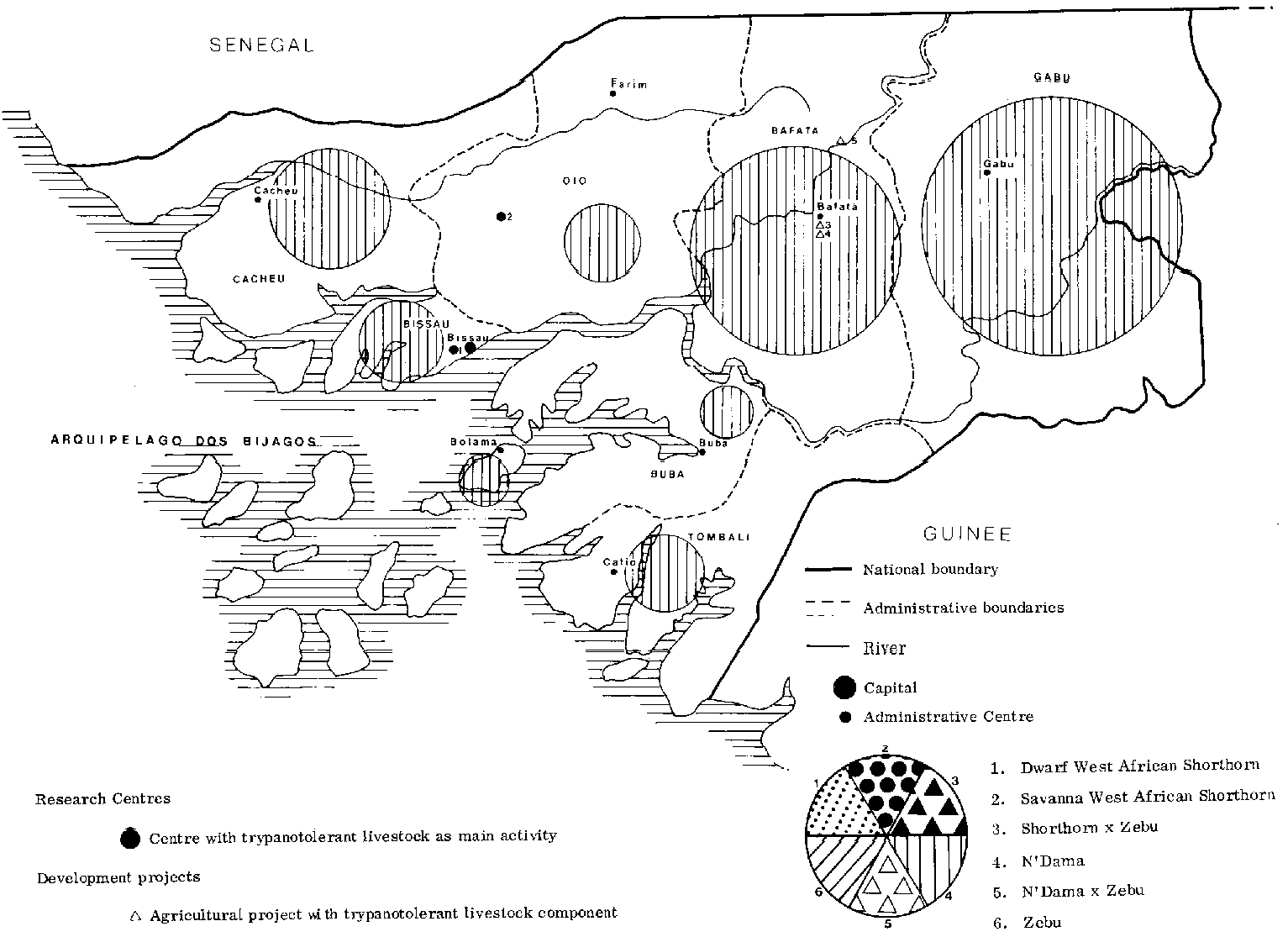
The Republic of Guinea Bissau lies on the west coast of Africa, with Senegal to the north and Guinea to the east and south. It includes the adjacent archipelago of Bijagoz with the island of Bolama. The country is made up of eight regions plus Bissau, the capital. Each region is divided into three to six sectors, with 34 sectors in au. The administrative boundaries and regional centres are shown in Figure 1. The Bolama region includes the Bijagoz archipelago.
The Department of Veterinary Services, with headquarters in Bissau, is part of the State Commissariat for Agriculture and Animal Husbandry. There is a regional Veterinary Services office in the main town of each region.
Basic data for the country are given in Table 1.
Table 1. Background data for Guinea Bissau.
|
Area |
36 125 km² |
|
|
Latitude |
10°55'-12°40' N |
|
|
Longitude |
13°40'-16°40' W |
|
|
Population |
||
|
|
number |
530 000 |
|
|
density |
14.7/km² |
|
Livestock numbers |
||
|
|
cattle |
166 016 |
|
|
sheep |
25 253 |
|
|
goats |
74 735 |
Sources: For population, OAU, 1978; for cattle numbers, national census, 1977; for sheep and goat numbers, agricultural statistics, 1975.
Most of the country has a Sudano-Guinean climate with one rainy season from May to November. The average annual rainfall ranges from 1 400 to 2 600 mm. The southern area has a Guinean climate, with rainfall at the higher end of the range.
According to the OAU/STRC tsetse distribution map (1977), Glossina palpalis, G. longipalpis and G. morsitans are found throughout the country, and G. fusca in the south. However, no information is available concerning the exact distribution and level of challenge.
A cattle census was carried out as part of a 1977 national vaccination campaign, with results shown in Table 2. Though these figures are given as representing the total herd, in fact, the vaccination campaign probably only reached about 80 to 85% of the cattle in the country. Thus, the actual total number of cattle in Guinea Bissau is probably closer to 200 000. About 75% of the animals vaccinated were in Bafata and Gabu Regions in the east, and 9% were in Cacheu Region on the northern part of the coast.
Table 2 also gives figures for the sheep and goat population. There are about 100 000 small ruminants in Guinea Bissau, with about three times as many goats as sheep. The distribution of sheep is similar to that of cattle, with about 76.4% in Bafata and Gabu Regions. Goats are fairly evenly distributed throughout the country.
3.1 BREED DESCRIPTION
3.1.1 N'Dama
The majority of the cattle in Guinea Bissau described as 'N'Dama' or 'Foula' are not of the typical N'Dama type, but represent a rather heterogeneous population. Field observations of about 10 herds indicated that about 60% of the cattle are of modest size (1.00 to 1.10 m at the withers), with very pale coats, often white with black markings (particularly the ears) and horns of medium size (see Figure 3.6, volume 1), only about 20 to 30% of these animals are the typical N'Dama type and the rest are heterogenous.
A sub-type of the N'Dama, called 'Boenca' or 'Boyenca' was described as nearer the typical Guinean N'Dama. These 'Boenca' are found in the southeastern part of the country on the border with Guinea.
Table 2. Livestock numbers and distribution in Guinea Bissau, 1977.
|
Region
|
Cattle |
Sheep |
Goats |
||||||||||
|
Females |
Males |
Draft Oxen
|
Total
|
%
|
Number
|
%
|
Number
|
%
|
|||||
|
Cows |
Heifers |
Calves |
Bulls |
Steers |
Calves |
||||||||
|
Cacheu |
7 645 |
1 587 |
2 403 |
597 |
826 |
1 853 |
98 |
15 009 |
9.0 |
893 |
3.5 |
7 585 |
10.1 |
|
Bissau |
3 575 |
1 240 |
939 |
350 |
501 |
708 |
79 |
7 392 |
4.5 |
849 |
3.4 |
13 820 |
18.5 |
|
Oio |
2 750 |
825 |
679 |
526 |
575 |
483 |
128 |
5 966 |
3.6 |
2 922 |
11.6 |
10 960 |
14.7 |
|
Bafata |
21 820 |
6 592 |
7 276 |
2 034 |
3 954 |
5 895 |
432 |
48 003 |
28.9 |
7 174 |
28.4 |
10 252 |
13.7 |
|
Gabu |
33 837 |
10 250 |
9 918 |
4 639 |
6 775 |
8 557 |
2 834 |
78 810 |
46.3 |
12 134 |
48.0 |
19 979 |
26.8 |
|
Bolama |
1 114 |
331 |
336 |
134 |
207 |
281 |
159 |
2 562 |
1.5 |
146 |
0.6 |
2 020 |
2.7 |
|
Buba |
1 328 |
395 |
401 |
160 |
246 |
334 |
70 |
2 934 |
1.8 |
700 |
2.8 |
5 113 |
6.8 |
|
Tombali |
3 305 |
998 |
1 000 |
431 |
601 |
828 |
177 |
7 340 |
4.4 |
435 |
1.7 |
5 006 |
6.7 |
|
Total |
75 374 |
22 218 |
22 952 |
8 871 |
13 685 |
18 938 |
3 977 |
166 016 |
|
25 253 |
|
74 735 |
100 |
|
% |
45.4 |
13.4 |
13.8 |
5.3 |
8.3 |
11.4 |
2.4 |
|
100.0 |
|
|
|
|
Sources: For cattle, national census, 1977; for sheep and goats, agricultural statistics, 1975.
3.1.1.1 Performance Traits. There is little information available on the performance of the N'Dama in Guinea Bissau. Average daily milk yields of 1.6 kg over 136 days of lactation were recorded for 21 N'Dama cows at the Bissau station, according to the 1977 annual report of the Department of Veterinary Services. These cows were partially milked, with the calves suckling after milking.
Ten white N'Dama cows with black ears and mucosae were measured at the Bissau station. Their size was considered fairly representative of animals under village husbandry conditions. Their mean height at the withers was 106 em (with a range of 101 to 110 em), their mean heart girth was 138.4 em (ranging from 125 to 145 em) and their mean scapulo-ischial length was 122.5 em (ranging from 110 to 131 cm). From these measurements and observations in the field, the average weight of adult cows can he estimated at 170 to 180 kg.
A 1975 census recorded 137 527 cattle, with an annual offtake rate of 6.4%, consisting of 3.4% sales and 3.0% slaughter. Mortality rates reported were 3.2% at birth and 4.6% for other age categories. These are much lower mortality rates than those recorded in the other survey countries.
3.1.1.2 Index of Productivity. Table 3 summarizes estimates of the main production traits required to build up a productivity index covering the total weight of one-year-old calf plus the liveweight equivalent of milk produced per 100 kg of cow maintained per year. This productivity index has been derived for meat and milk production under village conditions in a light tsetse challenge area (country visit information).
Table 3. N'Dama productivity estimates.
|
Parameter |
Production Environment |
|
Village/low tsetse challenge/ meat and milk |
|
|
Cow viability (%) |
96a |
|
Calving percentage |
55a |
|
Calf viability to one year (%) |
75a |
|
Calf weight at one year (kg) |
90a |
|
Annual milked out yield (kg) |
82.5 |
|
Productivity indexb per cow per year (kg) |
47.0 |
|
Cow weight (kg) |
190a |
|
Productivity indexb per 100 kg cow maintained per year (kg) |
24.8 |
a. Estimate.
b. Total weight of one-year-old calf plus liveweight equivalent of milk produced.Source: Country visit information.
3.1.2 The 'Manjaca' breed, which has been described as a Shorthorn type found in Guinea Bissau, seems to be disappearing. A few of these animals can be found in some herds in Cacheu Region towards the coast, and on the islands. This shorthorn type is being absorbed: its influence is only recognized by a greater heterogeneity in the herds of these areas, with a higher proportion of black and black spotted animals and horns which are atypical for the N'Dama (shaped in a short crescent, for example).
3.2 DISEASE
According to the Director of Veterinary Services, rinderpest and contagious bovine pleuropneumonia (CBPP) have been eradicated. Blackquarter and anthrax are present, and regular vaccinations are carried out. Brucellosis is also a problem.
Trypanosomiasis is not considered a major problem. No information was available on the more common trypanosome species or the distribution of the disease. The use of Berenil is fairly common, however, which suggests that there are eases of trypanosomiasis, even though virtually all of the cattle in the country are of the trypanotolerant breeds.
3.3 HERD MANAGEMENT AND COMPOSITION
Herd management varies widely from the coastal region towards the eastern part of the country. In the western area, the Balante and Mandjako are crop farmers, and households keep only a small number of cattle. In the east, the Fulani and Mandingo have a traditional livestock system based on larger herds. These differences are revealed in Table 4.
Table 4. Cattle herd sizes in five regions of Guinea Bissau.
|
Herd Size (number of cattle)
|
Number of Herds |
|||||
|
Cacheu |
Bissau |
Oio |
Bafata |
Gabu |
Total |
|
|
250-500 |
- |
- |
- |
14 |
29 |
43 |
|
150-249 |
1 |
- |
- |
37 |
62 |
100 |
|
100-149 |
2 |
- |
3 |
61 |
95 |
161 |
|
50-99 |
19 |
3 |
19 |
209 |
318 |
568 |
|
25-49 |
40 |
12 |
52 |
271 |
439 |
814 |
|
5-24 |
736 |
591 |
165 |
196 |
261 |
1 949 |
|
1-4 |
1 777 |
652 |
57 |
- |
- |
2 486 |
|
Total |
2 575 |
1 258 |
296 |
788 |
1 204 |
6 121 |
|
Cattle per region |
15 009 |
7 392 |
5 966 |
48 003 |
76 810 |
153 180 |
|
Average cattle per household |
5.8 |
5.9 |
20.9 |
60.9 |
63.8 |
25 |
Source: National census, 1977.
The use of draught oxen in farming is rare, except in Bafata and Gabu Regions, where there are an estimated 1 000 pair of working oxen. The numbers of oxen reported for au the regions are given in Table 2.
The sheep and goats in Guinea Bissau are of the West African Dwarf type. Their numbers and distribution among regions are indicated in Table 2. No performance data are available.
5.1 RESEARCH CENTRES
Two governments livestock stations are in operation, at Bissau and Bissora, and a third one is planned at Pradis. These are described in Table 5.
Table 5. Research centres in Guinea Bissau.
|
Name and reference to Figure 1 |
Bissau Station |
Bissora Station |
Pradis Station Project |
|
Organization responsible |
Direction of Veterinary Services, B. P. 26, Bissau |
Direction of Veterinary Services |
|
|
Breeds and numbers |
About 100 N'Dama cattle and a few Charollais and Friesian crossbreds |
About 150 N'Dama |
Planned to have 500 ha and 200 milking cows |
|
Objectives |
Improvement of milk production |
|
Dairy farming station |
|
External aid |
German Democratic Republic |
|
Switzerland |
|
Comments |
There is a small laboratory which should soon be developed into an animal pathological laboratory with the help of the US and Brazil. |
|
|
5.2 DEVELOPMENT PROJECTS
At present there are no development projects aimed exclusively at livestock, though a number of integrated agricultural development projects include a livestock component focusing on the use of draught oxen. These are the Integrated Development Project - Rice and Cotton, at Bafata with French cooperation (CFDT), the Development Project - Groundnuts, also at Bafata with French cooperation (IRHO) and including a training centre and a draught oxen component, and the Multiplication Project for Seed-Rice supported by the FAO at Contuboel in Bafata Region (FAO Guinea Bissau 75/039).
FAO (1977). 'Guinee Bissau - Synthèse nationale'. Draft. Rome.
Guinea Bissau, State Commissariat for Economic Development and Planning (1975). 'Estatistica pecuaria: Inventario geral de gado'. Bissau.
Guinea Bissau, State Commissariat for Agriculture and Animal Husbandry, Direction of Veterinary Services (1977). Annual report 1977. Bissau.
Guinea Bissau, State Commissariat for Economic Development and Planning (1977). Annuario estatistico 1977. Bissau.