1. Background
2. Livestock numbers and distribution
3. Cattle
4. Sheep and goats
5. Research and development activities
6. Selected bibliography
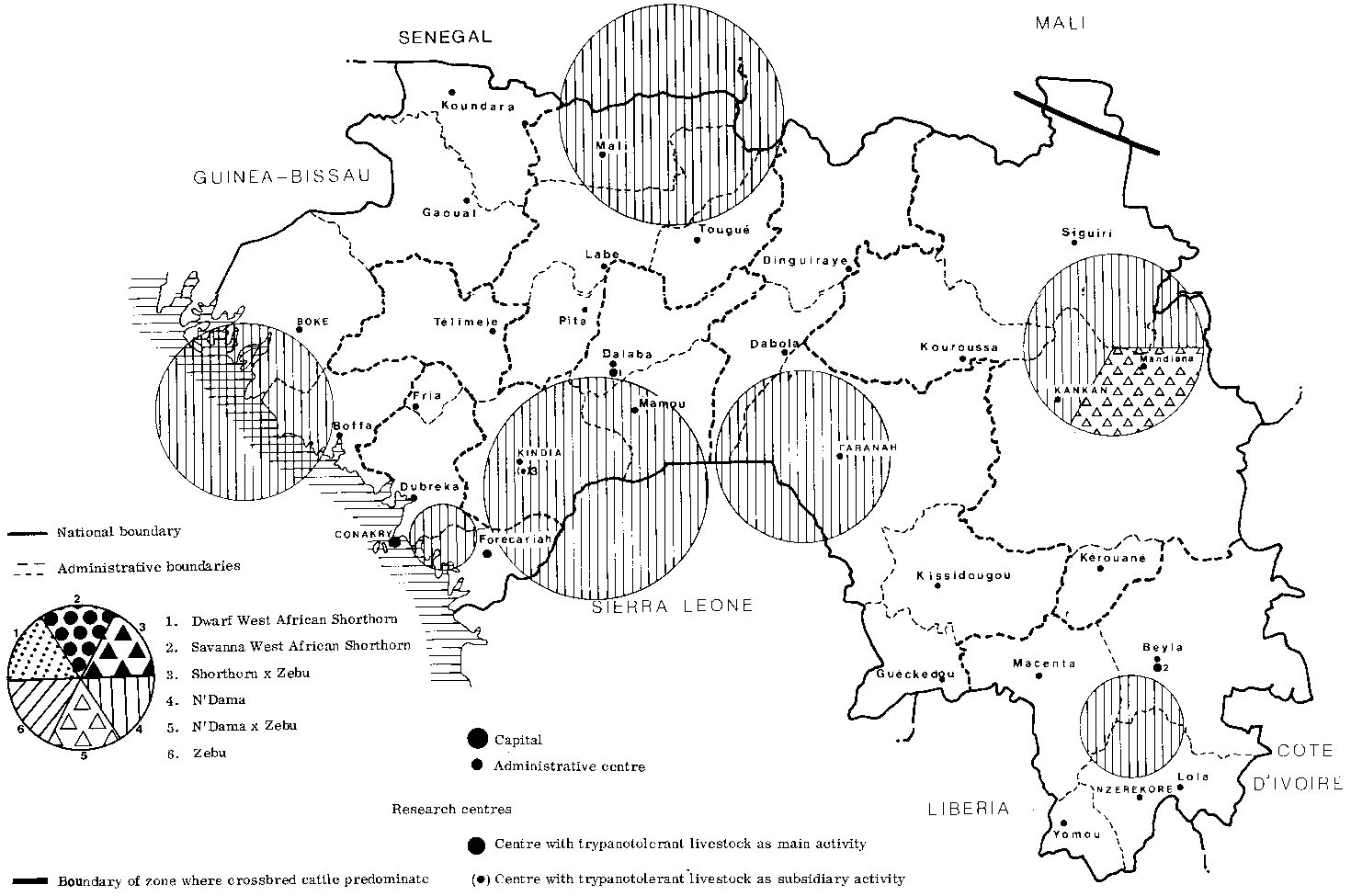
The Republic of Guinea lies on the west coast of Africa, with Senegal and Guinea Bissau to the north, Mali and Ivory Coast to the east and Sierra Leone and Liberia to the south. The country, with its capital at Conakry, is divided into 33 regions, grouped under seven Ministères du Développement Rural (MDR). The boundaries and administrative centres of the MDRs are depicted in Figure 1.
Livestock production is supervised by the Direction Générale de l'Elevage, which is part of the Ministère des Aménagements, Pêche et Elevage (MAPE). Every region has a Direction Régionale de l'Elevage which is responsible to the Direction Générale at the technical level and to the regional authorities at the administrative level.
Basic data for the country are given in Table 1.
Table 1. Background data for Guinea.
|
Area |
245 900 km² |
|
|
Latitude |
7°-12°30' N |
|
|
Longitude |
8°-15° W |
|
|
Population |
||
|
|
number |
5 695 000 |
|
|
density |
23.2/km² |
|
Livestock numbers |
||
|
|
cattle |
1 215 000 |
|
|
sheep |
540 000 |
|
|
goats |
535 000 |
Sources: For population, OAU, 1978; for livestock numbers, national census, 1976.
Guinea can be divided into four distinct ecological zones:
1. Lower Guinea (Basse Guinée), which extends 300 km along the Atlantic coast in the west. This area covers 45 000 km², with a Guinean climate and an average annual rainfall between 2 000 and 4 000 mm. The main towns are Boké, Conakry and Kindia.2. Central Guinea (Moyenne Guinée), with a Guinean climate, covering 54 000 km² along the Fouta Djallon massif. The altitude ranges from 600 to 1 500 m and the average annual rainfall is between 1 500 and 2 000 mm. The main towns are Mamou and Label
3. Upper Guinea (Haute Guinée) in the northeast is the largest region, extending over 100 000 km². The climate is Sudano-Guinean, with an average annual rainfall between 1 200 and 1 800 mm. The main towns are Faranah and Kankan.
4. Forest Guinea (Guinée forestière) in the southwest covers 46 000 km² with a forest climate and average annual rainfall from 1 700 to 3 000 mm. The main towns are Beyla, Kissidougou and Nzérékoré.
According to the OAU/STRC tsetse distribution map, G. palpalis is found throughout the country, G. fusca in the west (Lower Guinea), G. longipalpis and G. morsitans in Central and Upper Guinea, G. tachinoides in the northeast and G. pallicera in the southeast. However, the level of tsetse challenge is light to negligible in large areas of the country. Some of the relatively heavily infested areas are: the northern part of the Fouta Djallon massif in Central Guinea, including Gaoual, Koundara, Mali and Tougué Regions; in Upper Guinea in Siguiri and Mandiana Regions towards the northeastern border; and in Kindia Region in Lower Guinea.
Table 2 gives livestock numbers in 1976 for the MDRs and for the country as a whole, according to the Direction Générale de l'Elevage.
2.1 CATTLE NUMBERS AND DISTRIBUTION
Official estimates of the cattle population in Guinea are around 1.2 million, though some (e. g. Mongodin, 1975) estimate 2 million head. Government sources report a reduction in the cattle population from 1.5 minion, recorded in 1958 and 1962, to 1.3 million in 1974 and 1.2 million in 1976.
These figures (like those in Table 2) are not based on an actual livestock census, but are estimates produced by the Direction Générale de l'Elevage, which usually revises upwards the figures submitted by the regional authorities. Even if these adjustments are insufficient and cattle numbers are in fact greater than the figures quoted here, the estimates still suggest that the cattle population has been decreasing in Guinea or has at least remained static over the past few years. This finding is surprising, particularly as it contrasts sharply with the situation in the neighbouring countries.
Table 2. Livestock numbers in Guinea, 1976.
|
MDR |
Cattle |
Sheep |
Goats |
|
Boké |
185 000 |
74 500 |
91 000 |
|
Conakry |
27 000 |
29 900 |
19 000 |
|
Faranah |
179 000 |
74 400 |
59 000 |
|
Kincha |
289 200 |
116 500 |
109 000 |
|
Kankan |
183 000 |
81 000 |
50 000 |
|
Labé |
290 000 |
116 500 |
137 000 |
|
Nzérékoré |
61 800 |
47 200 |
75 000 |
|
Total |
1 215 000 |
540 000 |
535 000 |
Source: Official estimates.
The natural increase in herd numbers may be slow, but it is likely that there are other reasons for the stagnation or decline in herd size, in particular the illegal export of cattle to neighbouring countries such as Sierra Leone, Liberia, Ivory Coast and Maul This illegal trade is encouraged by the rigid regulations governing formal livestock trading in Guinea, such as fixed prices and offtake rates and the channeling of all trade through an official board.
Table 2 and Figure 1 show the distribution of cattle according to the MDRs. The distribution by ecological zone is shown in Table 3. This table reveals that the Fouta Djallon plateau in Central Guinea accounts for nearly 50% of the national herd. The human and animal populations on this plateau are relatively dense, especially in the central area, around Labe and Pita towns.
Table 3. Cattle distribution by ecological zone.
|
Area
|
Cattle |
Average Density
|
|||
|
km² |
% of total country |
Number |
% of National herd |
||
|
Lower Guinea |
45 000 |
18 |
219 200 |
18 |
4.9 |
|
Central Guinea |
54 900 |
22 |
572 000 |
47 |
10.4 |
|
Upper Guinea |
100 000 |
41 |
309 000 |
26 |
3.1 |
|
Forest Guinea
|
46 000 |
19 |
114 800 |
9 |
2.5 |
|
245 900 |
100 |
1 215 000 |
100 |
4.9 |
|
Source: Based on official estimates.
Lower Guinea accounts for 18% of the national herd, with a cattle population density similar to the national average. However, the distribution of cattle within this zone is extremely uneven. The greatest number of herds are found near the Fouta Djallon massif in Boké, Télimélé and Kindia Regions. There are many fewer cattle in Boffa, Dubreka and Forecaria Regions along the coast, and in large areas there are no cattle whatsoever. The cattle population of Central Guinea, on the other hand, is fairly evenly distributed throughout the zone. Upper Guinea is about twice the size of Central Guinea and accounts for about one-quarter of the cattle: the density of the cattle population in this zone is one-third that of Central Guinea, and the distribution is more irregular. The cattle population is small in the forest zone, except in the transitional regions of Beyla, Kissidougou and Gueckedou.
2.2 DISTRIBUTION OF SHEEP AND GOATS
Table 2 shows that sheep and goats are found throughout the country, but estimates of their numbers reported by local authorities differ widely from those of the central government. A recent study by Latinoconsult (1977) estimates a national population of 562 000 sheep and goats, while official estimates are double this figure, (FAO 1978a) indicates 420 000 sheep and 385 000 goats. The discrepancies in these estimates reveal the lack of reliable information in this sector. An approximate distribution by ecological zone is shown in Table 4.
Table 4. Distribution of sheep and goats by ecological zone, 1976.
|
|
Sheep |
Goats |
||
|
Number |
% of National flock |
Number |
% of National flock |
|
|
Lower Guinea |
116 900 |
22 |
108 000 |
20 |
|
Central Guinea |
220 500 |
41 |
245 000 |
46 |
|
Upper Guinea |
124 500 |
23 |
84 000 |
15 |
|
Forest Guinea
|
78 100 |
14 |
100 000 |
19 |
|
540 000 |
100 |
537 000 |
100 |
|
Source: Official estimates.
3.1 BREED DESCRIPTION
Most cattle in Guinea are of the N'Dama breed. About 5% are Zebu crosses, called Méré, found particularly in Siguiri Region and also in Kankan Region of Upper Guinea.
3.1.1 Guinean N'Dama
The appearance of the Guinean N'Dama varies considerably, as described in detail by Ducos (1961). Only the general traits and the most important variations observed in the field will be described here. (See Figure 3.9, volume 1).
In Lower Guinea and near the northeastern border in Gaoual and Koundara Regions, the appearance of the cattle is fairly uniform. The animals are relatively large (110 to 115 em at the withers) with large horns, often of classical lyre shape. Their coats are generally light coloured as in the classical type, but pale yellow to light fawn, and the mucosa are also light. About 80 to 90% of the animals in these areas are of this type.
In Central Guinea (Fouta Djallon), which is considered the cradle of the N'Dama breed, the animals are smaller (100 to 110 cm at withers) and more heterogeneous in appearance. About two-thirds have self coloured coats, varying in shade from pale yellow to brown, and there are also black, white and pied animals. The size and position of the horns vary considerably. They are not necessarily long: a medium crescent is common, and 2 to 3% of the animals are hornless.
The animals in Upper and Forest Guinea tend to be larger than those of Fouta Djallon. Their coats are generally darker. Most of the animals are brown, but about 10% are multicoloured with a white background.
3.1.1.1 Performance Traits. Cattle performance in Guinea is generally very low. According to the Latinoconsult study (1977), the calving rate is 66%. The annual mortality rate for calves below one year is 30 to 40%, for calves one to two-years it is 10% and for adult animals 5%. Weights gains average approximately 40 kg/year, and average carcass yield is 45%.
3.1.1.2 Index of Productivity. Table 5 summarizes estimates of the main production traits required to build up a productivity index covering the total weight of one-year-old calf plus the liveweight equivalent of milk produced per 100 kg of cow maintained per year. This productivity index has been derived for meat and milk production under village conditions in a light tsetse challenge area.
3.1.2 Zebu x N'Dama Crossbreds or 'Méré'
The 'Méré' are found in Upper Guinea near the Mali border and in the Niger River valley, in Kankan and particularly in Siguiri Region. The only Zebus are bulls imported from Mali which are used to produce the crossbreed. The Malinke people in this area carry out crossbreeding largely because the 'Méré' tend to be heavier and more sturdily built than the local N'Dama and thus make better draught oxen.
3.1.3 Exotic Cattle
A number of imported purebred cattle are kept on government breeding stations. At present, the most important exotic breed is the Red Steppe (Krasnaya Steppnaya), imported from the USSR. These animals are bred as purebreds and as crosses on state farms at Ditinn and Famoyla. Jersey, Ayrshire and Friesian, imported from Bulgaria, are kept at the Institut de Recherches Agronomiques de Foulaya.
Table 5. N'Dama Productivity Estimates.
|
|
Production Environment |
|
Village/low tsetse challenge/meat and milk |
|
|
Cow viability (%) |
95 |
|
Calving percentage |
66 |
|
Calf viability to one year (%) |
65 |
|
Calf weight at one year (kg) |
90 |
|
Annual milked out yield (kg) |
99 |
|
Productivity indexa per cow per year (kg) |
50.6 |
|
Cow weight (kg) |
225 |
|
Productivity indexa per 100 kg cow maintained per year (kg) |
22.5 |
a. Total weight of one-year-old calf plus liveweight equivalent of milk produced.Source: Information obtained during country visit.
3.2 DISEASES
Rinderpest has practically disappeared in Guinea, with no outbreaks for the past ten years. Contagious bovine plueropneumonia (CBPP) is e-till a major problem, though the incidence of this disease has decreased due to a prevention campaign carried out by the government with the collaboration of FAO. This disease is particularly widespread in Upper Guinea and occurs occasionally in Forest Guinea, but not in Central or Lower Guinea. Anthrax, blackquarter and pasteurellosis are widespread, particularly in Central Guinea (Fouta Djallon).
Gastro-intestinal parasites are common. They cause serious problems, particularly mortality among calves.
Trypanosomiasis is generally not a serious problem among cattle in Guinea due to the trypanotolerance of the N'Dama. However, the incidence of trypanosomiasis is high in Madiana and Siguiri Regions of ripper Guinea and in Koundara, Tougue and Dabola Regions at the edge of the Fouta Djallon massif.
3.3 HERD MANAGEMENT AND COMPOSITION
3.3.1 Cattle Husbandry
Cattle husbandry practises in Guinea have been described by several authors, including Balde (1939) and Diallo (1965). Traditional management systems vary among ethnic groups. The largest of these groups are the Malinké in Upper Guinea, the Fulani in Central Guinea and the Soussou in Lower Guinea. The Fulani and Malinké play an important role in livestock production throughout West Africa, though livestock management practises differ to some extent between the Fulani of Fouta Djallon and those elsewhere.
Transhumance has become rare in Guinea, except in Lower Guinea and the areas north and west of the Fouta Djallon plateau. People still move between the Télimélé plateau during the rainy season and the Lower Guinea plains of Boké and Boffa Regions during the dry season. In densely populated agricultural areas, the herds are sometimes moved short distances during the growing season to keep them from damaging the crops. During this period, they are herded during the day and kept in pens at night, hut during the dry season they are left to graze relatively freely. In some areas the herds roam without supervision; in others they are maintained under varying degrees of control.
The cows are milked regularly during the rainy season, and when possible during the dry season as well. In Fouta Djallon, making is nearly always done by women. In areas where the animals are looked after by a hired herdsman, he generally milks them and traditionally keeps the milk for himself two days a week, though this custom appears to be dying out. Milk is not only important in terms of family consumption, hut also the sale of fresh and curdled milk is an important source of income.
Under intensive farming systems in Fouta Djallon, women gather manure and spread it on the fields. During the dry season, the cattle are kept at night in enclosures, called 'tapades' which are fertilized in this way and then used for crop production. During transhumance, the manure left by the herds sometimes serves as a form of payment to farmers who allow the animals to graze on their land.
The people in Forest Guinea do not have a tradition of keeping cattle, and the animals in this zone tend not to be as well looked after as those in other parts of the country. However, these cattle are generally of a good size and healthy appearance, probably due to an abundance of grazing and the fact that they are not milked
Two mixed farming systems can be identified in Guinea in which cattle play an important role. In Upper Guinea, crop production is based to a large extent on the use of draught oxen. High quality beef is also produced when the animals are slaughtered young. In Fouta Djallon, crop and livestock production are well integrated, with cattle providing manure for the 'tapades' and in turn grazing on crop residues such as eleusine straw and others.
3.3.2 Herd Size and Composition
According to Hamon (1967), households generally own about 5 to 15 cattle, while herds usually contain animals belonging to a number of households In Fouta Djallon herds tend to be smaller than in Lower and Upper Guinea. The Latinoconsult study (1977) reported the figures on herd sizes in Central and Upper Guinea given in Table 6 which indicate differences between the two zones.
Table 6. Herd sizes in Central and Upper Guinea.
|
|
Central Guinea |
Upper Guinea |
||||||
|
Tougué, Mali |
Gaoual |
Boké |
Kindia |
|||||
|
No. of Cattle in Herd |
No. of Herds |
% of Total |
No. of Herds |
% of Total |
No. of Herds |
% of Total |
No. of Herds |
% of Total |
|
1-10 |
523 |
80 |
5 646 |
80 |
1 373 |
71 |
290 |
54 |
|
11-50 |
130 |
20 |
1 328 |
19 |
489 |
25 |
232 |
43 |
|
51 and above |
|
|
87 |
1 |
81 |
4 |
15 |
3 |
|
Total |
653 |
|
7 061 |
|
1 943 |
|
537 |
|
Source: Latinoconsult, 1977.
The Latinoconsult study (1977) also reports herd composition figures from a survey of 3 000 cattle in the four ecological zones. Herd composition percentages derived from this Study are presented in Table 7.
Table 7. Cattle herd composition by ecological zone (percent).
|
|
Lower Guinea |
Central Guinea |
Upper Guinea |
Forest Guinea |
|
Cows |
40 |
41 |
33 |
36 |
|
Calves |
27 |
20 |
18 |
19 |
|
Heifers |
16 |
25 |
26 |
29 |
|
Young bulls |
15 |
8 |
7 |
9 |
|
Bulls |
1 |
4 |
7 |
4 |
|
Oxen |
1 |
2 |
9 |
3 |
|
Total |
100 |
100 |
100 |
100 |
Source: Latinoconsult, 1977.
3.3.3 Draught Oxen
Draught oxen have been used in Guinea for some time. Diallo (1965) reports that the Fulani of Fouta Djallon have been using ploughs since 1925. Draught oxen are now used particularly widely in Upper Guinea, and it is because of this that the herds in that zone show a hither percentage of males than elsewhere in the country (see Table 7). According to official statistics, as well as Hamon (1967), the males in the herds of Central Guinea and Upper Guinea can be categorized as follows:
|
|
Central Guineaa |
Upper Guineab |
|
Draught oxen |
1.7% |
14.6% |
|
Non-draught oxen |
2.8% |
1.0% |
|
Bulls |
3.9% |
5.8% |
|
Total adult males in herd |
8.4% |
21.4% |
a. Mamou, Télimélé, Gaoual, Pita, Mali and Tougué Regions.
b. Siguiri, Dabola, Kankan and Kouroussa Regions.
The 1973 annual report of the Direction de l'Elevage also includes figures on teams of two oxen, as well as the total cattle population, for a number of regions. These are reproduced in Table 8.
Table 8. Cattle population and ox teams in nine regions.
|
|
Teams of Two Oxen |
Cattle |
|
Kindia (Lower Guinea) |
86 |
57 000 |
|
Labé (Central Guinea) |
400 |
57 800 |
|
Pita (Central Guinea) |
1 177 |
66 700 |
|
Dabola (Upper Guinea) |
3 638 |
36 700 |
|
Faranah (Upper Guinea) |
1 834 |
35 400 |
|
Kankan (Upper Guinea) |
6 707 |
64 300 |
|
Kouroussa (Upper Guinea) |
5 007 |
44 700 |
|
Siguiri (Upper Guinea) |
12 000 |
65 500 |
|
Beyla (Forest Guinea) |
1 500 |
51 800 |
Source: Guinea, Direction de l'Elevage.
The sheep in Guinea are of the dwarf Djallonké breed, with average body weights of about 20 kg, though the sheep in Upper Guinea tend to be much larger than elsewhere in the country. The West African Dwarf goats weigh on average about 15 kg. Flock productivity is low, especially among sheep, due to high mortality rates.
5.1 RESEARCH CENTRES
All animal husbandry research in Guinea is focused on the improvement of N'Dama milk production by crossbreeding with exotic animals. There is little research on pasture production or on small ruminants. Three research centres in the country are described in Table 9, and their locations are shown in Figure 1.
5.2 MULTIPLICATION HERDS
Studies are being carried out on the possibility of opening two selection centres for N'Dama cattle, one in Lower Guinea in Boké Region and the other in Upper Guinea between Kissidougou and Kankan. This project is funded by FAO/UNDP (Project No. GUI/74/022).
The World Bank is carrying out a feasibility study for an N'Dama selection and multiplication project to follow up a preliminary study carried out by Latinoconsult. The objectives are to improve animal health and zootechnical services, to establish a rearing and fattening ranch and to establish pilot centres for cattle breeding. There would also be project components for training, pig farming and animal nutrition.
These FAO and World Bank projects may possibly be coordinated in a common programme of selection, multiplication and production of the N'Dama breed.
Table 9. Research centres in Guinea.
|
Name |
Ferme d'Etat de Ditinn |
Ferme d'Etat de Famoyla |
Institut National de Recherches Agronomiques de Foulaya (INRAF) |
|
Location (reference in Figure 1) |
35 km from Dalaba (Kindia MDR) in Central Guinea, Fouta Djallon |
25 km from Beyla (Nzérokoré MDR) in the savanna of Forest Guinea at an altitude of 1000 m |
near Kindia ( |
|
Organization responsible |
Ministère des Aménagements, Pêche et Elevage |
Ministère des Aménagements, Pêche et Elevage |
Sécrétariat d'Etat à la Recherche Scientifique |
|
Size |
approximately 600 ha, half of which is cultivated |
475 ha in use (1000 ha available) |
5000 ha |
|
Breeds and numbers |
450 in 1976, 305 in 1978: 79 N'Dama, 147 Red Steppe and 79 crossbreds |
380, including N'Dama, Red Steppe and crossbreds (April 1978) |
INRAF has imported a number of cattle for crossing with the N'Dama: Jersey, Ayrshire, Holstein imported between 1972 and 1976. |
|
Objectives and activities |
Genetic improvement of N'Dama for milk production. It is intended to introduce the Red Steppe, ¼ N'Dama crossbreds bred inter se, into the 'Centres d'Accouplement' (mating centres). |
Genetic improvement N'Dama through crossbreeding (as at Ditinn). Improvement of cattle feeding by production of forage (maize, etc.). Training: a livestock faculty of 150 students is associated with the farm (2-year training for agricultural assistants). |
This is the main national agricultural research institute, associated with a Faculty of Agronomy. Work with cattle focuses on N'Dama improvement, mainly for milk production. |
|
External aid |
USSR |
USSR |
Bulgaria |
Balde, S (1939). 'L'Elevage au Fouta Djallon'. Bull. Inst. Fran. Afrique noire. pp. 630-644.
Diallo, A M (1965). 'Le boeuf dans la société Peulh du Fouta-Djallon'. D. Vet. Sc. thesis, Ecole Nationale Vétérinaire d'Alfort, 59p.
Doutressoulle, G (1938). 'Le croisement Tarentais-N'Dama en Guinée francaise'. Bull. Serv. Zoot. Epiz. AOF. 1 (4), pp. 6-17.
Ducos, P (1961). 'L'Elevage en Guinée et la structure génétique de la race N'Dama'. Bull. Inst. Fran. Afrique noire. 23 (3), pp. 886-901.
Guinea, Direction Générale d'Elevage. (1973). Rapport Annuel. Conakry.
Hamon, J L (1967). 'Rapport au Gouvernement de la Guinée sur le rôle de l'élevage dans le progrès de l'économie agricole'. Rapport No. AT 2333. Rome, FAO.
Latinoconsult S A (1977). 'République de Guinée. Projet de développement de l'élevage'. Conakry.
Mongodin, B (1975). 'Projet pour l'étude, la sélection et la multiplication de la race bovine N'Dama de Guinée'. Rapport de mission. Maisons-Alfort, IEMVT, 20 p.

 1
1