1. Background
2. Livestock numbers and distribution
3. Cattle
4. Sheep and goats
5. Research and development activities
6. Selected bibliography
The Republic of Sierra Leone lies on the west coast of Africa, with Guinea to the north and east and Liberia to the south. The country is divided into three provinces plus a small Western Area including the Freetown penninsula and the capital, Freetown. The provinces are made up of 12 districts as follows:
|
Province or Area |
Capital |
Districts (with headquarters if different) |
|
Southern |
Bo |
Bo, Bonthe (Matru), Moyamba and Pujehun |
|
Eastern |
Kenema |
Kailahun, Kenema and Kono (Sefadu) |
|
Northern |
Moken |
Kambia, Bombali (Makeni), Koinadugu (Kabala), Port Loko and Tonkolili (Magburaka) |
Western Area Freetown
Livestock services are provided by the Veterinary Division of the Ministry of Natural Resources, formerly the Ministry of Agriculture and Natural Resources, with regional offices in all the provinces. For the provision of livestock services, the Northern Province is divided into northeastern (Kabala) and northwestern (Teko-Makeni) sections.
Basic data for the country are given in Table 1.
Sierra Leone has a humid tropical rainforest climate, with a rainy season from April to November. The annual rainfall averages between 2 000 and 5 000 mm.
According to the OAU/STRC tsetse distribution map (1977), the whole country is infested with G. palpalis and G. fusca G. longipalpis and G. morsitans are found in the north and G. nigrofusca and G. pallicera pallicera in the east. No further information on the tsetse distribution in Sierra Leone was collected. However, it appears that in the northern half of the country, the challenge is low and trypanosomiasis is not a major problem.
Table 1. Background data for Sierra Leone.
|
Area |
72 300 km² |
|
|
Latitude |
7°-10° N |
|
|
Longitude |
10°-13° 30' W |
|
|
Population |
||
|
|
number |
3 053 000 |
|
|
density |
42.2/km² |
|
Livestock numbers |
||
|
|
cattle |
207 100 |
|
|
sheep |
47 400 |
|
|
goats |
112 100 |
Sources: For population, OAU, 1978; for livestock numbers, Veterinary Division estimates, 1978.
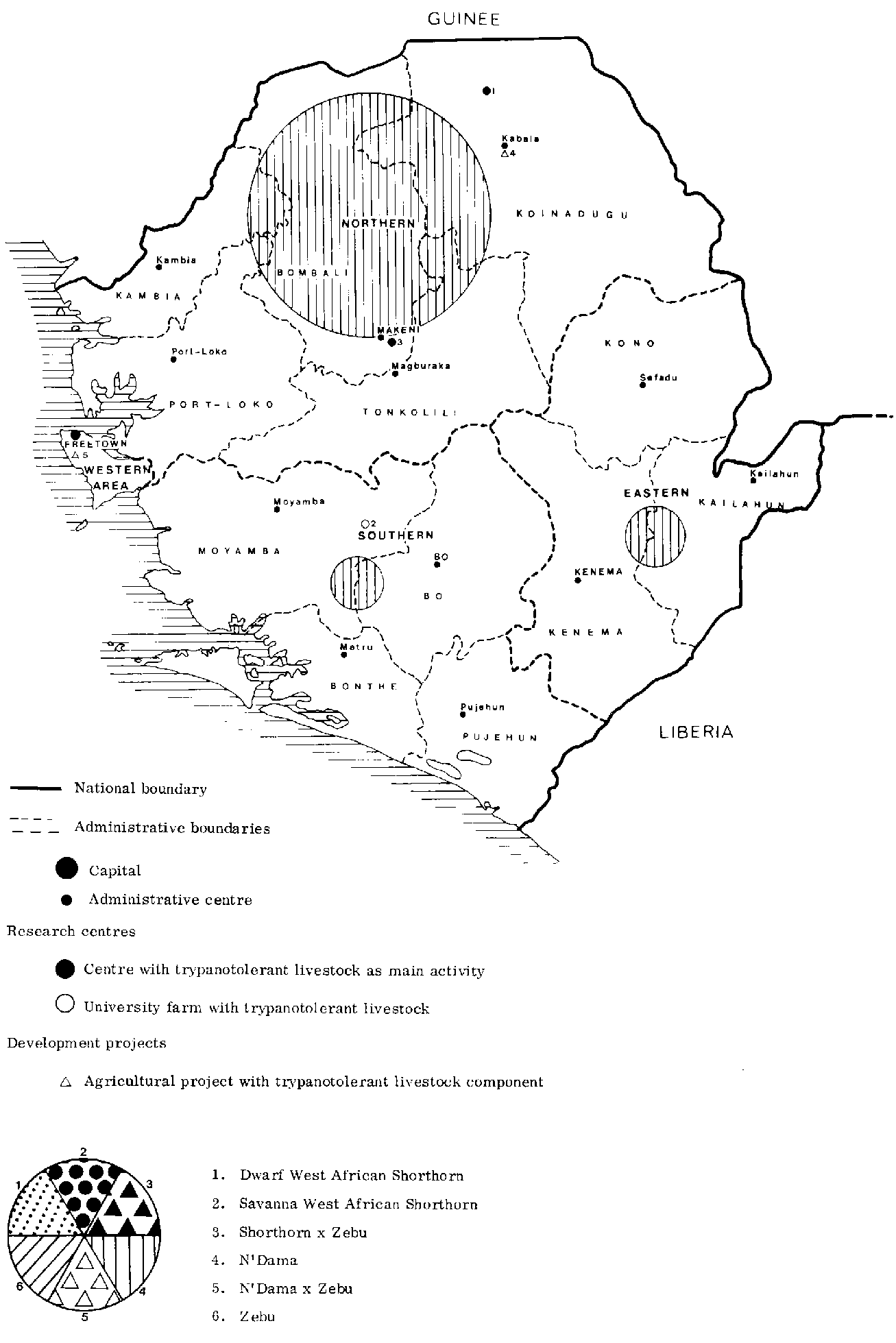
There has been no recent cattle census in Sierra Leone. Official estimates are still based on figures collected during the joint vaccination campaign (JP 15) carried out in 1967/68. At that time, 163 329 animals were vaccinated and FAO (1971) derived from this figure an estimate of the total cattle population at 204 855 which has been widely used since then. The distribution of cattle throughout the country is very uneven, as shown in Table 2 and Figure 1. Two districts in Northern Province account for more than 80% of the national herd - Koinadugu with 52% and Bombali with 32% (FAO, 1971). More recently, the number of cattle has in creased in the south, from 2 036 in 1968/69 (FAO, 1971) to 8 600 in 1978, i.e. from 1 to 4% of the national herd.
Table 2. Livestock distribution in Sierra Leone.
|
Province or Area
|
Cattle |
Sheep |
Goats |
|||
|
Number |
% of Total |
Number |
% of Total |
Number |
% of Total |
|
|
Southern |
8 600 |
4.1 |
14 800 |
31.2 |
42 300 |
37.7 |
|
Eastern |
11 800 |
5.7 |
11 200 |
23.6 |
25 300 |
22.6 |
|
Northern |
186 700 |
90.2 |
21 200 |
44.8 |
42 200 |
37.6 |
|
Western Area |
|
|
200 |
0.4 |
2 300 |
2.1 |
|
Total |
207 100 |
100.0 |
47 400 |
100.0 |
112 100 |
100.0 |
Source: Veterinary Division estimates, 1978.
Sheep and goats are distributed more evenly throughout the country, with about one-third in Southern Province. There are more than twice as many goats as sheep and approximately twice as many cattle as goats. Trends in the sheep and goat population are not known, but it is likely that they are more numerous than indicated in the official estimates.
A recent aerial survey carried out by the consultants for the National Livestock Development Study suggests that the total livestock numbers in the country may he significantly higher than the quoted figures.
3.1 N'DAMA BREED DESCRIPTION
All the cattle in Sierra Leone belong to the N'Dama breed. They are generally of the classical N'Dama type, but with uniformly pale coats, varying in shade from yellow to fawn. A small number of Sahiwals have been imported from Kenya and bred as pure and crossbred types at Teko Station, but are not described here.
3.1.1 Performance Traits
Touchberry (1967) gives a good deal of precise data on N'Dama performance at the Musaia Stock Farm from the period 1949 to 1965. It must be kept in mind that all these figures were obtained under research station conditions.
Concerning reproduction performance, Touchberry (1967) recorded an average age at first calving of 39.4 months for 231 cows at Musaia. Under village conditions, the typical age at first calving is from three to four years (FAO, 1971). The average calving interval at Musaia was 407 days, with a range of 267 to 1 062 days. Under village conditions, the calving interval may be as low as 12 to 14 months, but usually it is closer to 16 months (Holt 1973). The average lifetime production for the cows at Musaia was 3.7 calves. In the village herds, the calving season extends from November to March. At Musaia, the season is longer, but 67% of the cows calve between September and February.
Touchberry (1967) recorded an annual mortality rate of 7% for animals under two years old. Mortality rates tend to be higher under village conditions: Holt (1973) reports 23.5% mortality from birth to one year, accompanied by a 5% abortion rate.
Partial milking in village herds gives a daily milk yield of 0.6 litres per cow (FAO, 1971). The FAO report also quotes a study by Jones (1953) of milk yields under station conditions which averaged 2 kg per day, as shown in Table 3.
Figures reported for body weights of N'Dama in Sierra Leone vary widely. Touchberry (1967) reports the following weights for animals of various ages at Musaia Stock Farm (kg):
|
Age (mo) |
Birth |
6 |
9 |
12 |
18 |
24 |
36 |
48 |
|
Females |
15 |
70 |
89 |
101 |
128 |
162 |
207 |
219 |
|
Males |
17 |
75 |
96 |
109 |
132 |
164 |
220 |
277 |
Table 3. Milk production by N'Dama cows at Teko Station and Musaia Stock Farm, 1944 to 1952.
|
Station or Farm |
Year |
Av. No. Cows in Milk |
Av. Lactation (days) |
Av. Milk Yield per Lactation (kg) |
|
Teko |
1944 |
8 |
152 |
177 |
|
Teko |
1945 |
9 |
203 |
327 |
|
Teko |
1946 |
8 |
337 |
489 |
|
Teko |
1947 |
9 |
294 |
503 |
|
Teko-Musaia |
1948 |
10 |
285 |
556 |
|
Musaia |
1949 |
10 |
263 |
626 |
|
Musaia |
1950 |
11 |
237 |
523 |
|
Musaia |
1951 |
12 |
197 |
420 |
|
Musaia |
1952 |
17 |
136 |
365 |
|
Overall |
|
94 |
225 |
442.7 |
Source: Jones, 1953, quoted in FAO, 1971.
Joshie et al. (1957) report much higher weights from Musaia: 136 kg for males and 138 kg for females at 1 year, 220 and 151 kg at 2 years and 363 and 238 kg for adults. Boston gives weights recorded at Niala University College farm from 1944 to 1951 in kg as follows (quoted in Holt, 1973):
|
Age/Sex |
Birth |
6 mo. |
2 yr |
Adult male |
Adult female |
|
Natural pasture |
17 |
75 |
145 |
311 |
235 |
|
Improved pasture |
20 |
95 |
220 |
390 |
310 |
Fattening trials with N'Dama cattle were carried out at Njala University College farm. These showed that daily weight gains over a period of about two months increased from 0.33 kg on pasture only to 0.49 kg on pasture plus supplementary wheat flour and rice.
Table 4. Results of fattening trials at Njala University College farm.
|
|
Diet |
|||
|
Wheat Flour Only |
Wheat Flour and Rice Only |
Pasture, Wheat Flour and Rice |
Pasture ad Libitum plus Minerals |
|
|
Average age (days) |
375 |
436 |
490 |
557 |
|
Initial weight (kg) |
130 |
122 |
141 |
174 |
|
Final weight (kg) |
122 |
141 |
174 |
183 |
|
Average daily change (kg) |
-0.14 |
0.35 |
0.49 |
0.33 |
Source: Boston, quoted in Holt, 1973.
Liveweight, carcass weight and dressing out percentages are reported for animals slaughtered at Musaia and at the Njala University College abattoirs. These figures are given in Table 5.
Table 5. Liveweight, carcass weight and dressing out percentages at Musaia and Njala University College abattoir, 1970-72.
|
|
Musaia Farm
|
Njala University College Abattoira |
||
|
Bulls |
Steers |
Cows |
||
|
Number |
54 |
233 |
149 |
72 |
|
Estimated age (yrs) |
3.3 |
4.5 |
4.7 |
5.8 |
|
Liveweight (kg) |
232 |
199 ± 37b |
205 ± 38b |
190 ± 22b |
|
Carcass weight (kg) |
97 |
|
|
|
|
Dressing out % (cold) |
41.6 |
47 ± 3 |
48 ± 3 |
45 ± 3 |
a. Cattle purchased on the hoof throughout the country and also from Guinea.
b. After 18-hours starvation.
Sources: For Musaia, Touchberry, 1967; for Njala, Boston et al., 1975.
3.1.2 Index of Productivity
Table 6 summarizes estimates of the main production traits required to build up a productivity index covering the total weight of one-year-old calf plus the liveweight equivalent of milk produced per 100 kg of cow maintained per year. This productivity index has been derived for meat production under station conditions in a light tsetse challenge area (Touchberry, 1967).
Table 6. N'Dama productivity estimates.
|
|
Production Environment |
|
Station/low tsetse challenge/meat |
|
|
Cow viability (%) |
98 |
|
Calving percentage |
78.2 |
|
Calf viability to one year (%) |
93 |
|
Calf weight at one year (kg) |
105 |
|
Annual milked out yield (kg) |
- |
|
Productivity indexa per cow per year (kg) |
77.1 |
|
Cow weight (kg) |
238 |
|
Productivity indexa per 100 kg cow maintained per year (kg) |
32.4 |
a. Total weight of one-year-old calf plus liveweight equivalent of milk produced.
Source: Touchberry, 1967.
3.2 DISEASE
According to Kamara (1978), rinderpest and contagious bovine pleuro-pneumonia (CBPP) have not been a problem since the 1966/67 joint vaccination campaign (JP 15), which was accompanied by follow-up measures extending until 1974. There are a few fairly localized seasonal cases of blackquarter and anthrax, and annual vaccinations for these diseases are still carried out. Streptothricosis and demodectic mange cause problems for imported animals, but N'Dama are resistant to these diseases.
Helminthiasis is an important limitation on meat production. The most frequent parasites are Haemonchus contortus, Trichostrongylus, Bunostomum, Gaigeria, Strongyloides and Ascaris, particularly in calves.
Trypanosomiasis occurs, even among the N'Dama. These animals are more likely to become susceptible to this disease when they are under stress from other diseases or undernourished during the dry season.
3.3 HERD MANAGEMENT AND COMPOSITION
Most of the cattle in Sierra Leone belong to Fulani who have come from Guinea. These people have tended to keep their traditional livestock management systems in all the neighbouring countries which they inhabit.
Generally, the stock keepers do not own their own land, but rent land from the sedentary population through the local chiefs. They move from time to time in search of better grazing. Even the herds belonging to sedentary groups may be moved short distances, with the night pens reestablished occasionally in a new location. Cattle tend to graze on the hills during the rains and in the lowlands and cultivated areas during the dry season. The cattle are kept in ward at night and are milked regularly. Among the Fulani, cattle are usually tended by the owner or a member of his family; outside herders are seldom employed. Other people who own cattle tend to hire Fulani herders. According to the 1971 FAO report, the average herd consists of 20 to 30 cows. In the north the herds tend to be larger, with a maximum of 50 to 150 head (see Figure 3.40, volume 1).
From 1930 to 1950, the use of oxen as draught animals was encouraged, and a number of farmers actually began using oxen in Bombali District. However, this practice subsequently declined (FAO, 1971).
A programme to settle the Fulani was carried out between 1953 and 1968 in Koinadugu District, called the 'Foula Settlement Scheme in the Koinadugu District'. Seven-year renewable leases were granted on tracts of about one square mile (259 ha) for every 100 cows and their female calves, with the agreement of the local authorities. The Fulani were meant to keep their animals on their rented land most of the year, but were allowed to move elsewhere at the end of the dry season. The Agriculture Division of the Ministry of Agriculture and Natural Resources supervised the programme with the agreement of the local chief who received one-third of the rent.
This programme cannot be judged a success, as only 80 to 100 Fulani families were settled out of a total of 1 000 to 2 000. The FAO report (1971) cites a number of reasons for this failure. For one thing the rents charged under the programme were higher than what the Fulani might have been paying for the use of pasture land elsewhere. Also, the tracts of land which were rented were too small, which led to overgrazing due to permanent overstocking. Finally, the government extension and veterinary services were insufficient.
In Kailahun District of Eastern Province, the local farmers keep small herds of cattle, estimated at about 3 000 head in all. The husbandry system here is quite different from that of the Fulani. The herds are smaller, averaging about 30 head, and are formed by combining the animals of several different owners. Cows are seldom milked, and the herds are penned during the harvest season.
The small ruminants in Sierra Leone are of the typical West African Dwarf breeds - Djallonké sheep and Guinean goats. (see Figure 3.74, volume 1). The average weight of adult sheep is about 20 to 30 kg and of adult goats about 20 to 25 kg.
Although small ruminants have been bred at various stations, there is little information on their productivity. FAO (1971) reports the age at first lambing of local sheep kept at Musaia as 15 to 18 months and prolificacy as 141%, with two lambings a year. These data indicate high potential fertility, but there are also high annual mortality rates among lambs, ranging from 16 to 67%, depending on the year.
Sheep breeding trials carried out at the stations have not been a success. FAO (1971) quotes a 1945 report of the Department of Agriculture as follows: 'Experience with local sheep over several years at Njala and Teko indicates that they are completely uneconomic under any treatment. They are of poor conformation, slow growing and very subject to disease.'
At Teko Station, milk production from local goats averaged 25 kg over a lactation of 56 days. Lactations ranged from 24 to 111 days, with a maximum yield per lactation of 46 kg.
Although tolerant to trypanosomiasis, the sheep and goats in Sierra Leone are sensitive to a number of other diseases. These include internal parasites, heart-water and foot rot.
Small ruminants are generally kept for home meat consumption and are not sold commercially. They are usually slaughtered for traditional ceremonies. Households generally keep only a few sheep and goats, except the Fulani in the north whose flocks tend to be larger. Sheep and goats are sometimes tethered to prevent damage to crops.
There are three main centres in Sierra Leone which carry out research and multiplication activities with N'Dama cattle and with local sheep and goats. These are depicted in Table 7.
Two development projects are underway in the livestock sector. The Koinadugu Integrated Agricultural Development Project in Koinadugu District, with headquarters at Kabala, has its objectives to redevelop the Musaia Stock Farm, to carry out a training programme in the use of draught oxen and to establish three ranches. Financial support is from the European Development Fund (EDF) of the European Economic Community (EEC) and technical assistance from Carl Bro of Denmark. The project period is 1978 to 1982. The location is shown in Figure 1 by  4.
4.
A Northern Integrated Agricultural Development Project (NIADP) with headquarters at Makeni (shown by 5 in Figure 1) has a small livestock component The aims are to investigate the potential for cattle development in the northern area and the four year project financed by the World Bank includes the building up of a fact finding ranch.
A general study is also being carried out, supported by the EDF of the EEC, to determine the best government strategy for project preparation and other activities aimed at improving the integration of the livestock sector in the agricultural economy, improving the marketing of livestock products, reducing dependence on imported animal products, reinforcing the framework of government activities in the livestock sector and increasing the provision of other services. This project is scheduled for 1978/79 and covers the whole country.
Table 7. Research and multiplication centres.
|
Name |
Musaia Stock Farm |
Njala University College, Animal Science Department Farm |
Teko Station |
|
Location (reference in Figure 1) |
20 km north of Kabala, Koinadugu District, Northern Province |
Moyamba District, Southern Province |
5 km south of Makeni in Northern Province |
|
Organization responsible |
Ministry of Agriculture, Freetown |
University of Sierra Leone |
Veterinary Division, Ministry of Natural Resources, Freetown |
|
Size |
936 ha |
76 ha |
800 ha |
|
Breeds and numbers |
About 120 N'Dama cattle in 1978, between 600 and 800 cattle from 1964 to 1968 |
93 N'Dama cattle, 97 local sheep and 11 goats |
85 N'Dama, 32 Sahiwal and 70 N'Dama x Sahiwal cattle, 56 sheep |
|
Objectives |
N'Dama breeding and improvement |
Improving cattle, sheep and goats through breeding and better feeding. Performance is recorded and there is a small veterinary laboratory. |
Improvement of the N'Dama breed by crossing with Sahiwal imported from Kenya in 1974. |
|
External aid |
It is planned to redevelop Musaia Stock Farm in the framework of an integrated development project funded by the European Economic Community |
|
External aid is required for analysis and interpretation of the results (Kamara, 1978). |
|
Comments |
Touchberry (1967) analysed data recorded at Musaia from 1949-64. The station is now less active for various reasons and the size of the herd is considerably reduced. |
|
|
Boston, W D, Leigh, I S, Romans, J R, Norton, H Wand Kastelic, J (1975). 'Slaughter characteristics of N'Dama cattle in Sierra Leone'. Journal of Tropical Agriculture. 52, pp. 53-58.
FAO (1971). 'Sierra Leone - integrated development of the agricultural sector - the livestock industry'. Technical Report No. 6. ESE:SF/SIL 3. Rome, FAO. 121p.
Holt, S (1973). 'Cattle component'. In Feasibility and pre-investment study for Nothern Province Development Project. Freetown, Ministry of Agriculture and Natural Resources.
Kamara, R S (1978). 'Animal health and production in Sierra Leone'. Paper submitted to the OAU Sub-Regional Meeting on Animal Health and Production in West Africa, held in Lomé in July.
Sierra Leone, Ministry of Agriculture and Natural Resources (1965). Report of the Agricultural Division 1965. Freetown, Government Printer.
Sierra Leone, Ministry of Agriculture and Natural Resources, Veterinary Division (1974). 'Report of the Veterinary Division for the years 1964-1974'. Freetown, Government Printer.
Thomas, M E R (1976). 'Some suggestions for livestock development with emphasis on cattle in Sierra Leone'. Accra, FAO.
Touchberry, 1967. 'A study of N'Dama cattle at the Musaia Animal Husbandry Station in Sierra Leone'. Urbana, University of Illinois Agricultural Research Station.

 1
1 2
2