1. Background
2. Livestock numbers and distribution
3. Cattle
4. Sheep and goats
5. Research and development activities
6. Selected bibliography
The Republic of Mali is a landlocked country in West Africa surrounded by Algeria to the north, Mauritania and Senegal to the west, Guinea and the Ivory Coast to the south and Upper Volta and Niger to the east. The capital is at Bamako, and the country is divided into 6 regions and 42 administrative Cercles. In each Cercle there is a Secteur d'Elevage (livestock sector) under the Service de l'Elevage et de la Santé Animale, which is a part of the Ministère du Développement Rural. This ministry is also in charge of the Institut d'Economie Rurale (IER), which is responsible for agricultural research, and the Office Malien du Bétail et de la Viande (OMBEVI) with responsibilities for livestock production and marketing.
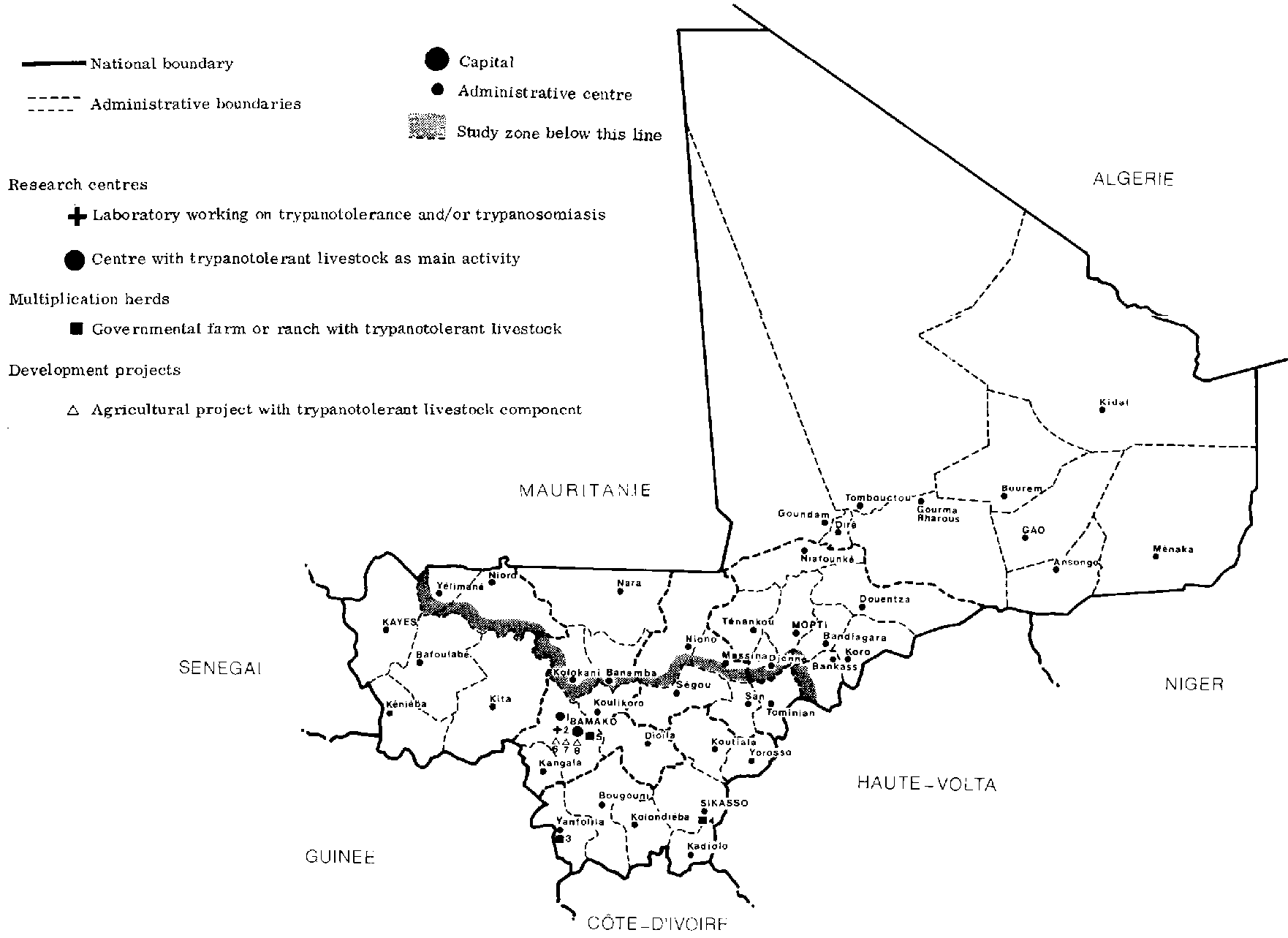
The Secteurs d'Elevage included in this study are those below the northern tsetse limit where significant numbers of cattle of the trypanotolerant types are found. These are listed in Table 2 and their locations are shown in Figure 1.
Basic data for the study area and for the country as a whole are given in Table 1.
Table 1. Background data for Mali.
|
|
Whole Country |
Study Area |
|
|
Area |
1 240 000 km² |
220 000 km² |
|
|
Latitude |
10°-25° N |
10°-14° N |
|
|
Longitude |
4 E°-12° W |
4° W-12° W |
|
|
Population |
|||
|
|
number |
5 840 000 |
3 500 070a |
|
|
density |
4.71/km² |
15.9/km² |
|
Livestock numbers |
|||
|
|
cattle |
3 915 000 |
1 810 000 |
|
|
sheep and goats |
8 000 000 |
1 600 000 |
a. Estimate.
Sources: For population, OAU, 1978; for livestock numbers, government veterinary reports, 1976.
The area under study extends from the Sudano-Guinean to the Sahelo-Sudanian climatic zones, with one rainy season from April/May to October. The annual rainfall ranges from 700 to 1 400 mm.
In addition to the OAU/STRC tsetse distribution map (1977), Gruvel (1977) carried out a survey of trypanosomiasis in Mali in the framework of a UNDP/FAO project on the economics of trypanosomiasis. He identified three glossina species, two riverine species, G. palpalis gambiensis and G. tachinoides and one savanna species, G. morsitans submorsitans. He described their distribution in detail as follows:
The northern limit of glossina in Mali can be defined by a line including from West to East the river Senegal, the river Baoulé and its large curve, the river Niger from the south of Kolokani to up stream of Segou, the river Bani up to the vicinity of San, then continuing more-or-less due east in the direction of Upper Volta...The distribution of each species is still little known. However, it seems that G. m. submorsitans is present in high density west of the Senegal river basin, and south west towards Guinea and Ivory Coast. It is also present in the Dioila region, then towards the east near Upper Volta. G. p. gambiensis and G. tachinoides are present almost everywhere along the bush covered banks of the trig rivers and their tributaries. Their habitat is sometimes distinct, but often overlapping.
From the small amount of information concerning tsetse distribution in Mali and the observations made during the mission, it seems that the tsetse infestation south of the river Niger decreases regularly from the southwest to the northeast, from the Yanfolila Sector where the three species are found together up to the Koutiala Sector where the scarcity of the savanna species and the presence of the riverine species are noticed. Consequently, the infection risk decreases progressively towards the east along with the deep forest following the river networks.
There has been a general movement of cattle from north to south following the recent droughts. This exodus has changed the distribution of animal numbers and of breeds throughout the country and to some extent has disrupted the farming societies in the southern areas. Herds of Fulani cattle can now be observed on the southern border with Upper Volta.
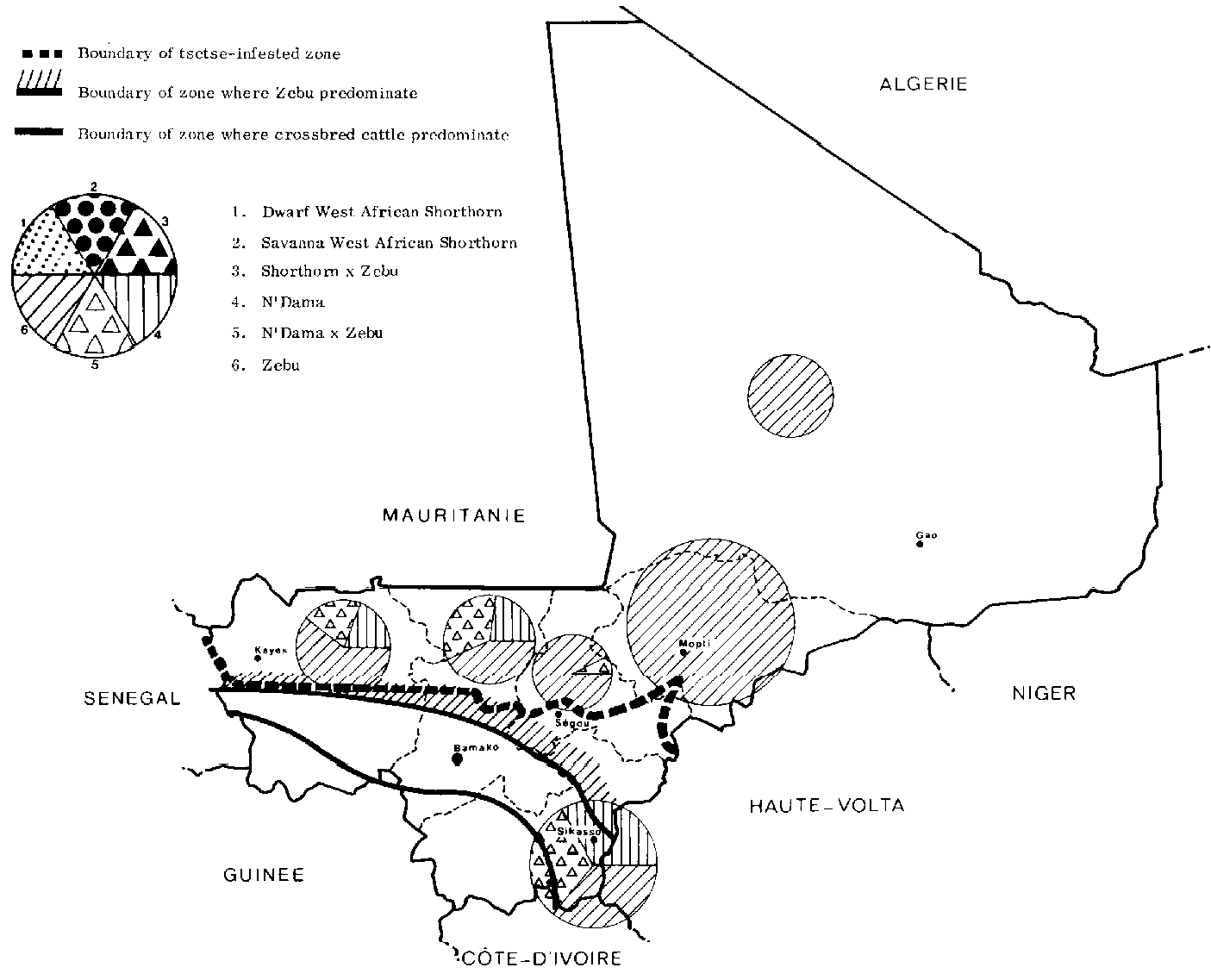
Livestock numbers in the Secteurs of the study area are given in Table 2. The cattle population is broken down into N'Dama, Zebu and crossbred types. The N'Dama account for 26% of the cattle in the study area and 12% of the national herd. The crossbreds are 29% of the cattle in the study area and 13% of the national herd. Thus a quarter of the national herd is composed of N'Dama and crossbreds.
Figure 2 shows the distribution of the cattle population in each region and the percentage of each breed type. This figure shows the northern limit of the tsetse zone, as described by Gravel (1977), and the approximate boundaries of the areas where Zebu, crossbred and N'Dama cattle predominate. These boundaries reflect Atabani's (1966) field observations of a Zebu/humpless boundary between Nioro Du Sahel in the northwest and Sikasso in the southeast.
Only approximate numbers can be given for sheep and goats and no figures for individual breeds are available. Though the Zebu cattle have apparently been moving south as a result of the drought, no similar trend has been observed among the Sahelian sheep and goat populations.
Table 2. Livestock numbers and distribution in the study area of Mali ('000).
|
|
Cattle |
Sheep
|
Goats
|
|||||||
|
Total |
N'Dama % |
Cross breed % |
Zebu % |
|||||||
|
Kayes Region |
||||||||||
|
|
Kayes |
155 |
5 |
3 |
30 |
19 |
120 |
78 |
65 |
150 |
|
|
Bafoulabé |
98 |
28 |
29 |
50 |
51 |
20 |
20 |
35 |
30 |
|
|
Kénéba |
28 |
28 |
100 |
- |
- |
- |
- |
20 |
15 |
|
|
Kita |
49 |
29 |
59 |
15 |
31 |
5 |
10 |
14 |
10 |
|
Bamako Region |
||||||||||
|
|
Koulikoro |
30 |
5 |
17 |
15 |
50 |
10 |
33 |
15 |
15 |
|
|
Bamako |
150 |
40 |
27 |
70 |
46 |
40 |
27 |
100 |
100 |
|
|
Kangaba |
24 |
24 |
100 |
- |
- |
- |
- |
7 |
2 |
|
|
Dioila |
125 |
30 |
24 |
60 |
48 |
35 |
28 |
40 |
40 |
|
Ségou Region |
||||||||||
|
|
Ségou |
195 |
- |
- |
25 |
13 |
170 |
87 |
124 |
187 |
|
|
San |
66 |
- |
- |
- |
- |
66 |
100 |
68 |
38 |
|
|
Tominian |
60 |
- |
- |
- |
- |
60 |
100 |
83 |
28 |
|
Sikasso Region |
||||||||||
|
|
Yanfolila |
55 |
55 |
100 |
- |
- |
- |
- |
15 |
8 |
|
|
Bougouni |
178 |
90 |
51 |
38 |
21 |
50 |
28 |
33 |
22 |
|
|
Kolondiéba |
104 |
15 |
14 |
42 |
40 |
47 |
46 |
25 |
14 |
|
|
Kadiolo |
81 |
40 |
49 |
21 |
26 |
20 |
25 |
7 |
11 |
|
|
Sikasso |
213 |
50 |
23 |
63 |
30 |
100 |
47 |
107 |
58 |
|
|
Koutiala |
181 |
25 |
14 |
90 |
50 |
66 |
36 |
57 |
20 |
|
|
Yorosso |
18 |
1 |
6 |
3 |
17 |
14 |
77 |
18 |
6 |
|
Total |
1 810 |
465 |
|
522 |
|
823 |
|
833 |
754 |
|
Source: Compiled by authors from Mali, Secteurs d'Elevage, Rapport Annuel, 1975, 1976, 1977.
Figure 2. Cattle numbers and breed distribution.
Three main types of cattle are observed in the study area: N'Dama, Zebu (mainly Sudanian Fulani Zebu) and Méré or Bambara. A few Savanna West African Shorthorn (Baoulé type) may he observed in the southeastern part of the country (Coulomb and Deslandes, 1978).
3.1 BREED DESCRIPTIONS
3.1.1 N'Dama
The classical Guinean N'Dama, as described in chapter 3 of volume 1, is found in Kenieba, Kangaba, Yanfolila and Bougouni Secteurs. In Yanfolila, the adult cows typically measure about 105 cm at withers, and oxen over 6 years old can reach 118 ± 13 cm (IEMVT, 1971). The N'Dama in the other Secteurs of the study area are more variable, with black, red, grey, black and white or red and white coats and fairly typical horns. (See Figures 3.2, 3.3 and 3 19, volume 1.)
3.1.1.1 Performance Traits. In discussing the performance of N'Dama cattle in Mali, a distinction must be made between production data collected under village conditions and performance levels achieved under research station conditions at the Centre National de Recherches Zootechniques de Sotuba, near Bamako The figures given in different sources and for different years vary widely and must be treated as approximations.
Among reproduction traits, age at first calving was recorded by IEMVT (1971) as 42 to 48 months under village conditions in Yanfolila Secteur. At the Sotuba station, the age at first calving was 42.5 months ± 40 days between 1952 and 1957 (Pagot and Delaine, 1959). SEDES (1971) reports a calving rate of 60 to 65% for N'Dama in Yanfolila; at Sotuba station, the calving rate was 75% in 1974 (CNRZ, 1975).
The mortality rate among calves under village conditions tends to be high: SEDES (1971) reports calf mortality at 35 to 40% in Yanfolila Secteur, and Morel (1973) gives an estimate of 21% for all of southern Mali.
Based on surveys carried out in 1975 in Yanfolila Secteur, Diarra (1977) estimated an average daily milk production of 1.5 litres per cow, with a 190-day lactation, giving a total production of 285 litres per lactation, with 4.7% butterfat content. Reports of the Secteurs d'Elevage of the study area give an average daily production of 1.5 litres over a lactation period of 180 to 210 days, or a total production of 270 to 315 litres per lactation. Under research station conditions at Sotuba, yields were significantly higher, totaling 566 to 600 kg per cow over an average lactation of 200 days (CNRZ, 1974, 1975, 1976). Cows at the station were supplemented with cotton seed and millet bran.
Growth was measured at the Sotuba station for the period 1952-57 under an improved feeding regime of grazing plus concentrates. During the dry season, these animals were supplemented with sorghum and maize silage. Weights were recorded in kg as follows (Pagot and Delaine, 1969; Capitaine, 1972):
|
|
6 months |
12 months |
18 months |
24 months |
36 months |
|
female |
46 |
80 |
99 |
123 |
188 |
|
male |
46 |
82 |
101 |
124 |
188 |
IEMVT (1971) recorded weights under village conditions in Yanfolila Secteur without any supplementation for the period 1970-71:
|
|
6-12 months |
12-24 months |
24-36 months |
24-48 months |
||||
|
n |
kg |
n |
kg |
n |
kg |
n |
kg |
|
|
female |
24 |
81 ± 2 |
29 |
92 ± 2 |
- |
- |
30 |
98 ± 2 |
|
male |
20 |
82 ± 2 |
23 |
94 ± 3 |
45 |
102 ± 1 |
- |
- |
At Bafoulabé abattoir in Kayes Region, average carcass weights in 1977 were 162 kg for bulls (n = 175), 146 for oxen (n = 66) and 133 for cows (n = 51). At Sikasso abattoir average carcass weights in 1976 were 123 kg for bulls (n = 503), 115 kg for oxen (n = 1 104) and 82 kg for cows (n = 2 976). The Sikasso ahattoir recorded average liveweights and carcass weights for humped and humpless cattle over seven years old, as given in Table 3.
Table 3. Liveweights and carcass weights recorded at Sikasso abattoir.
|
|
Bulls |
Oxen |
Cows |
|||
|
humped |
humpless |
humped |
humpless |
humped |
humpless |
|
|
Liveweight (kg) |
375 |
290 |
380 |
300 |
300 |
260 |
|
Carcass weight (kg) |
180 |
154 |
188 |
163 |
155 |
132 |
|
Dressing out % |
48 |
53 |
49 |
54 |
52 |
51 |
Source: Mali, Secteur d'Elevage de Sikasso, 1976.
3.1.1.2 Index of Productivity. Table 4 summarizes estimates of the main production traits required to build up a productivity index covering the total weight of one-year-old calf plus the liveweight equivalent of milk produced per 100 kg of cow maintained per year. This productivity index has been derived for two main production environments, meat and milk production under village conditions in a high tsetse challenge area and meat production only under ranch conditions, also under high tsetse challenge.
Table 4. N'Dama productivity estimates.
|
|
Production Environment |
|
|
Village/high tsetse challenge/meat and milk |
Ranch/high tsetse challenge/meat |
|
|
Cow viability (%) |
95 |
98 |
|
Calving percentage |
62.5 |
75 |
|
Calf viability to one year (%) |
62.5 |
70 |
|
Calf weight at one year (kg) |
81 |
120b |
|
Annual milked out yield (kg) |
178.1 |
- |
|
Productivity indexa per cow per year (kg) |
52.2 |
63.6 |
|
Cow weight (kg) |
230 |
250 |
|
Productivity indexa per 100 kg cow maintained per year (kg) |
22.7 |
25.5 |
a. Total weight of one-year-old calf plus liveweight equivalent of milk produced.
b. Estimate.
Source: For village conditions, SEDES, 1971 and IEMVT, 1971; for ranch conditions, personal communication from ranch management.
3.1.2 Méré or Bambara
The Méré or Bambara is a stabilized Zebu x N'Dama cross. The size and appearance of these animals depend mainly on the proportion of Zebu blood and the type of Zebu involved (see Figure 3.55, volume 1). Dumas (1973) recorded average linear measurements and weights for Méré over five years old which are presented in Table 5.
Table 5. Measurements and weights of adult Méré
|
|
Bulls (n = 9) |
Oxen (n= 103) |
Cows (n= 159) |
|
Height at withers (cm) |
105.4 ± 4.6 |
110.7 ± 1.0 |
102.1 ± 0.7 |
|
Heart girth (cm) |
149.6 ± 9.3 |
153.7 ± 1.7 |
138.0 ± 0.9 |
|
Scapulo-ischial length (cm) |
134.5 ± 6.7 |
138.2 ± 1.4 |
125.3 ± 0.9 |
|
Weight (kg)
|
255 |
270 |
210 |
|
(range: 210-340) |
(range: 190-375) |
(range: 140-190) |
Source: Dumas, 1973.
Another crossbred called the N'Dama of Kaarta or crossbred of Kaarta is found north of Kita. This seems to be a stabilized N'Dama x Zebu cross. These animals have the light coat of the N'Dama with no trace of hump, but they are larger, with an average size at withers of 1.10 to 1.20 m (CNRA, 1978). It would seem worthwhile to collect more information on this crossbreed, but the area where the animals are found is difficult to reach.
3.1.3 Other Crossbreeds
Production data are only available for the N'Dama x exotic crosses kept at Sotuba under experimental conditions. Figures for milk production and liveweights are presented in Tables 6 and 7.
Table 6. Milk production from crossbreds at Sotuba.
|
|
Jersey N'Dama |
Red Steppe x N'Dama |
Mont-beliard x N'Dama |
Holstein x N'Dama |
Maure Zebu x N'Dama |
Red Steppe x Zebu |
|
Number of cows |
23 |
13 |
10 |
2 |
2 |
5 |
|
Milk produced (kg) |
1 135 |
1 022 |
1 530 |
939 |
256 |
1 593 |
|
Length of lactation (days) |
251 |
269 |
328 |
313 |
75 |
300 |
|
Lactation number |
1-6 |
1-4 |
2-4 |
1 |
1-2 |
1-3 |
|
Survey period |
1974-75 |
1974-75 |
1974-75 |
1975 |
1975 |
1974-75 |
Source: CNRZ, 1975, 1976.
3.2 DISEASE
Among contagious diseases, rinderpest has been under strict control for some time and no cases have been recorded in the study area recently. Contagious bovine pleuropneumonia (CBPP) is observed nearly everywhere, but particularly in Kayes Region in the west and Koutiala, Yorosso, Tominian and San Secteurs in the east, where it has been occurring with increasing frequency. Other infectious diseases occur locally, usually without causing serious problems. Tuberculosis has occurred recently in Kayes Region, especially affecting the Zebu herds.
Among parasitic diseases, the most important of those caused by external parasites in the study area are scabies, streptothricosis and tick-borne fevers. Gastro-intestinal parasites occur everywhere, but especially in Yorosso, Tominian, San and Segou Secteurs in the eastern part of the study area. These are mainly Strongylus and Ascaris.
Trypanosomiasis is the most serious animal health problem throughout the study area, particularly in the Secteurs with Zebu and crossbred herds. In Kayes Region, it is an important cause of mortality among Zebus, and even among crossbreds, while in the other regions under study it is less important but still poses a serious problem.
Table 7. Liveweights of crossbreeds at Sotubaa.
|
|
Jersey x N'Dama |
Holstein x N'Dama |
(Jersey x Red Steppe) x N'Dama
kg |
(Jersey x Red Steppe) x Zebu
kg |
||||||||||
|
Female |
Male |
Female |
Male |
Female |
Male |
Female |
Male |
Female |
Male |
|||||
|
no. |
kg |
no. |
kg |
kg |
kg |
kg |
kg |
kg |
kg |
kg |
kg |
|||
|
Birth |
20 |
17 + 1 |
36 |
18 + 1 |
17 |
18 |
18 |
18 |
19 |
19 |
23 |
21 |
30 |
20 |
|
6 months |
20 |
94 + 8 |
36 |
105 + 6 |
80 |
87.5 |
98 |
115 |
111 |
126 |
135 |
144 |
102 |
100 |
|
12 months |
19 |
105 + 8 |
28 |
180 + 8 |
142 |
149 |
154 |
195 |
161 |
178 |
205 |
173 |
165 |
178 |
|
Survey period |
1973-75 |
1972-75 |
1974 |
1973-75 |
1974 |
1974 |
1974 |
|||||||
a. Calves of N'Dama cows were allowed to suckle, while calves of crossbred cows were bucket fed. From the age of four months they were grazed on improved pasture during the day, supplemented with 1 kg concentrates daily.Sources: For Jersey x N'Dama crosses, CNRZ, 1976, for the period 1973-75; Braeunig and Braeunig, 1975, for 1972-75; and CNRZ, 1975, for 1974. For Holstein x N'Dama crosses, Braeunig and Braeunig, 1975, for the period 1973-75; and CNRZ, 1975, for 1974. For (Jersey x Red Steppe) x N'Dama and (Jersey x Red Steppe) x Zebu crosses, CNRZ, 1975.
According to Gruvel (1977):
Three species of glossina present in Mali can transmit pathogenic trypanosomes to cattle, T. vivax, T. congolense, T. brucei.A distribution map of animal trypanosomiasis in West Africa, established by Mornet (1953), indicates the incidence of these different species of trypanosomes in each region and shows the predominance of T. congolense followed by T. vivax in Mali.
Studies carried out by Morel (1973) show the existence of T. congolense in the Secteurs of Segou (at Katiana), San (at Jene and Diele) and Sikosso (at Zignasso and Klela), and of T. vivax in the Secteurs of Macina (at Macina) and Sikasso (at Nkonala).
Trypanosomiasis enzootics, are severe everywhere, but more so among Zebus and crossbreds with substantial Zebu blood, either in the savannas or along rivers under forest galleries. The disease is even found among the trypanotolerant N'Dama and causes some mortality especially among the young. However, these humpless cattle can live in areas where Zebu and Méré would die.
The Fulani tend to treat their animals themselves with Berenil, while the settled farmers tend to rely on the annual visits of government veterinary staff.
3.3 HERD MANAGEMENT AND COMPOSITION
3.3.1 Management
In general, two livestock production systems occur in the study area: transhumance, which is more important toward the north, and settled agriculture, which predominates in the south. These systems overlap to some extent. The special features of production systems in the four regions of the study area will be described, moving from west to east.
In the northern part of Kayes Region, the nomadic Fulani herd their cattle all through the year and move with the herds in response to environmental conditions. Breeding animals are chosen according to their fertility and conformation, and inferior bull calves are castrated and old or sterile animals culled. Government veterinary measures are generally accepted by the cattle owners.
In Kayes Secteur, the Toronké people select animals according to their conformation and their colour. The cows are milked completely and the calves put out to pasture at a very early age.
Towards the south, the Malinké are agriculturalists who have not given much attention to cattle production until recently with the introduction of draught oxen. In Keneba Station, particularly in the southern part, the large herds are owned by Fulani from Fouta Djallon.
In the parts of Bamako Region under study, cattle are kept chiefly by settled Bambara, Fulani and Malinké people. The animals are moved every year between March and May to be closer to permanent sources of water. The Bambara of Dioila Secteur are agriculturalists who tend to leave herding to the older children or to hired Fulani herdsmen.
In this region, as well as Sikasso, cattle are herded during the day and tethered at night during the rainy season, but after the harvest they are left to roam freely from December to May. This leads to serious losses due to thefts, accidents and predators, as well as weight loss. The government livestock services have been campaigning to end this practice, and some of the local cattle owners have come to realize the advantages of herding their cattle during the dry season and have begun taking steps to provide an adequate feed supply for this period.
In the southwestern part of Sikasso Region (Yanfolila and Bougouni Secteurs), the local people do not practice crop farming or livestock rat-sing on an intensive basis. N'Dama cattle are kept for ceremonial occasions and sometimes for sale. They roam freely during the dry season and are herded during the cropping season, often by hired Fulani herdsmen. During this time, the animals are penned at night two or three km from the village, with the milk cows tethered outside the pen. A shelter is sometimes constructed for the calves. A large family may keep a separate herd, but more often the animals of one area are herded together. The herdsman is generally paid FM 50 (US $ 0.11) per month for each animal in the herd, plus the milk obtained on Mondays and Fridays. The transhumant cattle owners of the area are accustomed to inoculating their animals and by their example have influenced the settled population to do the same.
Draught oxen have been used for some time and their use is now increasing. There are about 25 000 oxen in this area out of a total of 250 000 throughout the country, according to a 1978 estimate of the CNRA. Manure is often used on the fields.
In Kolondieba Secteur in the central part of Sikasso Region, crossbreeding is widely practiced and the Méré or Bambara are used as draught oxen. The Fulani Zebu is used more widely for crossbreeding than the Maure, as it is considered less sensitive to trypanosomiasis. Though the people in this area are agriculturalists, they do not tend to use manure. The cattle are left to roam freely during the dry season, with the attendant problems already mentioned.
A number of Fulani came with their herds from further north to Kadiolo, Sikasso, Koutiala and Yorosso Secteurs, in the eastern part of the region, as a result of recent droughts, and they have never gone back. This has led to conflicts with the local farming population.
Among the farmers, cattle are herded during the day and tethered at night, except for the largest herds which might be fenced. The animals are generally herded by the older children, rather than by hired Fulani herdsmen. Both the Fulani and the local farmers must move their cattle short distances during the rainy season to avoid areas of tsetse infestation. The animals do not roam widely during the dry season because they must stay near the few permanent sources of water.
In general, only the Fulani milk their cattle, and sheep and goats are seldom milked. Oxen have been used for some time in this area: the four Secteurs together account for about 80 000 oxen, or 32% of the total for the country. Manure is widely utilized for cropping. Farmers often allow animals to graze on their land in return for the manure produced.
In Segou Region there are both sedentary farmers and a substantial transhumant population. The sedentary Bobo, Marka and Minianka keep their animals in the fields in pens or tethered near their houses. Draught oxen and manure are widely used.
3.3.2 Herd Size and Composition
Herd sizes vary widely, but in general Fulani herds consist of 150 to 200 cattle, while the settled population keeps family or village herds of about 50. Typical herd composition percentages were given for Yanfolila Secteur by IEMVT (1971). These are reproduced in Table 8.
Table 8. Typical herd composition in Yanfolila Secteur (%).
|
|
0-1 |
1-2 |
2-3 |
3-10 |
|
Years |
Years |
Years |
Years |
|
|
Female |
9.0 |
7.5 |
7.3 |
43.5 |
|
Male |
8.8 |
7.2 |
5.2 |
4.7 |
|
Castrate |
- |
- |
- |
6.8 |
|
Total |
17.8 |
14.7 |
12.5 |
55.0 |
Source: IEMVT, 1971.
The government veterinary service reported the composition of two herds, one belonging to Fulani and another to settled farmers in the 1976 annual report for Yorosso Secteur as follows (%):
|
|
Young |
|||||
|
Oxen |
Bulls |
Cows |
Bulls |
Heifers |
Calves |
|
|
Fulani |
8 |
4 |
44 |
12 |
14 |
18 |
|
Settled farmers |
20 |
4 |
26 |
20 |
12 |
18 |
The composition of these two herds can only be taken as suggestive of the general pattern. They reveal the tendency of farmers, who use draught animals for cultivation, to keep a higher proportion of oxen than pastoralists.
4.1 BREED DESCRIPTION
The sheep and goats of the study area are typical of the Djallonké and West African Dwarf types described in Volume 1. Dumas (1973), quoting veterinary reports from Bougouni Secteur, gives an average height at withers for Djallonké sheep of 45 to 60 cm and an average weight of 20 to 30 kg. The average carcass weight of 1 424 sheep slaughtered at the Sikasso abbatoir was 10 kg. Dumas reports an average height of 40 to 50 cm for the Fouta Djallon goats and an average weight of 18 to 20 kg. The average carcass weight of 1 163 goats slaughtered at Sikasso abbatoir was 10 kg.
4.2 DISEASE
According to Raymond and Dumas (1973), the most important diseases affecting small ruminants are those caused by gastro-intestinal parasites and liver flukes (fascioliasis), as well as respiratory diseases, foot-rot and scabies. At Sotuba from 1953 to 1959, under improved management conditions, 55% of the deaths among Djallonké sheep were due to respiratory diseases, 20 to 22% were due to gastro-intestinal diseases and internal parasites (with 10% of this due to parasitaemia), 8% were due to external parasites, 0.8% to viral diseases and the rest to other causes (including 13% losses of young due to lack of milk from the ewes).
5.1 RESEARCH CENTRES AND PROGRAMMES
The Centre National de Recherches Zootechniques (CNRZ) with 150 ha of land at Sotuba, five km from Bamako, comes under the Institut d'Economie Rurale (IER, B. P. 258, Bamako) of the Ministère du Développement Rural. Its location is indicated in Figure 1 by · 1. As of the end of 1977, this centre kept 169 N'Dama, Jersey x N'Dama, Red Steppe x N'Dama and Brahman x N'Dama cattle. Work underway includes comparative studies of the performances of different crossbreeds, experimentation on oestrus synchronization among Maure Zebu, early weaning trials and feeding trials using rice bran and mango silage.
A research programme on tsetse and trypanosomiasis is being carried out at the Laboratoire Central de Recherches Veterinaires, 10 km from Bamako, with funding from USAID and technical assistance from Texas A & M University. The location is shown by + 2 in Figure 1.
5.2 MULTIPLICATION HERDS AND DEVELOPMENT PROJECTS
There are three multiplication herds in Mali which include N'Dama cattle and three livestock development projects underway. These are described in Tables 9 and 10.
Table 9. Multiplication herds.
|
Name |
Opération N'Dama Yanfolila (ONDY) |
Ferme de Thé (Tea farm) |
Opération de Développement Intégré de Baguinda |
|
Location (and reference in Figure 1) |
103 km south of Bougouni |
20 km from Sikasso |
20 km from Bamako |
|
Organization responsible |
Service de l'Elevage et de la Santé Animale |
Ministère de l'Agriculture |
Ministère de l'Agriculture |
|
Size |
16 000 ha (8 000 ha in use) |
402 ha (102 ha of tea) |
3 300 ha (250 ha used to grow tomatoes, green peppers) |
|
Breeds and numbers |
984 N'Dama, 204 Djallonké sheep, 167 draught oxen |
169 N'Dama (original herd imported from Yanfolila in 1973) |
150 N'Dama, 40 Maure Zebu x N'Dama crosses |
|
Objectives |
Selection and multiplication of the N'Dama herd. Rural extension services. Identifying the animals and setting up a production data recording system. |
Meat production |
Milk and meat production |
|
External aid |
European Development Fund of the European Economic Community, 1974-1979 |
|
|
Table 10. Development projects.
|
Name |
Mali Livestock I |
Mali Livestock II or Projet Terres Nouvelles |
Développement de l'Elevage dans le Sud du Mali |
|
Location (and reference in Figure 1) |
One feedlot at Tienfala (30 km from Bamako) |
At present three areas - Kita, Mandingues Mounts, Dioila |
All of Sikasso Region, Dioila Secteur in Bamako Region and the southern parts of the Segou, San and Tominian Secteurs in Segou Region |
|
Organization responsible |
Office Malien du Bétail et de la Viande (OMBEVI), B P 1382, Bamako |
OMBEVI |
Service de l'Elevage et de la Santé Animale, Ministère de la Production, B. P. 265, Bamako |
|
Objectives |
Meat production through village-level fattening operations and feedlots (establishment of two feedlots) |
Livestock development envisaged in one of the three zones surveyed, including a tsetse eradication programme |
Improvement of animal health (vaccination and anthelmintic treatment), marketing, loans for fattening operations, expansion of the use of draught oxen |
|
External aid |
USAID |
USAID |
European Development Fund of the European Economic Community, for 4 to 5 years beginning in 1978 |
Atabani, Y I and Lequien, J (1966). 'Rapport de la mission FAO/ECA sur les possibilités d'exploitation de la production laitière au Mali', Rome, FAO, 33p.
Braeunig, J and Braeunig, P (1975). 'Zur Entwicklung der F1 Kalber bei der Einkreuzung von Jersey - und - DSR Bullen in die westafrikanische Rasse N'Dama'. Beitrage Trop. Landw. Vet. Med. 4, pp. 383-389.
Bremaud, O. Beck, K, Nissen, N and Vindrinet, R (1976). 'La santé animale au Mali'. Eschborn, Paris, GTZ/SEDES, 51p.
Capitaine, P (1972). 'Ghana husbandry development project: Feasibility study for four ranches: Zootechnical study'. Maisons-Alfort, IEMVT, 103p.
CNRA (Comité National de la Recherche Agronomique) (1976). 'Rapport de synthèse de 1975 de la division de la recherche zootechnique: Projet de programme de la compagne 1976'. Bamako.
CNRZ (Centre Nationale de Recherches Zootechniques) (1969, 1970, 1971, 1972, 1973, 1974, 1975, 1976). Rapport Annuel. Sotuba.
Coulomb, J and Deslandes, P (1978) Enquête sur les ressources génétiques bovines au Mali: Méthodologie. Paris, Ministère de la Cooperation/IEMVT.
Diarra, B (1977). 'Etude ethnologique du N'Dama de Yanfolila: Mémoire de fin d'études'. Diploma thesis, Katibougou, Institut polytechnique Rural.
Dumas, R (1973). 'Projet de développement de l'élevage dans le Mali-Sud: Génétique animale'. Paris, IEMVT/SEDES, 139p.
Frederickson, C, Poleman, G, Allred, W and Charlick, R (n.d.). 'Appraisal of the proposed tsetse-fly eradication and land-use development project in the Haute Valley (Sibi - Narina), Mali'. 48p.
Gruvel, J (1977). 'Rapport au Gouvernement du Mali sur le problème des trypanosomiases au Mali'. AGA/RP/TRYP/77/1. Rome, FAO.
IBRD (1970). 'Noses on agriculture, livestock end fisheries'. In Economic Development in Mali: Evolution, Problems and Prospects. Volume 2. Washington.
IEMVT (1971). 'Aménagement du berceau de la race N'Dama dans le eercle de Yanfolila'. Maisons-Alfort.
Lacrouts, M, Sarniguet, J and Tyc, J (1965). 'Exploitation du cheptel bovin au Mali'. Paris, Secrétariat d'Etat aux Affaires Etrangères Charge de la Cooperation, 296p.
Lacrouts, M and Tyc, J (1960). 'Les ressources animales de la République du Mali: Leur exploitation: Perspectives d'avenir'. 120p.
Lequien, J (1969). 'Contribution à l'étude des possibilités d'exploitation de la production laitière au Sénégal et au Mali'. D. Sc. thesis, University of Nancy, 241p.
Mali, Direction de l'Elevage et de la Santé Animale (1969). 'Programme d'amélioration et d'exploitation de l'élevage et des productions animales'. Bamako, 87p.
Mali, Division de la Recherche Zootechnique (1978). 'Rapport à la dix-huitième session du Comité Nationale de la Recherche Agronomique'. Bamako, Ministère du Developpement Rural.
Mali, Secteurs d'Elevage (1975, 1976, 1977). Rapport Annuel. Prepared by each Secteur d'Elevage for the Service de l'Elevage.
Morel, P C (1973). 'Projet de developpement de l'élevage dans le Mali-Sud: Pathologie des ruminants et des volailles'. Maisons-Alfort, Paris, IEMVT/SEDES, 49p.
N'Diaye, A D (1973). 'Problèmes sociaux et économiques posés par l'introduction de la culture attelée en milieu rural dans le cadre de l'opération arachide du Mali'. Diploma thesis, ESAT/BDPA, 35p.
Pagot, J (1958). 'Influence en zone tropicale de l'amélioration des conditions d'entretien sur le rendement d'un troupeau de taurins'. Rev. Elev. Méd. Vét. Pays Trop. 11, pp. 213-222.
Pagot, J and Delaine, R (1959). 'Etude biométrique de la croissance des taurins N'Dama'. Rev. Elev. Méd. Vét. Pays Trop. 12, pp. 405-416.
Raymond, M and Dumas, M (1975). 'Enquètes et projets d'amélioration de l'élevage des petite ruminants'. Paris, SEDES, 195p.
SEDES (1971). 'Création d'un berceau de la race N'Dama, Région de Yanfolila (Mali)'. Paris, 187p. plus annexes.
SEDES (1973). 'Rapport de synthèse'. In Projet de Développement de l'Elevage dans la Zone d'Elevage Sédentaire du Mali. Volume 1. Paris, 224p.
Serres, H (1974). 'Rapport sur l'étude des possibilités de développement de l'élevage dans le casier de Baguineda, République du Mali'. Maisons-Alfort, IEMVT.
Siryker, D (1973). 'The Malian cattle industry: Opportunity and dilemma'. Journal of Modern African Studies. 12, pp. 441-457.
Tall, A C (1971). 'La production laitière en République du Mali'. D. Vet. Med. thesis. Ecole Nationale Vétérinaire d'Alfort, 40p.
Traoré, N (1977). 'Opérations de développement rural et possibilités d'intensification de la production de viande bovine dans les zones agricoles du Sud-Mali'. Paper presented at the Colloque Recherches sur l'Elevage Bovin en Zone Tropical Humide. Held at Bouaké. 15p.
USAID (1975). 'Mali: Livestock sector grant'. Internal memorandum. Washington, D.C. (?).
Wundersee, WJ (1971). 'Voies visant l'amélioration des races bovines locales en République du Mali'. Sotuba, CNRZ, 21p.

 3
3 6
6