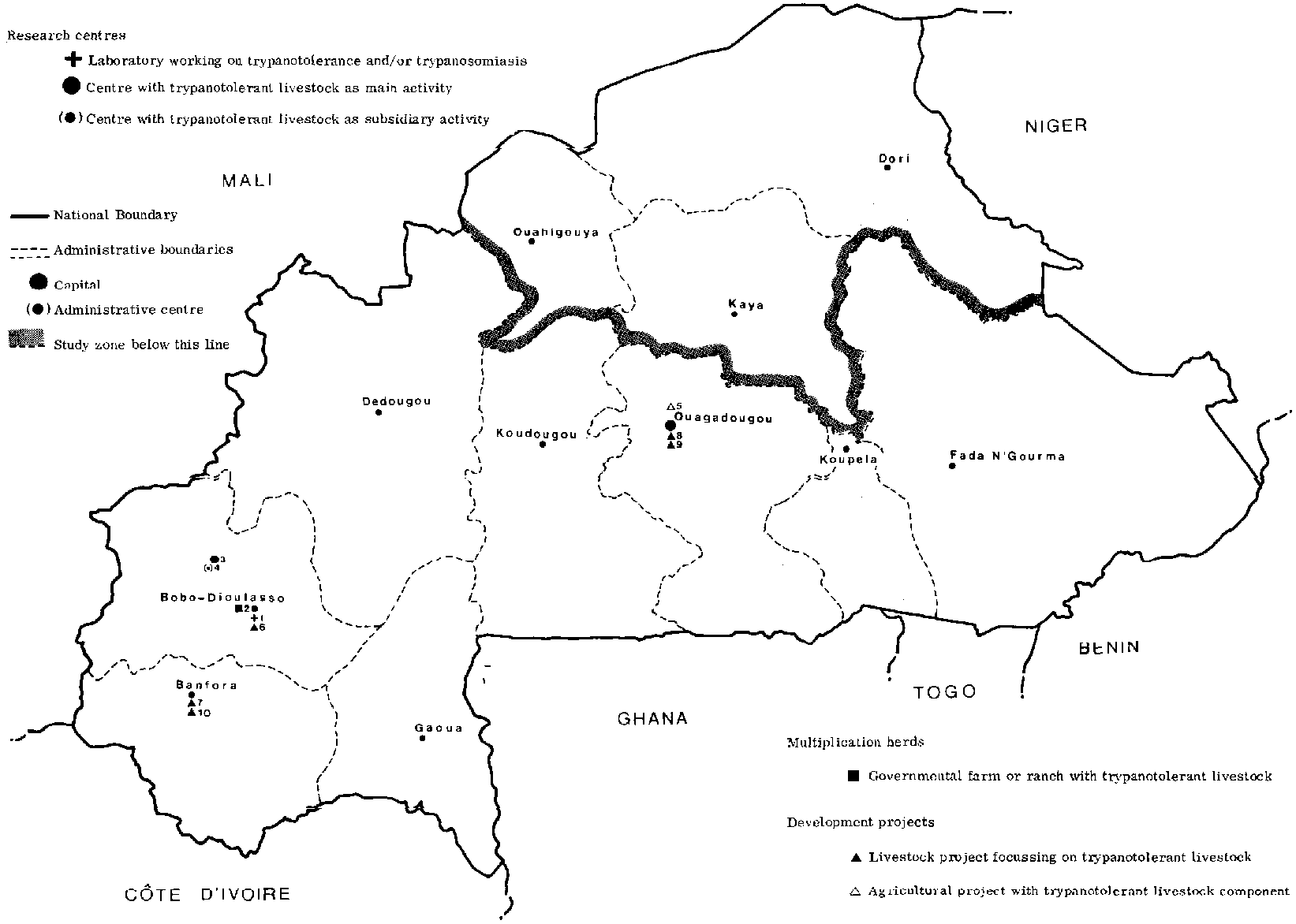
The Republic of Upper Volta is a landlocked country in West Africa surrounded by Mali to the north and west, Niger to the east and Benin, Togo, Ghana and the Ivory Coast to the south. The capital is at Ouagadougou, and the administrative structure is complex. There are three government organizations in Upper Volta with responsibilities in the field of animal health and production which in some cases overlap. There are the original Service de l'Elevage, the Offices Régionaux de Développement (ORD) now being developed and a third organization in charge of regional projects externally financed. (See Figure 1.)
The country is thus divided into 11 ORDs; there are also 10 administrative departments with 44 arrondissements and at the same time 8 Circonscriptions d'Elevage with 14 sectors and 51 veterinary stations. The study area includes all the ORDs except Kaya, Ouahigouya and Dori.
Basic data for Upper Volta as a whole and for the study area are given in Table 1.
Table 1. Background data for Upper Volta.
|
|
Whole Country |
Study Area |
|
|
Area |
274 200 km² |
203 000 km² |
|
|
Latitude |
9°30'-15° N |
9°30'-13° N |
|
|
Longitude |
5° 30' W-2°30' E |
5°30' W-2°30' E |
|
|
Population |
|||
|
|
number |
6 170 000 |
5 000 000a |
|
|
density |
22.5/km² |
24.6/km² |
|
Livestock numbers |
|||
|
|
cattle |
2 550 000 |
1 534 000 |
|
|
sheep |
1 800 000 |
1 000 000 |
|
|
goats |
2 600 000 |
1 800 000 |
a. Estimate.Sources: For population, OAU, 1978; for livestock numbers, Upper Volta, Direction des Services de l'Elevage, 1977.
There is one rainy season, which occurs between June and October and is often very short. In the northern part of the study area, the climate is Sahelo-Sudanian, with an annual rainfall between 600 and 1 000 mm. The southern part of the study area, which comprises about 15% of the entire country, has a Sudano-Guinean climate with annual rainfall between 1 000 and 1 400 mm.
According to the OAU/STRC tsetse distribution map (1977), over two-thirds of the country is infested with tsetse. G. tachinoides is found throughout the infested area, while G. morsitans is found mainly in the eastern region and less frequently in the north. G. palpalis is found in the west and southwest, and a small number of G. longipalpis and G. medicorum are found in the southernmost part of the country.
Gruvel and Gauch (1977) carried out a study of animal trypanosomiasis in Upper Volta as part of an FAO/UNDP regional project. They found that the northern tsetse limit has moved south in the past 50 years and reported that tsetse are now confined to the area south of the 800 mm isohyet.
Table 2 gives livestock numbers in the 11 ORDs as of 1977. The proportions of humpless, Zebu and crossbred cattle are estimates.
Table 2. Livestock numbers in Upper Volta, 1977 ('000).
|
ORD
|
Cattle |
Sheep and Goats |
|||||||
|
Total |
Humpless |
Crossbred |
Zebu |
No. |
% of cattle in ORD |
||||
|
No. |
No. |
% of cattle in ORD |
No. |
% of cattle in ORD |
No. |
% of cattle in ORD |
|||
|
Banfora |
97 |
67.9 |
70 |
19.4 |
20 |
9.7 |
10 |
207 |
5.00 |
|
Diébougou |
130 |
117.0 |
90 |
10.4 |
8 |
2.6 |
2 |
207 |
5.00 |
|
Bobo Dioulasso |
163 |
65.2 |
40 |
40.8 |
25 |
57.0 |
35 |
362 |
8.75 |
|
Dédougou |
322 |
81.7 |
25 |
147.2 |
45 |
98.1 |
30 |
414 |
10.00 |
|
Koudougou |
184 |
55.2 |
30 |
36.8 |
20 |
92.0 |
50 |
259 |
6.25 |
|
Ouagadougou |
237 |
35.6 |
15 |
47.4 |
20 |
155.0 |
65 |
311 |
7.50 |
|
Koupéla |
107 |
32.1 |
30 |
64.2 |
60 |
10.7 |
10 |
104 |
2.50 |
|
Fada N'Gourma |
289 |
28.9 |
10 |
115.6 |
40 |
144.5 |
50 |
362 |
8.75 |
|
Kaya |
293 |
|
|
58.6 |
20 |
234.4 |
80 |
673 |
16.75 |
|
Ouahigouya |
155 |
|
|
|
|
155.0 |
100 |
311 |
7.50 |
|
Dori |
573 |
|
|
|
|
573.0 |
100 |
932 |
22.50 |
|
Totals |
2 550 |
483.6 |
19 |
540.4 |
21 |
1 531.0 |
60 |
4 142 |
100.00 |
Source: Upper Volta, Direction des Services de l'Elevage, 1977.
Of the total 4 142 000 small ruminants in 1977, approximately 2 485 000 were goats and 1 657 000 were sheep, giving a ratio of three goats for every two sheep. In the study area, there are about 1 500 000 goats and 1 000 000 sheep.
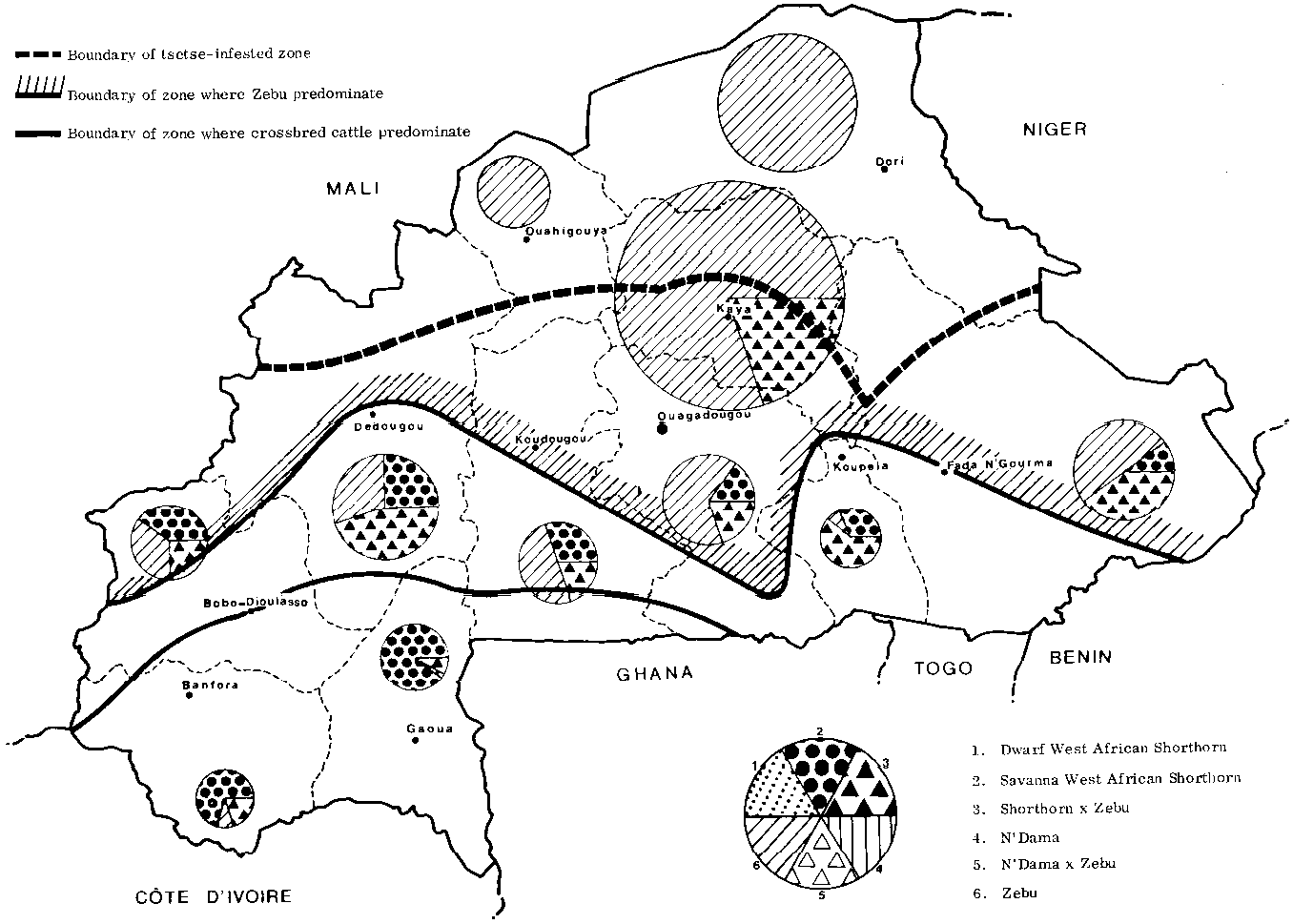
Humpless cattle account for about 19% of the total cattle herd throughout the country, and crossbreds for another 21%. In the study area, which includes au the ORDs except Dori, Ouahigouya and Kaya, about 32% of the 1 529 000 cattle are humpless and 35% crossbreds. Figure 2 shows the northern limit of the tsetse zone, the distribution of the national herd and the proportions of Zebu, crossbred and humpless cattle in the 11 ORDs.
3.1 BREED DESCRIPTION
The humpless cattle of Upper Volta belong mainly to the West African Shorthorn group and are known as Méré or Lobi (see Figure 3.38, volume 1) or Lobi Gouin in the south. Crossbreeding with Zebu is common, as indicated by numbers of crossbreds shown in Table 2. In Banfora ORD, there are also a number of N'Dama originating from Mali, and some Azaouak, imported from Niger, are kept, mostly on government research stations.
3.1.1 Méré
The Méré of Upper Volta resemble the Baoulé of Ivory Coast (see Chapter 3, volume 1), though according to Tyc and Legrand (1972) the Méré tend to be smaller in Banfora ORD in the south. These authors report that the Méré tend to increase in size from south to north, from Banfora to Gaoua and Dédougou, even without any signs of crossbreeding.
The mortality rate in the southwestern area, according to Tyc and Legrand (1972), ranges from 30 to 50% for calves up to one year old, mainly due to internal parasites. The average carcass weights for Méré at Banfora abbatoir in 1971 were 68 kg for 134 females and 74 kg for 258 males. Higher weights were reported from the Bobo Dioulasso abbatoir, namely 99.5 kg for 258 females, and 95 kg for 575 males, most likely because humpless cattle and crossbreds were grouped together. The average carcass weight for Zebu at Bobo Dioulasso was 114 kg. SCET (1972) reports average carcass weights from a number of abbatoirs around the country similar to those at Banfora; among humpless cattle, 80 kg for males and 75 kg for females, and among Zebu, 110 kg for males and 95 kg for females.
3.1.2 Zebu x Humpless Crossbreds
There are many Zebu x humpless crossbreds in Upper Volta, and their numbers seem to be increasing. There are already more crossbreds than pure humpless cattle, though both are often called Méré (see Figure 3.56, volume 1). The main crossbred area is a belt from west to east, including Bobo Dioulasso and Koudougou and widening parallel to the southern border south of Koupela and Fada N'Gourma.
Figure 2. Cattle numbers and breed distribution.
These crossbreds include au types of mixtures between the two original breeds and their appearance varies considerably. Their coats are mostly black, black-and-white or brown-and-white, and their horns are of medium length. They are generally small, smaller than the Borgou of Benin for instance.
According to Mordant and Lebrun (1969), the age at first calving under village conditions is between 4 and 5 years, with a calving interval of 540 to 730 days. The same authors report a mortality rate from birth to 4 years of about 50% in the southern part of the country under village conditions. Weights at birth and at eight months recorded on two government stations are given in Table 3. At Farako-Ba Station, crossbreds with a more humpless appearance studied from 1966 to 1977 were fed improved pasture plus hay, while at Saria Station, crossbreds with a more Zebu appearance were fed improved pasture plus straw and fodder from 1965 to 1967.
Table 3. Weights of crossbred cattle at birth and 8 months on two government stations.
|
|
Farako-Ba Station |
Saria Station |
||
|
Female |
Male |
Female |
Male |
|
|
Number of births |
14 |
15 |
14 |
15 |
|
Birth weight (kg) |
18 |
18 |
15 |
18 |
|
Number at 8 months |
4 |
3 |
5 |
5 |
|
8-month weight (kg) |
91 |
111 |
128 |
138 |
Source: Borget, 1969.
The only information available on draught capacity is from a trial carried out at Saria Station in 1965. An average continuous draught power of 60 kg was achieved by a pair of oxen weighing 480 kg, reported by Mordant and Lebrun (1969).
3.1.3 N'Dama
There are very few N'Dama in Upper Volta. A few are found in Banfora ORD near the Mali border, and some purebred N'Dama are kept on government stations in Matourkou and Samandeni in the southwestern part of the country.
The N' N'Dama kept on the stations are the classical Guinean type, with fawn coats, while those kept under village conditions are very often crossbred with Méré.
Adult cows kept at Matourkou Station under improved grazing on average measured 107 cm at withers and weighed 249 kg (van Binsbergen, 1973). Three two-year-old steers were kept for two months on a diet of cotton seed and Brachiaria ruziziensis hay: their average weight was 158 kg at the beginning and 188 kg at the end of the experiment, indicating an average weight gain of 517 g daily (van Binsbergen, 1973).
Draught capacity was tested by the Institut de Recherches Agronomiques Tropicales et des Cultures Vivrières (IRAT) at Farako-Ba and Saria Stations. At Farako-Ba, a pair of oxen weighing 730 kg achieved an average continuous draught power of 89 kg and a maximum of 235 kg (Pagot, et al., 1972). At Saria, a pair weighing 650 kg achieved a draught power of 70 to 80 kg on a continuous basis (Mordant and Lebrun, 1969).
3.1.4 Zebu
The Zebu of Upper Volta will not be described in detail, but they account for about one-third of the cattle in the study area, which is considered a tsetse-infested zone. These herds are owned by Fulani and are found mainly in the northern, drier portions of the study area where tsetse infestation is lower, but large herds are also moved into the areas where humpless cattle predominate, down as far as the southern border and into northern Togo, for example. They are also sometimes kept in small pockets in areas of humpless cattle and crossbreds, for example in the White Volta valley and the region west of Bobo Dioulasso. More recently, the Fulani seem inclined to move their herds towards the southwest, rather than only to the open plains of the southeast.
In Upper Volta, the Zebu are of the Sudanese Fulani Zebu breed. Their external appearance varies, both in terms of coat colour and the shape of the horns. They tend to be relatively small and light weight compared with other Zebu of this part of Africa
Studies of Zebu are largely carried out at the herd level in the Sahelian and Sub-Sahelian zones. However, at Matourkou Station four adult females were measured, averaging 1.16 m at withers and 270 kg liveweight. Rochez (1977) reported the results of five intensive fattening trials carried out with local Zebus in Kou Valley in Bobo Dioulasso ORD. The weight gains of these animals are presented in Table 4. Their average dressing out percentage was 56.5%.
Table 4. Zebu fattening operations in Kou Valley.
|
|
Intensive fattening |
Fattening under village conditions |
||||
|
I |
II |
III |
I |
II |
||
|
Number of animals |
10 |
9 |
9 |
11 |
10 |
|
|
Length of trial (days) |
252 |
236 |
124 |
90 |
180 |
|
|
Average weight: |
||||||
|
|
beginning |
218 |
243 |
230 |
382 |
325 |
|
|
end |
296 |
318 |
304 |
417 |
362 |
|
Average daily weight gain (g) |
308 |
550 |
593 |
388 |
205 |
|
Source: Rochez, 1977.
Zebu tend to be more popular than the humpless breeds in Upper Volta for several reasons: a higher offtake rate is possible with Zebu and they are more suitable for training as draught animals. Almost all draught animal development projects in the country use Zebu or crossbreds. However, in the southwest and the valleys of the Voltas, these animals must be kept under chemoprophylaxis. Throughout the southern area, trypanocidal drugs are heavily used, though not necessarily under veterinary supervision.
3.1.5 Azaouak and their Crosses
Data on Azaouak and their crosses are available from Matourkou Station. According to van Binsbergen (1973), milk yields averaging 1 059 kg over 238 days were obtained from 50 cows with lactations over 100 days, and Mordant and Lebrun (1969) reported average yields at the same station of 1 300 kg per lactation. Body weights for Azaouak and their crosses are shown in Table 5. As part of a fattening trial, three 12-month-old steers were fed a ration of cotton seed and Brachiaria ruziziensis hay over 58 days. Their average weight at the beginning of the period was 130 kg and at the end it was 172 kg, representing a daily weight gain of 724 g.
A crossbreed between West African Shorthorn, Azaouak and N'Dama was produced at Saria and Farako-Ba Stations by IRAT in an effort to produce improved draught animals. Malcoiffe (1972) reported the average age at first calving and calving intervals for this crossbreds given in Table 6. Weaning occurred naturally at 7.5 to 11 months, and cows were not milked.
Table 5. Body weights of Azaouak and their crosses at Matourkou Station.
|
|
Azaouak |
Azaouak x N'Dama |
Azaouak x Local Zebu |
Azaouak x (N'Dama x Zebu) |
||||||||||||
|
Female |
Male |
Female |
Male |
Female |
Male |
Female |
Male |
|||||||||
|
No. |
kg |
No. |
kg |
No. |
kg |
No. |
kg |
No. |
kg |
No. |
kg |
No. |
kg |
No. |
kg |
|
|
Birth |
48 |
21 |
45 |
23 |
29 |
19 |
19 |
21 |
10 |
21 |
10 |
23 |
8 |
22 |
6 |
21 |
|
6 months |
18 |
84 |
12 |
104 |
17 |
79 |
16 |
87 |
7 |
94 |
6 |
102 |
3 |
111 |
3 |
79 |
|
12 months |
21 |
134 |
12 |
168 |
16 |
122 |
14 |
132 |
8 |
132 |
5 |
160 |
3 |
155 |
3 |
126 |
|
18 months |
24 |
181 |
7 |
233 |
13 |
156 |
8 |
159 |
6 |
169 |
2 |
207 |
- |
- |
- |
- |
|
24 months |
21 |
212 |
5 |
254 |
12 |
190 |
7 |
178 |
7 |
198 |
2 |
225 |
- |
- |
- |
- |
|
30 months |
15 |
252 |
4 |
316 |
4 |
211 |
1 |
160 |
- |
- |
- |
- |
- |
- |
- |
- |
|
Study period |
1966-1972 |
1969-1972 |
1969-1972 |
|
|
|
|
|||||||||
Source: van Binsbergen, 1973.
Table 6. Age at first calving and calving interval for crossbreds between WAS, Azaouak and N'Dama (number of animals in brackets).
|
|
Average Age at First Calving (months) |
Average Calving Interval (days) |
|
|
Saria |
|||
|
|
1969 |
31 (9) |
371 (16) |
|
|
1970 |
31 (5) |
388 (18) |
|
Farako-Ba |
|||
|
|
1970 |
38 (4) |
378 (20) |
|
|
1971 |
37 (6) |
408 (20) |
Source: Malcoiffe, 1972.
The average weights of these crossbreds at the two stations are given in Table 7.
Table 7. Average weights of WAS, Azaouak and N'Dama crossbreds.
|
|
12 Months |
18 Months |
24 months |
30 Months |
36 Months |
||||||
|
no. |
kg |
no. |
kg |
no. |
kg |
no. |
kg |
no. |
kg |
||
|
Farako-Ba |
|||||||||||
|
|
female |
22 |
155 |
20 |
204 |
13 |
255 |
11 |
291 |
6 |
290 |
|
|
male |
10 |
174 |
8 |
224 |
5 |
259 |
3 |
328 |
1 |
345 |
|
Saria |
|||||||||||
|
|
female |
17 |
159 |
13 |
193 |
10 |
242 |
5 |
270 |
1 |
307 |
|
|
male |
8 |
189 |
6 |
230 |
4 |
302 |
2 |
389 |
- |
- |
Source: Malcoiffe, 1972.
3.2 DISEASE
The animal health situation in Upper Volta is a major concern; the cattle are generally in poor condition (Grovel and Gauch, 1977; Tyc and Legrand, 1972).
Rinderpest and contagious bovine pleuropneumonia (CBPP) are the most serious contagious diseases, spread widely through trade and transhumance. In 1974, two outbreaks of rinderpest and 13 outbreaks of CBPP were reported, though the outbreaks of CBPP were reduced to eight in 1977. This situation is disturbing because the government health authorities do not have the means to control these diseases. Tuberculosis occurs mainly in the north, and other contagious diseases, such as blackquarter, anthrax and foot-and-mouth, occur but have less serious economic consequences. There were 46 foci of foot-and-mouth in 1974.
The incidence of parasitic diseases is similar to the situation in other countries, except for a high incidence of rickettsiosis in the south, affecting mostly young animals. Veterinary treatments for trypanosomiasis and other parasitoses have been available in each ORD since 1956-57, though fees are charged. Grovel and Gauch (1977) reported that T. congolense and T. vivax are predominant in Upper Volta, together with T. brucei in the south. Their distribution and relative importance are totally unknown.
3.3 HERD MANAGEMENT AND COMPOSITION
Both transhumance and settled agriculture are common in Upper Volta. Philippe (1975) describes the traditional farmers and transhumants of the Leo area in the central southern part of the country, and his descriptions are quoted here as typical of the two predominant production systems.
3.3.1 Herd Management Under a Farming System
The Gurunsi, like all the inhabitants of savanna country, is above all a farmer. Therefore each village has its herds, however small they may be, usually tended by a Fulani herdsman: 900 cattle for 16 villages (= 2 cattle per 10 inhabitants). Cattle are the private property of the richest families in the village: often the chiefs, the marabouts and also old warriors.Traditionally, quantity is more important than quality. However, for two years now, villagers have begun to want to buy Zebus on ORD advice to train them as draught animals. Unfortunately, they have not received any assistance...
The herds constitute capital and animals are only slaughtered when they are either old, tired or sick, for weddings, funerals, feasts, sacrifices, of when money is needed (for taxes, purchase of millet, etc.). The economic role of the herd is th thus very limited: manure is never utilized, the milk goes to the Fulani herdsmen, and meat is hardly ever consumed (game meat is preferred). We would like to point out, however, the case of a farmer who owned more than 100 cattle. He started selling them off to buy a millet crusher, but he was also motivated by the fear of seeing his herd disappear with the herdsman. Often the Gurunsi livestock owners split up their cattle into small herds, each with its own herdsman (this is insurance against theft) (Philippe, 1975).
3.3.2 Problems of Transhumance
Only since 1972 have the villages situated away from the traditional trading routes with Ghana had regular dealings with the transhumants. Transhumants come from north of the area, from Kedougou and from further north. The northern Fulani herds are mainly made up of Zebus, while the others are made up of crossbreds, humpless cattle and some Zebus. They are less healthy than the village herds and the Fulani of the region accuse the transhumants' herds of spreading parasites to their cattle. This is very possible since all the herds meet at the same water ponds where they tread in the mud and contaminate the water. The transhumant herds have from 40 to 300 head, with an average of 100.
Transhumance is looked down upon by the local Gurunsi, Mossi and Fulani. Here one comes across the typical antagonism between the pastoralist from the north and the farmer from the Sudanese belt. Transhumants present a number of problems to the inhabitants of the region: the farmers' fields are not respected, waterponds are used up, well water is used at a time when it does not even meet human requirements, and thefts occur. The transhumant with his herd behaves like a master and has no respect for the farming population (Philippe, 1975).
3.3.3 Herd Composition
SCET (1972) carried out surveys of herd composition in 1969-70 in Diebougou and other ORDs. In all, 63 330 cattle were covered, with typical herd compositions by sex and age given in Table 8.
Table 8. Herd composition in Diebougou and other ORDs (percentages).
|
|
Humpless Cattle |
Zebu and Crossbreds
|
|||||||
|
Diebougou ORD |
Other ORDs |
||||||||
|
Females |
Males |
Total |
Females |
Males |
Total |
Females |
Males |
Total |
|
|
No adult teeth |
8.6 |
8.1 |
16.7 |
18.0 |
10.9 |
28.9 |
14.4 |
11.2 |
25.6 |
|
2 or 4 adult teeth |
10.9 |
8.9 |
19.8 |
15.5 |
13.1 |
28.6 |
14.0 |
9.8 |
23.8 |
|
6 and over adult teeth |
46.5a |
17.0 |
63.5 |
37.0a |
5.5 |
42.5 |
40.1a |
10.5 |
50.6 |
|
Totals |
66.0 |
34.0 |
100.0 |
70.5 |
29.5 |
100.0 |
68.5 |
31.5 |
100.0 |
a. Breeding females.Source: SCET, 1972.
Tyc and Legrand (1972) report the herd structure of the Méré in Banfora ORD, as given in Table 9. They remark that 'in our opinion sedentary breeders exploit their herds at too young an age; in fact, 65% of calves are sold or slaughtered during their second year and 30% between two and three years'.
Table 9. Herd composition of the Méré in Banfora ORD.
|
Females |
% |
Males |
% |
|
Cows 3 to 12 years |
53 |
Bulls (4% of adult cows) |
2 |
|
Heifers 2 to 3 years |
9 |
Young males 1 to 3 years |
5 |
|
Female calves 0 to 2 years |
20 |
Male Calves 0 to 1 year |
11 |
|
Total females |
82 |
Total males |
18 |
Source: Tyc and Legrand, 1972.
3.3.4 Draught Animals
Rochez (1977) described the role of draught animals in Upper Volta as follows:
Draught animals play one of the most important roles in the economic and agricultural development of the country. This method has not always been very popular with technicians, but the person directly involved, the Voltaian farmer, made up his mind about it a long time ago. In fact, with the return of favourable weather conditions, the number of ox and donkey teams has practically doubled in two years, from 21 000 in 1975 to 40 000 in 1977. Introduced 25 years ago on pilot farms, the popularity of draught animals has varied according to the regions.
He estimated the total number of draught oxen at 29 800 as of mid-1977. The rapid increase in the number of draught animals in recent years is illustrated by the fact that there were 36 pairs of oxen in Banfora ORD in 1971/72, according to Tyc and Legrand (1972), and there were 600 pairs in 1977.
4.1 SHEEP
The sheep of Upper Volta vary considerably, ranging from the Djallonké type in the southwest to the Sahelian breeds in the north. The Djallonké are found throughout the study area. Among the Djallonké, the Mossi variety, which is larger than the variety found further south, can be considered a savanna Djallonké (see Figure 3.76, volume 1). In the northern parts of the study area, there is considerable crossbreeding with the Sahelian breeds.
Mordant and Lebrun (1969) reported a lambing rate of 80 to 90% under village conditions in the southern part of the country. Lambing occurs chiefly from April to June and in September.
SCET (1972) reports an average carcass weight for sheep of 12.8 kg, while the Service de l'Elevage reports an average carcass weight of 8.5 kg in its 1976 meat production statistics, based on the weights of animals slaughtered at the freezing plant at Ouagadougou.
4.2 GOATS
According to Mordant and Lebrun (1969), the goats of Upper Volta are of an intermediate Sudanian type, between the Guinean and Sahelian goats in appearance. However, they cannot be considered a cross between these two breeds. SCET (1972) reports an average carcass weight for goats of 11 kg, while the average carcass weight recorded at the Ouagadougou freezing plant was 7.5 kg.
The chief diseases among goats, as well as sheep, are pleuropneumonia and internal parasites (Tyc and Legrand, 1972).
5.1 RESEARCH CENTRES
There is no animal husbandry research as such in Upper Volta. However, there are several biological research and training centres in the town of Bobo Dioulasso.
The Centre de Recherches sur les Trypanosomiases Animales in Bobo Dioulasso (B. P. 454) is indicated by +1 in Figure 1. This research centre, with assistance from IEMVT, is now studying the biological control of tsetse flies by the sterile male technique (see IEMVT, 1977). G. palpalis gambiensis is bred in the laboratory and the males are sterilized by radiation and released in the infested area. As of 1978, the centre planned to diversify its activities by initiating a study of the biochemical and genetic aspects of trypanotolerance. This new project was supported by West Germany and DGRST and IEMVT in France.
The Ecole de Lutte Anti-Tsetse (ELAT) is also at Bobo Dioulasso. With support from West Germany and France, this school trains technical staff for tsetse control organizations. Three other institutions at Bobo Dioulasso carry out work on human trypanosomiasis: the Organisation Commune de Contrôle des Grandes Endémies (OCCGE), the 'Muraz' centre doing medical research, particularly focussing on parasitology, and a centre of the French Office de la Recherche Scientifique et Technique Outre-Mer (ORSTOM) with a medical entomology team.
5.2 MULTIPLICATION AND EXTENSION
Multiplication and extension herds in the study area are described in Table 10. The main station engaged in multiplication work is at Markoye outside the study area in the Sahel. Here, a multiplication herd of Azaouak Zebu is kept, as well as sheep and goats.
Although the Samandeni and Farako-Ba stations are listed here as multiplication herds, they could also be described as research stations in terms of the work carried out in the past. They are designated as research stations in Figure 1.
5.3 DEVELOPMENT PROJECTS
There are six livestock development projects currently underway in Upper Volta with activities in the study area. These are described in Table 11.
Table 10. Multiplication and extension herds.
|
Name |
Centre de Formation de Matourkou |
Station de Samandeni, c/o CRTA, B.P. 454, Bobo Dioulasso |
Station de Farako-Ba |
|
Location (and reference in Figure 1) |
15 km south of Bobo Dioulasso |
Near Bobo Dioulasso |
Near Bobo Dioulosso |
|
Organization responsible |
|
Direction des Services de l'Elevage |
IRAT |
|
Size |
1 000 ha |
|
|
|
Breeds and numbers |
250 head including 80 N'Dama, 40 draught oxen and 115 Azaouak Zebu (1978) |
103 local humpless cattle or Méré, 30 N'Dama (1978) |
180 head, including 30 crossbred cows (humpless x Azaouak) and 13 Méré cows |
|
Objectives |
Training centre with a livestock component. Animal performance is recorded but there are no recent publications. |
The herd is mixed and no performance data are recorded. Could be integrated with the trypanotolerance research project. |
Draught animal research. Local humpless and N'Dama were crossed and the crossbred obtained was crossed with the Azaouak Zebu from Niger. Results for the first generation were satisfactory. |
Table 11. Development projects.
|
Name |
Aménagement des Vallées des Volta (AVV) |
Projet Elevage Ouest-Volta (PEOV) |
Feedlot de Banfora |
Assistance a la Culture Attelée |
Elevage Villageois |
Amélioration de l'Elevage traditionnel dans l'ORD de Banfora |
|
Location and headquarters (and reference in Figure 1) |
White, Red and Black Volta valleys, Ouagadougou |
Dedougou and Bobo Dioulasso ORD, Bobo Dioulasso |
Comoe ORD, Banfora |
Entire country, Ouagadougou |
Kaya, Koupéla and Fada Ngouma ORDs, Ouagadougou |
Banfora ORD, Banfora |
|
Organization responsible |
Ministère du Développement Rural |
Direction de l'Elevage, Ministère du Développement Rural, B.P. 116, Bobo Dioulasso |
ONERA - Ministère du Développement Rural, B. P. 33, Banfora |
Secrétaire Permanent du Comité de Coordination du Développement Rural, Ministère du Développement Rural, B.P. 575, Ouagadougou |
CIDR, Ministère du Developpement Rural, B. P. 35, Ouagadougou |
Ministère du Développement Rural |
|
Size |
|
58 000 km², 900 000 inhabitants |
facilities for 2 feedlots with 3 000 head each |
|
5 villages |
|
|
Breeds and numbers |
In 1978, approx. 3 500 cattle, mainly Zebus, of which 1 500 were draught oxen |
Cattle and small stock |
Approx. 400 Zebus |
All type of cattle and donkeys |
Cattle, sheep and goats |
Méré, crossbreds, Zebus |
|
Objectives |
Expansion and improvement of traditional herds. Establishment of villages in new areas using draught oxen for farming. |
Increase breeding stock for ranch development. Improve livestock marketing and reinforce veterinary facilities. Create 9 ranches and their development centre, Internal and external parasite control for sheep and goats. |
Industrial fattening pilot project including village fattening trials and introduction to local people. |
Encourage the use of draught animals in new regions. Consolidate their establishment where they are already in use. Use of animals for cultivation as well as pulling vehicles. Develop and extend improved ox-drawn equipment. |
Assist the livestock service in planning and establishing cattle and/or small-stock breeding projects at the village level. Vaccination programmes, village fattening; creation of reserves, pasture control, training. |
Promote cattle production in traditional areas to make it profitable at peasant farming level. Veterinary assistance, supplementary feeding, Zebu crossbreeding. |
|
External aid |
Netherlands and France (FAC) |
IBRD |
Germany (GTZ) |
UNDP, FAO and Denmark (DANIDA) |
USA (USAID) |
EEC (EDF) |
|
Project period |
3 years: 1975-1978 |
1976-1980 |
1976-1979 |
4 years: 1975-1979 |
1976-1978 |
4 years: 1976-1980 |
Borget, M (1969). 'Observations sur les troupeaux des stations IRAT'. In Colloque sur l'élevage. Fort Lamy, IEMVT, pp. 240-251.
Boudet, G and Dumas, R (1975). Intégration de la production animale dans l'exploitation agricole dans le cadre de l'aménagement des Voltas. Maisons Alfort, IEMVT, 151p.
Bremaud, O. Beck, K, Nissen, N. Vindrinet, R and Lindau, M (1976). La santé animale en Haute-Volta. Eschborn and Paris, GTZ/SEDES, 95P.
Gidel, R (1972). 'Etude sur la composition moyenne de troupeaux de bovine de Haute Volta et de Côte d'Ivoire en fonction de l'âge et du sexe'. Rev. Elev. Med. Vet. Pays Trop. 25, pp. 543-550.
Gruvel, J and Gauch, J G (1977). Les trypanosomiases animales en Haute Volta. AG:DP/RAF/75/001. Rome, FAO.
Hack, H (1974). Moglichkeiten der langfristigen Entwicklung der Sahellander Obervolta, Mali, Niger. Bonn, Federal Ministry for Economic Cooperation, 121p
Herman, L (1977). Cattle and meat marketing in Upper Volta. REDSO/WA 77-100 Abidjan, USAID.
IEMVT (1974). Implantation d'un ranch d'embouche en Haute Volta Région de Léo. Etude Agrostologique No. 40. Maisons Alfort.
IEMVT (1977). Programme de recherche sur la trypanosomiase bovine: Etude de la trypanotolérance. 738/DIR. Maisons Alfort.
Malcoiffe, C (1972). 'Note sur la gestion et l'évolution des troupeaux bovine des stations IRAT de Haute Volta (1963-1971)'. L'Agronomie Tropicale. 27 (5), pp. 608-632.
Mordant, J and Lebrun, J P (1969). Le potentiel zootechnique de la Haute Volta. Maisons Alfort, IEMVT, 327p.
Pagot, J. Coulomb, J and Petit, J P (1972). 'Revue et situation actuelle de l'emploi des races trypanotolérantes'. Paper presented at the Séminaire Inter-regional FAO/WHO sur la Trypanosomiase Africaine, held at Kinshasa, 42p.
Philippe J (1975). 'Etude socio-géographique pour l'implantation d'un ranch d'embouche dans la région de Léo'. Ouagadougou, Centre Voltaique de la Recherche Scientifique, Direction de l'Elevage et des Industries Animales.
Rochez, A (1977). Rapport final de l'expert en production animale: Assistance à la culture attelée. Project UPV 17 Den. Rome, FAO.
SCET-International (1972). 'Note de Synthèse'. In La production animale voltaique: Perspectives de developpement. Volume 2. Paris, Secrétariat d'Etat aux Affaires Etrangères.
SEDES (1975). L'Elevage en Haute Volta: Analyse et propositions d'orientation. Paris, Ministère de la Cooperation.
Traoré, S (1964). 'L'Elevage bovin en Haute Volta: Importance relative du zebu et du taurin'. Dr. Vet. Med. thesis, Ecole Nationale Vétérinaire de Lyon.
Tyc, J M and Legrand, M (1972). Développement de l'élevage dans l'ouest de la Haute Volta. Paris, SEDES.
Upper Volta, Direction des Services de l'Elevage (1977). Rapport annuel. Ouagadougou.
USAID (1976). 'Village livestock'. Project No. 686-0203. Ouagadougou.
van Binsbergen, H (1972). 'La culture attelée dans le développement rural'. Matourkou, FAO, 30p.
van Binsbergen, H (1973). 'Centre agricole polyvalent de formation de Matourkou (Phase II): Rapport final de l'expert en production animale'. Matourkou, FAO.
WIP (1975). Etude de factibilité d'un ranch d'embouche dans le sud-ouest voltaique (Banfora). Munich.

 2
2 5
5 6
6