1. Background
2. Livestock numbers and distribution
3. Cattle
4. Sheep and goats
5. Research and development activities
6. Selected bibliography
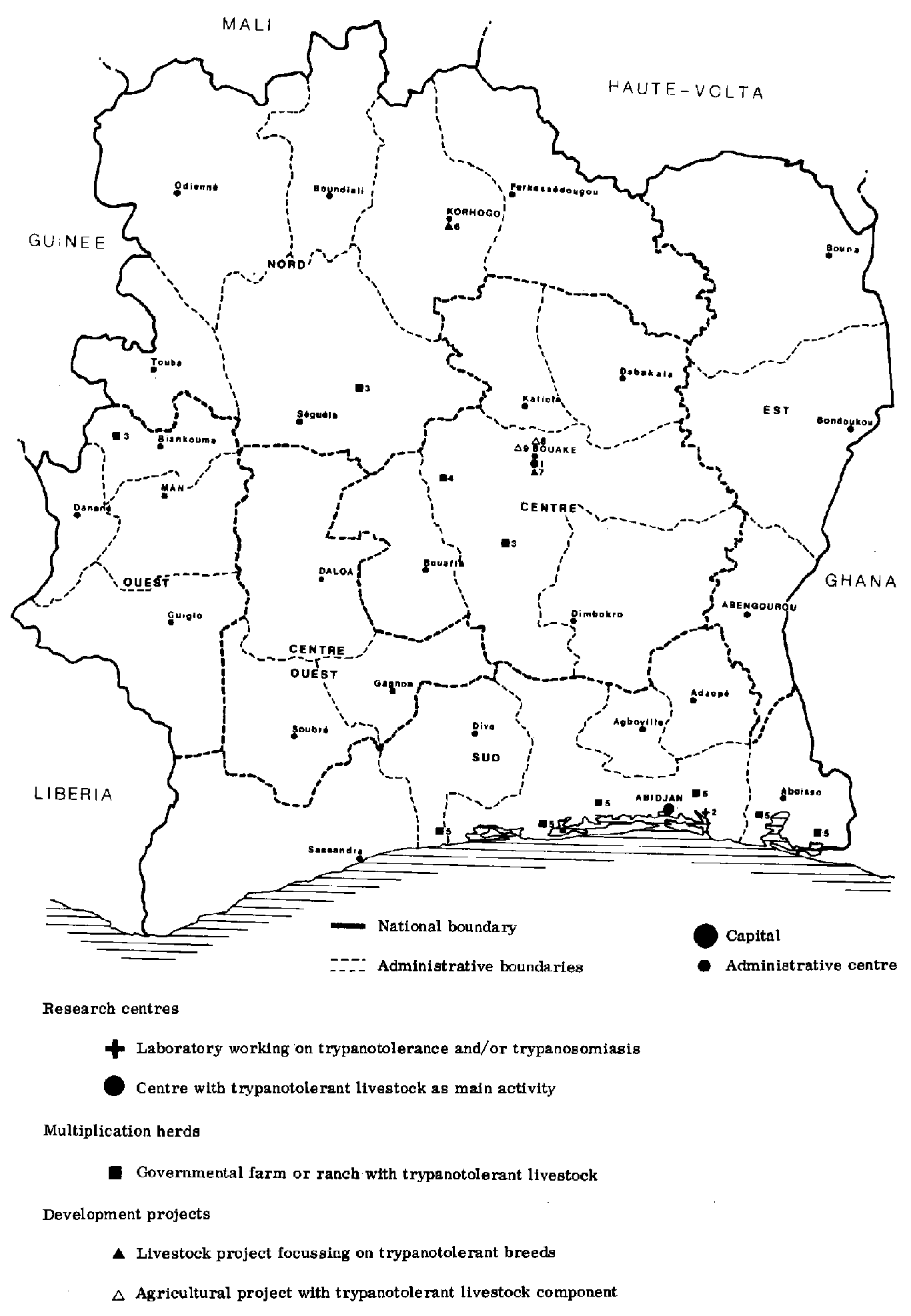
The Republic of Ivory Coast lies on the west coast of Africa, with Ghana to the east, Liberia to the west and Guinea, Mali and Upper Volta to the north. The country, with its capital at Abidjan, is divided into 26 administrative departments grouped into six regions with their regional centres as follows: Nord (Korhogo), Centre (Bouaké), Ouest (Man), Centre-Ouest (Daloa), Est (Abengourou) and Sud (Abidjan). (See Figure 1.)
In 1966, Ivory Coast created a Ministère de la Production Animale which includes among other sections a Direction des Services Vétérinaires, a Direction de la Production Animale and a Service d'Agrostologie et de Production Fourragère. The Direction de la Production Animale has an office in each region and department.
The Ministry has also created a Société de Développement des Productions Animales (SODEPRA) which is responsible for breeding, extension and development activities.
Basic data for the country are given in Table 1.
Table 1. Background data for the Ivory Coast.
|
Area |
322 500 km² |
|
|
Latitude |
5°-10° N |
|
|
Longitude |
3°-8° E |
|
|
Population |
||
|
|
number |
7 028 000 |
|
|
density |
21.8/km² |
|
Livestock numbers |
||
|
|
cattle |
516 000 |
|
|
sheep |
722 000 |
|
|
goats |
568 000 |
Sources: For population, OAU, 1978; for cattle numbers, national census, 1978; for sheep and goats, national estimate, 1975.
Ivory Coast has a forest and Guinean climate south of the eighth parallel with two rainy seasons from May to mid-July and October to November and an annual rainfall between 1 200 and 2 400 mm. In the north, the climate is Sudano-Guinean with one rainy season from July to November and an annual rainfall between 1 100 and 1 600 mm.
According to the OAU/STRC tsetse distribution map (1977), the entire country is infested with tsetse. The principal species are: G. palpalis which is found throughout the country, G. morsitans, G. longipalpis and G. tachinoides in the northern savanna region and G. fusca, G. medicorum and G. pallicera pallicera in the south. Gruvel and Gauch (1977) report that the distribution of these species is not known in more detail.
A number of surveys have been carried out recently in connection with ranching development projects in the savanna areas. Four species of tsetse have been identified in these areas: G. palpalis gambiensis and G. tachinoides found principally in the forest galleries, and G. morsitans submorsitans and G. longipalpis which are more widespread.
A general study of tsetse infestation in the savanna zone was launched in 1978 with assistance from FAO. This study should provide more exact information on tsetse distribution in the northern half of the country.
The cattle population is given in Table 2, broken down by region. In Nord Region, which accounts for nearly 80% of the national herd, figures are also given for each department. This table shows that 23% of the national herd are Zebu and 77% are of the humpless breeds.
A more recent census (1978) carried out by the Ministère de la Production Animale recorded 160 000 Zebu in Nord Region, which brings the national herd up to about 516 000 head.
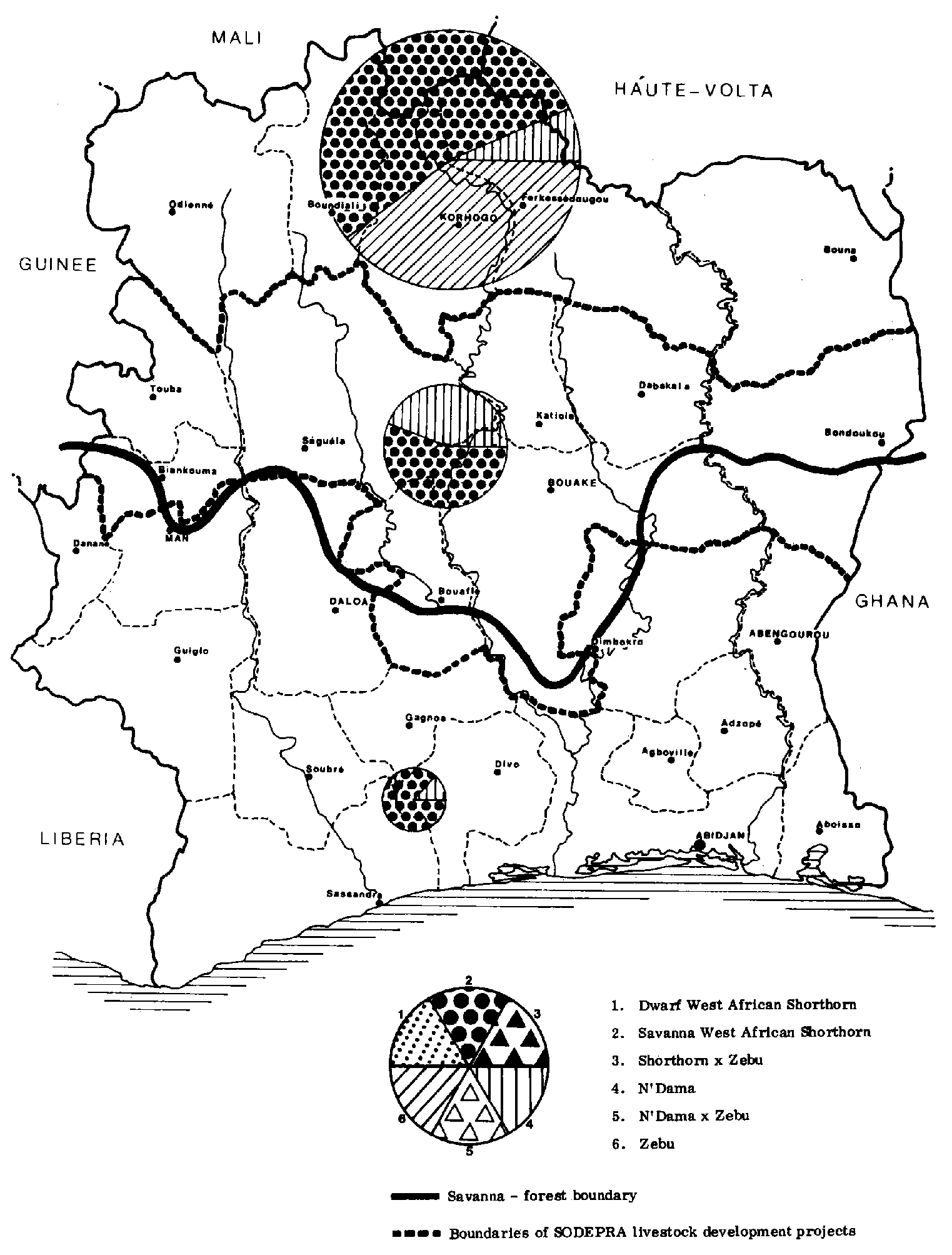
Table 3 and Figure 2 show the distribution of cattle according to three vegetational zones: the northern savanna including the five northern departments, the central savanna including eight departments and the forest region with thirteen departments. The table also gives the estimated total population of the three main cattle types, N'Dama, Baoulé and Méré, and Zebu.
As this table indicates, only 4% of the cattle in Ivory Coast are found in the southern forested area. In the savanna zones, cattle are distributed unevenly, with some very densely populated areas, such as Korhogo, the area north of Bouna, Boundiali and Tingrela, some intermediate areas and some areas with almost no cattle at all.
Figure 2. Cattle numbers and breed distribution.
Table 2. Cattle numbers in Ivory Coast, 1977.
|
Region |
Department |
Zebu |
Humpless |
Total |
|
Nord
|
Odienné |
7 800 |
28 400 |
36 200 |
|
Boundiali |
45 000 |
34 100 |
79 100 |
|
|
Korhogo |
32 500 |
86 800 |
119 300 |
|
|
Ferkéssédougou |
22 000 |
35 900 |
57 900 |
|
|
Bouna |
- |
58 800 |
58 800 |
|
|
Sub-Total |
|
107 300 |
244 000 |
351 300 |
|
Centre |
|
- |
43 400 |
43 400 |
|
Ouest |
|
- |
29 100 |
29 100 |
|
Centre-Ouest |
|
- |
13 700 |
13 700 |
|
Est |
|
- |
12 800 |
12 800 |
|
Sud |
|
- |
13 200 |
13 200 |
|
Total |
|
107 300 |
356 200 |
463 500 |
Source: Ivory Coast, Ministère de la Production Animale.
Table 3. Cattle distribution in Ivory Coast according to breed and vegetation zone.
|
Vegetation Zone |
N'Dama |
Baoulé and Méré |
Zebu |
Total |
% of National Herd |
|
North savanna |
27 000 |
217 000 |
160 000 |
404 000 |
78.3 |
|
Central savanna |
40 000 |
50 000 |
- |
90 000 |
17.4 |
|
Forest region |
3 000 |
19 000a |
- |
22 000 |
4.3 |
|
Total |
70 000 |
286 000 |
160 000 |
516 000 |
100.0 |
|
% of national herd |
13.6 |
55.4 |
31 |
100.0 |
|
a. Including a few Lagune cattle from the coastal region.Source: Ivory Coast, Ministère de la Production Animale.
The Baoulé account for about half the cattle population in the country. They predominate in the savanna areas, except in the west and northwest where the N'Dama are more numerous. They are also found in the forest area in small isolated groups. In 1967, the Baoulé were estimated at about 75% of the national herd, hut their numbers have been decreasing, mainly due to crossbreeding with Zebu.
The N'Dama are found in the northwest, in Odienné, Touba, Biankouma and Man Departments, which border the original breeding area of the Guinean type. N'Dama are also kept on three government ranches and on a number of private and government stud farms.
The Zebu have been introduced recently in Ivory Coast in a small area below the northern border of Tingrela, Boudiali, Korhogo and Ouangolodougou. They are kept alone or sometimes together with Baoulé.
In the areas where Zebu and humpless cattle are kept together, the crossbreds or 'Mere' are found, though it is difficult to estimate their numbers, especially as they include a variety of intermediate types. For the country as a whole, there are an estimated 36 000 Mere or 10 to 15% of the group classified as Baoulé or Mere in Table 3. There seems to be a good deal of crossbreeding going on in the north. Most often Zebu and Baoulé, are crossed, but also Zebu and N'Dama.
There are still a few Lagune cattle in the coastal and forest areas, though they are no longer in the majority because of the introduction of N'Dama and Baoulé from the savannas. Their numbers are often overestimated. Keita (1973), for example, reports 7 000 head, but they probably represent no more than 10% of the total cattle population in Sud Region, or about 1 000 in all.
No recent census of sheep and goats has been carried out. National estimates in 1975 were 722 000 sheep and 566 000 goats, but FAO (1978a) estimated one million sheep and one million goats in 1976.
3.1 BREED DESCRIPTION
Ivory Coast has five main cattle breeds or types: Baoulé (Savanna West African Shorthorn), N'Dama, Méré (Zebu x humpless), Lagune (Dwarf West African Shorthorn) and Zebu (Sudanese type from Mali and Upper Volta).
3.1.1 Baoulé
This breed is described in Chapter 3 of volume 1, (see Figures 3.33 and 3.37, volume 1), In Bouna Department in the northeast, these cattle are called Lobi, after a local tribe.
Some measurements have been carried out at Bouaké Centre by Tidori et al. (1975) as presented in Table 4.
Table 4. Measurements of Baoulé cattle.
|
|
Females |
Males |
|
N = 40 |
N = 26 |
|
|
Weight (kg) |
183 ± 4 |
267 ± 20 |
|
Height at withers (m) |
0.951 ± .014 |
1.001 ± .017 |
|
Height at sternum (m) |
0.467 ± .006 |
0.485 ± .010 |
|
Heart girth (m) |
1.284 ± .016 |
1.405 ± .026 |
|
Scapulo-ischial length (m) |
1.123 ± .017 |
1.212 ± .026 |
Source: Tidori et al, 1975.
Verly (1968) and Glattleider (1977) both recorded slightly lower heights at withers for Baoulé kept under village conditions: 0.92 to 0.94 m for adult cows.
3.1.1.1 Performance Traits. At Bouaké Centre, Tidori et al. (1975) recorded an average age at first calving of 25 months and 21 days + 40 days. Several surveys indicate this is between three and four years under village conditions.
The average calving interval calculated from 234 observations at Bouaké Centre (Tidori et al, 1975) was 421 days, and 80% of the observations ranged between 300 and 480 days, leading to an average fecundity rate of 85% per annum. Estimates under village conditions are 45% (Lemaitre, 1969) and 59% (SEDES, 1972).
Poivey and Seitz (1977) calculated average fecundity rates for 290 Baoulé cows in village herds at Dabakala and Korhogo. The average fecundity rate for cows with four teeth was 28%, for cows with six teeth 39% and for mature cows with eight teeth 56%. Thus, neither fecundity nor the level of precocity among these cows was very high.
Camus (1977) carried out two surveys of fecundity among herds in northern Ivory Coast under village conditions. Among cows with male calves, there were 4 754 births for all breeds, with a fecundity rate of 39.2%. Of these, there were 2 743 births for Baoulé cows, giving a fecundity rate of 40.3%, though the author mentioned that these figures could be underestimates. The second survey covered 150 000 cattle under the supervision of SODEPRA between June 1976 and June 1977. The average fecundity rate for cows from 2 to 11 years old was 40% and for cows from 3 to 10 it was 45%. Fecundity rates according to age group were as follows:
|
Age |
2-3 Years |
3-4 Years |
4-12 Years |
12-13 Years |
|
Fecundity Rate |
0.2% |
15.6% |
46.9% |
18.9% |
These surveys indicate that the fecundity rate under village conditions is low and that precocity is also low, as there is practically no calving under three years and very little under four years.
At Bouaké Centre, Tidori et al (1975) observed a calving season among Baoulé from September to December which accounted for 55% of the annual calving. Under village conditions, Poivey and Seitz (1977) observed that 68% of the annual calving occurred in three months from October to December. These calving seasons are the result of services at the end of the dry season (January to March) when there is maximum sunlight in the day time and nights are cooler.
It is difficult to get estimates of mortality rates, especially for calves. Gruvel and Gauch (1977) give a calf mortality rate of 45%. Camus (1977) estimates 12 to 15% and Poivey and Seitz (1977) 17%, and these two estimates, based on recent surveys, seem more reliable. However, Camus (1977) stresses the great variability in calf mortality among herds and among regions.
Few data are available on Baoulé milk production. Glattleider (1976) reports milk yields under village conditions in two areas as shown in Table 5.
Table 5. Baoulé milk production under village conditions.
|
Area |
Number of Cows |
Average Yield per Lactation (kg) |
Average Length of Lactation (days) |
Method of Milking |
|
Bouaké |
35 |
215 ± 29 |
285 |
direct milking (monthly recording) |
|
Dabakala |
6 |
318 ± 69 |
180 |
calf weighing before and after suckling |
Source: Glattleider, 1976.
Tidori et al. (1975) estimated 309 kg of milk produced from a sample of Baoulé, cows during the first 120 days of lactation based on calf weights. Godet (1977) reported a milked-out yield of about 400 g per day in the dry season and about 700 g per day in the rainy season under village conditions.
Growth among Baoulé cattle at Bouaké Centre, as measured by Tidori et al. in terms of weight, is shown in Table 6.
Poivey and Seitz (1977) estimated average calf growth under village conditions from the following linear regressions:
|
|
n |
|
r² |
|
female |
32 |
W= 19.5 ± 0.117D |
0.68 |
|
male |
23 |
W= 14.7 ± 0.162D |
0.79 |
where W is weight in kg and D is age in days.
Table 6. Baoulé growth at Bouaké Centre.
|
|
Birth |
6 Months |
1 Year |
18 Months |
2 Years |
3 Years |
Over 4 Years |
|
Female |
12 ± 0.3 |
62 ± 2 |
96 ± 3 |
124 ± 3 |
146 ± 3 |
166 ± 6 |
183 ± 4 |
|
(N) |
(209) |
(172) |
(144) |
(111) |
(97) |
(41) |
(96) |
|
Male |
13 ± 0.3 |
61 ± 2 |
93 ± 3 |
127 ± 4 |
162 ± 5 |
213 ± 10 |
267 ± 20 |
|
(N) |
(176) |
(138) |
(111) |
(81) |
(65) |
(28) |
(9) |
Source: Tidori, et al., 1975.
Lhoste (1977) derived an average growth rate of 200 to 350 g/day for periods varying from 80 to 460 days from a number of fattening trials carried out in Centre Region. An intensive fattening trial reported by CRZ (1973) achieved an average growth rate of 496 g/day with 12 Baoulé, cattle over a period of 84 days grazing Stylosanthes with supplementation.
Dressing out percentages for Baoulé, are around 50%. Rombaut (1973) recorded 74% meat, 15% fat and 11% bone for a four-year-old ox weighing 281 kg.
3.1.1.2 Index of Productivity. Table 7 summarizes estimates of the main production traits required to build up a productivity index covering the total weight of one-year-old calf plus the liveweight equivalent of milk produced per 100 kg of cow maintained per year. This productivity index has been derived for three production environments, two involving meat and milk production under village conditions in medium tsetse challenge areas and one involving meat production under improved station conditions under light tsetse challenge.
3.1.2 N'Dama
The Ivory Coast N'Dama seem on the whole very similar to those of Guinea, with uniform coats of yellow, fawn or more rarely brown. However, in the transition zone (Madinani) between Boundali and Odienné, 20 to 30% of the N'Dama have black coats (uniform pied) and about 30% have other variations, indicating a Baoulé influence.
Coulomb (1976) recorded a number of measurements for N'Dama at Bouaké Centre. Measurements of four-years-old animals are given in Table 8 to illustrate the size of this breed.
N'Dama in village herds tend to be smaller, as shown by the measurements reported by Glattleider (1976) given in Table 9.
Table 7. Baoulé productivity estimates.
|
Parameter |
Production Environment |
||
|
Village/low |
Village/low |
Station/low |
|
|
Cow viability (%) |
97 |
98 |
98 |
|
Calving percentage |
48 |
70 |
86.7 |
|
Calf viability to one year (%) |
80 |
55a |
88 |
|
Calf weight at one year (kg) |
70a |
75a |
94.5 |
|
Annual milked out yield (kg) |
48 |
70 |
- |
|
Productivity indexb per cow per year (kg) |
32.6 |
37.3 |
72.8 |
|
Cow weight |
180 |
200 |
183 |
|
Productivity indexb per 100 kg cow maintained per year (kg) |
18.1 |
18.7 |
30.8 |
a. Estimate.b. Total weight of one-year-old calf plus liveweight equivalent of milk produced.
Source: For first environment, personal communication from SODEPRA-Nord, 1978; second environment, Grovel and Gauch, 1977; third environment, personal communication from Centre d'Elevage de Bouaké, 1978.
Table 8. Measurements of N'Dama at Bouaké Centre.
|
|
Weight (kg) |
Height at withers (m) |
Heart |
Scapulo-Ischial |
|
Female (n = 34) |
287 ± 8 |
1.14 ± 0.01 |
1.56 ± 0.02 |
1.41 ± 0.02 |
|
Male (n = 20) |
329 ± 20 |
1.16 ± 0.02 |
1.64 ± 0.06 |
1.45 ± 0.05 |
Source: Coulomb, 1976.
Table 9. Measurements of N'Dama cows in two village herds.
|
|
Odienné |
Dabakala |
||||||
|
2 Teeth |
4 Teeth |
6 Teeth |
8 Teeth |
2 Teeth |
4 Teeth |
6 Teeth |
8 Teeth |
|
|
Number of observations |
17 |
24 |
13 |
48 |
11 |
20 |
25 |
74 |
|
Weight (kg) |
142 |
212 |
223 |
267 |
202 |
215 |
219 |
262 |
|
Heart girth (cm) |
1.22 |
1.35 |
1.42 |
1.46 |
1.40 |
1.43 |
1.45 |
1.50 |
|
Height et wishers (m) |
0.99 |
1.00 |
1.03 |
1.04 |
0.99 |
1.00 |
1.00 |
1.02 |
Source: Glattleider, 1976.
3.1.2.1 Performance Traits. The age at first calving for heifers with a bull permanently in the herd averages 35 months and 17 days ± 20 days (Coulomb, 1976). When bulls are only introduced during a mating season, the average age at first calving is three years. On the Abokouamekro Ranch (SEDES, 1972) the age at first calving is between 42 and 45 months.
The fecundity rate for N'Dama under improved conditions is excellent - over 80%. At CRZ Bouaké, the fecundity rate is 88.5 ± 3.2% and the average calving interval is 420.8 ± 9 days (Coulomb, 1976). At Abokouamekro Ranch, the fecundity rate is 80%. Under village conditions, however, fecundity is much lower, often only about 50% according to SODEPRA staff members. Camus (1977) reports an average fecundity rate of 36.8% among N'Dama covered by a Large survey in northern Ivory Coast. The average fecundity rate for au animals surveyed was 39.2%. He mentions, however, that the survey method could have led to underestimates. Nevertheless, these results indicate that fecundity among N'Dama under village conditions tends to be very low, probably less than 50%. This is lower than the rates achieved under improved conditions on government ranches and research stations by a ratio as large as 1:2.
The calving season for N'Dama cows is mainly from October to January. Coulomb (1976) calculated the percentage of calving in each month for 686 carvings recorded at Bouaké Centre over a ten-year period as follows:
|
JAN |
FEB |
MAR |
APR |
MAY |
JUNE |
JULY |
AUG |
SEPT |
OCT |
NOV |
DEC |
|
9.2% |
8% |
5.3% |
7.7% |
7.9% |
3.4% |
3.6% |
5.5% |
8.3% |
17.7% |
12.3% |
11.1% |
The greatest number of carvings occurred in October, and 50% of au carvings occurring during the four-month period from October to January.
The mortality rate recorded under improved conditions at the SODEPRA ranches is about 4% for the entire herd, and about 10 to 12% for unweaned calves (Glattleider, 1976). Camus (1977) reports 11.9% mortality for calves under one year under village conditions for the entire SODEPRA Nord Operation, 7.9% for the Odienné area with N'Dama herds, and 6.6% for the Touba area where the herds are largely N'Dama. However, because a number of calf mortalities may not have been recorded, the actual mortality rates have likely been underestimated.
Average N'Dama milk production was estimated by Coulomb (1976) at CRZ Bouaké at 3.3 litres per day during the first four months, based on calf growth. The average length of 11 lactations recorded at CRZ Bouaké was 206 ± 29 days, with an average yield of 588 ± 158 kgs. At the Bingerville breeding Centre in 1964 the average length of 12 lactations was 212 + 48 days with an average yield of 384 ± 136 kg. Some crossbreeding with the Jersey breed to improve milk production has also been undertaken at CRZ Bouaké (Letenneur, 1978) but these results are not quoted here.
The growth of a selected group of N'Dama was recorded at Bouaké Centre as shown in Table 10. Little information is available on N'Dama growth rates under village conditions. Camus estimated weights from measurements of heart girth among village herds as given in Table 11.
Table 10. N'Dama growth at Bouaké Centre.
|
|
Female |
Male |
||
|
number |
kg |
number |
kg |
|
|
Birth |
119 |
17 ± 0.5 |
111 |
18 ± 1.0 |
|
6 months |
189 |
84 ± 2.0 |
190 |
90 ± 2.5 |
|
12 months |
158 |
121 ± 3.0 |
163 |
130 ± 4.0 |
|
18 months |
139 |
154 ± 4.0 |
134 |
177 ± 5.0 |
|
2 years |
128 |
191 ± 5.0 |
111 |
227 ± 5.5 |
|
3 years |
44 |
260 ± 8.0 |
65 |
311 ± 10.0 |
|
4 years |
34 |
287 ± 8.0 |
20 |
329 ± 19.0 |
Source: Centre de Recherches Zootechniques de Minankro-Bouaké.
Table 11. Estimated weights of cattle in village herds (kg).
|
|
2 Teeth |
4 Teeth |
6 Teeth |
8 Teeth |
|
N'Dama |
167 |
184 |
204 |
225 |
|
(size of sample) |
(668) |
(342) |
(163) |
(132) |
|
Zebu x N'Dama |
217 |
233 |
242 |
267 |
|
(size of sample) |
(8) |
(9) |
(6) |
(6) |
|
Baoulé. |
148 |
168 |
187 |
204 |
Source: Camus, 1977.
This table indicates that N'Dama under village conditions tend to weigh 10% more than Baoulé while crossbred Zebu x N'Dama tend to weigh more than N'Dama.
Many fattening trials were carried out at Bouaké Centre between 1970 and 1976. From these Lhoste (1977) derives average daily weight gains for N'Dama males from 250 to 700 g, depending on the length of the trial (from 65 to 365 days) and the feeding regime. The conversion ratio is between 9.4 and 18.4. Dressing out percentages for N'Dama are high, ranging from 46.3 to 57.3%.
3.1.2.2 Index of Productivity. Table 12 summarizes estimates of the main production traits required to build up a productivity index covering the total weight of one-year-old calf plus the liveweight equivalent of milk produced per 100 kg of cow maintained per year. This productivity index has been derived for four production environments, two involving meat and milk production under village conditions in medium tsetse challenge areas, one involving meat production under improved station management with light tsetse challenge and one involving meat production under ranch management with medium tsetse challenge.
Table 12. N'Dama productivity estimates.
|
Parameter |
Village/medium |
Village/medium |
Station low challenge meat |
Ranch/medium |
|
Cow viability (%) |
98 |
98 |
98 |
98 |
|
Calving percentage |
45 |
70 |
86.7 |
80 |
|
Calf viability to one year (%) |
85a |
55 |
88 |
88 |
|
Calf weight at one year (kg) |
100a |
100a |
126 |
108 |
|
Annual milked out yield (kg) |
54.1 |
84.1 |
- |
- |
|
Productivity index per cow per year (kg) |
44.6 |
48.2 |
97.1 |
76.8 |
|
Cow weight (kg) |
250 |
250 |
287 |
260 |
|
Productivity index per kg cow |
17.9 |
|
|
|
|
maintained per year (kg) |
17.9 |
19,3 |
33.9 |
29.5 |
a. Estimate.
b. Total weight of one-year-old calf plus liveweight equivalent of milk produced.Sources: For first environment, personal communication from SODEPRA-Nord, 1978; for second environment, Gruvel and Gauch, 1977; for third environment, Coulomb, 1976; for fourth environment, personal communication from SODEPRA ranches, 1978.
3.1.3 Méré
Crossbreeding between Zebu and the humpless breeds is extensive in the northern areas, though there is little information about the Méré crossbreds or their numbers (see Figure 3.52, volume 1). Camus (1977) reports out of 1 016 herds observed in the SODEPRA-Nord area, 283, or 27.8%, had a Zebu or crossbred bull or some evidence of crossbreeding. Out of 578 herds observed in Korhogo and Boundiali-Ferké areas, 250, or 43.2%, showed some crossbreeding. He estimates weights of the males in these herds from measurements of heart girth, as given in Table 13. A total of 4 200 animals were measured.
Table 13. Weights of male cattle estimated from heart girths.
|
|
Baoulé |
Méré (Zebu x Baoulé) |
Zebu |
|||
|
no |
kg |
no |
kg |
no |
kg |
|
|
2 Teeth |
1 229 |
148 |
146 |
186 |
38 |
204 |
|
4 Teeth |
593 |
168 |
108 |
212 |
67 |
239 |
|
6 Teeth |
305 |
187 |
61 |
234 |
31 |
268 |
|
8 Teeth |
189 |
204 |
55 |
260 |
57 |
309 |
Source: Camus, 1977.
Taking average Baoulé weights as a base of 100, the index figures are 126 for Méré and 144 for Zebu. Thus, the average weights of Baoulé males increase by 25% as a result of crossbreeding with Zebu.
3.1.4 Lagune
The Lagune cattle which are found in the coastal and forest areas of Ivory Coast have been described in detail by Verly (1968). Their conformation is similar to the Baoulé, hut they are smaller. Generally, they are black-and-white or all black, and sometimes fawn. In the southwest around Sassandra and Tabou, however, the Lagune are frequently red-and-white or patchy red or brown, possible due to a mixture with N'Dama (see Figure 3.29, volume 1). Some authors consider the Lagune from the Sassandra as degenerate N'Dama. Table 14 gives measurements of various southern groups of Lagune cattle recorded by Verly (1968) and obtained during the 1978 country visit on which this report is based.
Table 14. Measurements of Lagune cattle.
|
|
JaqueviIle Area (Sud) |
Abidjan Area (Sud) |
Sassandra Area (Sud) |
Sassandra Area (Sud) |
|
Number of animals |
74 |
36 |
42 |
10 |
|
Age (years) |
- |
- |
5 |
adults |
|
Liveweight (kg) |
156 - 162a |
186 - 201a |
193 - 201a |
130 - 150a |
|
Height at withers (cm) |
85 ± 0.3 |
86 ± 0.5 |
90 ± 0.5 |
90.9 (88-98) |
|
Scapulo-ischial length (cm) |
106,8 ± 0.7 |
109.4 ± 1.0 |
113 ± 0.7 |
109.4 (99-124) |
|
Heart girth (cm) |
122.6 ± 0.8 |
131.6 ± 1.3 |
132 ± 0.7 |
124.7 (120-132) |
|
Husbandry system |
traditional |
traditional |
traditional |
palm plantations |
a. Weight estimated from measurements.Sources: For first three columns, Verly, 1968; for last column, country visit, 1978.
3.1.5 Zebu
The Zebu of Ivory Coast are of the Sudanese Fulani type, similar to those of Mali and Upper Volta where they originate. In the northern part of the country, in the Bagoué valley between Tingrela and Boundiali and between Niellé and Ouangolodogou, the Fulani are concentrated with their Zebu herds and there are very few humpless cattle. In more populous areas, Zebu herds are found in small isolated pockets, such as at Tawara, Niofoin and Dikodougou. These herds are fairly stationary: transhumance only occurs on a small scale and over short distances. It is government policy to settle the Fulani herders in the better developed, healthier areas whenever possible.
No detailed information will be given on the performance or productivity of Zebu as they are not in their natural area of distribution. Based on a survey of 9 000 head, Gruvel and Gauch (1977) reported a 40% calf mortality rate, a 28.5% mortality rate for females under one year, an abnormally long generation interval of 6.5 years, a 20% growth rate which was probably an overestimate, a 0.5 to 1.0% surplus of adult males and a 12% average offtake rate, with an annual herd increase of less than 2%.
3.2 DISEASE
The disease situation among cattle in Ivory Coast has been described by Gruvel and Gauch (1977). According to these authors, among infectious diseases rinderpest is a constant threat, requiring annual vaccinations, though there has not been an outbreak since 1973. Contagious bovine pleuropneumonia (CBPP) also causes major problems, stemming from the introduction of diseased animals from Guinea. Brucellosis requires stringent medical precautions, and vaccinations are necessary for blackleg and anthrax, which are endemic. Streptothricosis is found among settled Zebu herds and among improved breeds, which are particularly susceptible. Foot-and-mouth and lumpy skin disease are also present. Parasitical diseases are also widespread. Among samples from Odienné Boundiali and Korhogo, the Korhogo Laboratory found 39% gastro-intestinal strongylosis, 14% coccidiosis, 37% piroplasmosis, 7% trypanosomiasis and 7% filariosis.
It is generally agreed that trypanosomiasis is widespread throughout Ivory Coast and presents a major obstacle to upgrading or the introduction of new stock. The Korhogo laboratory carried out a survey of the northern departments in 1976. Out of 2 126 samples, 152 were positive, or 7.4%. A number of surveys undertaken over the years confirm this finding, indicating a trypanosomiasis infestation of about 7% in the savanna areas where the humpless breeds predominate
The Korhogo laboratory carried out a survey in 1975 of animals in poor condition from Zebu, crossbred, Baoulé and N'Dama herds likely to be infected with trypanosomiasis. The rate of infection ranged from 4.3 to 6.6% according to breed, but the differences were not significant.
Young animals seem to be the most susceptible to trypanosomiasis. Camus (1977) reported an infection rate of 9.6% among calves under two years, as compared with 4.9% for older animals, among sedentary herds of humpless cattle. The highest percentage of infected animals was in the 15-day-to-3-month age group.
Surveys undertaken by the Dakar laboratory in 1952 found T. congolense, T. vivax and T. brucei in Ivory Coast. Surveys carried out in 1975 by IEMVT found T. vivax and T. congolense among Zebu and humpless cattle, and it seems that these two species predominate in the north.
3.3 HERD MANAGEMENT AND COMPOSITION
The most common cattle production system in Ivory Coast is a sedentary system, with humpless cattle owned by farmers. There is also some transhumance or semi-transhumance among Fulani with Zebu herds who have recently come from neighbouring countries, but only the settled production system will be discussed here.
In the north, Baoulé cattle from one village are often herded together by a hired Fulani herdsman. Cattle play an important social role and are often slaughtered for traditional, religious or family feasts. They also represent a form of saving, and commercial offtake is low.
The role of the Fulani herdsmen is very important as the farmers who own the cattle do not supervise their care and may not even be able to identify which animals are theirs. The herdsmen generally receive a salary plus all or part of the milk from the herd, but their social status is precarious and they are often dissatisfied with their terms of employment. For this reason, there is often rapid turnover among herdsmen and the health and wellbeing of the animals tends to suffer.
In a survey in Nord Region supervised by the extension services, Godet (1976) found that among the Lobi people of Bouna the village children looked after the cattle herd. Milking in this area was rarer than elsewhere in the region: less than 50% of the herds were milked at all and only 25% were milked every day.
Poivey and Seitz (1977) surveyed Baoulé herds in Bouna, Dabakala and Korhogo and found from a sample of 761 animals an average herd composition of 31% males and 69% females. They found very few males over two years - virtually no steers and only 6 adult bulls. These findings were confirmed by Kouakou (1977) from a survey of 1 800 head and are probably due to a high offtake rate of young males. Field observations carried out in connection with this study varied widely: there were herds with as many as 5 adult bulls, but 5% of the herds had no bulls over 2 years old at all.
The Baoulé in Ivory Coast are kept almost exclusively under traditional village conditions. However, a few herds have been established under improved conditions by SODEPALM on palm tree plantations. They appear to have adapted very we'll to this new environment.
The government extension services have distributed N'Dama sires among sedentary herds in the north in an attempt to improve the Baoulé stock. Results have been mixed. Large herds of N'Dama are also maintained on government ranches. Sipilou and Abokouamekro ranches have reached their full stocking capacity of 5 000 and 4 000, while La Marahoué Ranch, with 3 000 N'Dama, is still growing. The management system on these ranches is described in chapter 3 of volume 1.
N'Dama have also been introduced on palm tree plantations by SODEPALM with the aim of absorbing the Baoulé. In addition, they are the most suitable breed for draught animals. The use of draught oxen is a fairly recent innovation in Ivory Coast, linked with cotton cultivation. As of 1977, there were about 15 000 draught oxen used in the cotton-growing area.
Lagune cattle are kept in areas where the farmers do not traditionally keep cattle. They are rarely herded.
4.1 BREED DESCRIPTION
Sheep in the Ivory Coast are of the Djallonké breed, also called Guinea or Dwarf West African sheep. Two varieties may be distinguished: the dwarf sheep found in forest areas, and the larger Djallonké Savanna sheep in the north.
Goats in the Ivory Coast are of the West African Dwarf or Guinea type. They are found throughout the country.
4.1.1 Sheep
4.1.1.1 Performance Traits. Rombaut and Van Vlaenderen (1976) report for sheep under village conditions an average height at withers of 40 to 60 cm and an average weight of 20 to 30 kg for adult females and 25 to 35 kg for adult males. Measurements recorded by Ginisty (1976) are given in Table 15.
Table 15. Measurements of sheep.
|
|
Females |
Young Males over 1 Year after Fattening
|
||||
|
1 Tooth |
2 Tooth |
3 Tooth |
4 Tooth |
5 Tooth |
||
|
Average weight (kg) |
17.8 |
19.1 |
21.1 |
23.3 |
21.0 |
24.0 |
|
Heart girth (cm) |
61.7 |
63.2 |
66.7 |
69.1 |
65.7 |
67.4 |
|
Height et withers (cm) |
50.7 |
50.8 |
51.2 |
54.7 |
52.2 |
52.7 |
|
Height to sternum (cm) |
29.7 |
30.2 |
29.5 |
30.8 |
30.2 |
29.5 |
|
Scapulo-ischial length |
- |
- |
- |
- |
- |
60.0 |
Source: Ginisty, 1976.
The same author checked oestrus twice a day in female lambs, and observed the first heat on average at 259 days (206-322 days). From this, the age at first lambing can be reckoned at 13 to 14 months. Rombaut and Van Vlaenderen (1976) reported a faster rate of development in southern Ivory Coast, with an average at first lambing of 11.5 months (9.5-14 months) They calculated a fecundity rate of 206%, based on short lambing intervals (75% were 7 months or less) and a 27% twinning rate.
In spite of these indications of excellent fecundity and satisfactory prolificacy among local sheep, Rombaut and Van Vlaenderen (1976) report a poor reproductive performance due to high mortality rates among the young. Among ewes mated when they were four to eight months old, there was an 89% mortality rate for lambs under one year. Among adult ewes, the mortality rate of lambs under one year was 62.5%. Lamb mortality rates were also higher among ewes who gave birth very frequently. Among those with a lambing interval of less than seven months, the lamb mortality rate was 76%. Among ewes with a lambing interval of seven months or more, on the other hand, the lamb mortality rate was only 19%, This poor productivity could he improved by better flock management, including controlled weaning, protection of female lambs and better spacing of mating, which would improve the condition of the ewes.
These findings were confirmed by Ginisty (1976), who studied reproductive parameters among sheep under traditional village conditions. He found that fertility was higher than 160%, as the females mated freely and lambed more than three times in two years. The prolificacy rate, on the other hand, was only 110%, meaning 10% twin births. This gave a fecundity rate of around 175%. However, the actual productivity of these village flocks was poor because up to 50% of the lambs died under four months of age.
The same author carried out an experiment with 400 ewes, comparing the reproductive performance of animals fed four types of improved diet with that of a control group. The results are shown in Table 16, with all the animals fed on improved diets grouped together.
Table 16. Reproduction performance of ewes under normal and improved feeding.
|
|
Improved Diet |
Control Group |
Total |
|
Fertility |
88% |
83% |
86% |
|
Prolificacy |
113% |
102% |
110% |
|
Fecundity |
99% |
85% |
95% |
|
Mortality of young |
15% |
48% |
24% |
Source: Ginisty, 1977.
These results confirm the observation that high lamb mortality rates are due to the poor condition of the ewes which is related to the reproduction pattern (Rombaut and van Vlaenderen, 1976) and to inadequate feeding.
Rombaut and Van Vlaenderen (1976) compared birth weights with lamb mortality rates for a sample of Ivory Coast sheep. Results are given in Table 17.
Ginisty (1976) reported preweaning growth rates for male lambs. The average daily gains are shown in Table 18. He also carried out several fattening trials with young male sheep (1976, 1977). The most important results are given in Table 19.
Table 17. Birth weights and lamb mortality.
|
Weight |
% of all Births |
Mortality to 5 months |
|
under 1 kg |
13% |
100% |
|
between 1 and 1.5 kg |
45% |
80% |
|
between 1.5 and 2 kg |
29% |
56% |
|
over 2 kg |
13% |
- |
Source: Rombaut and van Vlaenderen, 1976.
Table 18. Average daily gains for male lambs.
|
|
0-30 Days (g/day) |
0-60 Days (g/day) |
30-120 Days (g/day) |
0-120 Days (g/day) |
Weight at 4 Months (kg) |
|
Improved conditions at SOCIABE Station |
125-145 |
110-125 |
90 |
100 |
14 |
|
Village conditions |
70-95 |
50-65 |
50-55 |
55-60 |
9-10 |
Source: Ginisty 1976.
Table 19. Weight gains and conversion ratios for young male sheep.
|
|
1976 Trial |
1977 Trial |
|
|
Fodder + Concentrates |
Straw + Concentrates |
Savanna + Concentrates |
|
|
Animals |
young males |
6-month-old males |
7-month-old males |
|
Trial period |
182 days |
90 days |
90 days |
|
Weight at start (kg) |
12.2 |
15.4 |
15.6 |
|
Weight at end (kg) |
25 |
23.8 |
25.5 |
|
Average gain (g/day) |
70 |
93 |
110 |
|
Conversion ratio |
8.2 |
7.4 |
- |
Source: Ginisty, 1976, 1977.
Ginisty (1976) reports excellent dressing out percentages of 46.7% for ungraded Djallonké males and 49.6% for fattened males. He found a typical carcass composition of 64% muscle, 20% fat and 16% bones.
4.1.1.2 Index of Productivity. Table 20 summarizes estimates of the major production traits required to build up a productivity index based on the total weight of five-month-old lamb produced per 10 kg of ewe maintained per year. This productivity index has been derived for production under village and simulated village conditions in medium tsetse challenge areas.
Table 20. Productivity estimates.
|
Parameter
|
Production Environment |
|
|
Village |
Village Simulation |
|
|
Ewe viability (%) |
84 |
38 |
|
Lambing percentage |
175 |
206 |
|
Lamb viability to one year (%) |
50 |
50 |
|
Lamb weight at five months (kg) |
11.5 |
14 |
|
Productivity indexa per ewe per year (kg) |
10.9 |
20.9 |
|
Ewe weight (kg) |
23 |
23 |
|
Productivity indexa per 10 kg ewe maintained per year (kg) |
4.7 |
9.1 |
a. Total weight of five-month-old lamb produced.
Source: Country visit information.
4.1.2 Goats
There is no written information on goat production in Ivory Coast, but general observation suggests that goats tend to weigh slightly less than sheep in the same area, that prolificacy is higher among goats than among sheep (more frequent twinning), and that growth among goats is slower than among sheep (see Figure 3.85, volume 1).
4.2 DISEASES
The main disease problems among sheep and goats are Peste des Petits Ruminants (PPR), gastro-intestinal parasites, which mainly present problems among the young, and respiratory diseases.
5.1 RESEARCH CENTRES
Ivory Coast has a Ministère de la Recherche Scientifique. Within this Ministry, the animal production research activities are essentially confined to the Centre de Recherches Zootechniques de Minankro-Bouaké.
In the framework of the Ecole Nationale Supérieure d'Agronomie (ENSA), the Departement de Zootechnie also plans to carry out animal production research on mineral nutrition and small ruminants. These activities are still being set up, and have not yet produced any results. Other organizations under the Ministère de la Production Animale carry out field and laboratory studies in animal production, including the Cellule d'Appui of SODEPRA Nord and the Laboratoire de Pathologie Animale at Bingerville.
The Centre de Recherches Zootechniques de Minankro-Bouaké (CRZ) (B. P. 1152, Bouaké) is located 7 km north of Bouaké as indicated by · 1 in Figure 1. The centre also operates a sheep farm at Foro, 30 km north of Bouaké. The CRZ is part of the Departement Elevage of the Institut des Savanes (IDESSA), based in Bouaké, which is under the Ministère de la Recherche Scientifique.
The centre covers 470 ha (80% of which has been improved), and the sheep farm accounts for another 100 ha. As of 1978, there were 500 head of cattle, including 250 N'Dama and 150 Jersey x N'Dama, as well as 150 Baoulé which had been purchased but not yet brought to the centre. As of December 1977, about 500 head of local sheep were kept on the sheep farm.
The centre carries out studies of local cattle and sheep breeds, focussing on such areas as genetics, nutrition and production systems, in order to improve their productivity. Studies of natural pastures are also carried out, as well as possibilities for improvement in the areas of management, pasture dynamics, fertilization and fodder crops.
The centre also operates five outposts in cattle rearing areas. Their work is designed to provide information on productivity at the village level for the different local breeds.
The Laboratoire de Pathologie Animale de Bingerville (B. P. 206, Abidjan) is located near Abidjan, as shown by +2 in Figure 1, with one outpost in Korhogo (Nord Region) and another planned in Bouaké (Centre Region). This laboratory comes under the Ministère de la Production Animale.
Diagnostic work is carried out in the fields of parasitology, bacteriology and virology, poultry vaccines are produced. In 1977-78, the laboratory was supported by FAO/UNDP.
5.2 MULTIPLICATION HERDS
The major livestock multiplication activities in Ivory Coast are carried out by the Société de Developpement de Productions Animales (SODEPRA) (B. P. 1429, Abidjan) through its three N'Dama ranches described in Table 21.
Table 21. SODEPRA ranches for N'Dama cattle.
|
Name |
Abokouamekro |
Sipilou |
La Marahoue |
|
Location and reference in Figure 1 |
near Yamoussoukro 120 km south of Bouaké |
near Biankouma northeast of Man |
northwest of Ségéla |
|
|
· 3 |
· 3 |
· 3 |
|
Size |
12 000 ha |
10 000 ha |
60 000-100 000 ha |
|
Numbers |
4 000 N'Dama |
5 000 N'Dama |
3 000 N'Dama (still being developed) |
|
Starting year |
1962 |
1964 |
1975 |
|
Objectives: Selection and multiplication of the N'Dama breed. | |||
The Ministere de la Production Animale is also responsible for three livestock breeding centres distributed in each of the three main production areas. The Centre d'Elevage de Bingerville in the Sud Region near Abidjan works with poultry, but has recently set up an artificial insemination centre equipped to collect and freeze cattle semen. The Centre d' Elevage de Bouaké in the Centre Region kept a herd of Baoulé in the past and more recently a sheep flock. At present, this centre has no permanent herd, but rather serves as a transit station. The Centre d'Elevage de Korhogo in the Nord Region, with 350 ha, mainly works on pig production, but has a small herd of 20 Zebu cows and 20 crossbred Gobra Zebu x N'Dama.
The Centre National Ovin is located at Beoumi in the Centre Region 60 km west of Bouaké, as shown by  4 in Figure 1. This centre, under the Ministère de la Production Animale, is currently developing its own local sheep flock with the aim of improving and multiplying the local sheep. External aid is provided by the Economic Development Fund of the European Economic Community.
The Société pour le Developpement du Palmier à Huile (SODEPALM) (B. P. 2049, Abidjan) has recently started cattle production on its palm plantations. Herds are kept on six coastal plantations as shown by 5 in Figure 1, composed of Baoulé, crossbred and N'Dama cattle from Nord Region. As of 1977, there were 2 800 Baoulé and crossbreds at Ehania plantation, 1 100 Baoulé at Toumanguié, 850 N'Dama at Fresco, 300 N'Dama and 100 Baoulé at Tamabo, 70 N'Dama and 250 Baoulé and crossbreds at Anguedou and 220 N'Dama at Eloka. These herds are still being expanded (see Koua Brou, 1977).
5.3 DEVELOPMENT ACTIVITIES
Livestock development activities in Ivory Coast are mainly carried out by SODEPRA.
The Opération d'Encadrement de l'Elevage Sédentaire au Nord Côte d'Ivoire (known as SODEPRA-Nord), with headquarters at Korhogo (B.P. 24, Korhogo) as shown by  6 in Figure 1, covers eight departments of the Nord and Ouest Regions: Bouna, Ferké, Korhogo, Boundali, Odienné, Touba, Biankouma and Séguéla. Work is carried out with Baoulé, N'Dama and Zebu x humpless crossbreds. The objectives are to set Up extension services and to increase the trypanotolerant cattle population in northern Ivory Coast. These activities are organized in five areas, covering 30 sectors and 200 extension centres which are responsible for about 1 200 extension herds. External aid is provided by France (IEMVT and SEDES), Germany (GTZ) and Belgium (AGCD). The project period is 1975-1979, following up an earlier project carried out during 1972-1974. This project will be followed in turn by another phase, lasting until 1982.
More recently, in the Nord Region, an Opération d'Encadrement des Zebus dans le Nord has been initiated which provides extension services to the Fulani aimed at improving their livestock production.
The Projet de Promotion des Fermes d'Elevage en Region Centre (known as SODEPRA-Centre) has its headquarters at Bouaké (B.P. 1366, Bouaké), as shown by 7 in Figure 1. This project was launched in 1975-1976 with FAO cooperation and objectives similar to those of SODEPRA-Nord. It covers seven departments: Bouaké, Katiola, Dabakala, Dimbokro, Boundoukou, Bouaflé and Daloa. The objective is to provide extension services aimed at developing cattle, sheep, goats, pigs and poultry production. External aid is provided by FAO.
Some other programmes of the Ministère de la Production Animale are the Centre d'Embouche Industrielle de Ferkessedougou (a project aimed at fattening Zebus from Mali and Upper Volta with West German aid); the Ferme Semencière de Badikaha, largely involved in seed production but with some N'Dama steers and Baoulé; and the Bovins - Industriels - Viande Project, an intensive cattle breeding project aimed at meat production which is still at the planning stage.
The Compagnie Ivoirienne des Textiles (CIDT), with headquarters at Bouaké (B. P. 622, Bouaké) as shown by  8 in Figure 1, carries out cotton cultivation with 15 000 draught oxen in the savanna area. The Société pour l'Aménagement de la Vallée du Bandama (AVB), with headquarters at Bouaké, is interested in developing agricultural production systems based on rotation with fodder crops (Stylosanthes spp.). Cattle fattening and sheep breeding trials have been carried out in cooperation with the Centre de Recherches Zootechniques de Minankro-Bouaké.
Audru, J (1972). Investigations sur le ranch d'Abokouamékro et sur son extension (République de Côte d'Ivoire). Maisons Alfort, IEMVT, 121p.
Boudet, G (1963). Pâturages et plantes fourragères en République de Côte d'Ivoire. Maisons Alfort, IEMVT, 102p.
Boudet, G, de Wispelaere, G. Lebrun, J P and Rivière, R (1966). Etude agrostologique du ranch de Sipilou (République de Côte d'Ivoire). Etude Agrostologique No. 14. Maisons Alfort, IEMVT, 150p.
Cadot, R and Coulomb, J (1970). L'élevage bovin en Côte d'Ivoire - Bases économiques. Centre de Recherches Zootechniques de Minankro-Bouaké IEMVT, 44p.
Camus, E (1977a). 'Rapport d'activité 1977'. Cellule d'Appui. SODEPRA Nord. Abidjan, Ministère de la Production Animale.
Camus, E (1977b). La mortalité des veaux dans le troupeau sédentaire du Nord Cote d'Ivoire'. Paper presented at the Colloque Recherches sur l'Elevage Bovin en Zone Tropicale Humide, held in Bouaké, 9p.
Capitaine, P (1972a). Ghana husbandry development project: Feasibility study for four ranches: Zootechnical study. Maisons Alfort, IEMVT, 103p.
Capitaine, P (1972b). 'Etudes zootechnique et économique générales'. In Etude de factibilité des ranches d'Abokouamékro et de Sipilou en République de Côte d'Ivoire. Volume 4. Maisons Alfort, IEMVT, 182p.
Centre d'Elevage Bingerville (1966). Rapport annuel 1966. Abidjan, Ministère de la Production Animale, 90p.
Centre de Recherches Zootechniques de Minankro-Bouaké (1973, 1974, 1975, 1976, 1977, 1978). Rapport succinct. Bouaké.
Centre de Recherches Zootechniques de Minankro-Bouaké (1976). 'Bilan comparé de l'expérimentation d'amélioration de la race N'Dama par croisement Jersiais - N'Dama'. Bouaké, 38p.
Charray, J (1975). 'Bilan des abattages des boeufs N'Dama réalisés au CRZ de Minankro de mars 1974 à mars 1975 - Etude des carcasses'. Bouaké, Centre de Recherches Zootechniques de Minankro-Bouaké', 5p.
Charray, J (1977). 'Intégration de l'élevage à l'agriculture dans la région de Mankono en République de Cote d'Ivoire. Exemple de l'installation d'un noyau naisseur bovin: Difficultés-perspectives d'avenir'. Paper presented at the Colloque Recherches sur l'Elevage Bovin en Zone Tropicale Humide, held in Bouaké, 5p.
Charray, J. Coulomb, J and Mathon, J C (1977). 'Le croisement Jersiais x N'Dama en Côte d'Ivoire'. Rev. Elev. Med. Vet. Pays Trop. 30(1), pp. 67-83.
Côte d'Ivoire, Ministère de la Production Animale (1976). L'Elevage en Côte d'Ivoire: Programme de développement. Abidjan.
Côte d'Ivoire, Ministère de la Production Animale, Direction des Services Vétérinaires (1966, 1967, 1968, 1969). Rapport annuel. Abidjan.
Côte d'Ivoire, Ministère du Plan, SODEPRA (1973). 'Projet de développement de l'élevage bovin paysan dans le Nord de la Côte d'Ivoire'. Abidjan, 147p.
Coulomb, J (1967). 'Sélection des taurins de race N'Dama, 1956-1966'. Bouaké, Centre de Recherches Zootechniques de Minankro-Bouaké.
Coulomb, J (1969). 'Un essai d'engraissement intensif de zebus de boucherie réalise au Centre de Recherches Zootechniques de Minankro-Bouaké'. In IEMVT Colloque sur l'elevage. Fort Lamy, pp. 188-191.
Coulomb, J (1976). 'La race N'Dama: Quelques caractéristiques zootechniques'. Rev. Elev. Med. Vet. Pays Trop. 23 (4).
Coulomb, J. Rivière, R. Pagot, J and Cadot, R (1971). 'Métissage Jersiais x N'Dama: Résultats obtenus au CRZ de Bouaké-Minankro (1ère note)'. Maisons Alfort, IEMVT, 68p.
FAO (1973) Côte d'Ivoire: Etude sur le développement national Secteur de l'alimentation et de l'agriculture. Rome.
Gidel, R (1972). 'Etude sur la composition moyenne de troupeaux de bovine de Haute-Volta et de Côte d'Ivoire en fonction de l'âge et du sexe'. Rev. Elev. Med. Vet. Pays Trop. 25.
Ginisty L (1976). 'Selection et Amélioration des ovins et caprins de Côte d'Ivoire'. In Centre de Recherches Zootechniques de Minankro-Bouaké. Rapport Annuel 1975. Bouaké.
Ginisty L (1977). 'Amélioration de la productivité des petite ruminants'. In Centre de Recherches Zootechniques de Minankro-Bouaké. Rapport Annuel 1976. Bouaké.
Glattleider, D L (1976). 'Caractérisation des races locales de Côte d'Ivoire: Rapport préliminaire'. Bouaké, Centre de Recherches Zootechniques de Minankro-Bouaké, 38p.
Glattleider, D L (1977). 'Opération caractérisation des races bovines de Côte d'Ivoire'. In Centre de Recherches Zootechniques de Minankro-Bouaké. Rapport Annuel 1976. Bouaké.
Godet, G (1977). 'Rapport d'activité 1977'. Cellule d'Appui SODEPRA Nord. Abidjan, Ministère de la Production Animale.
Gotta, T B and Angba, A (1977). 'Situation sanitaire de l'élevage bovin en Côte d'Ivoire'. Paper presented at the Colloque Recherches sur l'Elevage Bovins en Zone Tropicale Humide, held in Bouaké, 9p.
Grandjean, J P (1972). 'Essai de croisement Jersiais - N'Dama en basse Cote d'Ivoire: Le demi-sang Jersiais - N'Dama.' D. Vet. Med. thesis, Ecole Nationale Vétérinaire d'Alfort.
Gruvel, J and Gauch, J G (1977). Les trypanosomiases animales en Côte d'Ivoire. Rome, FAO.
IEMVT (1972). L'élevage bovin dans les régions de Biankouma et de Touba (République de Côte d'Ivoire): Situation, tendances actuelles et possibilités d'évolution'. Etude Agrostologique No. 38. Maisons Alfort, 155p.
Jouve, J L and Letenneur, L (1972a). 'Etude en Côte d'Ivoire de la croissance de taurillons N'Dama entretenus suivant divers modes d'embouche '. Rev. Elev. Med. Vet. Pays Trop. 25, pp. 317-324.
Jouve, J L and Letenneur, L (1972b). 'Essais d'embouche intensive de taurins (Jersey x N'Dama) en Côte d'Ivoire'. Rev. Elev. Med. Vet. Pays Trop. 25, pp. 309-316.
Keita, B (1973). 'Tiergesundheit und tierische Producktion in der Republik der Elfenbeinkueste'. Ph.D. thesis, Justus Liebig University, Giessen, 787p.
Koua Brou, P (1977). 'L'élevage bovin sous palmeraie'. Paper presented at the Colloque Recherches sur l'Elevage Bovin en Zone Tropicale Humide, held at Bouaké, 12p.
Lacrouts, M (1975). Consideration sur l'approvisionnement en viandes de la Côte d'Ivoire. Abidjan and Maisons Alfort, Bureau National d'Etudes Techniques et de Developpement/IEMVT, 72p.
Lamizana, P (1969a). 'Le ranching en Côte d'Ivoire'. In IEMVT Colloque sur l'élevage. Fort Lamy, pp. 354-361.
Lamizana, P (1969b). 'Essai de production de viande bovine au Ranch d'Abokouamekro'. In IEMVT Colloque sur l'élevage. Fort-Lamy, pp. 352-353.
Lamizana, P (1976). 'Développement de l'élevage trypanotolérant en Côte d'Ivoire'. In Première consultation d'experts sur la recherche concernant la trypanotolérance et l'élevage d'animaux trypanotolérants. Working paper 10. Rome, FAO, 12p.
Latinoconsult S A (1974). Projet pour le développement des moyennes entreprises d'élevage en Côte d'Ivoire. Abidjan.
Lemaitre, Y (1969). Les noyaux d'élevage en Côte d'Ivoire. Rapport de Mission. Maisons Alfort, IEMVT, 83p.
Letenneur, L C (1973). 'Quelques éléments d'appréciation de la rentabilité des essais d'embouche (Cote d'Ivoire)'. Paper presented at the Colloque sur l'Embouche Intensive des Bovins en Pays Tropicaux, held in Dakar, sponsored by IEMVT.
Lhoste, P (1977). 'Reflexions sur les essais d'embouche menés en zone centre Côte d'Ivoire'. Paper presented at the Colloque Recherches sur l'Elevage Bovin en Zone Tropicale Humide, held in Bouaké, 13p.
Mathon, J C and Allix, P (1972). 'Exploitation des demi-sang Jersiais - N'Dama pour la production du fait au CRZ: Prix de revient du litre de fait'. Bouaké, Centre de Recherches Zootechniques de Minankro-Bouaké, 29p.
Mathon, J C and Catala, P E (1971). 'Métissage Jersiais - N'Dama: Résultats obtenus au Centre de Recherches Zootechniques de Minankro-Bouaké: Complément à la première note de juin 70'. Bouaké, Centre de Recherches Zootechniques de Minankro-Bouaké/IEMVT, 26p.
Mathon, J C, Jouve, J L and Letenneur, L (n.d.). 'Le croisement Jersey - N'Dama en Côte d'Ivoire: Intérêt, possibilités'. Bouaké, Centre de Recherches Zootechniques de Minankro-Bouaké/IEMVT, 7p.
Peleton, H (1977). 'Association agriculture - élevage sur bloc semi-mécanisé: Problèmes posés par le développement de l'embouche de bouvillons N'Dama en zone A. V. B.'. Paper presented at the Colloque Recherches sur l'Elevage Bovin en Zone Tropicale Humide, held in Bouaké, 5p.
Poivey, Y P and Seitz, J L (1977). 'Enquête sur les ressources génétiques bovines de Côte d'Ivoire et mise au point d'un système du contrôle du troupeau'. In Centre de Recherches Zootechniques de Minankro-Bouaké. Rapport Annuel 1976. Bouaké, 29p.
Richard, D (1972). 'Etude sur la population des bovine de race Baoulé du Centre d'Elevage de Bouaké: Etablissement des moyennes pondérales, standard, sélection'. Bouaké, Centre de Recherches Zootechniques de Minankro-Bouaké/IEMVT, 47p.
Rombaut, D (1973). Elevage bovin sous palmiers: Rapport au gouvernement de la Côte d'Ivoire. AT 3229. Rome, FAO, 57p.
Rombaut, D and Van Vlaenderen, G (1976). 'Le mouton Djallonké de Cote d'Ivoire en milieu villageois: Comportement et alimentation'. Rev. Elev. Med Vet. Pays Trop. 29 (2), pp. 157-172.
Schulz, E and Sett, M (1977). 'Etude sur l'utilisation de déchets d'ananas de fabriques de conserves pour l'engraissement des bovine et des pores'. Paper presented at the Colloque Recherches sur l'Elevage Bovin en Zone Tropicale Humide, held in Bouaké, 20p.
SEDES. (1972). L'élevage bovin dans le Nord de la Côte d'Ivoire: Situation et tendances actuelles - Possibilités de developpement. Paris.
Taze, Y. Cuisance, D and Politzar, H (1977). 'Les glossines dans le Nord de la Cote d'Ivoire: Contrainte sur le développement de l'élevage'. Paper presented at the Colloque Recherches sur l'Elevage en Zone Tropicale Humide, held in Bouaké, 14p.
Thierry-Lebbe, A (1968). 'Les productions animales en Côte d'Ivoire - situation actuelle et perspective de développement'. Abidjan, Ministère de la Production Animale, 56p.
Tidori, E, Serres, H. Richard, D and Adjuziogul, J (1975). 'Etude d'une population taurine de race Baoulé en Côte d'Ivoire' Rev, Elev. Med. Vet. Pays Trop. 28 (4), pp. 499-511.
Verly, P L (1968). 'Contribution à l'étude des races bovines autochtones en Côte d'Ivoire: Les boeufs Baoulé et Lagune'. Nat. Sci. Diploma thesis, University of Abidjan, 212p.
WIP (1971). 'Etudes des possibilités de création de ranches d'élevage en Côte d'Ivoire: Avant projet'. Munich, Wirtschafts- und Infrastruktur Plannungsgesellschaft, 197p.
Yao Kouakou, M (1977). 'Organisation de la recherche zootechnique en Côte d'Ivoire et optimisation de la valeur nutritive de la savane naturelle avec les peaux d'igname'. Paper presented at the Colloque Recherches sur l'Elevage Bovin en Zone Tropicale Humide, held in Bouaké, 10p.