1. Background
2. Livestock numbers and distribution
3. Cattle
4. Sheep and goats
5. Research and development activities
6. Selected bibliography
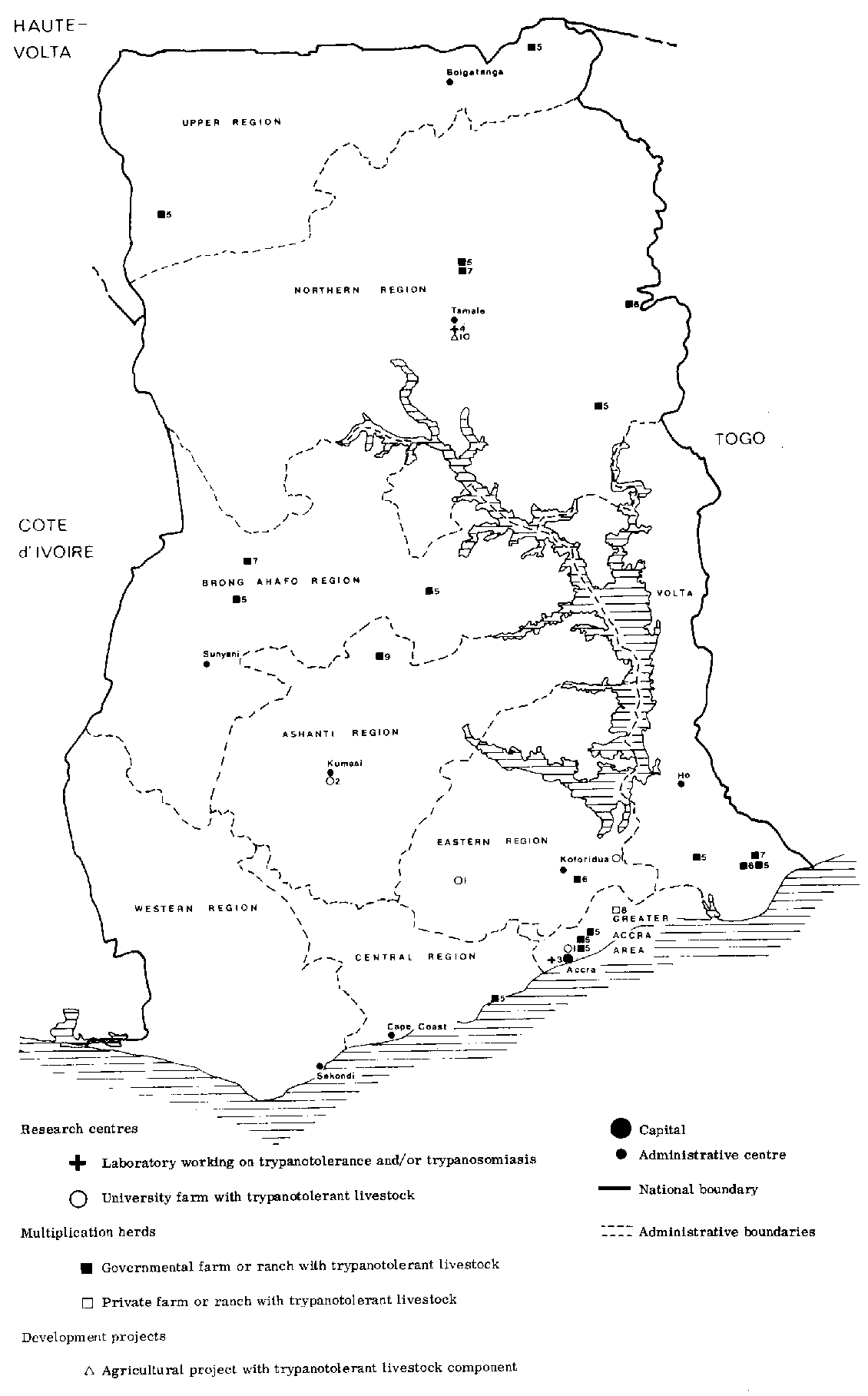
The Republic of Ghana lies on the west coast of Africa, with the Ivory Coast to the west, Upper Volta to the north and Togo to the east. The country is divided into nine regions, with the capital at Accra, as shown in Figure 1.
Two departments in the Ministry of Agriculture have responsibilities in the livestock sector: the Veterinary Services and the Animal Husbandry Department. These both have regional offices in the main towns of each region.
Basic data for the country are given in Table 1.
Table 1. Background data for Ghana.
|
Area |
238 500 km² |
|
|
Latitude |
4°30'-11° N |
|
|
Longitude |
1°15' E-3°15' W |
|
|
Population |
||
|
|
number |
10 000 000 |
|
|
density |
41.9/km² |
|
Livestock numbers |
||
|
|
cattle |
777 000 |
|
|
sheep |
905 000 |
|
|
goats |
780 000 |
Sources: For population, national estimates and FAO, 1976; for livestock numbers, Ghana, Veterinary Services, Ministry of Agriculture, 1975.
From north to south, the climate varies from Sahelo-Guinean to Sudano-Guinean to Guinean savanna and forest. The annual rainfall ranges from 1 000 mm in the northeast to 2 300 mm in the southwest. In addition, the Accra plains form a savanna region which is unusual for the coastal belt. This region, which extends eastward as far as Togo, receives an annual rainfall of only 800 to 1 000 mm.
According to the OAU/STRC (1977) tsetse distribution map, the entire country is infested with tsetse. G. tachinoides and G. morsitans are found in the northern region, though G. morsitans is less common. G. palpalis is found throughout the country except for a small pocket in the north, and G. longipalpis is found in the transitional savannas of the central region. G. fusca, G. pallicera pallicera, G. medicorum and G. tabaniformis are found in the southwestern forest zone. Though many types of tsetse are present, many specialists believe that the level of infestation is low in several regions, for example, the extensive northern areas and the Accra plains.
Table 2 gives livestock numbers in the nine regions as reported in the 1975 census carried out by the Ministry of Agriculture.
Table 2. Livestock numbers in Ghana, 1975 ('000).
|
Region
|
Cattle |
Sheep |
Goats |
|||
|
No. |
% |
No. |
% |
No. |
% |
|
|
Upper |
305 |
39.3 |
241 |
26.6 |
230 |
29.5 |
|
Northern |
276 |
35.5 |
224 |
24.8 |
215 |
27.6 |
|
Brong Ahafo |
17 |
2.2 |
80 |
8.8 |
67 |
8.6 |
|
Ashanti |
5 |
0.6 |
107 |
11.8 |
64 |
8.2 |
|
Western |
2 |
0.3 |
65 |
7.2 |
35 |
4.5 |
|
Central |
5 |
0.6 |
38 |
4.2 |
33 |
4.2 |
|
Eastern |
8 |
1.0 |
43 |
4.8 |
40 |
5.1 |
|
Volta |
77 |
9.9 |
85 |
9.4 |
82 |
10.5 |
|
Greater Accra |
82 |
10.6 |
22 |
2.4 |
14 |
1.8 |
|
Total |
777 |
100 |
905 |
100 |
780 |
100 |
Source: Ghana, Veterinary Services, Ministry of Agriculture, 1975.
According to these figures, the distribution of cattle is very uneven. Upper and Northern Regions account for 75% of the national herd, and the relatively dry plains of Greater Accra and Volta Regions in the southeast account for another 20%. There are very few cattle in Ashanti or Brong Ahafo Regions in the central part of the country or in the forest zone, which includes Western, Central and Eastern Regions.
The Central Bureau of Statistics (1977) reports a much higher cattle population, as indicated in Table 3, though this discussion will be based on the figures provided in Table 2.
Table 3. Livestock population, 1969-74 ('000).
|
|
1969 |
1970 |
1971 |
1972 |
1973 |
1974 |
|
Cattle |
900 |
926 |
855 |
839 |
876 |
912 |
|
Sheep |
1 300 |
1 315 |
1 337 |
1 421 |
1 506 |
1 606 |
|
Goats |
1 400 |
1 356 |
1 615 |
1 587 |
1 559 |
1 616 |
Source: Ghana, Central Bureau of Statistics, 1977.
Sheep and goats are more evenly distributed than cattle, but they are also heavily concentrated in the north. Upper and Northern Regions account for 50% of the national sheep population and 57% of the goats according to the Veterinary Services (1975).
The local cattle breeds found in Ghana, in order of numbers, are West African Shorthorn or Ghana Shorthorn (WAS), Sanga, Zebu (White Fulani and Sokoto Gudale), N'Dama and Dwarf West African Shorthorn. In addition, a number of exotic breeds have been imported for research purposes and are bred both as purebreds and crossbreds. These include Holstein-Friesian, Jersey, Droughtmaster (from Australia) Santa Gertrudis, Nellore Zebu (from Brazil), Red Poll and Austrian Brown. There are also small numbers of Hereford, Boran, Sahiwal, Brahman and Braford. The distribution of the main local breeds among the regions can be estimated from the Veterinary Services' census (1975), as shown in Table 4.
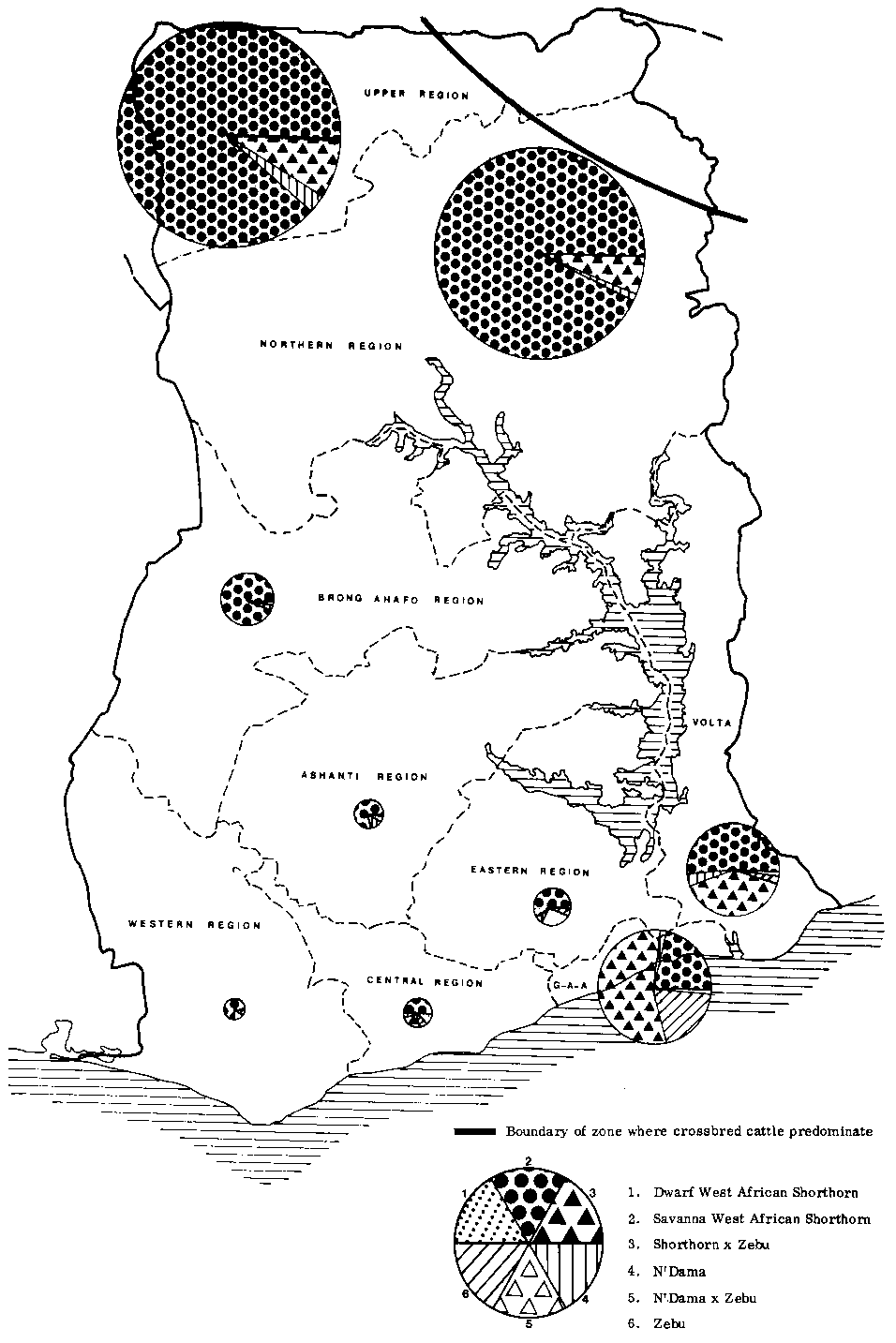
Table 4 indicates that the Ghana Shorthorn is the predominant cattle breed in Ghana, accounting for 79% of the national herd together with its crosses. Most of the crossbreds resemble the shorthorn type more closely than they do the Zebu. Next in number are the Sanga, a cross between the Ghana Shorthorn and the Zebu, accounting for about 120 000 head. Like the Zebu, the Sanga are found in the drier areas: towards the northern border and on the Accra plains extending into Volta Region. The proportion of Sanga and Zebu increases towards the northeastern corner of the country around Bawku. Relatively pure Zebu are found on the Accra plains, often in the same herds with Sanga. The N'Dama are scattered throughout the country, and are often crossbred in the villages (see Figure 2).
Figure 2. Cattle numbers and breed distribution.
Table 4. The distribution of local cattle breeds in Ghana.
|
Region |
Ghana Shorthorn and Crosses |
Sanga |
N'Dama |
Zebu |
Others |
|
Upper |
270 000 |
25 000 |
8 000 |
2 000 |
|
|
Northern |
257 000 |
15 000 |
3 000 |
1 000 |
|
|
Brong-Ahafo |
16 000 |
300 |
500 |
200 |
|
|
Ashanti |
4 000 |
300 |
600 |
100 |
|
|
Western |
1 500 |
400 |
- |
100 |
|
|
Central |
2 500 |
1 300 |
200 |
500 |
500 |
|
Eastern |
5 200 |
2 000 |
300 |
500 |
|
|
Volta |
42 000 |
30 000 |
3 000 |
1 000 |
1 000 |
|
Greater Accra |
18 000 |
48 000 |
1 000 |
14 000 |
1 000 |
|
Total |
616 200 |
122 300 |
16 600 |
19 400 |
2 500 |
|
% of National Herd |
79% |
16% |
2.1% |
2.6% |
0.3% |
Source: Ghana, Veterinary Services, Ministry of Agriculture, 1975.
3.1 BREED DESCRIPTION
3.1.1 Ghana Shorthorn
The Ghana Shorthorn breed belongs to the West African Shorthorn (WAS) group. WAS (pronounced 'wass') is the term most frequently used in Ghana to describe all cattle with a general Shorthorn appearance, even if traces of crossbreeding are evident.
Towards the northwestern border around Bole, Wa, Lawra and Tumu, there is a high concentration of relatively pure Ghana Shorthorns similar to the populations found in Ivory Coast around Bouna and in Upper Volta near Gaoua. Towards Bawku in the northeast, the proportion of Zebu in the herds increases and signs of crossbreeding can be seen, such as a generally larger size and stronger horns. The average height of the Ghana Shorthorn ranges from 1.00 to 1.10 m at withers according to Ngere (1974) and USAID (1967), hut the purebred animals around Wa rarely reach this size.
The age at first calving is around 34.8 ± 1.2 months, compared with 39 ± 1.6 for the N'Dama and 38.6 ± 1.1 for the Sokoto Gudale Zebu, according to studies carried out at Nungua (now Legon Agricultural Research Station) (Sada, 1968). Field observations suggest that calving generally occurs during the dry season from November to February. Calving rates recorded at government stations are between 60 and 70% (Capitaine, 1972). At Nungua from 1957 to 1966, the calving interval for the Ghana Shorthorn was 444 ± 13 days (n=99), compared with 457 ± 12 days (n=111) for the N'Dama and 465 ± 17 days (n=60) for the Sokoto Gudale Zebu (Sada, 1968). Capitaine (1972) reported a mortality rate among calves to one year of 35 to 45% under village conditions and 10% under ranch conditions. Mortality from one to two years was 10 to 15% under village conditions and 3 to 4% under ranch conditions, and adult mortality was around 4% under both conditions.
Montsma (1960, 1962) compared milk production estimates for Ghana Shorthorn, N'Dama and Sokoto Gudale Zebu cows by weighing calves three times a day before and after suckling at the Nungua station. Two experiments were carried out under different conditions. First, the milk yields were compared of cows lactating mostly during the dry season who were given small quantities of silage and concentrates. The average milk yields over 182 days were 383.5 ± 30.4 kg for Ghana Shorthorn, 460.4 ± 18.4 kg for N'Dama and 604.0 ± 30.8 kg for Sokoto Gudale Zebu (Montsma, 1960).
In the second experiment, the milk yields were compared of cows lactating mostly during the rainy season who were on a high level of supplementation. Their average milk yields over 252 days were 1 001 ± 27.4 kg for Ghana Shorthorn, 943 ± 38.1 kg for N'Dama and 1 531 ± 65.6 kg for Sokoto Gudale Zebu (Montsma, 1962). A similar experiment was carried out at Nungua in 1971, estimating the milk yields of 14 Ghana Shorthorn cows between their third and fifth lactation Over a period of 295 days, the average milk yield was 774 ± 27 kg, and the butterfat content was estimated at 5.4% (Ngere et al., 1975).
Montsma (1960) reported birth weights of 19 to 20 kg for male Ghana Shorthorn calves and 18 to 19 kg for females, depending on the time of calving. The same author in 1962 reported average birth weights of 21 kg for Ghana Shorthorn, 19 kg for N'Dama and 27 kg for Sokoto Gudale Zebu and weaning weights at 36 weeks of 154, 138 and 214 kg for the three breeds respectively.
Capitaine (1972) reported a survey carried out by Kassem in 1965 who obtained the following average weights for Ghana Shorthorn:
|
|
6 months |
12 months |
18 months |
24 months |
36 months |
|
female |
101 |
134 |
147 |
182 |
229 |
|
male |
80 |
135 |
134 |
178 |
256 |
USAID (1967) reported adult weights of 170 to 180 kg for Ghana Shorthorn cows and 190 to 200 kg for bulls under village conditions.
Ghana Shorthorn cattle are very good natured: in northern Ghana they are often tended by children who may ride on their backs (see Figure 3.47, volume 1). Around Tamale, this breed is used as draught oxen, but crossbreds are more often used because the purebred animals tend to be small.
3.1.2 Ghanaian Sanga
In Ghana, the Sanga is a crossbreed between a humpless breed and Zebu (see Figure 3.57, volume 1). This natural crossbreed seems to have been in existence for some time and is also found in other countries. The humpless breed used for the cross is nearly airways a Ghana Shorthorn, while the Zebu is usually one of the Sudanese types, often the White Fulani. Sometimes, the N'Dama replaces the Ghana Shorthorn, and the Sokoto Gudale Zebu may also be used. Some government stations have bred a special Sanga type called the Ndagu, which is a N'Dama x Sokoto Gudale Zebu cross.
There are about 122 000 Sanga in Ghana and their numbers are increasing at the expense of the Ghana Shorthorn. The Sanga are often herded with Zebu in the drier areas with relatively low tsetse challenge, particularly in the Greater Accra and Volta Regions.
As a crossbreed, the Sanga is understandably variable. In southern Ghana there is a fairly uniform type, predominantly white, frequently with black pigmentation on the ears and mucosa and sometimes with black spots, resembling the Borgou of Benin. This type is apparently a cross between the Ghana Shorthorn and White Fulani Zebu, but it is not clear how the White Fulani ancestry was introduced in this area on such a large scale.
Although the Sanga is kept on a number of government farms, there is little information available on performance traits. According to USAID (1967), average body weights are as follows (kg):
|
|
Birth |
1 Year |
2 Years |
3 Years |
|
female |
24 |
120 |
238 |
306 |
|
male |
24 |
125 |
250 |
328 |
Observations in the field suggest that these weights are higher than those generally achieved under village conditions.
The Sanga has a higher milk yield than the Ghana Shorthorn, and because it is larger it is more widely used as a draught animal. In low tsetse challenge areas, it is considered a good breed for beef production under ranch conditions, such as on the Shai Hills Ranch near Accra.
3.1.3 N'Dama
N'Dama were first brought to Pong Tamale in northern Ghana in 1932, and since then have been bred on government farms, stations and ranches. They are also kept in the villages for crossbreeding with the Sanga and Ghana Shorthorn. Though traces of N'Dama ancestry can be detected in the local cattle, this breed has not made a substantial contribution to Ghanaian stock outside the government farms and ranches.
In some cases, such as at the Legon Agricultural Research Station, two types of N'Dama may be distinguished: the Guinean N'Dama and the Gambian N'Dama. Most of the N'Dama are of the Guinean type; those recently imported from The Gambia are distinguished by their lighter colour and longer and slightly better shaped horns.
Most of the production data available for the N'Dama were presented in the discussion of the Ghana Shorthorn for comparison purposes. Capitaine (1972) reported the following average weights for this breed:
|
|
6 Months |
12 Months |
18 Months |
|
female |
97 |
142 |
147 |
|
male |
106 |
164 |
176 |
3.1.4 Dwarf West African Shorthorn
Typical Dwarf West African Shorthorn, similar to the Lagune breed, are found in Ghana but their numbers appear to be decreasing. These cattle are also called Muturu. They are found in the southeastern coastal area near Ada and Keta Lagoon. There is very little information on this breed in Ghana. Montsma (1959) reported an average weight for 40 adult cows in village herds of 166 ± 2 kg, an average height at withers of 0.88 ± 0.04 m, a heart girth of 1.30 ± 0.1 m and a body length of 1.07 ± 0.06 m.
3.1.5 Zebu
The Zebu breeds account for only 26% of the cattle population in Ghana, as shown in Table 4. Those in the northern regions have come from Upper Volta and are of the Sudanese Fulani type. Zebu have also been bred as part of government multiplication and crossbreeding schemes. The white breeds, such as the White Fulani, are particularly popular because they have been bred extensively on government farms, along with the Sokoto Gudale Zebu from Nigeria and the Nellore Zebu, recently imported from Brazil.
A great deal of data are available at the Legon Station on milk yields, growth and other production traits of the Sokoto Gudale Zebu (Montsma, 1962; Thompson, 1975). Some of this information was presented in the discussion of the Ghana Shorthorn for comparison.
3.1.6 Exotic Breeds and Experimental Crossbreeding
Substantial numbers of exotic cattle have been introduced in Ghana on government ranches and research stations, and a number of crossbreeding experiments have been carried out. These activities will not be discussed in this report, as they occur in special situations and no pertinent information was collected in the field.
3.2 DISEASE
The most important cattle diseases in Ghana are contagious bovine pleuropneumonia (CBPP), anthrax, blackquarter, brucellosis and foot-and-mouth disease. Trypanosomiasis is also present, but not a serious problem according to the Veterinary Services since most of the cattle are trypanotolerant.
Tick-borne diseases, such as piroplasmosis and rickettsiosis, and streptothricosis are serious problems for imported livestock and restrict the introduction of exotic breeds. Droughtmaster cattle from Australia are particularly sensitive to streptothricosis, according to staff members of the Pong Tamale Veterinary Laboratory and the Shai Hills Ranch.
A crossbreeding experiment was carried out in the Sogakofe area using artificial insemination with imported semen from seven exotic breeds. All the animals produced proved to be sensitive to streptothricosis to some extent. According to the Veterinary Services, the Droughtmaster crosses were extremely sensitive, the Brahman, Friesian and Hereford crosses were very sensitive and the Bradford, Boran and Sahiwal crosses were somewhat sensitive.
3.3 HERD MANAGE ME NT AND COMPOSITION
Most cattle owners in Ghana are farmers, but increasingly town dwellers are becoming absentee cattle owners, using hired herdsmen. Except for these absentee owners, the typical family owns a small number of cattle, 5 to 20 in the Northern Region for example. By contrast, herds on the Accra plains may reach several hundred head. Average herd composition figures for the nine regions are given in Table 5.
Table 5. Herd composition by region (%).
|
Region |
Cows |
Heifers |
Calves |
Bulls |
Young Bulls |
Oxen |
Breeds Probably Dominant |
|
Western |
44 |
21 |
23 |
3 |
6 |
3 |
Ghana Shorthorn |
|
Central |
38 |
23 |
23 |
3 |
9 |
4 |
Ghana Shorthorn |
|
Volta |
45 |
17 |
21 |
2 |
8 |
7 |
Ghana Shorthorn, Sanga |
|
Accra |
41 |
23 |
20 |
2 |
9 |
5 |
Sanga, Ghana Shorthorn, Zebu |
|
Eastern |
41 |
22 |
20 |
2 |
8 |
7 |
Ghana Shorthorn |
|
Ashanti |
40 |
17 |
22 |
6 |
9 |
6 |
Ghana Shorthorn |
|
Brong Ahafo |
42 |
18 |
19 |
5 |
12 |
4 |
Ghana Shorthorn |
|
Northern |
44 |
17 |
19 |
4 |
11 |
5 |
Ghana Shorthorn |
|
Upper |
40 |
20 |
15 |
6 |
11 |
8 |
Sanga, Ghana Shorthorn |
|
Overall |
42 |
19 |
18 |
5 |
10 |
6 |
Ghana Shorthorn |
Source: Ghana, Veterinary Services, Ministry of Agriculture, 1975.
Herd composition figures were also obtained for four districts in Upper Region by Gunn Rural Management Property Ltd. (1977). These are given in Table 6.
Relatively high percentages of oxen are kept in areas where they are used as draught animals. In Tamale and Bolgatanga, for instance, oxen may account for as much as 10% of the herds.
Table 6. Herd composition in four districts of Upper Region (%) and average holdings.
|
|
Cows |
Heifers |
Calves |
Bulls |
Young Bulls |
Oxen |
Average Number per Owner |
|
Wa |
44 |
22 |
24 |
3 |
7 |
- |
19 |
|
Tumu |
39 |
17 |
28 |
4 |
10 |
2 |
18 |
|
Bolgatanga West |
36 |
17 |
15 |
12 |
9 |
11 |
12 |
|
Nangodi |
37 |
16 |
15 |
12 |
11 |
9 |
8 |
Source: Gunn Rural Management Property Ltd., 1977.
In the north, which is the main livestock region, herds are usually tended by the village children (see Figure 3.47, volume 1). Often the animals of several households are herded together, tended by a number of children. It is also becoming more common to hire a Fulani herdsman to look after cattle, particularly among absentee owners. The Fulani keep the herds in pens at night and milk them regularly, as the milk is a large part of the herdsman's salary (see Figure 3.46, volume 1). A farmer may allow a herd to graze on his land in exchange for the manure produced: this arrangement is particularly common in the southeast.
4.1 BREED DESCRIPTION
4.1.1 Sheep
Most of the sheep in Ghana are of the West African Dwarf breed, also known as the Forest type. Some crossbreeding is carried out with the larger Sahelian sheep, but crossbreds account for only 10% of the total population. At Legon Agricultural Research Station, a crossbred has been produced called Nungua Blackhead, between the local Forest type and the Persian Blackhead (Somali). Measurements for the Forest type and the new crossbreed are given in Table 7 and weights in Table 8.
Two fattening trials were carried out with West African Dwarf sheep at the Kumasi University Farm. Over a 125-day period, eight animals of both sexes were fed Cynodon plectostachyus and concentrates and another group of eight were fed the same diet plus rice straw. The results of this experiment are presented in Table 9.
Table 7. Measurements of Forest and Nungua Blackhead sheep.
|
|
Forest Type |
Nungua |
Blackhead |
||||
|
|
Young (15 mo.) |
Ewe |
Ram |
Young (15 mot) |
Ewe |
Ram |
|
|
Body weight (kg): |
|||||||
|
|
mean |
17 |
21 |
26 |
22 |
32 |
39 |
|
|
range |
15-19 |
20-28 |
- |
19-27 |
26-42 |
29-48 |
|
Height at withers (cm): |
|||||||
|
|
mean |
48 |
49 |
53 |
53 |
58 |
60 |
|
|
range |
45-50 |
49-50 |
- |
51-56 |
56-60 |
59-61 |
|
Heart girth (cm): |
|||||||
|
|
mean |
65 |
68 |
73 |
72 |
84 |
84 |
|
|
range |
56-69 |
67-69 |
- |
65-80 |
78-88 |
81-88 |
Source: Ngere, 1973.
Table 8. Body weights at birth and weaning for Forest and Nungua Blackhead sheep.
|
|
Forest Type |
Nungua Blackhead |
|
Weight at birth (kg) |
1.3 ± 0.23 |
2.3 ± 0.45 |
|
Weight at weaning (12 weeks) (kg) |
5.8 ± 0.7 |
9.8 ± 1.9 |
|
Average daily gain up to weaning (g) |
50 ± 9 |
90 ± 20 |
Source: Ngere, 1973.
Table 9. Results of fattening trials with West African Dwarf sheep.
|
|
Feeding Regime |
|
|
Cynodon + Concentrates |
Cynodon + Concentrates + Rice Straw |
|
|
Initial age (months) |
4.75 |
4.75 |
|
Initial weight (kg) |
9.50 ± 0.62 |
10.50 ± 0.50 |
|
Final weight (kg) |
13.25 ± 0.88 |
12.61 ± 0.79 |
|
Average daily gain (g) |
30 ± 0.46 |
17 ± 0.46 |
Source: Tuah and Tetteh, 1972.
4.1.2 Goats
The goats in Ghana are of the West African Dwarf breed, also called the Forest goat. Oppong (1963) reported an age at first kidding under village conditions of 14 months, implying sexual maturity between 6 and 8 months. Among goats kept at Kumasi University Farm, the prolificacy rate was 185 kids per 100 births, with 35% single, 49% twin, 17% triplet and 1% quadruplet births. The kidding interval was 229 days. Table 10 summarizes estimates of the major production traits required to build up a productivity index based on the total weight of five-month-old kids produced per 10 kg of female goat maintained per year. This index is derived from production estimates under station conditions and low tsetse infestation.
Table 10. Dwarf goat productivity estimates.
|
Female goat viability (%) |
90a |
|
Kidding percentage |
260 |
|
Kid viability to one year (%) |
76 |
|
Kid weight at four months (kg) |
7.5 |
|
Productivity indexb per female goat per year (kg) |
15.6 |
|
Female goat weight (kg) |
25 |
|
Productivity indexb per 10 kg female goat maintained per year (kg) |
6.2 |
a. Estimate.
b. Total weight of five-month-odd kids produced.
Source: Sada and Vohradsky, 1973; Vohradsky and Sada, 1973.
4.2 DISEASE
According to the Veterinary Services in Kumasi (Bonniwell, personal communications), sheep in Ghana are affected by a 'confinement and malnutrition syndrome' which is due to the fact that the animals are usually penned a great deal of the time and do not have sufficient opportunity for grazing. They become less resistant to other diseases, such as a gastro-intestinal parasites, bacterial infections and pneumonia. Peste des petite ruminants (PPR) is also a major problem. This endemic disease is widespread among sheep in Ghana and also causes very high mortality rates among goats. Other diseases include gastro-intestinal parasitosis, in particular due to Haemonchus contortus, heartwater and other tick-borne diseases. At Nungua, the mortality rate among goats reached 85% in 1973-74, with 36% of this due to PPR.
Research and development activities in Ghana are carried out on university farms, farms under the Animal Husbandry Service and other institutes, farms and ranches. It is difficult to classify the various facilities strictly into research centres, multiplication herds or development projects.
5.1 RESEARCH
5.1.1 University of Ghana
The Animal Sciences Department of the University of Ghana carries out research at three stations. These are described in Table 11.
5.1.2 Kumasi University Farm
The Animal Production Department of Kumasi University of Science and Technology carries out animal husbandry research on a 150-ha farm in Ashanti Region east of Kumasi town. The location is designated by  2 in Figure 1. As of 1977, 268 cattle were kept on the farm, including 143 N'Dama, 70 Holstein-Friesian, 45 Ghana Shorthorn and 10 crossbreds. In addition, there were 74 West African Dwarf sheep and 72 West African Dwarf goats. The farm serves a training and multiplication function and research projects are carried out by the students.
5.1.3 Achimota Animal Research Institute
This research institute is situated at Achimota, 10 km from Accra, designated by + 3 in Figure 1. Research on trypanosomiasis is carried out, including studies on the carriers of this disease, Glosssina biology and pathological studies of the affected animals. The institute maintains two stations with cattle, sheep and goats, one at Pokuasi in Greater Accra Region and the other at Nyankpala in Northern Region near Tamale. No precise information on the activities of these stations was available.
5.1.4 Research Facilities at Pong Tamale
Animal husbandry work is carried out at a number of institutions in Pong Tamale, 25 km north of Tamale town in Northern Region. The Regional Veterinary Service Board is responsible for the Pong Tamale Veterinary Laboratory, which is indicated by + 4 in Figure 1. Though this laboratory has fairly well developed facilities, it lacks the resources to develop its research programme further. Also at Pong Tamale are the Animal Husbandry Regional Service Board, which operates a stock farm, the Veterinary College, which also operates a farm with 40 cattle, and one ranch of the Ghana Livestock Company.
West Germany is assisting a trypanosomiasis control project based at Pong Tamale and covering mainly Northern and Upper Regions. This is a two-year project divided into two phases, first an equipment, training and prospecting phase to be followed by an eradication programme.
Table 11. Agricultural research stations of the University of Ghana.
|
Name |
Legon Agricultural Research Station(formerly Nungua) P.O. Box 68, Legon |
Kpong Agricultural Research Station |
Kade Agricultural Research Station |
|
Location (and reference in Figure 1) |
Greater Accra Region 25 km north of Accra |
Eastern Region 80 km N.E. of Accra |
Eastern Region 120 km N.W. of Accra, forest area |
|
Size |
720 ha |
|
|
|
Breeds and numbers |
417 cattle: 122 Ghana Shorthorn, 36 Sokoto Gudale, 9 Droughtmaster, 119 crossbred Jersey, 124 crossbred Friesian, 57 others (January 1978) |
200 cattle: 122 N'Dama and various crossbreeds between N'Dama and Red Poll, Santa Gertrudis and Brown Swiss |
200 cattle from the Legon Station were transferred here at the beginning of 1978 because of draught |
|
|
383 sheep: 152 Forest type, 126 Nungua Blackhead, 6 Sudan type and crossbreds, 99 others |
300 sheep |
|
|
Objectives |
Research on milk yield and nutrition. Genetic improvement of sheep. Performance records kept of all animals. |
Farming and animal husbandry research. Plan to breed N'Dama only, progressive elimination of crossbreeds. |
Same as Legon Station. |
5.2 DEVELOPMENT AND MULTIPLICATION ACTIVITIES
5.2.1 Animal Husbandry Service Stock Farms
The Animal Husbandry Service of the Ministry of Agriculture operates 12 multiplication farms for cattle as listed in Table 12. Their locations are shown by  5 in Figure 1. The objectives of these farms are to improve and multiply livestock breeds for the benefit of local livestock owners, to produce meat and milk, to distribute sires and to carry out adaptation tests.
Table 12. Animal Husbandry Service stock farms.
|
Region
|
Name and Location
|
Cattle |
|
|
Numbers |
Breeds |
||
|
Upper |
Wa (western Upper R.) |
260 |
Ghana Shorthorn, N'Dama |
|
Upper |
Bazua (northern Upper R.) |
140 |
Sanga, N'Dama, White Fulani |
|
Northern |
Pong Tamale (north of Tamale) |
50 |
Ghana Shorthorn |
|
Northern |
Bimbila (eastern Northern R.) |
100 |
Ghana Shorthorn, Sanga, N'Dama |
|
Brong Ahafo |
Atebubu |
70 |
Ghana Shorthorn |
|
Brong Ahafo |
Wenchi |
75 |
Sanga, N'Dama, White Fulani |
|
Central
|
Winneba (west of Accra)
|
100 |
Sanga, White Fulani |
|
300 |
Nellore Zebu (Brazil) |
||
|
75 |
Droughtmaster (Australia) |
||
|
Volta |
Amelorkope |
290 |
N'Dama, Sanga, White Fulani |
|
Volta |
Adakpo |
100 |
Ghana Shorthorn, Sanga, White Fulani |
|
Greater Accra |
Nungua (20 km NE of Accra) |
615 |
N'Dama, Sanga, White Fulani |
|
Greater Accra |
Maledjor |
100 |
Nellore Zebu (Brazil) |
|
Greater Accra |
Amrahia Dairy Farm |
480 |
Friesian |
|
Total |
|
2 755 |
|
Source: Information from country visits.
5.2.2 State Farms Organization (P.O. Box 299, Accra)
The State Farms Organization is an important business enterprise coming under the Ministry of Agriculture. The organization manages several farms around the country with the primary objectives of agricultural production and extension. On three of these farms described in Table 13, cattle are raised, mainly of local breeds. There is no well-defined breeding policy and no information is available on performance.
Sheep are raised on a number of other state farms in Ashanti, Western, Central and Volta Regions. Although no detailed information is available, there are apparently serious problems connected with the management of these flocks.
Table 13. State farms which keep cattle.
|
Name |
Demon Ranch |
Ohawu-Akatsi Ranch |
Kwamoso State Farm |
|
Location (and reference in Figure 1) |
East part of Northern Region 120 km from Tamale |
Southern part of Volta Region |
Eastern Region north of Accra |
|
Size |
|
|
800 ha |
|
Breeds and numbers |
Approx. 100 cattle, mainly Ghana Shorthorn, with Sanga and N'Dama crossbreds |
800-1000 Ghana Shorthorn plus Sanga and N'Dama (from Tadzewa ranch) |
|
|
Comments |
|
This ranch provides other state farms with livestock. |
This farm is in the process of building up its own cattle herd with stock from the Ohawu ranch. The main activity is oil palm production. |
Source: Information from country visits.
5.2.3 Ghana Livestock Company
This company operates three cattle ranches, one of which is still being developed. Assistance has been provided by the IBRD and a number of commercial banks. The ranches are described in Table 14.
5.2.4 Shai Hills Ranch (P.O. Box 9577, Airport, Accra)
This ranch is being developed in Greater Accra Region about 40 km northeast of Accra with funding from the Bank of Ghana and technical assistance from Gunn Rural Management Property Ltd. of Australia. The location is shown by 8 in Figure 1. As of the end of 1977, 1 100 cattle of different breeds were kept on this 6 400-ha ranch for meat production and to demonstrate the viability of commercial cattle ranching. The goal is to build up a herd of 4 000, including 1 500 breeding cows. The cattle on the ranch have all been identified and the facilities are well developed. Plans have been made to record the performance of the herd.
Table 14. Ghana Livestock Company ranches.
|
Name |
Pong Tamale Ranch |
Tadzevu Ranch |
Branam Ranch |
|
Location (and reference in Figure 1) |
Northern Region north of Tamale |
Volta Region |
Brong Ahafo Region north of Wenchi |
|
Size |
6 000 ha |
|
|
|
Breeds and numbers |
1500 cattle, including 180 N'Dama cows, 500 Ghana Shorthorn cows, 100 Sanga cows and 100 White Fulani Zebu cows |
Approx. 500 cattle, mainly Sanga and White Fulani Zebu |
No livestock as of the beginning of 1978 |
|
Objectives |
Multiplication ranch, Livestock will he transferred to Branam Ranch and this will become an animal husbandry station. |
|
Livestock is to be transferred from Pong Tamale Ranch. |
Source: Information from country visits.
5.2.5 Sheep and Goat Production Development Project (P.O. Box 4308, Kumasi)
This project is being carried out by the Ministry of Agriculture on Ejura Farm in Ashanti Region north of Kumasi with assistance from FAO/UNDP. The location is shown by 9 on Figure 1. As of 1977, 830 local and Sahelian sheep and 40 local goats were kept on 800 ha, with the aim of multiplying improved animals and producing sires for local breeders. Performance parameters such as productivity and growth are being recorded.
5.2.6 Ghanaian - German Fertilising
This is an integrated agricultural development project based in Northern Region at Tamale. The animal husbandry component focuses on training personnel and draught animals. Six draught animal training centres have been established, covering 20 to 30 farms each. The location of this project is shown by  10 in Figure 1.
5.2.7 Northern Livestock Development Project
A large Ranching and Enclosures Project was being launched in 1978 at Pwalugu in Northern Region with funding from the Bank of Ghana and technical assistance from Gunn Rural Management Property Ltd. This project will include both cattle and sheep production, and local stock raisers will be involved.
5.2.8 Miscellaneous Activities
There are a number of private commercial farms in Ghana, particularly in the south, including dairy farms in Greater Accra Region. A large dairy project is being undertaken at Kwaha Dairy Farm, Ltd. which will import Friesian cattle with assistance from West Germany and Denmark.
5.3 DEVELOPMENT PLAN GUIDELINES FOR THE LIVESTOCK SECTOR
According to the 1975-1980 Development Plan, development of the livestock sector will focus on:
- community projects including pasture improvement, fencing, veterinary assistance, genetic improvement of livestock and artificial insemination services,- intensified cattle breeding programmes in five regions,
- establishment or improvement of cattle breeding centres for the production of meat and milk, and
- establishment or improvement of small stock breeding centres.
Achimoto Research Institute (1973, 1974). Annual Report. Achimoto.
Buadu, M K (1972). 'The reproductive potential of Dwarf goats in the humid forest zone of Ashanti'. In Proceedings of the Fifth Animal Science Symposium. Faculty of Agriculture, Kumasi University of Science and Technology, pp. 7-11.
Capitaine, P (1972). Ghana husbandry development project: Feasibility study for four ranches: Zootechnical study. Maisons Alfort, IEMVT, 103p.
FAO (1976). 'Perspective study of agricultural development in Ghana: Livestock production'. ESP/PS/CHA/76/13. Rome, 66p.
FAO (1977). 'Agricultural development planning project: Ghana meat development project'. AG:DP/GHA/72/007. Rome, 172p.
Fischer, K, Lang, H and von Watzdorf, W (1975). Ghanaian German agricultural development project: Northern and Upper Region: Project evaluation: Final report. Hamburg.
Ghana, Central Bureau of Statistics (1977). Economic Survey, 1972-74. Accra.
Ghana, Veterinary Services/Ministry of Agriculture (1975). 'Livestock Census' Accra.
Gunn Rural Management Property, Ltd. (1977). Northern livestock development: Republic of Ghana. Brisbane.
Kahoun, J (1970). 'Effects of crossbreeding on growth rate and body conformation in local cattle on the Accra plains, Ghana'. Parts 1 and 2. Ghana J. Agric. Sci. 3, pp. 131-134, and 5, pp. 51-56.
Landsbury, T J (1960). 'A review of some limiting factors in the nutrition of cattle on the Accra plains, Ghana'. Trop. Agric. (Trinidad). 37, pp. 185-192.
Montsma, G (1959). 'Some notes on the conformation of West African Dwarf cattle'. Trop. Agric. (Trinidad). 36, pp. 299-303.
Montsma, G (1960). 'Observations of milk yield and calf growth and conversion rate on three types of cattle in Ghana'. Trop. Agric. (Trinidad). 37, pp. 293-302.
Montsma, G (1962). 'Observations of milk yield and calf growth and conversion rate on three types of cattle in Ghana. II: Effects of plane of nutrition'. Trop. Agric. (Trinidad). 39, pp. 123-129.
Ngere, L O (1973). 'Size and growth rate of the West African Dwarf sheep and a new breed, the Nungua Black Head of Ghana'. Ghana J. Agric. Sci. 6, pp. 113-117.
Ngere, L O (1974). 'Crossbreeding for beef in Ghana and Nigeria'. In First World Congress on Genetics Applied to Livestock Production. Volume 3. Madrid, pp. 737-742.
Ngere, L O, Hagan, R. Oppong, E N Wand Loosli, J R (1975). 'Milking potential of the West African Shorthorn cow'. Ghana J. Agric. Sci. 8, pp. 31-35.
Oppong, E W (1963). 'A note on goats in Ghana with reference to the need to develop goat husbandry to improve the nation's diet'. The Ghana Farmer. 9 (4), pp. 144-149.
Oppong, E W (1973). 'Diseases of sheep in Ghana'. Ghana J. Agric. Sci. 6, pp. 3-7.
Rose-Innes, R (1963). 'The behaviour of free-grazing cattle in the West African humid tropics: Studies on a herd of West African Shorthorns on the Accra plans, Ghana. I: Rainy season'. Emp. J. Exper. Agric. 31, pp. 1-13.
Sada, I (1968). 'The length of the gestation period, calving interval and service period in indigenous West African cattle: N'Dama, West African Shorthorn and Sokoto Gudale'. Ghana J. Agric. Sci. 1, pp. 91-97.
Sada, I and Vohradsky, F (1968). 'Milk yield and butterfat content of F1 generation Jersey x indigenous breeds of Ghana'. Beitrage zur Trop. Sub-Trop. Landw. u. Trop. Vet. Med. pp. 63-69.
Sada, I and Vohradsky, F (1973) Sb. Vys. Sk. Zemed. Praze Provozne Ekon. Fak. Cesk. Budejovicich Rada Biol. 6, pp. 173 ff.
SEDES (1972). 'Rapport general'. In Etude de factibilité du projet relatif au developpement de l'élevage au Ghana. Volume 1. Paris, 137p.
Stewart, J L (1928). Report on the livestock of the coastal area of the Eastern Provinces of the Colony Gold Coast. Accra, Government Printer, 9p.
Stewart, J L (1937). 'The cattle of the Gold Coast'. Vet. Record. 49, pp. 1289-1297.
Tuah, A K (1973). 'Prospects for dairying in the "Kumasi District" of the Ashanti Region of Ghana: Review of the situation'. Ghana J. Agric. Sci. 7, pp. 157-164.
Tuah, A K and Tetteh, A (1972). 'The effect of feeding urea supplement on the performance of confined West African Dwarf Sheep'. In Proceedings of the Fifth Animal Science Symposium. Faculty of Agriculture, Kumasi University of Science and Technology, pp. 83-93.
University of Ghana Agricultural Research Station, Nungua (now Legon) (1967). Annual Report 1966-67. Nungua.
University of Ghana Agricultural Research Station, Nungua (now Legon) (1975). Annual Report 1973-74/1974-75. Nungua.
USAID (1967). Ghana livestock development handbook. Accra, 127p.
Vohradsky, G and Sada, I (1973). Sb. Vys. Sk. Zemed. Praze Provozne Ekon. Fak Cesk. Budejovicich Rada Biol. 6, pp. 161 ff.
Wharton, F D, Shepard, J M and Buama, T F (1967). 'Preliminary studies on supplemental feeding of cattle reared under essentially "local" conditions in Northern Ghana'. Ghana J. Agric. Sci. 7, pp. 30-36.