1. Background
2. Livestock numbers and distribution
3. Cattle
4. Sheep and goats
5. Research and development activities
6. Selected bibliography
The Republic of Togo lies on the west coast of Africa with its capital at Lomé. The country forms a narrow strip of land stretching north to Upper Volta, with Ghana to the west and Benin to the east. It is divided into five regions - Region Maritime, Region des Plateaux, Region du Centre, Region de la Kara and Region des Savanes - each of which includes several administrative districts. Most of the government services are organized according to these divisions.
The former Service de l'Elevage et des Industries Animales has recently been divided into a Direction de la Production Animale under the Ministère du Développement Rural and a Direction des Services Vétérinaires et de la Santé Animale under the Ministère de l'Aménagement Rural. These services are provided throughout the country through offices in several circumscriptions, each of which is responsible for a number of veterinary posts at the local level.
Basic data for the country are given in Table 1.
Table 1. Background data for Togo.
|
Area |
56 800 km² |
|
|
Latitude |
6°-11° N |
|
|
Longitude |
0°-1° 50' E |
|
|
Population |
||
|
|
number |
2 280 000 |
|
|
density |
40.1/km² |
|
Livestock numbers |
||
|
|
cattle |
214 000 |
|
|
sheep |
792 000 |
|
|
goats |
730 000 |
Sources: For population, OAU, 1978; for livestock numbers, Togo, Service de l'Elevage, 1976.
North of the eighth parallel, the climate is Sahelo-Sudanian, with one rainy season from March to October. The annual rainfall averages 1 100 mm in the far north, 1 200 to 1 300 mm in the Fazas mountains and 1 600 mm in the Aledjo mountains. In the southern part of the country, the climate is Sudano-Guinean and Guinean, with two rainy seasons from March to July and September to November. The annual rainfall increases as one moves inland from the coast, and reaches 1 500 to 1 700 mm on the slopes of the Akposso mountains.
According to the OAU/STRC tsetse distribution map (1977), the entire country is infested with tsetse. G. palpalis and G. longipalpis are found in the south, G. morsitans and G. longipalpis in the centre and east, G. palpalis and G. tachinoides in the north and G. morsitans in the extreme northern part of the country.
Itard (1968) has drawn up a detailed tsetse distribution map for the Region des Savanes, which has the largest cattle population. He found G. tachinoides and G. palpalis in this area. The Direction des Services de l'Elevage et des Industries Animales produced a sketch map of tsetse distribution in Togo, and Mawuena (1976) made a summary of tsetse distribution in the country as a whole.
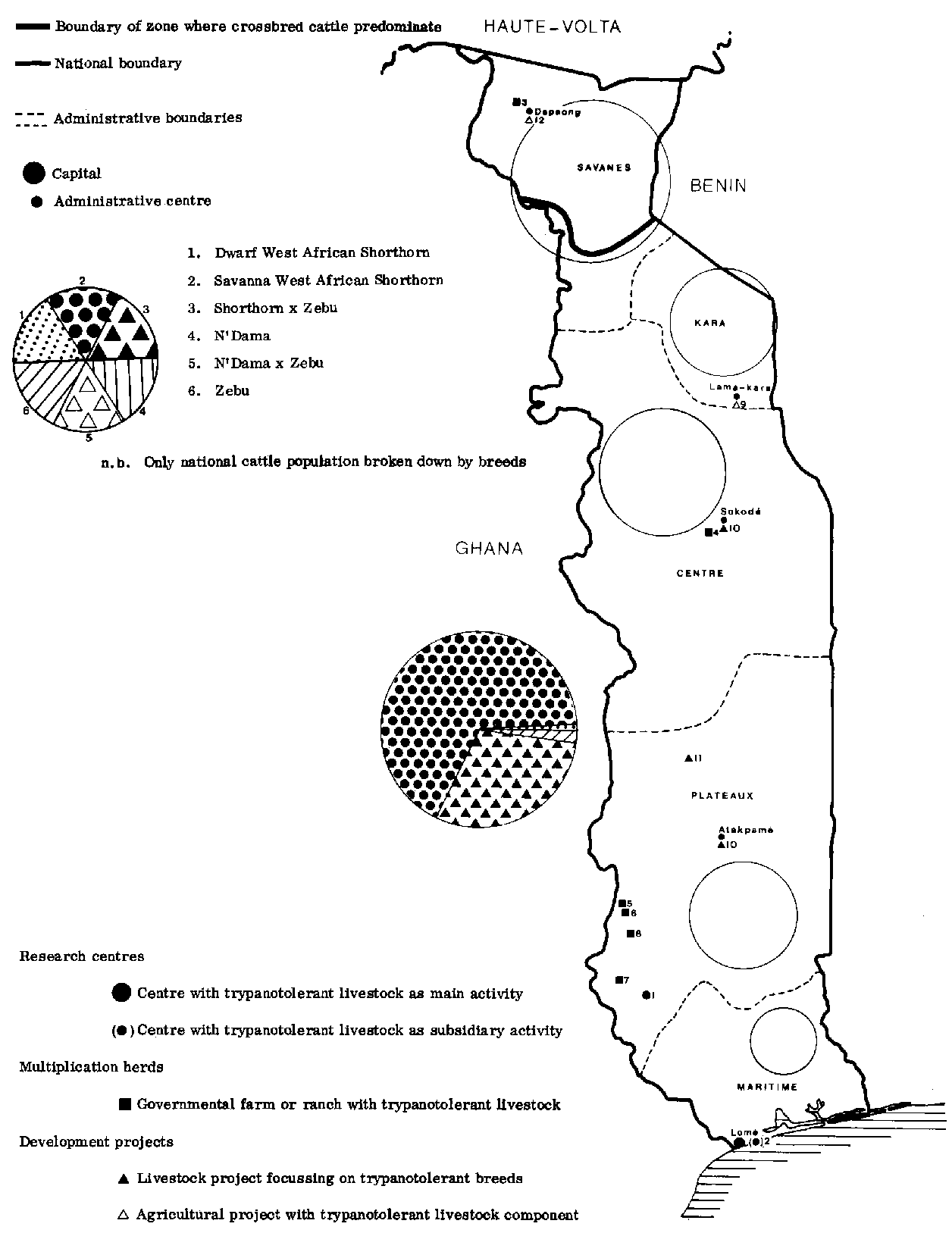
The distribution of livestock in the five regions is shown in Table 2 and Figure 1. The dominant cattle breeds in each region are indicated, but no precise figures on the distribution of individual breeds are available.
Table 2 reveals that the cattle population in Togo is concentrated in the north, with Region des Savanes and Region de la Kara accounting for 54% of the national herd. Region du Centre and Region des Plateaux in the centre of the country have much smaller cattle populations.
There are seven times as many small ruminants in the country as cattle. They are also concentrated in Region de Savanes and Region de la Kara in the north and in Region Maritime.
3.1 BREED DESCRIPTION
In southern Togo, all cattle with a general shorthorn appearance tend to be called Lagune, though, strictly speaking, the Lagune breed, or Dwarf West African Shorthorn, seems to be disappearing. Most of the animals known focally as Lagune should actually be classified as Borgou.
Table 2. Livestock distribution in Togo, 1976.
|
Cattle |
Sheep |
Goats |
|||||||||||
|
Region
|
Total Number |
% of National Total |
Density head/km² |
Breed Distribution |
Total Number |
Density head/km² |
Number |
% of National Total |
Number |
% of National Total |
|||
|
Lagune |
Somba |
Borgou |
Zebu |
||||||||||
|
Savanes |
80 000 |
37 |
9.2 |
- |
a |
a |
c |
440 000 |
50.9 |
237 000 |
30 |
203 000 |
28 |
|
Kara |
36 000 |
17 |
8.0 |
- |
a |
b |
- |
219 000 |
48.7 |
100 000 |
13 |
119 000 |
16 |
|
Centre |
51 000 |
24 |
2.5 |
- |
a |
b |
- |
187 000 |
9.3 |
93 000 |
12 |
94 000 |
13 |
|
Plateaux |
34 000 |
16 |
2.0 |
- |
b |
a |
c |
325 000 |
19.4 |
169 000 |
21 |
156 000 |
21 |
|
Maritime |
13 000 |
6 |
2.0 |
c |
c |
a |
c |
351 000 |
55.3 |
193 000 |
24 |
158 000 |
22 |
|
Entire Country |
214 000 |
100 |
3.8 |
1% |
67% |
30% |
2% |
1 522 000 |
27.0 |
792 000 |
100 |
730 000 |
100 |
a. Most numerous breed.
b. Breed present, but not dominant.
c. Small number in region.Source: Service de l'Elevage et des Industries Animales, 1976.
The Somba, a typical Shorthorn, is the most numerous breed in the country, though crossbreeding seems to be increasing.
The Borgou is a cross between Zebu and Somba, or sometimes Zebu and Lagune. This is a very heterogenous group in Togo. The most typical animals are found in Region des Savanes, though the Borgou are also the most numerous breed in Region Maritime and Region des Plateaux.
Zebu cattle have not been kept in Togo traditionally, though small numbers of Zebu may be found, particularly in the northern part of Region des Plateaux. Nomadic Zebu herds come into the northeastern part of the country from Upper Volta, and Zebu being taken to slaughter also cross over Togo.
Two other African breeds have also been introduced. The N'Dama are kept on research stations and are found in small numbers over a fairly wide area. The Wakwa Zebu, a cross between the Brahman and Adamawa Fulani Zebu, has been imported into the Plateaux de Dayes area from Cameroon. Some exotic breeds are kept on research stations, for example, German Brown and German Yellow at Avetonou and Gir and Guzera Zebu from Brazil at Anécho.
Improved animals have been imported in the past, but have not been kept as pure breeds. Their contribution to crossbreeding, however, may explain the unusual appearance of the cattle in Region des Plateaux.
3.1.1 Lagune
It appears that the Lagune breed in Togo is rapidly being absorbed by the other local breeds, and the population described as Lagune is very heterogeneous. Leclerq (1970) found significant differences in the size of animals from a herd described as Lagune on a coconut plantation and from another herd near Assahoun which had traditionally been considered pure Lagune. The average measurements of these two herds are given in Table 3.
Table 3. Measurements of two herds of Lagune cattle (cm).
|
|
Adults 5-8 Years on Coconut Plantation (n = 40) |
Adult Females 5 to 10 Years in Assahoun Area (n = 10) |
|
Height at withers |
101.4 ± 1.1 |
93.2 ± 1.4 |
|
Height at sternum |
46.4 ± 0.9 |
45.1 ± 1.1 |
|
Heart girth |
137.5 ± 1.9 |
128.9 ± 2.4 |
|
Body length |
116.3 ± 1.9 |
109.6 ± 2.8 |
|
Head length |
38.6 ± 0.5 |
34.9 ± 0.9 |
Source: Leclerq, 1970.
Domingo (1976) also recorded measurements of Lagune cattle, as well as Somba and Borgou, in different age categories. These are presented in Table 4.
Leclerq (1970) reported a fecundity rate of 70% and an age at first calving between 3 and 3½ years for a herd of Lagune cattle which belonged to the Société Régionale d'Aménagement et de Développement (SORAD) in Anécho. The average carcass weight of these animals was estimated at 80 kg.
3.1.2 Somba
The Somba are typical humpless Shorthorns, similar in appearance to the Baoulé of Ivory Coast and the Ghana Shorthorn. This is still the most numerous breed in Togo, though crossbreeding with Zebu, Borgou and sometimes N'Dama is increasing (see Figure 3.34, volume 1). Relatively pure Somba are found in Region de la Kara and in Region du Centre near Sokodé, which is an extension of the Atacora high-lands of Benin, inhabited by the Somba people, where the breed is said to have originated.
There is little information available on the productivity of the Somba in Togo. The measurements made by Domingo (1976) are given in Table 4, suggesting that the Somba and the Lagune are about the same size. Information on carcass weights was obtained from the Service de l'Elevage et des Industries Animales for Region des Savanes, Region du Centre and Region des Plateaux, as given in Table 5. Animals were classified as Zebu or humpless, which included Somba and Borgou.
Table 4. Measurements of Lagune, Somba and Borgou cattle (cm).
|
Age Group |
Lagune |
Somba |
Borgou |
|
|
15-18 months |
||||
|
|
Number |
46 |
53 |
45 |
|
|
Height at withers |
80.6 ± 0.2 |
80.3 ± 0.0 |
91 ± 0.4 |
|
|
Heart girth |
102.8 ± 0.3 |
106.4 ± 0.6 |
120.7 ±1.0 |
|
|
Scapulo-ischial length |
92.3 ± 0.8 |
91.9 ± 1.0 |
106.4 ± 0.8 |
|
3 - 3½ years |
||||
|
|
Number |
54 |
47 |
47 |
|
|
Height at withers |
95 ± 0.2 |
94 ± 0.4 |
95 ± 0.2 |
|
|
Heart girth |
126.8 ± 0.7 |
124.6 ± 0.5 |
133.3 ± 0.8 |
|
|
Scapulo-ischial length |
114.3 ± 0.4 |
114.7 ± 0.4 |
116.6 ± 0.6 |
|
5 years |
||||
|
|
Number |
54 |
76 |
50 |
|
|
Height at withers |
96.2 ± 1.1 |
97.1 ± 0.8 |
106.6 ± 0.9 |
|
|
Heart girth |
136.3 ± 2.1 |
136.6 ± 1.4 |
145.3 ± 1.4 |
|
|
Scapulo-ischial length |
119.7 ± 1.3 |
120.2 ± 1.4 |
128.4 ± 1.4 |
Source: Domingo, 1976.
Table 5. Carcass weights of Zebu and humpless cattle.
|
Region
|
Number
|
Weight in kg |
||
|
Average |
Range |
|||
|
Region des Savanes: Dapaong and Mango |
||||
|
|
Zebu |
207 |
105.4 |
47-184 |
|
|
humpless |
1 421 |
67.7 |
18-147 |
|
Region du Centre: Sokodé |
||||
|
|
Zebu |
148 |
141.0 |
76-248 |
|
|
humpless |
2 085 |
80.0 |
18-234 |
|
Region des Plateaux: Kpalimé and Atakpamé |
||||
|
|
Zebu |
815 |
139.0 |
- |
|
|
humpless |
1 279 |
103.0 |
44-117 |
Source: Service de l'Elevage et des Industries Animales 1976.
3.1.3 Borgou
It is almost impossible to define a standard type for the Borgou breed in Togo, as all the intermediate types between the humpless breeds and the Zebu are commonly grouped under this name. Measurements for these animals are given in Table 4. No other specific information is available.
3.1.4 N'Dama
Table 6 summarizes the estimates of the main production traits requires to build up a productivity index covering the total weight of one-year-old calf plus the liveweight equivalent of milk produced per 100 kg of cow maintained per year. This productivity index has been derived for meat production under the conditions of Avetonou Station in a low tsetse challenge area.
3.1.5 Wakwa Crosses
The only information available on the Wakwa Zebu in Togo is derived from data on crossbreds with the local breed at the Centre Agricole de Dzogbegan in the western part of Region des Plateaux. Average weights recorded between 1968 and 1971 are given in Table 7.
Table 6. N'Dama productivity estimates.
|
Parameter
|
Production Environment |
|
Station/low challenge/meat |
|
|
Cow viability (%) |
99 |
|
Calving percentage (%) |
67 |
|
Calf viability to one year (%) |
95 |
|
Calf weight at one year (kg) |
126 |
|
Annual milked out yield (kg) |
- |
|
Productivity indexa per cow per year (kg) |
80.6 |
|
Cow weight (kg) |
283 |
|
Productivity indexa per 100 kg cow maintained per year (kg) |
28.5 |
a. Total weight of one-year-old calf plus liveweight equivalent of milk produced.
Sources: Information from country visit.
Table 7. Average weights of local and crossbred cattle at Centre Agricole de Dzobegan (kg).
|
|
Birth |
6 months |
12 months |
18 months |
24 months |
36 months |
|
Local breed (male & female) |
13 |
48 |
88 |
131 |
171 |
202 |
|
Wakwa x local: female |
22 |
114 |
188 |
229 |
276 |
- |
|
Wakwa x local: male |
22 |
130 |
202 |
217 |
295 |
393 |
Source: Information from country visit.
3.2 DISEASE
Among contagious diseases, there has been no outbreak of rinderpest since the end of a vaccination campaign carried out in 1965. Contagious bovine pleuropneumonia (CBPP) was a serious problem from 1960 to 1970, but has not occurred recently. Foot-and-mouth disease occurs in Region de la Kara and Region des Savanes in the north, and anthrax occurs in some areas where cattle have been imported. Tuberculosis is found almost exclusively in animals which have been imported or smuggled in illegally.
Turning to parasitic diseases, treatment for ectoparasites and gastro-intestinal parasites is carried out regularly by veterinary teams which visit every region of the country.
Trypanosomiasis is endemic throughout the country, with T. vivax and T. congolense the most important trypanosomes (Mawuena, 1976). Preventive measures are carried out to control this disease.
3.3 HERD MANAGEMENT AND COMPOSITION
According to Somoko-Balantpli and Freitas (1978), 'Togo, even with certain favourable climatic conditions, is not an important livestock country. Livestock rearing is a minor, almost marginal activity which enables certain traditional expenses to be met'.
Generally speaking, the rural population consists of two groups. The great majority are almost exclusively sedentary farmers from a large number of tribes. In addition, there are Fulani who farm and raise livestock. Both groups practice rotational cropping with a long fallow period.
Though the Fulani in Togo are good farmers, they also spend a great deal of time looking after their livestock. They tend to value large herds more highly than the quality of the animals. They rent land for cultivation from the local tribes, and there is often friction between the two groups, especially during the cropping season.
The Fulani construct pens near their houses where their cattle are tethered at night. Each animal knows its place where it goes independently and waits to be tied the leg or the horns. Where cattle are kept on coconut plantations at the coast, each animal is tied to a particular tree every night for a month in order to provide manure. The cattle are milked once a day in the morning and then taken out to graze during the day. They are often herded by children during the rainy season, but by adults during the dry season when grazing is more difficult to find.
The local farmers in the southern part of the country are not as interested in livestock production, and even show a certain contempt for cattle herding, though they feel they are exploited by their Fulani herdsmen. Exceptions are the Konkomba of Region du Centre, the Kabré of Region de la Kara and the people of Region de Savanes, who seem to place more importance on livestock. The herding system among the local farmers differs from that of the Fulani in that after the harvest they leave their animals to roam freely until the next cropping season. They also appear to use more herdsman than the Fulani for the same number of animals, at least in Region des Savanes. According to a study carried out in that region by the Service de l'Elevage et des Industries Animales (Tchaniley, 1975), there were 751 Fulani herdsman with 66 170 cattle, or 88 cattle per herdsman, and 340 herdsman of other tribes with 11 967 cattle, or 35 cattle per herdsman.
In Region de la Kara herd sizes tend to be fairly small. According to the Service de l'Elevage et des Industries Animales 1 171 herds, or 85% of 1 381 herds surveyed in the region were less than 50 head in 1976, 143, or 10%, were 50 to 100 head and only 67, or 5%, were more than 100 head. Sarniguet and Legrand (1974) give the typical herd composition in Togo, based on a detailed census of 3 906 cattle carried out in 1969, as shown in Table 8.
Draught animals are not used in the traditional farming systems. There are very few draught oxen in the country, and these are generally kept on experimental farms.
Table 8. Typical herd structure.
|
Breeding cows (3½-11 years) |
39.8% |
Adult bulls |
8.0% |
|
Heifers (1½-3½ years) |
18.7% |
Oxen (over 2 years) |
2.8% |
|
Female calves (0-18 months) |
16.6% |
Young bulls (1-2 years) |
3.8% |
|
Total females |
75.1% |
Male calves (0-18 months) |
17.5% |
|
|
|
Total males |
24.9% |
Source: Sarniguet and Legrand (1974).
4.1 BREED DESCRIPTION
Sheep and goats in Togo are mainly of the Djallonké or Guinean type. In the more urbanized areas there are also a few crossbred Djallonké x Sahelian sheep. In Region Maritime, this crossbred is called Vogan sheep.
4.1.1 Sheep
For adult sheep over four years, the height at withers is generally about 50 to 55 cm and the liveweight 22 to 24 kg for ewes and 26 to 32 kg for rams. The age at first lambing is about 18 months, and the lambing rate is about 110%. Mortality up to weaning is about 20%, among lambs after weaning it is 10% and among adult animals 5%. Table 9 gives average body weights in three regions according to age. Carcass yields for animals kept under village conditions average about 50% (SEDES, 1975).
Table 10 summarizes estimates of the major production traits required to build up a productivity index based on the total weight of five-month-old lamb produced per 10 kg of ewe maintained per year. This productivity index has been derived for production under village conditions in a light to medium tsetse challenge area.
Table 9. Body weights for sheep in three regions (kg).
|
Age in months
|
Region des Plateaux |
Region du Centre |
Region de la Kara |
|||
|
female |
male |
female |
male |
female |
male |
|
|
0-2 |
3.5 |
4.0 |
5.0 |
5.0 |
- |
- |
|
4-6 |
7.5 |
7.0 |
8.0 |
10.0 |
- |
- |
|
10-12 |
13.0 |
13.0 |
15.5 |
17.0 |
11.5 |
11.0a |
|
13-18 |
16.0 |
17.0 |
- |
- |
- |
- |
|
19-24 |
17.0 |
20.0 |
22.0 |
26.0 |
- |
- |
|
25-36 |
19.0 |
21.0 |
22.0 |
- |
16.0 |
16.0 |
|
37-48 |
21.5 |
25.0 |
23.0 |
28.5 |
20.0 |
22.0 |
|
over 48 |
24.0 |
- |
24.0 |
33.0 |
22.0 |
26.0 |
a. 8-12 months
Source: SEDES, 1975.
Table 10. Productivity estimates for sheep.
|
Parameter
|
Production Environment |
|
Village/light to medium challenge |
|
|
Ewe viability (%) |
95 |
|
Lambing percentage |
165 |
|
Lamb viability to one year (%) |
80 |
|
Lamb weight at five months (kg) |
11.5 |
|
Productivity indexa per ewe per year (kg) |
15.6 |
|
Ewe weight (kg) |
23 |
|
Productivity indexa per 10 kg ewe maintained per year (kg) |
6.8 |
a. Total weight of five-month-old lamb produced.
Source: Information from country visit.
4.1.2 Goats
According to SEDES (1975), typical height at withers for adult goats is 40 to 45 cm and liveweight is 18 to 22 kg for females and 22.5 to 25 kg for males. The age at first kidding is about 15 months and the kidding rate is about 120%. Mortality rates are slightly higher for goats than for sheep. 22% up to weaning, 10% for kids after weaning and 8% for adult animals. Milk production averages about 30 kg over 60 days. Typical body weights among goats in three regions are given in Table 11.
Carcass yields are about 50% for goats kept under village conditions and about 52% for young animals reared on an improved diet. The Service de l'Elevage et des Industries Animales gives the following average carcass weights for sheep and goats in three regions in 1976:
|
|
Region des Savanes |
Region du Centre |
Region des Plateaux |
|||
|
number |
kg |
number |
kg |
number |
kg |
|
|
sheep |
122 |
7.9 |
416 |
9.1 |
1 605 |
10.5 |
|
goats |
208 |
6.7 |
709 |
7.1 |
1 560 |
9.0 |
Table 11. Body weights for goats in three regions (kg).
|
Age in months
|
Region des Plateaux
|
Region du Centre |
Region de la Kara |
||
|
male |
female |
male |
female |
||
|
0-2 |
2.0 |
4 |
4 |
|
|
|
4-6 |
5.5 |
7 |
8 |
- |
- |
|
10-12 |
11.0 |
12 |
13 |
9a |
8.0a |
|
13-18 |
12.0 |
- |
- |
- |
- |
|
19-24 |
14.0 |
17 |
16 |
- |
- |
|
25-36 |
16.0 |
22 |
18 |
11 |
13.0 |
|
37-48 |
19.0 |
25 |
19 |
13 |
18.0 |
|
over 48 |
23.0 |
- |
22 |
19 |
25.5 |
a. 8-12 months.
Source: SEDES, 1975a.
Table 12 summarized the estimates of major production traits required to build up a productivity index based on the total weight of five-month-old kid produced per 10 kg of female goat maintained per year. This productivity index has been derived for production under village conditions in a light to medium tsetse challenge area.
4.2 DISEASE
Peste des Petits Ruminants (PPR) is the most widespread infectious disease among sheep and goats in Togo, particularly during the rainy season. Generally small ruminants receive no veterinary treatment, but some flocks are beginning to be vaccinated and dewormed on a fairly regular basis (Amaizo and Kavégé, 1978).
4.3 FLOCK MANAGEMENT AND COMPOSITION
Tchaniley (1975) has reported on the management of sheep and goat flocks in Togo. Among the Fulani, small ruminants are kept crowded together at night in small pens near the owner's house. Women and children are responsible for their care. During the cropping season, they are tethered during the day near the house with enough rope to allow them to eat the grass and legumes left by the cattle. At midday, they are given water and tethered in a new place. During the dry season, sheep and goats are allowed to roam freely in flocks in search of scarce grazing. Watering is a problem during this season because the animals are not tended and must find sources of water on their own.
Table 12. Productivity estimates for goats.
|
Parameter
|
Production Environment |
|
Village/light to medium challenge |
|
|
Female goat viability (%) |
92 |
|
Kidding percentage |
180 |
|
Kid viability to one year (%) |
78 |
|
Kid weight at five months (kg) |
7.5 |
|
Productivity indexa per female goat per year (kg) |
11.0 |
|
Female goat weight (kg) |
20 |
|
Productivity indexa per 10 kg female goat maintained per year (kg) |
5.5 |
a. Total weight of five-month-old kid produced.
Source: Information from country visits.
Among the local farming population, households generally own a few sheep and goats which are looked after by the old men, women or children. Management of the flocks is the same as among the Fulani, except that they are often supplemented with bran, cassava and yam parings.
According to SEDES (1975a), the average size of flocks in Region des Plateaux is 16, and 24% consist of less than five animals and 7% of more than 50. In Region du Centre, the average flock size is only 3, with 41% of the flocks composed of 1 to 2 animals and only 2% over 30, and in Region de la Kara the average flock size is 19. In Region des Plateaux, 39% of all households keep only sheep, while 30% keep both sheep and goats. In Region de la Kara, 20% of the households keep only sheep, and 63% keep sheep and goats. The typical composition of sheep and goat flocks by age and by sex is shown in Table 13.
Table 13. Composition of sheep and goat flocks (%).
|
|
Sheep |
Goats |
||||
|
Region des Plateaux |
Region du Centre |
Region des Plateaux |
Region du Centre |
|||
|
Structure by Age |
||||||
|
|
0-6 months |
24 |
22 |
34 |
31 |
|
|
|
6-12 months |
21 |
14 |
20 |
16 |
|
|
|
1-2 years |
18 |
23 |
19 |
21 |
|
|
|
2-4 years |
22 |
21 |
16 |
19 |
|
|
|
>4 years |
15 |
20 |
11 |
13 |
|
|
Structure by Sex |
||||||
|
|
All females |
73 |
76 |
71 |
71 |
|
|
|
All males |
27 |
24 |
29 |
29 |
|
|
|
|
Females > 2 years |
32 |
39 |
23 |
30 |
|
|
|
Females 1-2 years |
14 |
15 |
14 |
17 |
|
|
|
Females < 1 year |
27 |
22 |
34 |
24 |
|
|
|
Males > 2 years |
5 |
2 |
4 |
2 |
|
|
|
Males 1-2 years |
4 |
8 |
5 |
4 |
|
|
|
Males < 1 year |
18 |
14 |
20 |
21 |
Source: SEDES, 1975a.
5.1 RESEARCH
The two centres carrying out research on trypanotolerant livestock in Togo are described in Table 14.
5.2 MULTIPLICATION HERDS
A number of stations around the country keep small herds of cattle, sheep and goats. These include Nassablé Station in Region des Savanes near Dapaong ( 3 in Figure 1), Na Station near Sokodé in Region du Centre ( 4 in Figure 1), Dzogbegan Monastery on Dayes Plateau in Region des Plateaux ( 5 in Figure 1), Dayes-Apeyiné Centre ( 6 in Figure 1), the Centre d'Apprentissage Agricole de Tové ( 7 in Figure 1) and the Centre Polyvalent d'Adéta ( 8 in Figure 1).
Table 14. Research Centres.
|
Name |
Centre d'Elevage et de Recherche sur la Trypanosomiase et la Trypanotolérance (CERTT) (B. P. 27, Agou-Gare) |
Ecole Supérieure d'Agronomie (B.P. 1515, Lomé) |
|
Location (and reference in Figure 1) |
Avetonou, 100 km from Lomé on Kpalimé road |
Lomé |
|
Organization responsible |
Ministère du Développement Rural |
Université du Benin |
|
Size |
650 ha |
5 ha |
|
Breeds and numbers |
1 783 cattle: 139 Brown Swiss and German Yellow, 759 N'Dama, 50 local breeds, 398 crossbred European x local (F1), 435 crossbred F1 x N'Dama, 2 crossbred local x N'Dama (July 1978) |
Sheep |
|
Objectives |
Research on trypanotolerance and on the genetic potential of trypanotolerant and non-trypanotolerant types and their crossbreeds. Research on the economic value of the trypanotolerant types. Systematic collection of production data. |
Improvement of different food crop varieties in Togo combined with sheep production. Genetic improvement of the local breed through selection, crossbreeding and feeding. |
|
External aid |
Germany |
|
|
Project period |
1977-1980 |
|
Source: Information from country visit.
5.3 DEVELOPMENT PROJECTS
Four development projects are described in Table 15.
Table 15. Development projects.
|
Name |
'Togo-Nord' Programme d'Amenagement du Nord Togo |
PRO-DE-BO Developpement de l'Elevage Bovin pour la Culture Attelée (B.P. 144, Sokode) |
Projet du Ranch de l'Adélé |
Projet Pilote Agricole |
|
Location (and reference in Figure 1) |
Region de la Kara (Lame Kara) |
Region des Plateaux et Region de Centre (Sokode and Atakpamé) |
Region du Centre |
Region des Savanes (Dapaong) |
|
Organization responsible |
Ministère du Développement Rural |
Ministère du Développement Rural |
|
|
|
Size |
|
|
60 000 ha, 15 600 tropical livestock units (TLU) |
Covering 1 400 farms |
|
Objectives |
Integrated rural development and improvement of production techniques. Plans to import 200 Zebus into the Lama Kara area for use as draught oxen. |
Establishment of five training and demonstration stations for draught oxen. |
WIP feasibility study for three ranches. Breeding ranch to be developed first. |
Integrated agricultural development project. |
|
External aid |
UNDP/FAO |
EEC (EDF) |
EEC (EDF) |
EEC (EDF) |
|
Project period |
1976-1978 |
1977-1978 |
|
|
Source: Information from country visit.
Amaizo, B F and Fiadogbe, F (1977). 'La transhumance au Togo et l'élevage bovin'. Paper presented at the Colloque Recherches sur l'Elevage Bovin en Zone Tropicale Humide, held in Bouaké.
Amaizo, B F and Kavégé, K F (1978). 'Inventaire des maladies du bétail au Togo'. Paper presented at the Réunion Sous-Régionale OAU/IBAR de l'Afrique de l'Ouest, held in Lomé, 10 - 14 July.
Centre Agricole de Dzogbegan (1969). 'Rapport d'élevage bovin, caprin, avicole'. Dzogbegan.
Centre Agricole de Dzogbegan (?). 'Note sur l'élevage bovin: Introduction de la race Wakwa au Togo'. Dzogbegan.
CERTT (1978). 'Proposition pour une programme de travail pour l'étude de la trypanotolérance'. Avetonou, Ministère du Développement Rural/GTZ.
Diallo, A (1960). 'Considérations sur l'élevage des bovine dans la zone soudano-guinéenne'. Dr. Vet. Med. thesis, Ecole Nationale Vétérinaire, Toulouse, 88p.
Djato, K N (1975). 'Contribution à l'étude de l'approvisionnement en viande au Togo'. Dr. Vet. Med. thesis, Ecole Inter-Etats des Sciences et Médecine Vétérinaire, Dakar, 108p.
Domingo, A M (1976). 'Contribution à l'étude de la population bovine des Etats du Golf du Benin'. Dr. Vet. Med. thesis. Ecole Inter-Etat des Sciences et Médecine Vétérinaire, Dakar.
Itard, J (1968). 'Enquête entomologique dans la région des savanes (Rép. du Togo)'. Rev. Elev. Med. Vet. Pays Trop. 21 (3), pp. 375-385.
Leclerq, P (1970). L'élevage bovin dans la région maritime du Togo. Maisons Alfort, IEMVT, 115p.
Mawuena, K (1976). 'La situation de la trypanosomiase animale au Togo'. Lomé, Direction des Services Vétérinaires et Sante Animale.
Mueller, J O (1967). Problèmes de l'élevage contractuel des bovine par les pasteurs Foulbe (Peulh) en Afrique occidentale: Arguments et opinions relatifs au developpement de l'élevage en milieu paysan en prenant exemple sur les Ewes et d'autres tribus au Togo. Munich, IFO Institut fur Wirtschaftsforschung, Afrika-Studienstelle, 187p.
Sarninguet, J and Legrand, Y (1974). Diagnostic et perspectives sur la production animale au Togo. Paris, SEDES, 109p.
SEDES (1975). Projet de développement des productions ovines et caprines dans les Regions Plateaux, Centrale, la Kara: Rapport général et rapports complémentaires. Paris, 336p.
Somoko-Balantpli, M and Freitas, M A (1978). 'Considérations sur l'élevage, la production et les industries animales au Togo'. Paper presented at the Réunion Sous-Régionale OAU/IBAR de l'Afrique de l'Ouest, held in Lomé, 10-14 July.
Tchaniley, M (1975). 'Signification économique et sociale de l'élevage traditionnel des ruminant au Togo'. Dr. Vet. Med. thesis, Ecole Inter-Etat des Science et Médecine Vétérinaire, Dakar.
Togo, Direction de la Statistique (1973). Annuaire statistique du Togo 1973. Lome, Ministère du Plan, 181p.
Togo, Direction du Service de l'Elevage et des Industries Animales (1961, 1963, 1964, 1965, 1966, 1969, 1970, 1971). Rapport Annuel. Lomé, Ministère de l' agriculture, de l'Elevage et des Eaux et Forêts et Ministère de l'Economie Rurale.
Togo, Direction Générale du Plan et du Développement (?). Troisième plan de développement économique et sociale, 1976-1980. Lomé, Ministère du Plan, 547p.
Togo, Ministère du Développement Rural (1976). 'Programme du développement de l'élevage au Togo'. Lomé, 10p.

 9
9 10
10