1. Background
2. Livestock numbers and distribution
3. Cattle
4. Sheep and goats
5. Research and development activities
6. Selected bibliography
The People's Republic of Benin is a narrow strip of land on the west coast of Africa, with its capital at Porto-Novo. The country is surrounded by Togo to the west, Upper Volta and Niger to the north and Nigeria to the east. The administration is divided into six provinces, each of which is composed of several districts which in turn are sub-divided into Communes Rurales.
The Service de l'Elevage comes under the Ministère du Développement Rural et de l' action Coopérative and has its headquarters at Parakou. A Société de Développement des Ressources Animales (SODERA) has also been established under the same ministry. The Service de l'Elevage is organized into seven livestock regions which correspond to the provinces, except for Borgou Province which is divided into South Borgou and North Borgou, or Kandi, regions. These livestock regions are divided into sectors, each with one or more Postes d'Elevage.
In 1975, the Centre d'Action Régionale pour le Développement Rural (CARDER) was formed under the Ministère du Développement Rural et de l'action Coopérative. This brings together all government activities at the regional level in agriculture, animal husbandry, development of waterways, forestry, fishing and agricultural processing.
Basic data for the country as a whole are given in Table 1.
The climate in the northern part of the country is Sahelo-Sudanian, with one rainy season from May to October. In the south, the climate is Sudano-Guinean and Guinean, with two rainy season from March to July and from September to November. Annual rainfall throughout the country averages about 1 200 mm, increasing from west to east.
According to the OAU/STRC tsetse distribution map (1977) and Gravel (1978), the entire country is infested with tsetse. G. fusca and G. mediocorum are found in the south, G. palpalis gambiensis is found everywhere except in the northwest, and G. tachinoides is found everywhere except in the far south. G. longipalpis is found in the southern half of the country and G. morsitans in the northern half, except for the northeast. Lazic (1976) carried out a detailed study of the tsetse infestation on the pilot livestock breeding farms at M'Bétécoucou and Samiondji as part of an FAO project entitled 'Développement de la Culture Attelée et de la Production Animale'.
Table 1. Background data for Benin.
|
Area |
112 600 km² |
|
|
Latitude |
6° 20'-12° 30' N |
|
|
Longitude |
1°-4° E |
|
|
Population |
||
|
|
number |
3 200 000 |
|
|
density |
28.4/km² |
|
Livestock numbers |
||
|
|
cattle |
726 000 |
|
|
sheep |
881 000 |
|
|
goats |
848 000 |
Sources: For population, OAU, 1978; for livestock numbers, Service National de l'Elevage, 1977.
The livestock population in the six provinces is given in Table 2 as recorded in 1977 by the Service de l'Elevage.
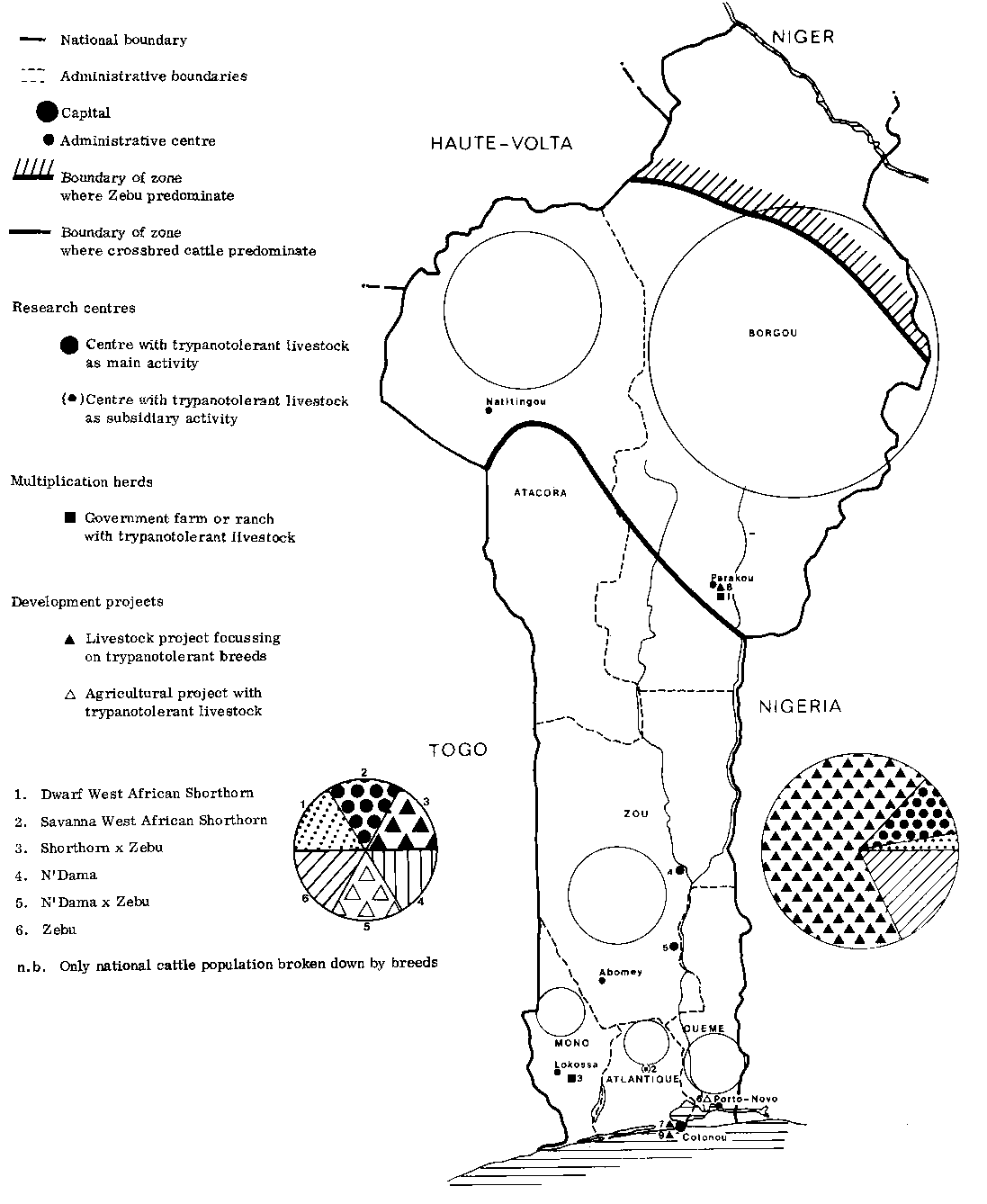
According to Gruvel (1978), the distribution of cattle breeds in Benin is complicated and in a state of change. Estimates of cattle numbers and distribution by breed type are given in Table 3.
This table indicates that the largest breed group is the Zebu x Borgou crossbreed, which illustrates the absorption process of humpless cattle by Zebu which is taking place. The 2 700 Somba recorded for Boukombé District may however be an underestimate. In Table 2 the breed types are reduced to four groups with the approximate distribution of each.
There are more than 1.7 million small ruminants in Benin, with approximately the same number of sheep as goats for the country as a whole. In Borgou Province there are more sheep than goats, while in Zou and Mono Provinces the sheep and goat populations are about equal. There are more goats than sheep in the other southern provinces and Atacora Province.
Table 2. Livestock distribution by province, 1977.
|
Province
|
Cattle |
Sheep |
Goats |
|||||||
|
Numbers |
% of National Total |
Lagune |
Somba |
Borgou & crosses |
Predominantly Zebu |
Numbers |
% of National Total |
Numbers |
% of National Total |
|
|
Borgou |
482 600 |
66.5 |
- |
- |
a |
a |
367 500 |
41.7 |
284 000 |
33.5 |
|
Atacora |
138 700 |
19.1 |
- |
a |
a |
- |
165 000 |
18.7 |
199 000 |
23.4 |
|
Zou |
56 100 |
7.7 |
|
a |
a |
- |
200 000 |
22.7 |
190 000 |
22.4 |
|
Ouemé |
21 500 |
3.0 |
a |
- |
b |
- |
60 000 |
6.8 |
73 000 |
8.6 |
|
Atlantique |
12 000 |
1.7 |
a |
- |
b |
- |
14 600 |
1.7 |
31 000 |
3.7 |
|
Mono |
14 700 |
2.0 |
a |
- |
b |
- |
74 000 |
8.4 |
71 000 |
8.4 |
|
Total |
725 600 |
|
20 000 |
75 000 |
500 000 |
130 000 |
881 000 |
100.0 |
848 000 |
100.0 |
|
% |
|
100.00 |
3 |
10 |
69 |
18 |
|
|
|
|
a. Majority group.
b. Minority group.
Source: Service de l'Elevage, 1977.
Table 3. Cattle distribution by breed type, 1976
|
Breed Type |
Distribution |
Number |
% of National Herd |
|
Zebu |
North of Borgou Province |
55 200 |
7.7 |
|
Zebu x Borgou |
Centre and south of Borgou Province |
253 100 |
35.3 |
|
Somba |
Boukombé District |
2 700 |
0.3 |
|
Borgou x Somba |
Atacora Province |
104 600 |
14.6 |
|
Borgou |
South Borgou and east Atacora |
193 600 |
27.0 |
|
Borgou x Lagune |
South and centre of country |
81 700 |
11.4 |
|
Lagune |
Lower valleys of Ouémé, Aplahoué and Abomey |
26 500 |
3.7 |
|
Total |
|
717 400 |
100.0 |
Source: P Canard and B Striffling, quoted in Gravel, 1978.
3.1 BREED DESCRIPTION
The four cattle types in Benin are the Lagune, or Dwarf West African Shorthorn, the Somba, or Savanna Shorthorn, the Borgou, which is a Zebu x humpless crossbred, and the Zebu.
3.1.1 Lagune
The Lagune cattle of Benin are typical of the breed as described in chapter 3 of volume 1. The coat is usually black, black with white spots, or black-and-white (see Figure 3.27, volume 1). Red or red-and-white animals are very rare. Mucosa, eyelids and hoofs are black. The average height at withers was 0.88 m for a sample of 17 adult cows recorded by Striffling (1977).
3.1.1.1 Performance Traits. Heinemann (1963) reported a calving rate of only 35 to 45% for Lagune cattle kept under village conditions, and Lazic (1978) recorded a calving rate of 58% at Samiondji Station in 1976-77. The Ministère du Développement Rural et de l'action Coopérative gave a calving rate of 70% for metayage operations (see chapter 3 of volume 1) which seems very high compared to the figures given in the other sources.
For metayage operations, the Ministère du Développement Rural reported mortality rates of 15% for calves up to one year and 7% for adult animals. At Samiondji Station, mortality rates of 24% for calves up to one year and 5% for adult cows were recorded by Lazic (1978).
Striffling (1977) reported average birth weights of 11 kg for 8 female calves and 10 kg for 5 males and body weights of 53 kg for the same group of females and 47 kg for the males at six months. The average weight of adult cows was 131 kg. Lazic (1978) gave average weights for different age groups as shown in Table 4.
Table 4. Average weights for Lagune cattle.
|
|
Females |
Males |
||
|
number |
kg |
number |
kg |
|
|
Birth |
16 |
9.5 |
17 |
10 |
|
6 months |
11 |
47.0 |
9 |
49 |
|
12 months |
6 |
87.0 |
5 |
83 |
|
Adults |
51 |
152.0 |
- |
- |
Source: Lazic, 1978.
Striffling (1977) recorded average weights of cows under ranching conditions in 1976-77. Six three-year-old cows weighed an average of 159 kg each, six four-year-olds averaged 158 kg, seven five-year-olds averaged 163 kg and 29 cows six-years-old and over averaged 165 kg.
3.1.1.2 Index of Productivity. Table 5 summarizes the estimates of the main production traits required to build up a productivity index covering the total weight of one-year-old calf plus the liveweight equivalent of milk produced per 100 kg of cow maintained per year. This productivity index has been derived for meat production under the conditions of Samiondji Station in a medium tsetse challenge area.
3.1.2 Somba
The Somba of Benin are stocky animals with good conformation for meat production. The height at withers is 0.90 to 1.00 m, and the coat is generally dark, either uniformly black, black-and-white, red-and-white or pied, usually with dark extremities (see Figure 3.44, volume 1). Average measurements from two surveys are given in Table 6.
Table 5. Lagune productivity estimates.
|
Parameter
|
Production Environment |
|
Station/medium challenge/meat |
|
|
Cow viability (%) |
95 |
|
Calving percentage |
58 |
|
Calf viability to one year (%) |
76 |
|
Calf weight at one year (kg) |
85 |
|
Annual milked out yield (kg) |
- |
|
Productivity indexa per cow per year (kg) |
38.4 |
|
Cow weight (kg) |
152 |
|
Productivity indexa per 100 kg cow maintained per year (kg) |
25.3 |
a. Total weight of one-year-old calf plus liveweight equivalent of milk produced.
Source: Lazic, 1978.
Table 6. Measurements from two samples of Somba cattle.
|
|
I |
II |
|
Number of animals |
36 |
76 |
|
Sex and age |
adult cows |
over 5 years |
|
Height at withers (m) |
0.92 |
0.97 |
|
Scapulo-ischial length (m) |
1.05 |
1.20 |
|
Heart girth (m) |
1.30 |
1.37 |
|
Body weight (kg) |
149 |
|
Sources: For I, Striffling, 1977; for II, Domingo, 1976.
3.1.3 Borgou
The Borgou in Benin is a crossbreed between West African Zebu (main White Fulani Zebu) and West African Shorthorn. The coat is usually white or grey, or sometimes black-and-white, and the mucosa are usually black (see Figures 3.50 and 3.58, volume 1). Height at withers ranges from 1.05 to 1.20 m among adult animals (Striffling, 1977). These animals are much more docile than the Lagune or Somba.
3.1.3.1 Performance Traits. Striffling (1977) reported a calving rate under village conditions of 54.5% in Borgou Province, compared with 73% for a sample of 14 cows at M'Bétécoucou Station in 1975/76. The calving rate varies considerable according to the degree of trypanosomiasis infestation. Lazic (1978) recorded a calving rate at M'Bétécoucou of only 33% in 1976/77. At M'Bétécoucou, the mortality rate during 1976/77 was 28% for calves and 12% for adult cows (Lazic, 1978). The average weights of Borgou cattle at M'Bétécoucou Station in 1976/77 are given in Table 7.
Table 7. Average weights of Borgou at M'Bétécoucou Station.
|
Age |
Females |
Males |
||
|
number |
kg |
number |
kg |
|
|
Birth |
15 |
16 |
26 |
17 |
|
6 months |
16 |
66 |
18 |
86 |
|
12 months |
17 |
112 |
12 |
130 |
Source: Lazic, 1978.
Average weights reported by Striffling (1977) are given in Table 8.
Table 8. Average weights of Borgou.
|
Age in Months
|
Females |
Males |
||
|
number |
kg |
number |
kg |
|
|
Birth |
26 |
15.6 |
29 |
16.4 |
|
6 |
19 |
71.5 |
19 |
90.9 |
|
12 |
17 |
116.7 |
11 |
125.9 |
|
18 |
13 |
151.7 |
10 |
163.6 |
|
24 |
9 |
206.7 |
9 |
199.5 |
|
36 |
2 |
197.0 |
3 |
225.6 |
Source: Striffling, 1977.
Average weights for adult animals range around 250 kg. Striffling (1977) recorded an average weight of 244 kg for a sample of 81 adult cows under village conditions and 248 kg for a sample of 30 adult cows under ranching conditions; Lazic (1978) reported an average weight of 226 kg for 73 adult cows at M'Bétécoucou Station. At Okpara Farm, an average weight of 307 kg was recorded in 1974 for a sample of 43 males over 5 years old (Striffling et al., 1975).
Viaut (1966) recorded an average dressing out percentage of 52% at the Parakou abbatoir for 24 males and 8 females. The average liveweight of the males was 265 kg and the average carcass weight 137 kg, while for the females average liveweight was 227 kg and carcass weight 117 kg.
3.1.3.2 Index of Productivity. Table 9 summarizes the estimates of the main production traits for Borgou cattle needed to build up a productivity index covering the total weight of one-year-old calf plus the liveweight equivalent of milk produced per 100 kg of cow maintained per year. This productivity index has been derived for meat production under conditions at M'Bétécoucou Station in a medium tsetse challenge area.
Table 9. Borgou productivity estimates.
|
Parameter
|
Production Environment |
|
Station/medium challenge/meat |
|
|
Cow viability (%) |
88 |
|
Calving percentage |
33 |
|
Calf viability to one year (%) |
72 |
|
Calf weight at one year (kg) |
119 |
|
Annual milked out yield (kg) |
- |
|
Productivity indexa per cow per year (kg) |
30.1 |
|
Cow weight (kg) |
226 |
|
Productivity indexa per 100 kg cow maintained per year (kg) |
13.3 |
a. Total weight of one-year-old calf plus liveweight equivalent of milk produced.
Source: Lazic, 1978.
3.1.4 Pabli
Several authors (e. g. Brémaud, 1967) have mentioned the existence of a Pabli breed in the Kérou area north of Kouandé in Atacora Province. This area is now populated by typical Borgou cattle; red animals were pointed out during the country visit as the remnants of the Pabli breed, which has effectively been absorbed by the Borgou.
3.1.5 Crossbreeds
There is great variety in appearance among crossbreeds in Benin depending on the original breeds which were crossed and the proportions of each (see Figures 3.62 and 3.63, volume 1). There are no precise data on the performance of the crossbreeds, but these values are generally similar to those obtained for the breeds which were crossed. The N'Dama breed has been introduced on Okpara Farm near Parakou in Borgou Province and in the south at the SOBEPALH palm plantation near Ouédo in Atlantique Province for crossbreeding purposes. There is little trace of N'Dama influence in village herds.
3.2 DISEASE
According to Gruvel (1978) and statistics from the Service National de l'Elevage for 197-5, the cattle disease situation in Benin is similar to that found in other West African countries. Serious viral and bacterial diseases are uncommon and seem to be under control, but parasitic diseases are a serious problem.
Among infectious diseases, there has been no sign of rinderpest since 1972. Contagious bovine pleuropneumonia (CBPP) was last reported in the north in 1973, brought in by animals from Upper Volta. Pasteurellosis occurs throughout the country: there were 95 foci in 1975. Anthrax is found largely in Atacora Province, with 20 foci in 1975. Some tuberculosis cases have been reported in Borgou Province, mainly among Zebu.
Parasitic diseases are the chief cause of poor health among cattle in Benin. The most common are coccidiosis, gastro-intestinal strongylosis, ascariasis, piroplasmosis and trypanosomiasis. Streptothricosis occurs mainly in the south.
Trypanosomiasis is a major problem in the northern part of the country: there were 1 125 outbreaks in 1975. Microscopic examinations to determine the types of trypanosomes involved are not carried out on a regular basis. T. vivax, T. congolense and T. brucei have all been reported, with T. vivax occurring most frequently. Lazic (1978) found that 86% of a herd of Borgou cows at M'Bétécoucou responded positively to trypanosomiasis tests, along with 51% of a herd of Lagune cows at Samiondji. These findings suggest that the level of trypanosomiasis infestation in Benin is very high.
3.3 HERD MANAGEMENT AND COMPOSITION
There are two general types of traditional cattle production in Benin: sedentary production in the Guinean region, which accounts for about 20% of the national herd, and transhumant production, which accounts for the other 80% (Atchy, 1976). Transhumance generally occurs from the south to the north and from the west to the east.
Sedentary production systems in the south can be grouped into three types. The first involves free grazing on flooded plains. When waters are low in tsetse areas from December to June, the animals are left to graze freely on fields demarcated by water. As the water rises, the animals are gathered together and kept on rafts and fodder is collected from outside the flooded area and brought to them every day by boat. Animals belonging to village fishermen and farmers are combined in one herd which is tended by a hired herdsman. In other areas, farm households own two or three cows only, which they take out in the morning to graze tethered at the edge of the fields. They are brought back to the farms in the evening. Under the third type of production system, cattle belonging to several owners are brought together in herds and tended by hired Fulani herdsmen under palm trees, coconut trees, on fallow land or on bush savanna. These herds are milked regularly and the milk is marketed in the towns. The animals are largely Borgou, and many suffer from streptothricosis.
Most livestock production in the central and northern parts of the country is carried out by Fulani who look after their own animals (accounting for more than 50% of the total cattle population) or are hired to look after animals which belong to other people. The Fulani in Benin are relatively sedentary, but they make brief seasonal migrations, leaving the old people and a few cows which have recently calved at their winter camp which is never moved. In Borgou Province, the herds are brought in every evening and individual animals are tethered in a circular arrangement near the camp. The calves are tethered in the centre and the cows on the outside, with the bulls left free. The cows are milked twice a day.
Somba farmers in the northeast keep cattle in small family herds. They are herded during the cropping season, but after the harvest they are left to roam freely.
The size of cattle herds depends on the owners and the production system employed. Herds in the south tend to be small, while those in the north, particularly in Borgou Province, tend to average about 80 head (Striffling, 1977).
Table 10 gives typical herd compositions for the two main livestock regions, Borgou and Atacora Provinces, and for the south, where the herds are chiefly composed of Lagune cattle.
Table 10. Herd composition in three areas (%).
|
|
Borgou Province |
Atacora Province |
Southern Area |
|
Male calves (< 1 year) |
11.6 |
10.3 |
8 |
|
Young bulls (1-3 years) |
9.5 |
8.8 |
4 |
|
Oxen and bulls
|
2.4 |
5.4 |
2 |
|
|
3.4 |
3 |
|
|
Total males |
23.5 |
27.9 |
17 |
|
Female calves (< 1 year) |
12.2 |
10.9 |
11 |
|
Heifers |
16.8 |
18.0 |
14 |
|
Cows |
47.5 |
43.2 |
58 |
|
Total females |
76.5 |
72.1 |
83 |
Sources: For Borgou and Atacora, Striffling, 1977; for southern area, Brémaud, 1967.
4.1 BREED DESCRIPTION
Most of the sheep in Benin are of the Djallonké breed. In the north, there are also Fulani sheep and crossbreds between the two types. Sheep in the north tend to be bigger than in the south.
Arnaud (1977) quoted an annual birthrate over two years of 1.74 lambs per ewe at the Lycée Agricole de Sékou. The same author reported an average age at first lambing of 10 months under village conditions and a lamb mortality rate of approximately 40%. Average weights for adult ewes in good conditions were 20 to 25 kg, and for adult rams 30 to 35 kg.
Table 11 summarizes estimates of the major production traits required to build up a productivity index based on the total weight of five-month-old lamb produced per 10 kg of ewe maintained per year. This productivity index has been derived for production under station conditions in a low to medium tsetse challenge area.
Table 11. Sheep productivity estimates.
|
Parameter
|
Production Environment |
|
Station/low to medium challenge |
|
|
Ewe viability (%) |
95a |
|
Lambing percentage |
174 |
|
Lamb viability to one year (%) |
60 |
|
Lamb weight at five months (kg) |
11.5 |
|
Productivity indexb per ewe per year (kg) |
12.3 |
|
Ewe weight (kg) |
22.5 |
|
Productivity indexb per 10 kg ewe maintained per year (kg) |
5.5 |
a. Estimate.
b. Total weight of five-month-old lamb produced.
Source: Arnaud, 1977; information from country visits.
The goats in Benin are of the West African Dwarf type (see Figure 3.84, volume 1). No information on their production traits was available.
4.2 DISEASE
The most important disease affecting small ruminants in Benin is Peste des Petits Ruminants (PPR). Many animals suffer from helminthiasis, which makes them weak and more susceptible to infectious diseases such as PPR.
4.3 FLOCK MANAGEMENT
Sheep and goats are owned by individual households and are generally kept in small numbers around the house. The animals from a village are never brought together in one flock. Most households keep sheep and goats together and have two to five animals in all. They are not given any veterinary attention or supplementary feeding.
There are no livestock research centres as such in Benin. However, M'Bétécoucou and Samiondji Stations, which are listed in Table 12 under multiplication herds, are treated as research stations in Figure 1 because research work is being carried out at these stations by FAO. Multiplication herds are described in Table 12 and development projects in Table 13.
Table 12. Research and multiplication herds.
|
Name |
Centre d'Elevage de l'Okpara (B. P. 361, Cotonou) |
Lycée Agricole de Sékou |
Ferme de Kpinnou |
Station de M'Bétécoucou |
Station de Samiondji |
|
Location (and reference in Figure 1) |
Borgou Province, 16 km from Parakou |
Atlantique Province |
Mono Province |
Zou Province |
Zou Province |
|
Organization responsible |
SODERA |
|
SODERA |
SODERA |
SODERA |
|
Size |
37 000 ha |
|
300 ha |
5 000 ha (25 000 planned) |
9 000 ha (15 000 planned) |
|
Breeds and numbers |
about 750 Borgou, about 150 N'Dama |
80 cattle, 210 sheep |
80 Lagune, 200 Borgou for fattening |
Breeding herd of 111 Borgou + 300 Borgou draught oxen |
Breeding herd of 112 Lagune, 200 Borgou oxen kept in reserve as draught animals |
|
Objectives |
Selection and multiplication of Borgou and N'Dama for distribution in rural areas - 6 000 head planned (2 500 breeding cows). |
Demonstration herd as part of the training programme. In 1963-65, several Brown Swiss were introduced, but now only traces remain in the herd. |
Selection and multiplication of Borgou x Lagune for the métayage operation in the southern area. |
Selection and multiplication of Borgou. Data on trypanosomiasis and weight are available on monthly basis and data on reproduction on daily basis for the past two years. |
Selection and multiplication of Lagune breed. Same data as for M'Bétécoucou. |
|
External aid |
Banque Ouest Africaine de Développement (BOAD) |
|
FAO/UNDP (B. P. 506, Cotonou) |
FAO Project BEN 72/015 (B. P. 506, Cotonou) |
FAO Project BEN 72/015 (B. P. 506, Cotonou) |
Table 13. Development projects.
|
Name |
SOBEPALH (Société Béninoise de Palmeraies d'Huile) |
Projet de Développement de la Culture Attelée et de la Production Animale |
Amélioration et Développement de la Production Animale (B. P. 506, Cotonou) |
Projet de Développement de l'Elevage dans le Sud Borgou |
Projet de Développement de l'Elevage des Petits Ruminants |
|
Location (headquarters and reference in Figure 1) |
Ouémé Province (Porto Novo) |
entire country (Cotonou) |
entire country (Cotonou) |
South Borgou Province (Parakou) |
Atacora, Borgou and Zou Provinces (Cotonou) |
|
Organization responsible |
Ministère du Développement Rural |
SODERA |
SODERA |
SODERA |
|
|
Size |
21 cooperatives each comprising several villages |
|
|
|
|
|
Breeds and numbers |
2 813 cattle (Lagune and some N'Dama crossbreds) 130 pairs of draught oxen |
Borgou, Lagune and crossbreds |
Borgou, Lagune and crossbreds |
|
|
|
Objectives |
Meat and manure production. |
Development of draught animals, commercial beef production. Demonstration, establishment of livestock centres for Borgou (M'Bétécoucou) and Lagune (Samiondji) and collection and improvement of draught oxen (Okpara). |
Continue work of M'Bétécoucou and Samiondji Stations. Introduce improved livestock husbandry methods in the rural areas. |
Improve and expand traditional herds. Introduce veterinary services. Reduce calf mortality from 30 to 10%. |
Increase national production and revenue. Raise living standards of small farmers. Introduce improved herd management. Establish supporting technical centre and an animal health component including treatment against PPR and parasites. |
|
External aid |
|
UNDP/FAO 72/015 |
UNDP/FAO BEN/77/002/A/01/12 |
EEC (EDF) |
USAID |
|
Project period |
|
1974-1977 |
1977-1981 |
4 years |
1978-1983 |
Arnaud, R (1977). 'Projet de développement de la production ovine: Province de Zou'. UNDP/FAO project. Cotenou, SODERA, 21p.
Assogba, M N (1977). 'Contribution à l'étude de la couverture des besoins en protéine d'origine animale de la population de la République Populaire du Benin'. Dr. Vet. Med. thesis, Ecole Inter-Etat des Sciences et Médecine Vétérinaire, Dakar.
Atchy, A A (1976). 'Contribution a l'étude de la transhumance en République Populaire du Benin'. Dr. Vet. Med. thesis, Ecole Inter-Etat des Sciences et Médecine Vétérinaire, Dakar.
Benin, Direction Nationale de l'Elevage (1975). Statistiques 1975. Cotonou.
Benin, Ministère du Développement Rural et de la Coopération (1969). 'Essai d'embouche a la ferme de l'Okpara'. In IEMVT. Colloque sur l'élevage. Fort Lamy, pp. 362-373.
Benin, Ministère du Développement Rural et de l'Action Coopératives (1977). Projet de Développement de l'élevage des petite ruminants. Cotonou. 18p.
Bernet, J and Winterhalter, H (1969a). 'Opération metayage au Dahomey avec des bovine trypanotolérants. In IEMVT. Colloque sur l'élevage. Fort-Lamy, pp. 134-139.
Berney, J and Winterhalter, H (1969b). 'Premiers résultats de sélection et de croisement à partir d'animaux laitiers'. In IEMVT. Colloque sur l'élevage. Fort Lamy, pp. 499-502.
Berney, J and Winterhalter, H (1969c). 'Comportement d'animaux laitiers importés d'Europe après 20 mois d'adaptation'. In IEMVT. Colloque sur l'élevage. Fort Lamy, pp. 140-147.
Brémaud, O (1967).La production de boeuf en relation avec sa commercialisation. AT 2387. Rome, FAO, 58p.
Borget, M, Delcasso, Dumont Glele, A and Lefort, (1969). 'Possibilités de développement de la production fourragère au Dahomey'. In IEMVT. Colloque sur l'élevage. Fort Lamy, pp. 459-467.
Dineur, B (1978). 'Projet pour l'amélioration et le développement de la production animale au Benin: Rapport et activités'. UNDP/FAO project. Cotonou 48p.
Domingo, A M (1976). 'Contribution à l'étude de la population bovine des états du Golfe du Benin'. Dr. Vet. Med. thesis, Ecole Inter-Etat des Sciences et Médecine Vétérinaire, Dakar, 148p.
Gani, S S (1976). 'Contribution à l'étude de l'exploitation du troupeau bovin en République Populaire du Benin'. Dr. Vet. Med. thesis, Ecole Inter-Etat des Sciences et Médecine Vétérinaire, Dakar.
Gruvel, J (1978). Rapport au gouvernement de la République Populaire du Benin sur la lutte contre les trypanosomiases en République Populaire du Benin. AGA/RP/TRYP/78/1. Rome, FAO, 52p.
Guelly, P and Saka, G S (1978). 'Intervention de la délégation de la République Populaire du Benin'. Paper presented at the Conference OAU sur la Santé et la Production Animale dans les Etats de l'Afrique de l'Ouest, held in Lomé, 10-14 July.
Heinemann, H (1963). Le développement des ressources animales et de la santé animale au Dahomey. Report No. 1688. Rome, FAO/ETAP, 23p.
Kofod, H (1964). Enquête laitière entreprise au titre de la campagne mondiale contre la faim dans la République du Dahomey. FFHC/ANB/64/17. Rome, FAO, 13p.
Lazic, S (1976). 'Enquête sur les glossines et les trypanosomiases autour des fermes pilotes d'élevage de M'Bétécoucou et de Samiondji: Rapport partiel.' Projet UNDP/FAO pour le Développement de la Culture Attelée et de la Production Animale. Cotonou.
Lazic, S (1978). 'Comparison of production of trypanotolerant cattle types: Lagune and Borgou cattle in Benin'. Report by the International Livestock Centre for Africa to the UNDP/FAO Project BEN/77/002. Nairobi.
Putman, W C (1969). Livestock survey of West Africa. New York, Rockefeller Foundation, 35p.
Striffling, B (1977). 'L'élevage bovin'. Cotonou.
Striffling, B. Canard, P and Paseri, P (1975). 'Enseignements tirés d'observations faites sur bovine mis à l'embouche dans le centre de la République Populaire du Benin'. UNDP/FAO Projet pour le Développement de la Culture Attelée et de la Production Animale, Cotonou, 44p.
UNDP/FAO (1977). 'Conclusions et recommandations du projet'. In Benin: Projet de développement de la culture attelée et de la production animale. AG:DP/BEN/72/015 Final Report. Rome, FAO, 32p.
Viaut, P L S (1966). La méthodologie pour un développement de l'élevage harmonisé avec l'ensemble du développement rural et exemples d'application. AT 2252. Rome, FAO, 22p.

 1
1 6
6 7
7