1. Background
2. Livestock numbers and distribution
3. Cattle
4. Sheep and goats
5. Research and development activities
6. Selected bibliography
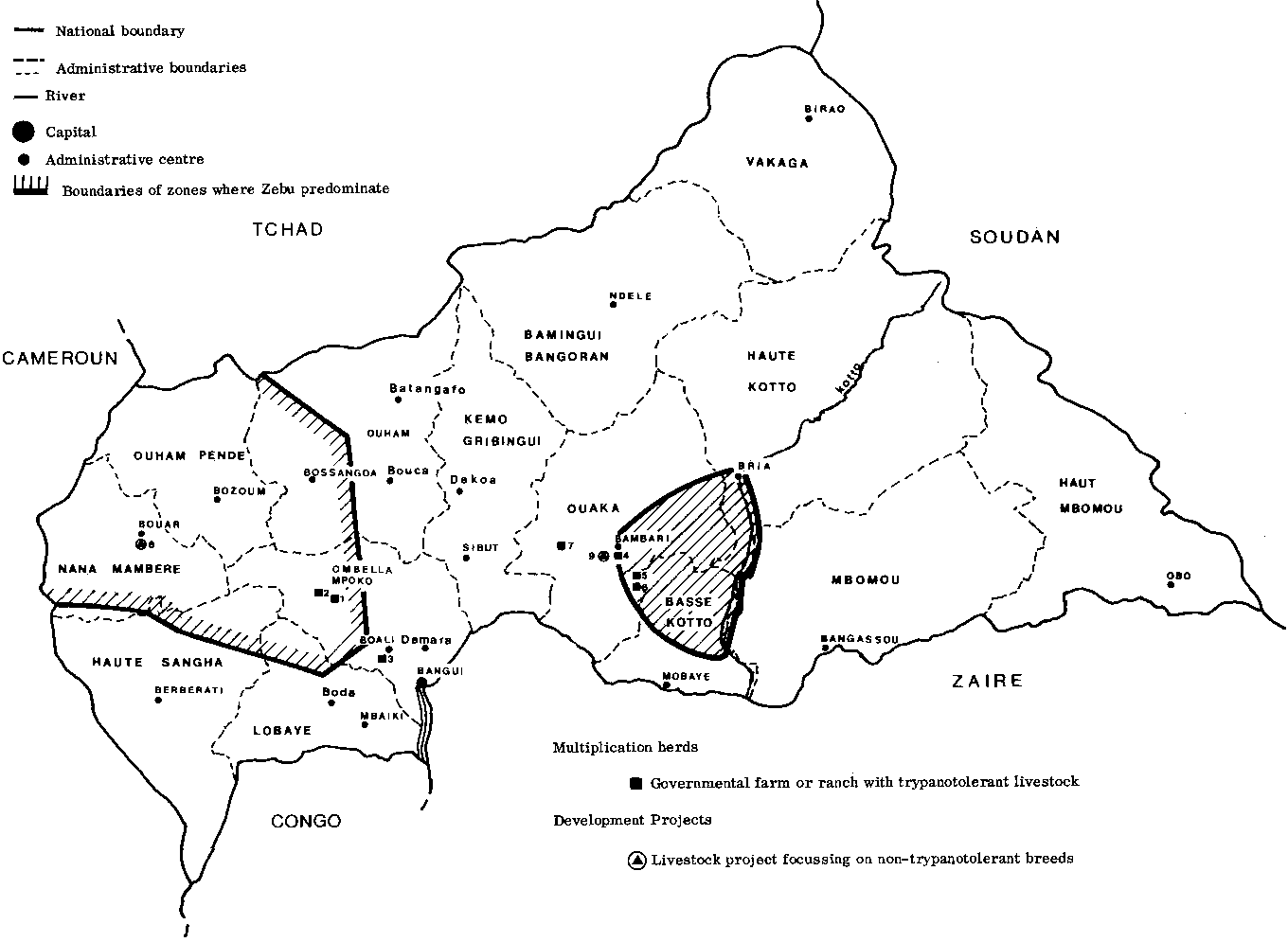
The Central African Republic is a landlocked country in the middle of the African continent, bordered by Cameroon to the west, Chad to the north, Sudan to the east and Congo and Zaire to the south. The country is divided into 14 Prefectures, with its capital at Bangui, as shown in Figure 1.
The Service de l'Elevage is part of the Ministère de l'Agriculture, de l'Elevage, des Eaux et Forêts, de la Chasse, de la Pêche et du Tourisme. The Service is meant to provide technical and veterinary services to livestock raisers and to manage government ranches and métayage operations. There is also a Société d'Etat de Gestion des Abattoirs under the same ministry, as well as a Bureau d'Etudes et de Coordination (BEC) concerned with the study of agricultural projects and general problems of agricultural development.
In fact, the Service de l'Elevage does not operate at present, as it lacks the necessary financial and material resources. Technical and health support for the Zebu herd is provided by the FAO/UNDP development project, with headquarters at Bouar, and the EDF project centred at Bambari.
Basic data for the country as a whole are given in Table 1.
Table 1. Background data for Central African Republic.
|
Area |
623 000 km² |
|
|
Latitude |
3°-11° N |
|
|
Longitude |
14°-28° E |
|
|
Population |
||
|
|
number |
1 827 000 |
|
|
density |
2.9/km² |
|
Livestock numbers |
||
|
|
cattle |
850 000 to 1 115 000 |
|
|
sheep |
64 000a or 76 000b |
|
|
goats |
650 000a or 506 000b |
Sources: For population, OAU, 1978; for cattle numbers, national estimates for 1978; for sheep and goats, a. UDEAC et al., 1976, b. FAO, 1978.
Three climatic zones can be distinguished in the country: a dense forest zone in the south with a humid tropical climate and annual rainfall averaging 1 800 mm, a central Guinean savanna zone with annual rainfall averaging 1 400 mm, and a sub-Sahelian zone in the north with grassy savannas and annual rainfall averaging 1 200 mm.
According to the OAU/STRC tsetse distribution map (1977), the region northwest of Bouar is free of tsetse. This is a continuation of the Adamawa Plateau of Cameroon with an altitude of over 1 000 m. The region southeast of Bambari has recently been freed of tsetse as the result of an eradication campaign. The rest of the country is infested, but the tsetse, especially G. fuscipes, are generally concentrated in the forest galleries, leaving wide areas of savanna tsetse free.
According to Bertucat (1965), the northeastern part of the country is infested with G. tachinoides, G. morsitans and G. fuscipes, the central area with G. morsitans and G. fuscipes, and the southern area with G. fuscipes. Two localized eradication campaigns were carried out in the 1960s, in the Baboua area west of Bouar and along the Topia River east of Carnot, to make it possible for cattle to cross there. The area between Boda and Berberati and the triangular zone between Bouca, Damora, Sibut and Dekoa are heavily infested and thus unsuitable for Zebu, even on a temporary basis. In the eastern part of the country, the areas around N'Délé and east of the Kotto River are also heavily infested. Attempts to drive Mbororo cattle into these regions in 1954, and again in 1963, led to heavy losses and had to be abandoned.
There has been no recent large-scale study of tsetse infestation in the Central African Republic. A World Bank livestock project in the western part of the country, now in the planning stage, will include such a study.
2.1 CATTLE
Most of the cattle in the Central African Republic are Mbororo Zebu. The Mbororo people began migrating into the country with their herds around the ning of the century from northern Cameroon, western Chad, eastern Niger and the extreme north of Nigeria and settled in the highlands west of Bouar which are free of tsetse. From there, they have slowly moved down towards the south and southeast where the pastures are richer. More recently, the same movement towards the south has occurred further east, in the Bambari area. Between 1960 and 1978, these movements increased and the number of Mbororo Zebu in the country doubled.
These animals are concentrated in two livestock regions. To the west in the highlands around Bouar, there are about 650 000 to 800 000 Mbororo Zebu, including 150 000 further south up to 60 km from Bangui. To the east, there are 200 000 to 300 000 animals in the area east of Bambari.
The movement of these animals into tsetse-infested areas can be explained by several factors: a shortage of grazing further north due to drought and increased agricultural settlement, the availability of pastures with particularly low livestock and wildlife populations, and a reduction of the tsetse challenge due to low rainfall and low humidity associated with the Sahelian droughts, The Mbororo have also developed strategies to minimize the risk of trypanosomiasis by grazing on the open highlands where tsetse infestation is light, watering and crossing rivers only at night or after fires, avoiding particularly heavily infested areas during the rainy season and using trypanocidal drugs. However, in spite of these precautions, there is a risk that the incidence of trypanosomiasis is increasing due to increasing animal numbers and the incorrect use of drugs, and it is feared that the Mbororo herds may be forced to withdraw to the north. The most serious consequence of the increase in cattle numbers and the breakdown of the traditional transhumance system however, is rapid pasture degradation due to overgrazing and anarchistic burning, leading to denuded pastures in the highlands and hush invasion in the savanna areas.
The indigenous peoples of the Central African Republic did not keep cattle at all until the late 1950s. At that time Baoulé and N'Dama began to be imported by the government and basic breeding herds were distributed to the villages under the métayage system described in chapter 3 of volume 1. As of 1969, there were 18 700 Baoulé, 800 N'Dama and a number of N'Dama x Mbororo crossbreds.
2.1.1 Baoulé
The Baoulé were imported from Ivory Coast and Upper Volta between 1955 and 1969. Their distribution under the métayage system is shown in Table 2 as of 1969. At that time, the total Baoulé population was 18 700, but this has decreased and is now probably closer to 15 000.
The cattle kept under métayage throughout the country increased from 7 620 in 1965 to 15 150 in 1969. The population then remained fairly stable until 1974, but since then it seems to have decreased. In the Bossembélé area for example, there were 1945 cattle in village métayage herds and on redistribution stations in 1974, and only 640 in 1977. In the Bambari area, there were 4 350 in 1974 and only 3 970 in 1977.
It is difficult to know how much of this decline in cattle numbers is real and how much is due to censusing problems. However, there are several factors which could explain the decline. For one thing, cattle which are not supervised cause damage to crops and are then killed or injured by farmers. For examples in 1974 in the Bossembélé area 67 of the 123 cattle deaths reported were caused by arrows or spears and another 20 were due to road accidents. Livestock owners who come before traditional tribunals are also often required to pay heavy fines in the form of cattle. In addition, the Service de l'Elevage, which has been inoperative for several years, is the only official marketing channel for the sale of métayage cattle. The official selling price for cattle was fixed in 1969 and is now about 50% below the market price. These factors explain the widespread illegal sale and slaughter of animals which has reached alarming proportions and the number of failures recorded among the métayage operations.
Table 2. Distribution of Baoulé cattle under the métayage system, 1969.
|
Préfecture |
Number of Participants |
Number of Cattle |
|
Nana Mambéré |
158a |
1 938 |
|
Haute Sangha |
95 |
990 |
|
Ouhamoendé |
113a |
1 312 |
|
Ouham |
128 |
1 508 |
|
Ombella-Mpoko |
103 |
2 157 |
|
Lobayé |
24 |
306 |
|
Kemo Gribingui |
74 |
931 |
|
Bamingui-Bangoran |
2 |
54 |
|
Ouaka |
205a |
2 996 |
|
Basse-Kotto |
104 |
1 334 |
|
Mbomou |
102 |
824 |
|
Haut-Mbomou |
28 |
267 |
|
Haute-Kotto |
34 |
503 |
|
Vakaga |
- |
- |
|
Total under Métayage |
1 170 |
15 150 |
a. Including métayages with N'Dama and N'Dama x Zebu crossbreds.
Source: Central African Empire, Bureau d' Etudes et de Coordination, 1977.
2.1.2 N'Dama
N'Dama were imported from Zaire and Ivory Coast between 1952 and 1954 and again between 1965 and 1969. They are kept on government ranches at Boali, Bambari, Tambia and Bokolobo and in villages under the métayage system in the Boali and Bambari areas. There is little information available on these animals, but it seems that their numbers have been decreasing recently due to excessive slaughtering on the ranches.
2.1.3 N'Dama x Mbororo Zebu
During the 1960s, N'Dama x Mbororo crossbreeding experiments were initiated at Bokolobo Ranch in the eastern livestock region (see Figure 3.67, volume 1) and a number of N'Dama bulls were distributed to the Mbororo pastoralists. The objectives were to produce draught animals for the farming population which were larger than the N'Dama but had a certain level of trypanotolerance, and also to interest the Mbororo breeders in the advantages of crossbreeding. The introduction of crossbred draught oxen was fairly successful, hut this programme came to a halt in 1970 due to the problems of the Service de l'Elevage.
At the outset, the Mbororo showed little interest in the trypanotolerant breeds or their crosses because they were smaller than their Zebu cattle and were poor walkers. However, as the Mbororo have settled in regions where they could observe Baoulé and N'Dama herds for some time, they have been impressed with the good condition of these animals. Renewed efforts to crossbreed with the N'Dama, which are more highly regarded than the Baoulé because of their conformation and their adaptability to herding, would likely meet with a favourable response. At present, the number of crossbreds is estimated at 1 500 to 2 000.
2.2 SHEEP AND GOATS
The distribution of sheep and goats in 11 of the Préfectures of the Central African Republic is given in Table 3 as of 1975.
Table 3. Distribution of sheep and goats, 1975.
|
Prefecture |
Sheep |
Goats |
|
Ombella-Mpoko |
1 859 |
31 983 |
|
Lobaye |
1 671 |
23 263 |
|
Haute Sangha |
3 536 |
20 283 |
|
Nana Mamberé |
6 514 |
49 750 |
|
Ouham Pendé |
7 112 |
94 720 |
|
Ouham |
3 134 |
173 382 |
|
Kemo Gribingui |
- |
51 063 |
|
Ouaka |
28 818 |
107 628 |
|
Basse Kotto |
9 261 |
63 958 |
|
M'Bomou |
561 |
17 310 |
|
Haute Kotto |
1 081 |
16 810 |
|
Total |
63 547 |
650 150 |
Source: UDEAC et al., 1976.
3.1 BREED DESCRIPTIONS
No distinction can be made between Baoulé and N'Dama in terms of their health conditions, fecundity or resistance to disease, particularly to trypanosomiasis. Both breeds have adapted quickly to their new environment.
3.1.1 Baoulé
The Baoulé in Central African Empire tend to be larger than in their areas of origin in Ivory Coast (see Figure 3.36, volume 1), This can be explained by a more favourable environment and husbandry system. Between 1965 and 1969, the calving rate was estimated at 66 to 70%. The mortality rate was 20% for calves, 7% for one- to two-year-olds and 4% for adult cows. Losses among adult males were about 10%, mostly due to illegal slaughter.
Table 4 summarizes estimates of the main production traits required to build up a productivity index covering the total weight of one-year-old calf produced per 100 kg of cow maintained per year. This productivity index has been derived for meat production under village conditions in a medium tsetse challenge area.
Table 4. Baoulé productivity estimates.
|
Parameter |
Production Environment |
|
Cow viability (%) |
96 |
|
Calving percentage |
68 |
|
Calf viability to one year (%) |
80 |
|
Calf weight at one year (kg) |
90 |
|
Annual milked out yield (kg) |
- |
|
Productivity indexa per cow per year (kg) |
50.0 |
|
Cow weight (kg) |
190 |
|
Productivity indexa per 100 kg cow maintained per year (kg) |
26.3 |
a. Total weight of one-year-old calf produced.
Source: Lacrouts et al., 1967.
3.1.2 N'Dama
The early métayage operations in Central African Empire did not include N'Dama because they are larger than the Baoulé and their temperament was considered more difficult. However, the N'Dama now observed under métayage conditions appear manageable and well adapted. At Grimari, for example, herds of 60 are tended by one herdsman and penned at night with no problems.
3.2 DISEASES
Trypanosomiasis in the Central African Republic is due chiefly to T. vivax and T. congolense. The Baoulé and N'Dama herds have not received any veterinary attention for the past eight years. However, their good condition is emphasized by observers throughout the country. Losses are mainly due to helminthiasis among calves, to pasteurellosis, blackquarter and rickettsiosis. In the eastern area, mucosal disease is also common. Tuberculosis is transmitted from the Mbororo Zebu herds and brucellosis is also present, but the incidence of these two diseases is unknown.
3.3 HUSBANDRY SYSTEMS
3.3.1 Métayage
Métayage operations were introduced in Central African Republic during the 1950s (see Desrotour et al., 1967; Desrotour and Renard, 1969). Villagers were encouraged to build up small herds of cattle for commercial offtake and also for home consumption, particularly in connection with traditional ceremonies. Each participating family received a basic breeding herd of 1 bull and 5 to 10 heifers from the government distribution centres. They agreed to provide one family member to tend the animals during the day and to build a pen to keep them at night. They also agreed to provide minerals and not to introduce other animals into the herd without the agreement of the Service de l'Elevage. They were to repay the government's initial investment through the natural expansion of their herds by returning the same number of animals they had received, all at least 18 months old, within five years (see Figure 3.38, volume 1).
In practice, cattle kept under métayage are often left to roam freely during the day and are not provided with any night shelter or mineral supplementation. The cows are not milked. They have not been dipped or sprayed or received any veterinary attention for the past eight years. These herds tend to be viewed with hostility by neighbouring farmers and the participants are often forced to slaughter their animals.
The average size of a métayage herd is about 12. As of 1974, the average herd composition was 36.9% adult females and 7.2% adult males, 32.5% female calves up to two years and 23.4% male calves, making a total of 69,4% females and 30.6% males. It is estimated that about 50% of the original métayage herds have failed to expand or have even decreased. However, some métayage herds have been very successful. For example, at Kidjigra near Bambari, a herd which consisted of 3 heifers and 1 bull in 1957 has now grown to 200 animals, without any further purchases and allowing for the sale or slaughter of a number of males.
3.3.2 Ranching
Government ranches operate on a fairly small scale with N'Dama herds of 60 to 250. Management is very simple: all the animals are kept together in one herd, servicing and weaning are not controlled and castration is rare. However, the animals are dipped regularly and receive mineral supplementation. The system of fenced pastures initiated earlier has been abandoned, and the herds are now tended by Mbororo herdsmen who do not follow any pasture management system The number of animals has diminished considerably due to excessive slaughtering.
3.3.3 Draught Oxen
The use of oxen for ploughing was introduced in the cotton region in the north using Mbororo and Arab Zebu. During the 1960s, experiments were carried out using N'Dama, Baoulé and N'Dama x Mbororo crossbreds as draught animals in the Bossembélé and Bambari areas, with assistance from the French Fonds d' aide et de Cooperation (FAC). The crossbreds were the most successful, as the Baoulé and N'Dama were considered too light to work on heavy soils with the implements available (see Figures 3.22 and 3.46, volume 1).
At present, there are about 100 pairs of oxen in the Bambari area, more than half Mbororo or Arab Zebu. However, N'Dama and Baoulé oxen are now more favoured because of their resistance to disease. Yet overall, the use of oxen is decreasing in the area, despite the support of the Christian missions, due to the absence of the government livestock service.
The oxen are usually worked for three hours ploughing in the early morning and then led out to pasture where they are herded or tied. Towards the end of the afternoon they do some lighter draught work and are then put in night pens and fed on crop residues. Losses are high, approaching 50% for the country as a whole, mainly due to poor management, and in particular poor feeding and overwork. Farmers have shown an interest in draught animals, but the government training centres have almost disappeared.
4.1 BREED DESCRIPTION
The sheep and goats in Central African Republic are of the West African Dwarf type. The sheep are usually black-and-white. Some crossbreeding has been observed with the Mbororo sheep, which is a Djallonké Savanna type. The crossbreds are often white and have longer legs. The goats are black or black-and-white, but brown goats with a black line on the back are also common.
Little information is available on diseases among sheep and goats, but the most important problem seems to he helminthiasis.
The management system for sheep and goats is comparable to that in similar parts of Africa. The animals are left to roam freely and are not given any mineral supplementation or shelter at night. Goats are generally valued more highly than sheep. They are reared for sale and for slaughter during traditional ceremonies, rather than as a regular source of home consumption.
5.1 RESEARCH CENTRES
The only research centre in operation is the Institut Pasteur at Bangui, which carries out research on ticks and tick-borne diseases. It also carried out a study recently on tsetse infestation in the Topia area near Carnot.
5.2 MULTIPLICATION HERDS
The ranches with multiplication herds are described in Table 5. There is little information available, but apparently these operations are decreasing. There is no important livestock centre for sheep and goats.
5.3 DEVELOPMENT PROJECTS
Two livestock projects are concerned with the Mbororo Zebu: the FAO/UNDP project aimed at strengthening animal health services in the eastern region, 'Renforcement des Services de Santé Animale dans la Zone Occidentale', with headquarters at Bouar (B. P. 183) as shown by  8 in Figure 1, and the EDF project l'Aménagement et Assainissement d'une Zone d'élevage, dans la Région de Bambari'' with headquarters at Bambari (c/o FED, B. P. 1298, Bangui) as shown by 9 in Figure 1. An extension of the EDF project was envisaged, including the reorganization of the N'Dama ranches in the eastern area, but, as of April 1978, this component seemed to have been dropped.
A World Bank project, 'Développement de l'Elevage Traditionnel dans la Zone Occidentale', is now under study. This project should continue the work of the FAO project with Mbororo Zebu. In addition, it includes suggestions for the reorganization of the Service d'élevage, and studies of tsetse infestation.
The only project directly concerned with trypanotolerant cattle is the 'Projet de Relance pour le Développement de l'Elevage Bovin Baoulé'. This is being studied by the Bureau d'Etudes et de Coordination of the Ministère de l'Agriculture, de l'Elevage, des Eaux et Forêts, de la Chasse, de la Pêche et du Tourisme, but the necessary financial support has not yet been made available. There is no project concerned with sheep and goats.
Table 5. Multiplication herds.
|
Name |
Station de Redistribution de Bossembélé |
Station de Redistribution de Doumie |
Ranch N'Dama de Boali |
Station de Bambari |
Station de Bokolobo |
Station de Tambia |
Centre de Multiplication Semenciere Grimari |
|
Location (and reference to Figure 1) |
Préfecture of Ombella Mpoko |
Préfecture of Ombella Mpoko |
Préfecture of Ombella Mpoko 50 km from Bangui, on road to Bouar |
Préfecture of Ouaka |
Préfecture of Ouaka Bambari-Alindao road |
Préfecture of Basse-Kotto on Bambari-Alindao road |
Préfecture of Ouaka |
|
Organization responsible (address) |
Service de l'Elevage (c/o Ministère de l'Agriculture, Bangui) |
Service de l'Elevage |
Service de l'Elevage |
Service de l'Elevage |
Service de l'Elevage |
Service de l'Elevage |
Ministere de l'Agriculture and FAO |
|
Size |
± 400 ha |
± 400 ha |
± 800 ha |
± 300 ha |
± 800 ha |
± 1 000 ha |
± 100 ha |
|
Breeds and numbers |
135 Baoulé as of February 1978 |
138 Baoulé as of February 1978 |
127 N'Dama as of February 1978 |
62 N'Dama as of March 1978 |
88 N'Dama with traces of Mbororo blood as of March 1978 |
80 N'Dama as of March 1978 |
75 N'Dama in two herds |
|
Objectives |
Gathering and distributing breeding stock for métayage. |
Production of breeding stock |
Production of breeding stock |
Production of breeding stock |
Production of breeding stock |
Manure production, demonstration at the College Technique d' Agriculture de Grimari situated at the Centre | |
Agrotec (1978). Prolongation du projet 'Assainissement et Aménagement d'une Zone d'Elevage à Bambari'. Rome.
Bertucat, P H (1965). 'L'élevage bovin en République Centrafricaine'. Maisons Alfort, IEMVT, 102p.
Bille, J C (1967), Note sur les stations d'élevage de la République Centrafricaine. Etude Agrostologique No. 22. Maisons Alfort, IEMVT, 31p.
Central African Empire, Bureau d'Etudes et de Coordination (1977), 'Projet de relance pour le développement de l'élevage bovin Baoulé en ECA'. Bangui
Central African Empire, Bureau d'Etudes et de Coordination (1978). Projet de relance de la culture attelée dans le nord. Bangui.
Central African Empire, Direction de l'Elevage et des Industries Animales (1970). Effectifs bovins 1969. Bangui, 4p
Central African Empire, Ministère de l'Agriculture, de l'Elevage, des Eaux et Forêts, de la Chasse, de la Pêche et du Tourisme (1978). Programme quinquennal de développement du secteur élevage. Bangui.
Central African Empire, Service de l'Elevage et des Industries Animales (1974a, 1977a). Rapport annuel du Service de l'Elevage, secteur de Bossembélé. Bossembélé.
Central African Empire, Service de l'Elevage et des Industries Animales (1974b, 1977b). Rapport annuel du Service de l'Elevage, secteur de Bambari. Bambari.
Charray, J (1967). 'Production et commercialisation du bétail et de la viande en République Centrafricaine'. IEMVT. Maisons Alfort, 66p.
Desrotour, J. Finelle, P. Martin, P and Sinodinos E (1967). 'Les bovins trypanotolerants, leur élevage en RCA'. Rev. Elev. Méd. Vét. Pays Trop. 20 (4) pp. 589-594.
Desrotour, J. Finelle, P. Martin, P and Clair, M (1969). 'Lutte contre les trypanosomes bovines en République Centrafricaine'. In IEMVT. Colloque sur l'élevage. Fort Lamy, pp. 158-165
Desrotour, J and Renard, R (1969). 'L'élevage centrafricain: Bilan des cinq dernières années'. In IEMVT. Colloque sur l'élevage. Fort Lamy, pp. 30-32.
FAO (1971). Mission Centrafrique: Rapport sur le secteur agricole en République Centrafricaine. DDA: DISC/71/3. Rome, 33p.
IBRD (World Bank) (1978). Projet de développement de l'élevage, en zone occidentale. Washington, D.C.
IEMVT (1967). 'Recherches et production'. In Région de recherches vétérinaires et zootechniques d'Afrique Centrale: Rapport annuel 1967. Volume 1. Maisons Alfort, 479p. Farcha.
Lacrouts, M and Sarniguet, J (1964), 'Notes sur la commercialisation du bétail et de la viande en République Centrafricaine'. Bangui, 39p.
Lacrouts, M, Sarniguet, J and Tyc, J (1967). Le cheptel bovin de la République Centrafricaine: Production, commercialisation, perspectives d'avenir. Paris, Secrétariat d'Etat aux Affaires Etrangères Chargé de la Coopération, 321p.
Lemonnier, G (1966) 'Introduction du bétail trypanotolerant en République Centrafricaine'. Dr. Vet. Med. thesis, Ecole Nationale Vétérinaire d'Alfort, 79p.
ORSTOM (1977) Prospection entomologique sur les glossines dans la zone d'élevage de la haute vallée de la Topia. Bangui.
Peyre de Fabrègues, B and Capitaine, P (1977). Aménagements de pâturages dans l'ouest Centrafricain et orientation nouvelle de l'élevage bovin: Rapport de la deuxième mission. Maisons Alfort, IEMVT/ECA Service de l'Elevage.
UDEAC, ECA and SEDES (1976). Etudes préliminaires à la création d'une communauté économique du bétail et de la viande: Approvisionnement en viandes: La République Centrafricaine. Bangui, 95p.
UDEAC, Ministère Français de la Coopération, United Nations (1976). Etudes préliminaires à la création d'une communauté économique du bétail et de la viande: Les problèmes de la santé animale au Tchad, en République Centrafricaine et au Cameroun.

 1
1