1. Background
2. Livestock numbers and distribution
3. Cattle
4. Sheep and goats
5. Research and development activities
6. Selected bibliography
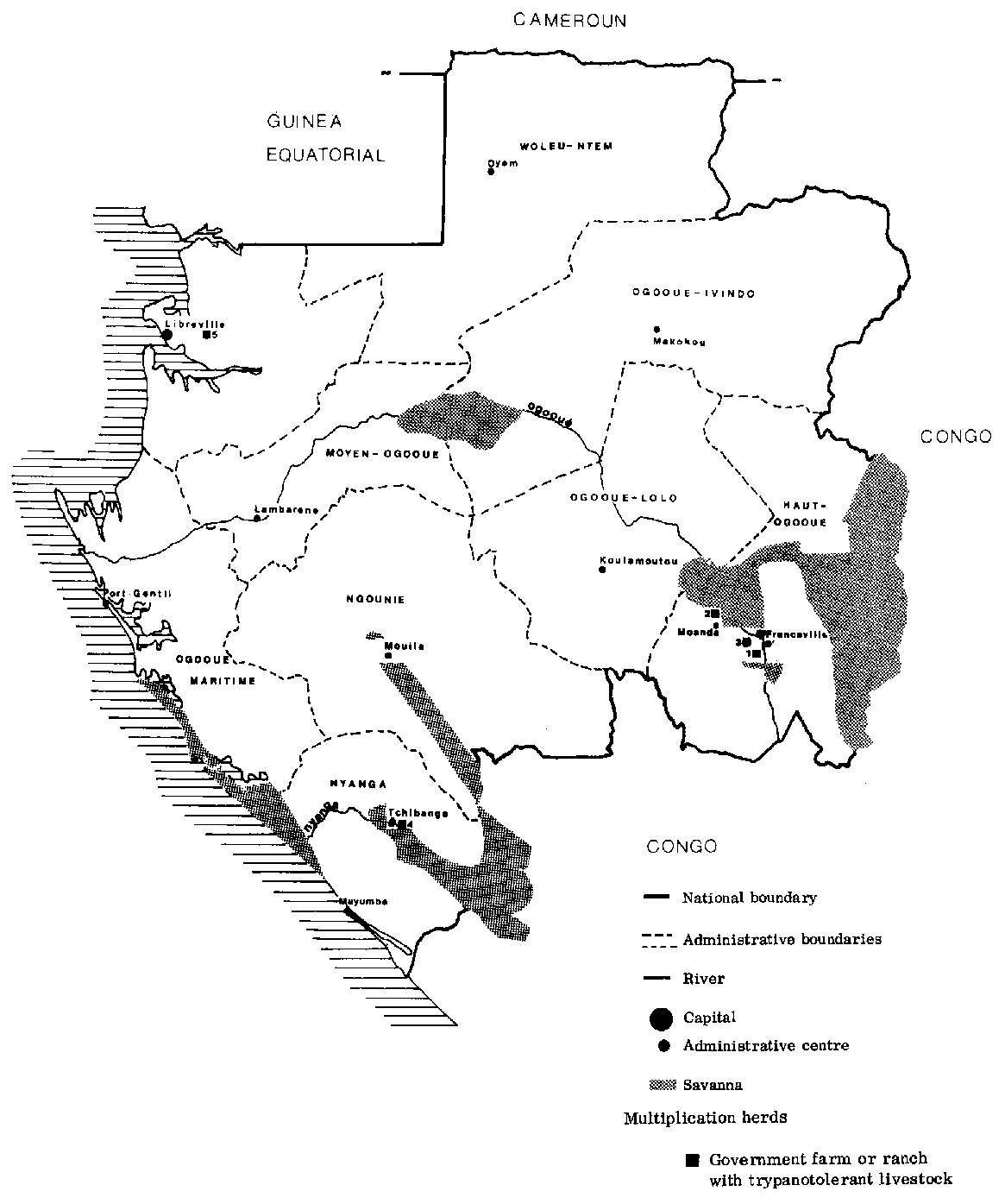
The Republic of Gabon on the west coast of Africa is bordered by Equatorial Guinea and Cameroon to the north and Congo to the east and south. The country is divided into nine administrative regions, with its capital at Libreville, as shown in Figure 1.
The Direction de l'Elevage et des Industries Animales comes under the Ministère de l'Agriculture, de l'Elevage et du Développement Rural, with headquarters at Libreville. It is composed of zootechnical, veterinary and animal industry divisions, with responsibility for animal health controls, quality control of livestock products and the 'diffusion and application of the means of production' in the livestock sector. The Office Gabonais d'Amélioration et de Production de Viande (OGAPROV) in the same ministry is responsible for the improvement and development of cattle, sheep and goat production. At the local level, the country is divided into seven livestock regions, with one or more offices in each.
Basic data for the country as a whole are given in Table 1.
Table 1. Background data for Gabon.
|
Area |
267 700 km² |
|
|
Latitude |
2° 45' N-3 50° S |
|
|
Longitude |
8° 45' E-14° 30' E |
|
|
Population |
||
|
|
number |
544 000 |
|
|
density |
2.03/km² |
|
Livestock numbers |
||
|
|
cattle |
3 200 |
|
|
sheep |
47 000 |
|
|
goats |
52 000 |
Sources: For population, OAU, 1978; for cattle numbers, information from country visit; for sheep and goats, Gabon, Direction de l'Elevage et des Industries Animales, 1975.
Figure 1. Administrative divisions and location of multiplication herds.
Gabon has a Guinean forest climate, with annual rainfall varying from 1 600 mm in the south to 3 000 mm around Libreville. The country is almost entirely covered with humid tropical forest.
The OAU/STRC tsetse distribution map (1977) shows that the entire country is infested with G. palpalis, G. tabaniformis and G. haningtoni. A study carried out by IEMVT (1974) in the Okouma, Mounana and Yéyé highlands northwest of Franceville also found evidence of G. palpalis infestation.
The distribution of cattle, sheep and goats in the nine administrative regions is shown in Table 2.
Table 2. Livestock distribution, 1975.
|
Region |
Cattle |
Sheep |
Goats |
|
Estuaire |
53 |
4 000 |
4 000 |
|
Haut-Ogooué |
1 700 |
3 000 |
4 000 |
|
Moyen-Ogooué |
- |
4 500 |
5 000 |
|
Ngounie |
340 |
10 000 |
11 000 |
|
Nyanga |
151 |
5 500 |
6 000 |
|
Ogooué-Ivindo |
24 |
4 000 |
5 000 |
|
Ogooué-Lolo |
21 |
3 500 |
3 000 |
|
Ogooué-Maritime |
- |
1 500 |
3 000 |
|
Wolou-Ntem |
138 |
11 000 |
11 000 |
|
Total |
2 427 |
47 000 |
52 000 |
Source: Gabon, Direction de l'Elevage et des Industries Animales, 1975.
Cattle were not kept in Gabon until 1945, when trypanotolerant animals began to be imported on a small scale. The few non-trypanotolerant cattle in the country were imported in the 1970s. Although the 1975 census showed only 2 427 cattle, this number has probably risen to 3 000 or 3 500 due to the recent development of ranches in Haut-Ogooué.
Sheep and goats are widely kept throughout the country, though sheep are more numerous in the coastal areas. The populations shown in Table 2 must be regarded as estimates due to the difficulties involved in making an accurate census.
3.1 BREED DESCRIPTION
Lagune cattle were imported into Gabon in 1945, 1948, 1957 and 1958, mainly from Zaire, and smaller numbers of Baoulé were imported from Ivory Coast, beginning in 1956. Both these breeds have been introduced at the village level through métayage operations. They are no longer distinguished in Gabon - both are usually called Baoulé. They are found mainly in the north and in Ngounie and Nyanga Regions (see Figures 3.30 and 3.32, volume 1).
N'Dama were first introduced on the government farm at Tchibanga in 1962, imported from Congo by the former Société Gabonaise d'Elevage. More recently, other animals have been imported from Zaire and Senegal, now totalling about 1 900. They are found mainly on the ranches at Franceville and Okouma in Haut-Ogooué Region and on the Tchibanga farm in Nyanga Region. These animals are of the Guinean or Senegalese type, depending on their area of origin.
3.2 DISEASE
Among cattle in village herds, the most important disease problem is gastrointestinal helminthiasis. On the ranches, disease problems are not serious, except for brucellosis on the ranch at Okouma, which is now coming under control. All the cattle on this ranch are vaccinated against anthrax, blackleg, pasteurellosis, vibriosis and clamidiosis. The ranches at Okouma and Franceville are located on plateaux where tsetse infestation is very low, but animals in poor condition are treated with trypanocidal, as well as anthelmintic, drugs. Trypanosomiasis is caused by T. vivax and T. congolense.
3.3 HERD MANAGEMENT AND COMPOSITION
3.3.1 Village Herds
Village cattle are exclusively of the Lagune-Baoulé type. They are kept in herds of 7 to 12, roaming freely during the day and penned at night. They are seldom given mineral supplements and are not sprayed against ticks. The farmers also rarely call upon the livestock service for veterinary care. Numbers have not increased due to excessive slaughtering. These cattle were originally given to Gabonese farmers under the métayage system, but it seems that they are being sold to immigrants from Cameroon who keep them under the same conditions for commercial purposes.
3.3.2 Extensive Ranching
Extensive ranching is practiced on the presidential ranch at Franceville and the Tchibanga farm with N'Dama cattle grazing on natural savanna at a stocking rate of 5 ha/head. The cattle originating from Zaire are kept on fenced pastures and the cattle from Senegal are herded, often by Fulani herdsmen. The herds are not divided by age or by sex, but the cattle are given mineral supplements and are sprayed against ticks twice a month. The cow are sometimes milked by the Fulani herdsmen.
3.3.3 Intensive Ranching
Intensive ranching is practiced at Okouma on fenced artificial Stylosanthes pasture. The herds are grazed on a rotational system, with water troughs in every pasture. The cattle are N'Dama, Nguni imported recently from Swaziland and crosses between the two. They are given mineral supplements and each one is marked with an individual number, sprayed every week and weighed every month.
One bull is kept for every 15 heifers or 25 cows, with a mating season from November to February. Heifers are mated first at two years, and bulls are first put into service at four years. Calves are weaned between 6 and 8 months, and the males are castrated at 15 months.
4.1 BREED DESCRIPTION
The sheep and goats in Gabon are of the West African Dwarf type. Most of the sheep are black-and-white, but up to 30 or 40% have a tan back and black belly, particularly in the coastal areas. Goats are usually black or black-and-white, but brown goats with a black line along the back are also common.
4.2 DISEASE
The most serious disease problem, both in village flocks and on the ranches, is helminthiasis. On the Franceville and Okouma ranches, a vaccination programme is planned against anthrax, blackleg, enterotoxaemia, clamidiosis, brucellosis and Colynebacteridium ovis infestation.
4.3 FLOCK MANAGEMENT AND COMPOSITION
Village flocks vary from 5 to 80, according to the size of the village. Management practices are similar to those in other areas of tropical Africa. The sheep, in particular, are kept for home consumption and for traditional ceremonies.
On the ranches, the sheep and goats are marked with individual numbers and weighed monthly. During the day, the sheep at Franceville are grazed on fenced natural savanna pastures and those at Okouma on fenced artificial pastures. At night, they are kept in pens with solid walls.
Table 3. Multiplication herds.
|
Name |
Ranch Présidentiel de Franceville |
Ranch d'Okouma |
Bergerie de Franceville |
Ferme de Tchibanga |
Station de Ntourn |
|
Location (and reference in Figure 1) |
Haut-Ogooué Region |
Haut-Ogooué Region 20 km northwest of Monda |
Haut-Ogooué Region |
Nyanga Region |
Estuaire Region 50 km east of Libreville |
|
Organization responsible |
Office of the President (Libreville) |
OGAPROV (B. P. 245, Moanda) |
Ministère de l'Agriculture, de l'Elevage et du Développement Rural and OGAPROV |
Direction de l'Elevage et des Industries Animales (B. P. 136, Libreville.) |
Ministère de l'Agriculture de l'Elevage et du Développement Rural and FAO |
|
Size |
5 500 ha natural savanna |
12 000 ha available, 600 ha of artificial pastures in use |
300 ha natural savanna |
100 ha |
|
|
Breeds and numbers |
1 100 N'Dama cattle as of February 1978 |
As of March 1978, 850 cattle, including 377 N'Dama, 163 Nguni and 310 N'Dama x Nguni; 90 Dorper x Kirdi ewes, 20 Dorper ewes; 60 Boer x local goats. |
250 crossbred Dorper x Kirdi ewes as of March 1978 |
35 N'Dama cattle as of March 1978 |
53 Lagune cattle as of March 1978 |
|
Objectives |
Production of beef and breeding animals |
Development of the ranch and settlement of Gabonese farmers with crossbred cattle. Selection and multiplication of improved sheep and goats. |
Production of improved animals |
Beef production |
Manure production |
There are no research institutes or stations in Gabon working with the trypanotolerant breeds. The multiplication herds in the country are described in Table 3. The herds and flocks at the Okouma ranch are still being developed, and a cattle herd of 10 000 head is envisaged. There are plans to develop a kind of métayage system using N'Dama x Nguni crossbreds on artificial pastures.
The government also plans to establish two more extensive ranches in the Nyanga valley and in the Ogooué valley north of Moanda: 25 000 N'Dama would be kept at Nyanga and 12 000 at Ogooué. Preliminary studies have been completed and financial support is now being sought.
Gabon, Direction de l'Elevage et des Industries Animales, (1975), Rapport annuel: Activités de l'année 1975. Libreville.
IEMVT (1974). Enquête sur les glossines des plateaux d'Oukouma, Mounana et Yéye: République du Gabon. Maisons Alfort.
Nguema-Ndong, A (1977). 'Possibilités d'élevage dans les savanes en zone équatoriale au Gabon'. Paper presented at the Colloque Recherches sur l'Elevage Bovin en Zone Tropicale Humide, held in Bouaké, 5p.
UDEAC/ECA/SEDES (1976). Etudes, préliminaires à la création d'une Communauté Economique du bétail et de la Viande: Approvisionnement en viandes: Le Gabon. 38p.

 1
1