1. Background
2. Livestock numbers and distribution
3. Cattle
4. Sheep and goats
5. Research and development activities
6. Selected bibliography
The People's Republic of the Congo stretches northward from the west coast of Africa, with Gabon to the west, Cameroon and Central African Republic to the north, Zaire to the east and south and Angola to the south. The country is divided into nine regions, plus the capital at Brazzaville.
The Service de la Production Animale et de Médecine Vétérinaire (B. P. 83, Brazzaville) is attached to the Direction Générale des Services Agricoles et Zootechniques within the Ministère de l'Economie Rurale. The Service is responsible for livestock development throughout the country through regional veterinary offices and state farms and ranches. In addition, two ranches, at Louamba and Massangui, are managed by the Société Nationale d'Elevage (SONEL), a parastatal agency within the Ministère de l'Economie Rurale.
Basic data for the country are given in Table 1.
Table 1. Background data for Congo.
|
Area |
342 000 km² |
|
|
Latitude |
3° 40' N-5° S |
|
|
Longitude |
11° 10' E-18° 40' E |
|
|
Population |
||
|
|
number |
1 360 000 |
|
|
density |
4/km² |
|
Livestock numbers |
||
|
|
cattle |
43 300 |
|
|
sheep |
42 000 |
|
|
goats |
84 000 |
Sources: For population, OAU, 1978; for cattle numbers, Congo, Service de la Production Animale et de Médecine Vétérinaire, 1977; for sheep and goat numbers, UDEAC et al., 1976.
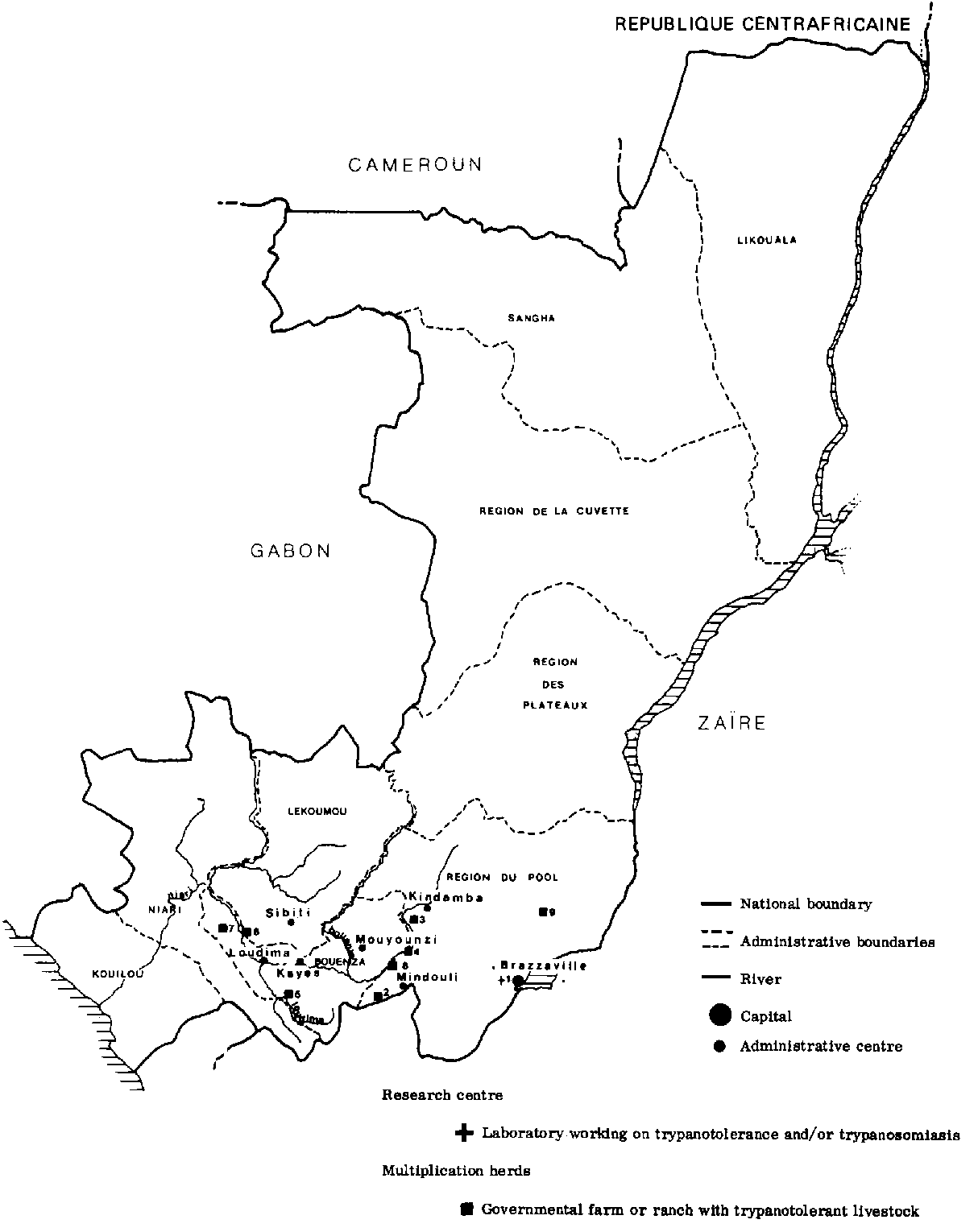
Congo has a humid climate with two rainy seasons. Approximately 65% of the country is covered with dense forests or mangrove swamps, including Lékoumou, Sangha and Likouala Regions, the northern and eastern parts of Cuvette Region, the northern part of Niari Region and the northeastern part of Kouilou Region. The rest of the country consists of Guinean savanna. Annual rainfall varies from 1 200 mm in the south to more than 1 800 mm in the north. More than 75% of the population lives in the southern area, between Brazzaville and Pointe-Noire, mainly concentrated on the savannas. (See Figure 1).
According to Baco (1965) and the OAU/STRC tsetse distribution map (1977), the entire country is infested with tsetse. Sangha, Likouala and Cuvette Regions in the north and Plateau Region are infested mainly with G. fuscipes and the southern area with G. palpalis. Another survey is now being undertaken by a medical team sponsored by ORSTOM, to revise the information available on tsetse distribution and bring it up to date.
The distribution of cattle throughout the nine regions is shown in Table 2. These are all trypanotolerant cattle, originally imported in the 1950s.
Table 2. Distribution of cattle
|
Region |
Government Farms or Ranches |
Private Farms or Ranches |
Total |
|
Kouilou |
- |
- |
- |
|
Niari |
- |
5 341 |
5 341 |
|
Lekoumou |
- |
3 430 |
3 430 |
|
Bouenza |
18 274 |
10 316 |
28 590 |
|
Pool-Brazzaville |
4 165 |
1 262 |
5 427 |
|
Plateaux |
23 |
49 |
72 |
|
Cuvette |
- |
172 |
172 |
|
Sangha |
142 |
80 |
222 |
|
Likouala |
22 |
- |
22 |
|
Total |
22 626 |
20 650 |
43 276 |
Source: Congo, Service de la Production Animale et de Médecine Vétérinaire, 1977.
Given the difficulties of enumerating cattle on private holdings, it is possible that the figures obtained by the regional veterinary offices for private farms and ranches are underestimates. For example, some estimate that the number of cattle on private holdings in the Pool-BrazzaviIle Region is closer to 4 500.
Figure 1. Administrative divisions, location of research centre and multiplication herds.
Of the national total, 98% are found in the savanna areas, including the valleys of the Bouenza and Loudima Rivers as well as the Niari River and its tributaries, and the forest area around Sibiti in the southern part of Lékoumou Region. It is estimated that 75% of these cattle are N'Dama, with the rest mainly Lagune. About 450 Zebu and Zebu x N'Dama were imported from 1945 to 1950, but these have all disappeared or were absorbed by the N'Dama.
The 1977 report of the Service de la Production Animale et de Médecine Vétérinaire included a census of the sheep and goat population, giving totals of 8 800 sheep and 4 600 goats. Again, these figures are underestimates. UDEAC et al. (1978) reported that there were 42 000 sheep and 84 000 goats in 1973, which is more accurate. Sheep and goats are found in every village throughout the country. The goat population is larger in general, but sheep are more numerous in the coastal area.
3.1 BREED DESCRIPTION
3.1.1 N'Dama
A few N'Dama were imported before 1949, and then between 1949 and 1955 about 2 520 were imported from Guinea. Again between 1967 and 1976, about 210 N'Dama were imported from Guinea, 1 650 from Senegal and 1 100 from Zaire. Most of these animals are of the classical Guinean type, with fawn to brown coats, sometimes spotted on the belly, and lyre-shaped horns (see Figure 3.23, volume 1). N'Dama of the Senegalese type, with slender bodies and lighter coats, are also found.
About 65% of the N'Dama in Congo are kept on government ranches, and the others by small farmers. They are concentrated in the savanna areas, in the southern parts of Niari, Bouenza and Pool-Brazzaville Regions, and in the forests of Lekoumou Region.
3.1.2 Lagune
Between 1949 and 1959, about 930 Lagune cattle were imported from Benin. During the same period, a few Baoulé were imported from Ivory Coast, but these have been absorbed by the Lagune. The Lagune cattle in Congo are kept exclusively in village herds, distributed throughout the same savanna and forest areas as the N'Dama. They are similar to the Lagune cattle of Benin. There has also been some crossbreeding for several years with N'Dama.
3.2 DISEASE
The main disease problems are rickettsiosis, piroplasmosis and gastrointestinal helminthiasis, and mineral deficiencies are also found, especially in village herds. Brucellosis was recently identified at the Dihessé Ranch, where it affected 37% of the females in the herd. Trypanosomiasis is caused by T. vivax and T. congolense. No systematic treatment is carried out, but disease incidence is low, mortality is relatively rare and birth rates are at an acceptable level.
3.3 HERD MANAGEMENT AND COMPOSITION
3.3.1 Village Herds
Cattle have been introduced at the village level through métayage operations initiated during the 1950s. Herds are generally from 10 to 20 head. The cattle usually roam freely during the day, but are sometimes penned at night. They are not given supplements and seldom receive veterinary attention. Animals are slaughtered for traditional ceremonies, but there is no commercial offtake.
In addition to these village herds, a number of individuals, such as shopkeepers and civil servants, have begun investing in cattle herds as a commercial undertaking in response to high meat prices. These herds generally consist of 50 to 100 head. They are herded on fenced pastures and receive some mineral supplements, but the general level of management is poor: weaning is not controlled, males are not castrated and the animals receive little veterinary attention.
3.3.2 Government Ranches
Government ranches for N'Dama cattle were first established in 1950, based on the ranching system practiced in Zaire.
Herd management problems have occurred, and at present these ranches are being reorganized. The cattle are watered at the rivers and are kept on fenced natural savanna pastures, which are now being subdivided in order to separate the herds according to age and sex. Firebreaks are constructed at the beginning of the dry season to prevent accidental fires. The animals are given supplementary potassium salt and are generally dipped every two weeks. They are weaned at six months, and castration is being introduced, along with dehorning, at one year. Slaughter cattle are sold when they reach 200 kg and breeding stock is culled at about 12 years. The cattle are branded with individual numbers.
All the sheep and goats in the country are of the West African Dwarf type. Most of the sheep are black-and-white, but sheep with tan backs and black bellies are also common, especially in the coastal areas (see Figure 3.70, volume 1). Goats are usually black or black-and-white, but animals with brown coats and a black line along the back are common.
No information is available on the performance of sheep and goats under village conditions. Birth rates among sheep at Odkiba farm, where difficult health problems have been encountered, averaged 110% in 1977, and the mortality rate averaged 32%.
Sheep and goats are affected by helminthiasis mineral deficiencies, mastitis and heartwater, but no information is available on the relative importance of these problems.
Village sheep and goats receive very little attention. They are allowed to roam freely during the day and are not provided with shelter, mineral supplementation or veterinary care. They are slaughtered during traditional ceremonies or are occasionally sold.
Two government farms have also started keeping sheep. At Odziba, the sheep are kept on fenced savanna pasture, lambs are weaned at four months and the males are castrated at one month. At the army farm at Kibélémoussia, the weaning and castration policy has not yet been defined. However, experience on this farm has indicated the importance of providing shelter. Since a clean, we'll-aerated wooden shelter was built for the flock, the annual mortality rate has dropped from 30 to less than 10%.
The Laboratoire Vétérinaire de Brazzaville (shown by +1 in Figure 1) was established in 1977 with technical assistance from the USSR. The staff are currently identifying the animal diseases observed on the government ranches and making estimates of their importance.
The most important multiplication herds in the country are listed in Table 3. In addition to these, there are smaller government breeding centres at Etoro in Plateaux Region, at Mokeko near Ouesso in Sangha Region, at Mankoussou farm in Pool Region and at the farm of the Société Cotonnière du Congo in Bouenza Region.
There are a few private commercial cattle ranches in Bouenza Region, but these are decreasing. The Socama ranch at Madingou has approximately 500 N'Dama and the ranch of the Bouenza monastery keeps approximately 300 N'Dama. The ranch of M. Joffre has approximately 30 N'Dama and that of M. Merle des Isles 120; the rest of their herds were sold to the government ranch at Dihessé.
Table 3. Multiplication herds.
|
Name |
Mpassa Farm |
APN Farm |
Louila Ranch |
Louboulou Ranch |
Office du Ranch de la Dihesse |
Louamba Ranch |
Massangui Ranch |
Ferme Ovine d'Odziba |
|
Location (and reference in Figure 1) |
20 km from Minduli, Pool Region |
Kibelemoussia, 20 km from Kindamba, Pool Region |
30 km from Minduli, Pool Region |
Near Loudima, Bouenza Region |
Near Loudima, Bouenza Region |
20 km from Kayie, Bouenza Region |
Near Mouyoundzi, Bouenza Region |
North of Brazzaville, Pool Region |
|
Organization responsible (address) |
Ministère de l'Economie Rurale |
Armée Populaire Nationale |
Ministère de l'Economie Rurale, Ministère du Plan |
Ministère de l'Economie Rurale |
SONEL (Société Nationale d'Elevage) (B. P. 81, Lutete) |
|
Ministère de l'Economie Rurale | |
|
Size |
16 000 ha fenced, 2 800 ha in use |
300 ha |
13 000 ha available, 5 200 ha in use |
11 000 ha available, 8 000 ha in use |
64 000 ha available, 6 000 ha in use |
12 000 ha fenced, 8 000 ha in use |
12 800 ha |
1 000 ha |
|
Breeds and numbers |
700 N'Dama |
240 N'Dama, 150 local sheep |
2 700 N'Dama |
2 750 N'Dama |
3 530 N'Dama |
6 000 N'Dama |
7 000 N'Dama |
310 local sheep (195 ewes), 30 Karakul |
|
Objectives |
Herd development |
Meat production |
Herd development to 5 000 head. Production of beef and breeding stock. |
Herd development to 5 000 head. Production of beef and breeding stock. |
Production of beef and breeding stock |
Flock development to 3 000 head. Production of meat and breeding stock. | ||
|
Remarks |
Since 1978, animals are marked with an individual number. Monthly weighing is planned. |
|
Changes in herds are recorded by category of animal and age groups. |
Individual reproduction records are kept |
Recording of changes within herds. Animals are branded with individual numbers. |
| ||
|
External aid |
|
|
Financial support from EDF; technical assistance J. van Lancker Co. |
Financial support from World Bank and France; technical assistance from IEMVT |
|
|
| |
|
Period |
|
|
March 1978 - March 1982 |
Ending in 1978 |
|
|
| |
Besides managing the government ranches and farms, the Service de la Production Animale et de Médecine Vétérinaire has recently initiated two development activities. First, in order to extend métayage operations in the country, the animals already allocated under the métayage system are being identified and where appropriate recovered. This operation has met with difficulties due to the lack of transport in the rural areas and the negative reactions of the villagers. The cattle involved are mainly Lagune plus some N'Dama. Second, extension work is being undertaken at the village level in order to introduce tick control measures. Neither of these projects requires external funding.
A UNDP/Congolese Government project 68/507, entitled 'Rural Development of the Pool and Koukouya Plateau Region' is financed also by Switzerland and FAC (France). During the second phase of this project, from 1974 to 1978, it was planned to count and mark all the cattle kept on the Mpassa farm and the cattle, sheep and goats in the villages of the area, but this effort met with substantial practical difficulties and now seems to have been abandoned. Preliminary tests have been carried out for trypanosomiasis which suggest that the infection rate is substantial. Tests for tuberculosis have also been carried out, but none of the test results are yet available.
Baco, C (1965). 'Contribution à l'étude de l'élevage bovin dans la République du Congo - Brazzaville.' Dr. Vet. Med. thesis, University of Lyon.
Congo, Service de la Production Animale et de Médecine Vétérinaire (1976, 1977). Rapport annuel. Brazzaville, Ministère de l'Economie Rurale, Direction Générale des Services Agricoles et Zootechniques.
Mongodin, B (1975) Projet de station laitière expérimentale a Brazzaville Rep. Pop. du Congo. Maisons Alfort, IEMVT, 53p.
Serres, H (1975) Rapport de mission au ranch de Dihessé. Maisons Alfort, IEMVT, 27p. plus annexes.
Serres, H (1976). Rapport de deuxième mission au ranch Dihessé. Maisons Alfort, IEMVT, 31p. plus annexes.
UDEAC, ECA and SEDES (1976). Etudes préliminaires à la création d'une Communauté Economique du Bétail et de ha Viande: Approvisionnement en viandes: Le Congo. 70p. plus annexes.

 2
2