1. Background
2. Livestock numbers and distribution
3. Cattle
4. Sheep and goats
5. Research and development activities
6. Selected bibliography
The Republic of Zaire lies in central Africa with a narrow outlet on the west coast. The country is bordered by Cabinda and Congo to the west, Central African Republic and Sudan to the north, Uganda, Rwanda, Burundi and Tanzania to the east, Zambia to the southeast and Angola to the south. It is divided into 9 regions, including the capital at Kinshasa, with 23 subregions.
The Service de Santé et Production Animales, under the Commissariat à l'Agriculture, operates through regional and subregional offices with responsibility for animal health and technical assistance to livestock raisers. The Office National de Développement de l'Elevage (ONDE), also under the Commissariat à l'Agriculture, is responsible for the management of government ranches and farms, veterinary laboratories and livestock development projects.
The study area includes the gas-Zaire, Bandundu and Equateur Regions. Basic data for the country as a whole and for the study area are given in Table 1.
Table 1. Background data for Zaire.
|
|
Whole Country |
Study Area |
|
|
Area |
2 345 000 |
763 000 |
|
|
Latitude |
5°N-13° 15'S |
5°N-8° S |
|
|
Longitude |
12° 16' E-31° 15' E |
12° 16' E-21° E |
|
|
Population |
|||
|
|
number |
25 389 000 |
9 500 000 |
|
|
density |
10.8/km² |
12.4/km² |
|
Livestock numbers |
|||
|
|
cattle |
1 079 000 |
281 000 |
|
|
sheep |
762 000 |
171 000 |
|
|
goats |
2 216 000 |
818 000 |
Sources: For population, OAU, 1978; for livestock numbers, Zaire, Division de la Statistique, 1977b.
The central basin and the Bas-Fleuve Subregion of the gas-Zaire Region, together comprising 48% of the country, are covered with forest. The rest of Bas-Zaire Region, Bandundu Region except for the area north of the Kasai River, and the northern part of Equateur Region are composed of Guinean savannas. Annual rainfall in the study zone varies from 1 400 mm in the south up to 2 000 mm near the Equator and hack down to 1 600 mm in the north. There are two rainy seasons, but in the north and especially in the centre of the study zone the seasons are not we'll marked and rain frequently occurs in the dry seasons.
According to the OAU/STRC tsetse distribution map (1977) and the ECA/FAO/OAU livestock development study (1973), the entire country is infested with tsetse except for the southern part of Shaba Region and a narrow strip on the eastern border of Kivu Region. Evans and Niemegeers (1955) also found that an area along Lake Tanganyika and another along Kwango River in the southern part of Bandundu Region were free of tsetse. This second area, located in the study zone, still seems to be tsetse free.
G. palpalis is found in all the infested area, G. fusca in the central basin and the north, G. tabaniformis in the central basin and G. morsitans in the southeast. However, the tsetse infestation on the southeastern plateaux is considered very light. A new study of tsetse infestation by medical teams is now underway, covering the most heavily infested regions - Bas-Zaire, Bandundu, Equateur, the western part of Haut-Zaire and the northern parts of Kasai Occidental and Kasai Oriental.
The distribution of cattle, sheep and goats among the nine regions is shown in Table 2. The livestock population is concentrated in the eastern and southeastern highlands, with 70% of the cattle, 75% of the sheep and 57% of the goats in Haut-Zaire, Kivu and Shaba Regions.
In the study zone, more than 85% of the cattle population are trypanotolerant. It is generally estimated that there are only 10 000 to 15 000 trypanotolerant cattle outside these three regions, or even less according to SEDES (1975), As of 1976, the three regions accounted for 281 000 cattle, or 26% of the national total, 171 500 sheep, 22% of the national total, and 818 000 goats, 37% of the national total, as shown in Table 2.
The entire cattle population of the study area was originally imported. The first cattle brought in were Barotse from Angola, beginning in 1889, but these have disappeared, at least as a pure breed. Some Barotse influence can be seen in the Mateba (see Figure 3.59, volume 1) and in the so-called Kisantu (see Figure 3.60, volume 1), an N'Dama x Angola crossbred which is now disappearing.
Table 2. Livestock distribution by regions.
|
|
Area (km²) |
Cattle ('000) |
Sheep ('000) |
Goats ('000) |
|
Kinshasa |
9 965 |
13.3 |
0.7 |
20.0 |
|
gas-Zaire |
53 920 |
110.9 |
56.1 |
109 7 |
|
Bandundu |
295 658 |
99.8 |
104.2 |
581.0 |
|
Equateur |
403 293 |
57.2 |
10.5 |
99.4 |
|
Haut-Zaire |
503 239 |
305.9 |
107.9 |
483.7 |
|
Kivu |
256 662 |
171.7 |
249.0 |
502.0 |
|
Shaba |
496 965 |
230.8 |
173.9 |
168 1 |
|
Kasai Oriental |
168 216 |
32.8 |
37,7 |
123.6 |
|
Kasai Occidental |
156 967 |
56.2 |
22.0 |
128.5 |
|
Total |
2 344 885 |
1 078.6 |
762.0 |
2 216.0 |
Source: Zaire, Division de la Statistique, 1977b.
Lagune cattle, called Dahomey in Zaire, were first imported from Benin in 1904 (Mortelmans and Kageruka, 1976). There are now about 13 000 to 15 000, found mainly under village conditions in the forest areas in Mayumbé in gas-Zaire Region, in Kwilu in Bandundu Region and around Lisala and Bumba in Equateur Region. Many farmers are trying to increase the size of their animals by crossbreeding their Lagune herds with N'Dama, and for this reason the Lagune is slowly disappearing as a pure breed.
N'Dama were first imported into Zaire from Guinea in 1920. They were kept on commercial farms and ranches in gas-Zaire and then distributed in Bandundu and Equateur Regions. N'Dama are very popular in Zaire, and their numbers are increasing, both on commercial ranches and in the villages. There are now between 235 000 and 245 000 in the country as a whole.
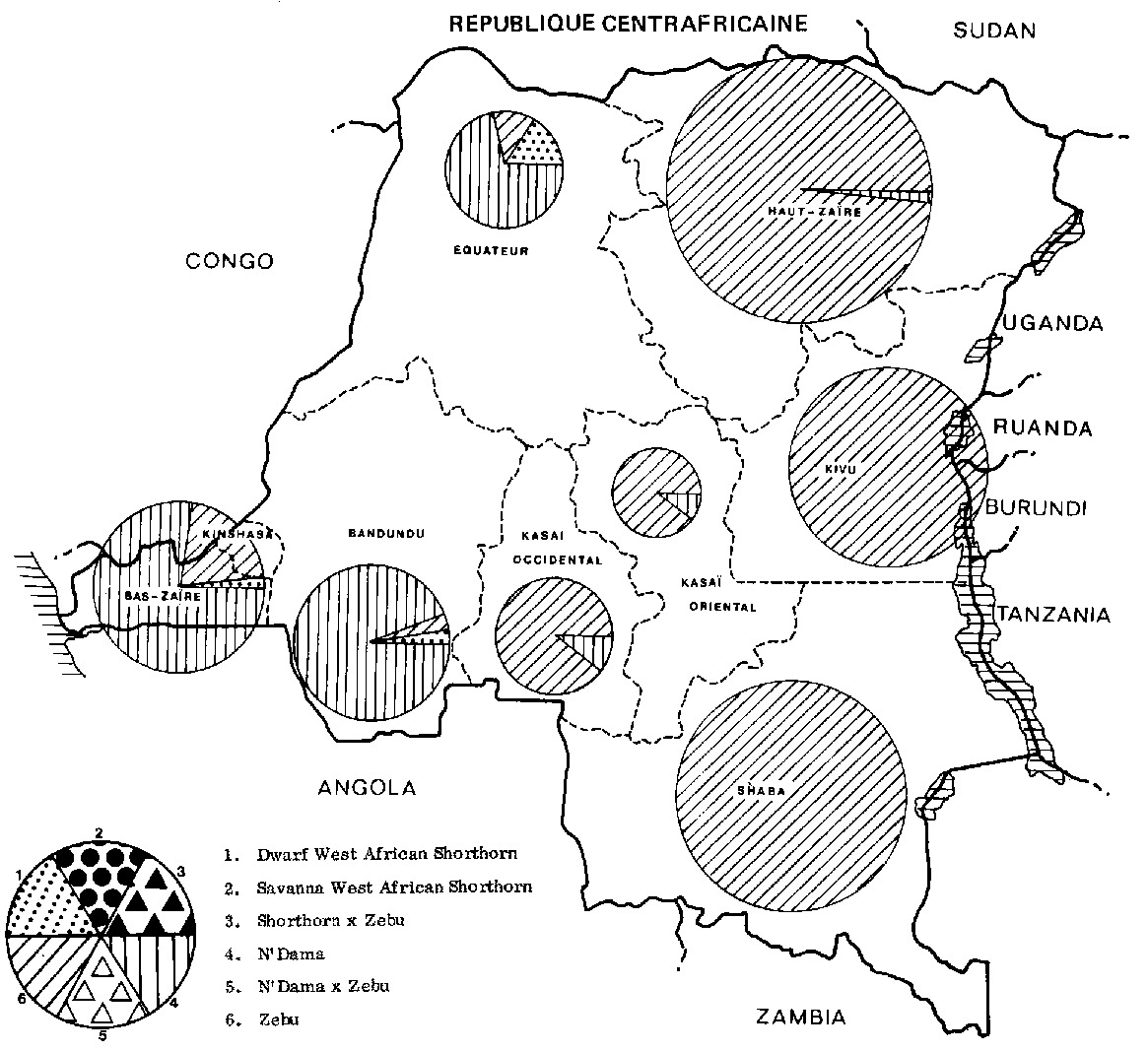
Table 3 gives the distribution of the main cattle breeds in the three regions of the study area. Figure 2 shows the distribution of the main breeds throughout the country, while Figure 3 shows the distribution of the trypanotolerant breeds within the study area and the effective boundary between Zebu and trypanotolerant types.
The boundaries of the study area are based on the distribution of trypanotolerant cattle breeds, and are less relevant for trypanotolerant sheep and goats. In fact, large numbers of Djallonké sheep and goats are found outside the study area. As Table 1 indicates, there are about 171 000 sheep and 818 000 goats in the study area. However, there are about 610 000 trypanotolerant sheep and 1 773 000 trypanotolerant goats in the country as a whole.
Figure 3. Cattle breed distribution and forest areas.
Table 3. Distribution of trypanotolerant cattle breeds by region, 1976 estimates.
|
|
Bas-Zaire plus Kinshasa |
Bandundu |
Equateur |
|
Lagune |
2 000 |
3 000 |
8 000-10 000 |
|
N'Dama + crossbreds |
95 000 |
92 000 |
40 000 |
|
Mateba + crossbreds |
26 000 |
- |
- |
|
Others |
|
4 000a |
7 000b |
a. Mainly crossbred N'Dama x Angola and some Africander.b. Mainly Ituri (Small Eastern African Zebu) kept on ranches under intensive chemoprophylaxis or curative treatment.
Source: Information from country visit.
3.1 BREED DESCRIPTION
3.1.1 Lagune or Dahomey
The Lagune cattle in Zaire were originally imported from Benin, and resemble the Lagune type described in chapter 3 of volume 1. Little information is available about this breed in Zaire. Mortelmans and Kageruka (1976) report average heights of 95 to 105 em at withers (see Figure 3.28, volume 1). Adult cows in good condition weigh between 150 and 200 kg and adult bulls from 200 to 300 kg and sometimes more. There is general agreement on the hardiness and fertility of the breed.
Table 4 summarizes estimates of the main production traits required to build up a productivity index covering the total weight of one-year-old calf produced per 100 kg of cow maintained per year. This productivity index has been derived for meat production under village conditions in a medium tsetse challenge area.
3.1.2 N'Dama
The N'Dama in Zaire are found mainly in gas-Zaire Region. They were originally imported from the Fouta Djallon area of Guinea, and have been kept as a pure breed and also crossed with Lagune, Barotsé, Angola and Africander cattle imported earlier. Back crossing to N'Dama was initiated as early as 1930. Since World War II, purebred N'Dama have been raised on large commercial ranches, subject to uniquely stringent selection criteria.
Table 4. Lagune productivity estimates.
|
Parameter |
Production Environment |
|
Cow viability (%) |
98a |
|
Calving percentage |
40 |
|
Calf viability to one year (%) |
85a |
|
Calf weight at one year (kg) |
80 |
|
Productivity indexb per cow per year (kg) |
27.2 |
|
Cow weight (kg) |
160 |
|
Productivity indexb per 100 kg cow maintained per year (kg) |
17.0 |
a. Estimate.
b. Total weight of one-year-old calf produced.
Sources: Estimates from Gimbi Research Station and Mortelmans and Kageruka, 1976.
The N'Dama in Zaire are basically of the Guinean type, though a little heavier and with better characteristics for meat production (see Figures 3.24, 3.25 and 3.26, volume 1). Their coats are generally fawn, sometimes with white spots on the belly. The males have red heads and necks. They graze during the hottest hours of the day without seeking shade. Animals kept under extensive ranching conditions in fenced pastures tend to have a nervous disposition.
3.1.2.1 Performance Traits. On the ranches, the age of bulls at first service is three years and heifers are first mated between 18 and 30 months. The calving rate under extensive ranching conditions is 75 to 80%, including only calves alive two weeks after birth when they are recorded. Under more intensive conditions, the calving rate is as high as 100%, for instance on the Diocese de Kikwit ranch with 1 300 head.
Mortality rates are generally very low. For example, on Kolo Ranch overall mortality is 1.0 to 1.5%, including animals missing and accidental deaths but not deaths of calves under two weeks old.
Milk production is estimated at 700 to 800 kg per lactation (ECA/FAO/OAU, 1973). Body weights of animals kept under grazing conditions on natural savanna without supplementary feed are given in Table 5. Weights were recorded at Kolo Ranch at the end of the dry season; the 3- and 4-year-old animals are generally 25 kg heavier during the rains.
Average adult weights of N'Dama at three different locations are given in Table 6.
Table 5. Body weights of N'Dama at various ages (kg).
|
Age in months |
Birth |
7 (weaning) |
12 |
18 |
24 |
36 |
48 |
|
Females - Mvuazi Station |
19 |
120 |
127 |
156 |
203 |
241 |
- |
|
Steers - Kolo ranch |
29 (2 weeks) |
116 |
139 |
176 |
207 |
280 |
331 |
Sources: Mortelmans and Kageruka, 1976; Risopoulos, 1966; and for Kolo, information from country visit.
Table 6. Body weights of adult N'Dama (kg).
|
|
Mvuazi Station |
Gimbi Station |
Kolo Ranch |
|
Females |
290 |
300-325 |
290-300 |
|
Males |
456 |
400 |
430-450 |
Sources: For Mvuazi, Risopoulos, 1966; for Gimbi, Mortelmans and Kageruka, 1976; for Kolo, information from country visit.
On ranches with meat production operations, oxen are slaughtered between three and four years at a liveweight varying from 320 to 360 kg. No special fattening programme is carried out. The dressing out percentage for animals on natural savanna varies from 50 to 55%.
3.1.2.2 Index of Productivity. Table 7 summarizes estimates of the main production traits required to build up a productivity index covering the total weight of one-year-old calf produced per 100 kg of cow maintained per year. This productivity index has been derived for four production environments: meat production under village conditions in a high tsetse challenge area at Idiofa in Bandundu Region, meat production under ranch conditions in a high challenge area at N'Djokélé in Bandundu Region, and meat production under ranch conditions in two low challenge areas at Kikwit in Bandundu Region and Kolo in gas-Zaire Region.
3.1.3 Mateba
Angola cattle were first introduced on Mateba Island in the mouth of the Zaire River, near Boma, in 1889 as a food supply for the workers on the Matadi-Kinshasa railway line. At the turn of the century, crossbreeding was introduced with imported Devon, Hereford and Africander cattle, and Devon were reintroduced in 1948. By now, the Mateba breed has stabilized, and is very homogeneous in appearance (see Figure 3.60, volume 1).
Table 7. N'Dama productivity estimates.
|
Parameter
|
Productivity Environment |
|||
|
Village/high challenge/meat |
Ranch/high challenge/meat |
Ranch/low challenge/meat |
Ranch/low challenge/meat |
|
|
Cow viability (%) |
98 |
99 |
99 |
99 |
|
Calving percentage |
60 |
65 |
80 |
100 |
|
Calf viability to one year (kg) |
70 |
90 |
98 |
95 |
|
Calf weight at one year (kg) |
110 |
130 |
140 |
140 |
|
Productivity indexb per cow per year (kg) |
46.2 |
76.1 |
110.3 |
133.5 |
|
Cow weight (kg) |
220a |
250 |
270 |
270 |
|
Production indexb per 100 kg cow maintained per per year (kg) |
21.0 |
30.4 |
40.9 |
49.5 |
a. Estimate.
b. Total weight of one-year-gild calf produced.
Source: Information from country visit.
Today, about 9 000 pure Mateba are kept by the Grands Elevages Company on Mateba Island and the adjoining river banks in an area which is apparently free of trypanosomiasis. They have adapted remarkably we'll to an unusual environment, wading in pastures covered with river water enriched by alluvium and grazing on so-called 'floating' grass which is rich in all the necessary mineral elements. Adult cows weigh more than 400 kg, adult bulls 600 kg and 4-year-old oxen 500 kg. The Mateba are not considered as trypanotolerant as the N'Dama or the Lagune.
Mateba have been introduced in the savanna areas of gas-Zaire, where they have adapted less successfully, affected by trypanosomiasis, the drier conditions and less abundant food supply. They have been crossbred to produce animals which are half and three-quarters N'Dama, but the crossbreds suffer with different intensities from the same health problems and also seem to develop skin diseases in the savanna environment. The company now plans to increase all crossbreds to three-quarters N'Dama in an effort to produce animals which will be more successful outside their original environment. There are about 18 000 crossbreds in the Cataractes Subregion of gas-Zaire and another 3 400 on a ranch of the Kasai Company at Pinanga in Kasai Occidental.
3.2 DISEASE
The health situation among trypanotolerant cattle in the study area is generally good, except for mineral deficiencies which are very important in certain locations. Trypanosomiasis is caused chiefly by T. vivax and T. congolense. N'Dama and Lagune cattle are not treated systematically for trypanosomiasis, but animals showing a rapid weight loss are dosed with Berenil and some ranches in heavily infested areas plan to give preventive treatment to week-old calves. Non-trypanotolerant cattle are subject to regular blood tests and veterinary treatment.
The incidence of several common diseases is lower in Zaire than in other comparable areas in Africa. Relatively important diseases include salmonellosis and necrobacillosis among the infectious diseases, as well as tick fevers, particularly piroplasmosis. Parasitic diseases are also relatively important, particularly helminthiasis, especially among herds which are kept enclosed at night and those fed Stylosanthes, which tends to carry parasites because it cannot be burnt, The non-trypanotolerant cattle and their crossbreds, on the other hand, are very susceptible to skin diseases, particularly to streptothricosis.
3.3 MANAGEMENT SYSTEMS
Cattle in the study zone are kept under two management systems: extensive commercial ranching (see Figure 3.24, volume 1) and village production under the métayage system (see Figure 3.21, volume 1).
3.3.1 Village Cattle Production Under Métayage
Cattle rearing is not traditional in Zaire, but was introduced at the village level at the beginning of the century through the métayage system (see chapter 3 of volume 1). Métayage operations have been developed on a large scale by the government, as well as by religious and commercial organizations. Originally, only Lagune cattle were raised under the métayage system, but since the 1950s N'Dama and N'Dama x Lagune crosses (see Figure 3.21, volume 1) have been used.
Herds under métayage are grazed on fenced pastures and penned at night. They receive mineral salts and health measures are carried out such as spraying. The number of applicants to participate in métayage systems is much greater than the capacity of the existing centres to supply the basic breeding herds.
The original métayage herds, composed chiefly of Lagune cattle in Equateur Region and the Bas-Fleuve Subregion of Bandundu, tend to receive much less attention. They roam freely during the day and are only slaughtered for traditional ceremonies or sold when there is a special financial need.
3.3.2 Ranching
Originally, all N'Dama cattle introduced into the study area were kept on ranches, and 66% of the cattle in the area were still on ranches as of 1970. Since that time, an increasing proportion has been introduced into villages through métayage operations and onto small farms. This trend has been most pronounced in Bandundu Region, where, by 1976, less than 45% of the cattle were still on commercial ranches.
Herds of N'Dama, Mateba, Ituri Zebu and Angolan crossbreds are kept on ranches. The ranching system, as described in chapter 3 of volume 1, is based on natural savanna grazing, except at Mpaka in Ubangi Subregion. Cattle are generally herded in Bandundu and Equateur Regions, while in gas-Zaire they are often kept on fenced pastures. Ranches keep from 1 000 to 25 000 head, with carrying capacities ranging from 2 to 5 ha per head. Where pastures are fenced, the cattle graze day and night; where herdsmen are used, the animals are kept in night paddocks or pens.
The animals are separated by sex, and by age as well if the size of the ranch permits. Breeding herds of mature cows generally include 4 to 5% bulls, while breeding herds of heifers include 7% bulls. The young, are usually branded and dehorned before three months but animals are only marked individually in selection herds and on the smaller ranches. They are castrated at seven months and weaned at eight months. They usually receive mineral supplements with anthelmintics in the form of salt licks. Both the animals which are herded and those on fenced pastures are generally watered once a day around noon at rivers, ponds or reservoirs. They are dipped or sprayed two to four times a month, at these times they receive some veterinary attention. For those animals on fenced pastures, these occasions are generally the only contact with people.
The offtake rate on the large ranches varies from 18 to 24%. Steers are usually slaughtered between three and four years and extra heifers are sold at two years. Breeding stock are culled at 10 or 11 years.
The pastures consist mainly of Hyparrhenia diplandra or H. gracilis, quickly becomes woody when it flowers and loses its nutritive value. Firebreaks are constructed and pastures are burnt off once a year to stimulate regrowth of new grass. Burning of dry-season pastures takes place at the beginning of the dry season or as soon as possible towards the end of the wet season, depending on whether the soils are light or heavy. Wet-season pastures are burnt during the rains.
Seasonal pasture burning has a number of advantages. The costs are low and, in addition to stimulating regrowth of the Hyparrhenia, burning reduces the population of tsetse flies, ticks and other insects and larvae, controls the growth of shrubs and disperses wild animals. Production based on artificial pastures, on the other hand, has never been economically feasible due to low meat prices, which were only 24 Makuta (US $ 0.22) per kg liveweight in 1975 for first quality.
This type of ranching system is being extended with modifications to small commercial farms owned by individuals such as shopkeepers and civil servants. Generally, herds of 50 to 150 are kept.
Most of the sheep and goats in Zaire are of the West African Dwarf breeds, though there is some crossbreeding with the East African breeds in the eastern part of the country. The sheep are usually black-and-white The goats are black or black-and-white, though brown goats with a black line down the back are also common.
There is little information available on diseases, though parasitic diseases seem to be important, as well as mineral deficiencies, especially among sheep.
Management is similar to that observed in other comparable regions of Africa, The flocks roam freely during the day and no shelter is provided at night They receive no mineral supplementation or veterinary attention.
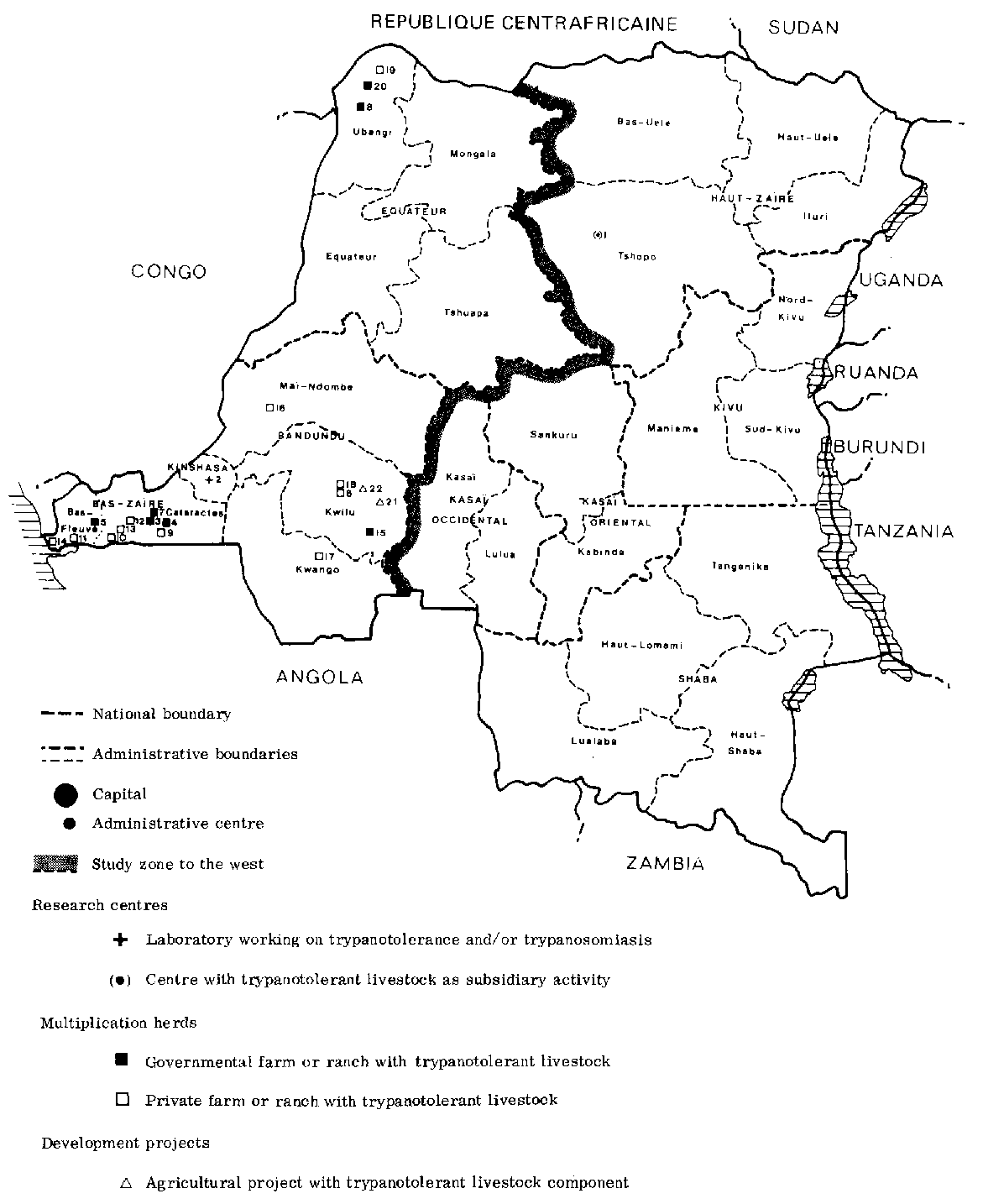
The headquarters of the Institut National pour l'Etude et le Recherche Agronomique (INERA, B. P. 2037, Kinshasa I) is at Yangambi in Haut-Zaire Region (Ref (·) 1 in Figure 1), and most of the research carried out is on crop farming. However, the Institute maintains several stations in the study area with herds of N'Dama and Lagune cattle which are used in métayage operations.
The Laboratoire Vétérinaire de Kinshasa (B. P. 8842, Kinshasa, ref +2 in Figure 1) is responsible for vaccine and antigen production and is well equipped to carry out research on trypanosomiasis. In addition, the Université Nationale du Zaire (UNAZA) carries out research on methods for detecting and diagnosing trypanosomiasis, mainly in cattle, with assistance from Belgium.
Métayage centres are described in Table 8 and government and commercial ranches in Table 9.
Four development projects are being carried out or planned in the study area. The Progrès Populaire d'Idiofa was initiated in 1960 by the Diocese of Idiofa in Kwilu Subregion of Bandundu Region (B.P. 8251, Kinshasa I,  21 in Figure 1). This integrated rural development project included in its 1974-79 development plan extension operations for small-scale and large-scale farms, construction of a veterinary laboratory, the development of a rural handicrafts industry and other types of training. The project also includes a métayage operation with 4 500 N'Dama cattle distributed among 260 villages and another 2 000 N'Dama in 8 breeding herds. The project is financed by the Diocèse of Idiofa, the Belgian government and a German Christian organization, Misereor.
Another agricultural programme, sponsored by the protestant church, is also being carried out in Kwilu Subregion ( 22 in Figure 1). This programme was launched in 1964 and includes a métayage operation with about 500 N'Dama cattle, along with technical and veterinary assistance for farmers. Sheep and goat production is also encouraged.
At the end of 1977, the Société Financière de Développement (SOFIDE) allocated funds for the establishment of a private goat farm. This will be located in gas-Zaire Region.
Table 8. Métayage centres.
|
Name |
Groupement d'Economie Rurale (GER) |
Station de Mvuazi |
Station de Gimbi |
Métayage du Bureau Diocesain de Developpement |
|
Location (and reference in Figure 1) |
B.P. 128, Mbanza Ngungu Cataractes, gas-Zaire Region |
Cataractes, Bas-Zaire Region |
Bas Fleuve, gas-Zaire Region |
B.P. 144, Kikwit, Kwitu Bandundu Region |
|
Organization responsible and address |
Commissariat a l'Agriculture (B.P. 7537, Kinshasa) |
INERA |
INERA (B. P., 76, Matadi) |
Diocese de Kikwit |
|
Size |
|
1 000 ha |
1 000 ha |
|
|
Breeds and numbers |
1 090 N'Dama in 5 reproduction herds and 3 340 in 182 métayage operations as of August 1978 |
100 ¾ N'Dama x ¼ Red Sindi crosses, 350 N'Dama in the station reproduction herd; 300 in 20 métayage operations, as of November 1978; 100 Djallonké sheep at the station |
80 Lagune, 150 N'Dama, 85 crossbreds at the station, 50 Lagune, 40 N'Dama in métayage operations |
150 N'Dama x Lagune crosses in reproduction herd, 200 in métayage operations |
|
Objectives |
Expansion of métayage system. |
Development of métayage operations with sheep and cattle. |
Development of métayage operations. |
Development of métayage with a reproduction herd of 400. |
Note: These centres keep monthly records of animal numbers by category.
Table 9a. Government and commercial ranches.
|
Name |
Inkisi Ranch |
Lola Ranch |
Kolo Ranch |
PEK Ranches |
Mateba Ranches Secteur de Mateba et Kanga |
Mateba Ranches, Secteur de Kiasundua |
Mateba Ranches Secteur de Yuku, km 110 |
|
Location (and reference in Figure 1) |
Cataractes Bas-Zaire Region |
North of Gemena, Ubangi, Equateur Region |
Kolo Fuma, Cataractes, Bas-Zaire Region |
Kitobola, Lovo, Cataractes, Bas-Zaire Region |
Mateba island and Zaire river banks near Boma, Bas Fleuve, gas-Zaire Region |
Malanga, Cataractes, Bas-Zaire Region |
Yuku, Cataractes, Bas-Zaire Region |
|
Organization responsible and address |
Commissariat à l'Agriculture, (B. P. 7537, Kinshasa) |
Commissariat à l'Agriculture |
J. van Lancker Co. (B. P. 199, Kinshasa) |
J. van Lancker Co. |
Cultures et Elevages au Zaire (CELZA) |
CELZA |
CELZA |
|
Size |
|
60 000 ha |
50 000 ha |
20 000 ha |
Island: 7 000 ha |
35 000 ha |
20 000 ha |
|
Breeds and numbers |
1 000 N'Dama |
7 000 N'Dama |
22 500 N'Dama |
9 000 N'Dama |
9 000 Mateba, 4 000 N'Dama x Mateba crosses |
9 000 N'Dama x Mateba crosses |
4 000 N'Dama x Mateba crosses |
|
Objectives |
Developing ranch aims to reach 20 000 head on 50 000 ha and provide cattle for meat production and breeding stock. |
Production of beef and breeding stock. Developing ranch aims to reach 20 000 cattle, plus sheep and pig production. |
Commercial ranch for production of beef and breeding stock. |
|
Absorption of Mateba by crossbreeding with N'Dama. | ||
|
External aid |
Rumania |
Belgian government 1973-83 |
|
|
|
|
|
|
Comments |
|
|
Records kept on individual animals in 400-hd selected breeding herds. Nerd recording by category and age group. |
The Mateba ranches were in the process of reverting to the Grands Elevage Company. | |||
Table 9b. Government and commercial ranches.
|
Name |
Donga Zola Ranch |
Gungu Ranch (B. P. 32. Kikwit) |
N'Djokélé Ranch |
Elevage de la Kalombi (B. P. 69. Kikwit) |
Elevage du Diocése de Kikwit |
Lombo Ranch (B. P. 69, Kikwit) |
Mpaka Ranch |
|
Location (and reference in Figure 1) |
Moanda, Bas Fleuve. Gas-Zaire Region |
Kwilu. Bas-Zaire Region |
Near Mushie, Mai Ndombe, Bandundu Region |
Near Feshi, Kwango, Bandundu Region |
Kwilu, Bandundu Region |
North of Gemena, Equateur Region |
Ubangi, Equateur Region |
|
Organization responsible and address |
private |
Office Nationale de Développement de l'Elevage (ONDE) |
J. van Lancker Co. (B. P. 199, Kinshasa) |
private |
Diocèse de Kikwit (B. P. 144. Kikwit) |
Plantations Lever au Zaire (PLZ, B. P. 8611, Kinshasa) |
CELZA |
|
Size |
2 500 ha |
2 500 ha |
100 000 ha available |
5 000 ha |
4 000 ha |
75 000 ha available |
75 000 ha available, 25 000 ha grazed |
|
Breeds and numbers |
1 600 N'Dama x Lagune crossbreds |
400 N'Dama. 500 Zebu, Africander and N'Dama crossbreds |
Zebu, 12 000 N'Dama |
1 400 crossbreds, N'Dama dominant with Angola and Zebu blood |
1 300 crossbreds N'Dama dominant with traces of Lagune, Africander and Angola |
7 000 N'Dama, 2 000 Ituri Zebu and Ituri x N'Dama crossbreds |
12 500 N'Dama x Ituri Zebu x Africander crossbreds |
|
Objectives |
Commercial ranch |
Commercial ranch |
Commercial ranch |
Commercial ranch |
Production of beef and breeding stock |
Mainly meat supply |
Mainly meat supply |
|
Comments |
Records kept of changes in herds by category of animals and age groups |
Individual records kept |
Reproduction data, individual records kept |
Recording of changes in herd by category of animals and age groups |
Recording of herd development | ||
|
|
Absorption by crossbreeding towards N'Dama |
|
Individual records started recently for selection herds. Ranch to be developed to 30 000 head by 1984 |
Ranch to be developed to 5 000 head by 1982 |
|
Ranch to be developed to 15 000 head |
Ranch to be developed to 20 000 head |
Finally, the 11-year Integrated Agricultural Development Project of Kwango-Kwilu has been proposed by the Office Nationale de Développement de l'Elevage (ONDE, B.P. 8839, Kinshasa) for the southern part of Bandundu Region. The study for this project was completed in 1977 It is planned to encourage the production of poultry, cattle, sheep and goats and to develop a meat marketing system The project is to include three components: the Service de Santé et Production Animales will be reorganized with a professional training and extension component, five medium-sized ranches will be established with herds of 3 000 to 4 000 each, and an abattoir will be constructed at Kikwit. Financing is now being sought.
Berlin Consult (1969). Recherches des possibilités de création d'un élevage pour la production de viande bovine sur les plateaux Batéké (Rep. Dem. du Congo). Berlin, 134p.
Bureau Diocésain de Développement, Evangélisation et Développement (1976). Rapport du séminaire. Kikwit.
Evans, F and Niemegeers, K (1955). 'Congo: Dispersion des tsetses'. Map.
FAO (1976). Rapport de la mission de programmation. Volume 2: Annexes. Rome.
IBRD (1973). Appraisal of the livestock development project: Rep. of Zaire. Nairobi, Agricultural Projects Department, Eastern Africa Regional Office.
INERA (1975). Rapport pour l'exercice. Yangambi
INERA (1976). Programme pour l'exercice. Yangambi.
Lenzen, M (1973). Progrès Populaire d'Idiofa (Projet d'intégration agriculture-élevage). Volume 1. Idiofa, 235p.
Marchés Tropicaux et Méditerranéens (1978). No. 1687.
Mortelmans, J and Kageruka, P (1976). 'Trypanotolerant cattle breeds in Zaire'. World Anim. Re. pp 14-17.
ONDE (1977). Projet de mise en valeur les savanes du Kwango-Kwilu. Kinshasa.
Risopoulos, S R (1966). Management and use of grass lands: Democratic Republic of Congo. Pasture and Fodder Crops Studies No. 1. Rome, FAO.
Zaire, Departement de l'Agriculture, Division des Services Generaux et Etudes Statistiques (1976). Recensement de l'agriculture 1970: Résultats définitifs. Kinshasa.
Zaire, Division de la Statistique (1977a). Statistiques agricoles. Annuaire rétrospectif 1970-74. Kinshasa.
Zaire, Division de la Statistique (1977b). Annuaire les statistiques agricoles. 1975-76. Kinshasa.
Zaire, Service National de la Production et Santé Animales (1975). Région de Bandundu. Rapport Annuel 1975. 40p.

 3
3 6
6