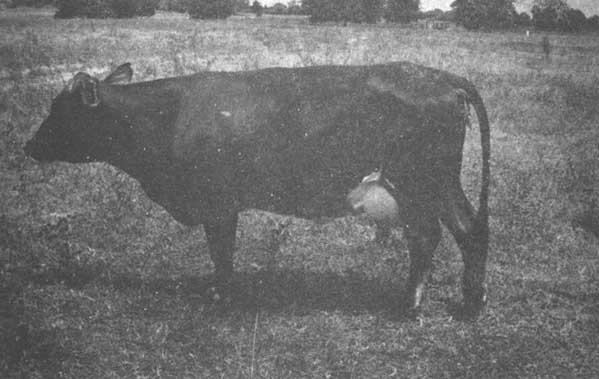
Kilifi Plantations is a private ranch of 2500 ha at the Kenya coast near Kilifi, north of Mombasa. Sisal is grown for export and milk is produced which is retailed in the surrounding area. The ranch is located at approximately 10 m above sea level on the Indian Ocean at 3.5º latitude south. Annual rainfall averaged 1043 mm from 1972 through the first half of 1978, the period during which data were collected for this study, and ranged from a low of 558 mm in 1974 to a high of 1261 mm in 1972. The main rainy season was from April through June, with a shorter rainy period in September and October, but some rain fell every month throughout the study period.
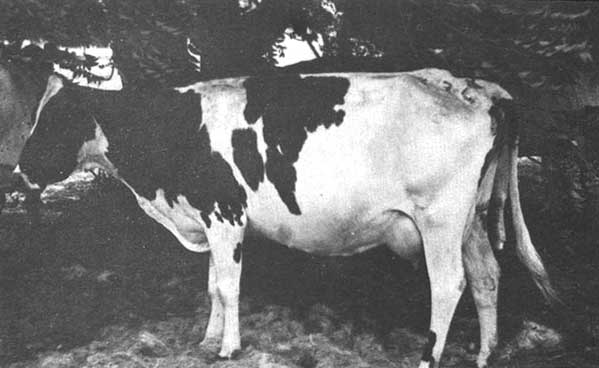
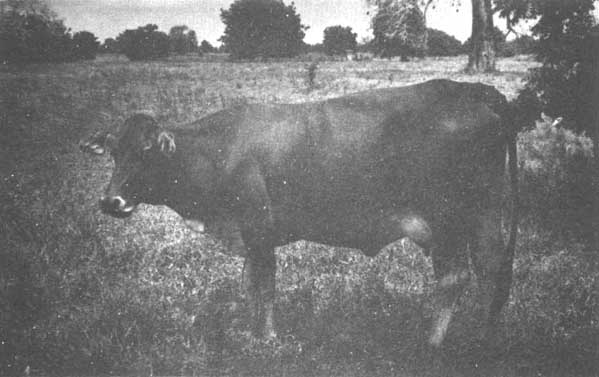
Data were recorded from two breeding groups, one approximately 2/3 Sahiwal and 1/3 Ayrshire and the other 2/3 Ayrshire and 1/3 Sahiwal. These were produced from a continuous two-breed rotation crossbreeding system begun in 1939 by the initial use of purebred Sahiwal sires on Ayrshire dams. Subsequently, for the most part, females by Sahiwal sires have been mated to Ayrshire sires and females by Ayrshire sires have been mated to Sahiwal sires. Approximately equal numbers of animals were recorded in each breeding group from 1972 through the first half of 1978. Information on the characters analyzed and the number of animals recorded is given in Table 1.
Table 1. Least-squares breeding group means and standard errors for maternal and growth characters, Kilifi Plantations
|
Breeding groupa |
Age at first calving |
Calving interval |
|
Lactation yield |
Annual lactation yield | ||
|
|
N |
days |
N |
days |
N |
kg |
kg |
|
2/3 Sahiwal - 1/3 Ayrshire |
463 |
1042b ± 8.0 |
954 |
390b ± 3.6 |
954 |
2662b ± 39 |
2503b ± 32 |
|
2/3 Ayrshire - 1/3 Sahiwal |
482 |
1019c ± 6.5 |
707 |
398c ± 4.6 |
707 |
2843c ± 50 |
2616c ± 42 |
|
|
|
Birth weight |
Average daily gain from birth to 50 kg |
Average daily gain from 50 to 90 kg |
Average daily gain from birth to 90 kg |
Calf survival | |
|
|
N |
kg |
g |
g |
g |
N |
% |
|
2/3 Sahiwal - 1/3 Ayrshire |
874 |
31.4b ± 0.28 |
349b ± 6.5 |
599b ± 6.9 |
472b ± 4.3 |
1063 |
86b ± 2.2 |
|
2/3 Ayrshire - 1/3 Sahiwal |
806 |
28.5c ± 0.21 |
408c ± 4.9 |
617c ± 5.2 |
517c ± 3.5 |
921 |
87b ± 1.7 |
a Both populations had stabilized with approximately 2/3 of the genes from the breed of the sire and 1/3 from the breed of the maternal grand-sire following several generations of a two-breed (Ayrshire and Sahiwal) rotation crossbreeding system.
bc Means with different superscripts differ at the P £ .05 level.
The dams on which records were analyzed were born during the 7-year period from 1968 through 1974 and were the progeny of 21 Ayrshire and 16 Sahiwal sires. The calves providing records for this study were born during the 5-year period from 1973 through 1977 and were the progeny of 20 Ayrshire and 6 Sahiwal sires. Some of the sires of each breed produced dams for which data were analyzed for reproduction and lactation characters and also calves which provided data on calf survival and growth characters. All matings from which data were analyzed were by artificial insemination with semen obtained from the Central Artificial Insemination Station at Kabete. Ayrshire sires were sampled from the United Kingdom, Canada, Finland and Sweden. All Sahiwal sires that produced progeny on which records were collected for this study were produced in Kenya. It is believed that a representative sample of sires of each breed was used.
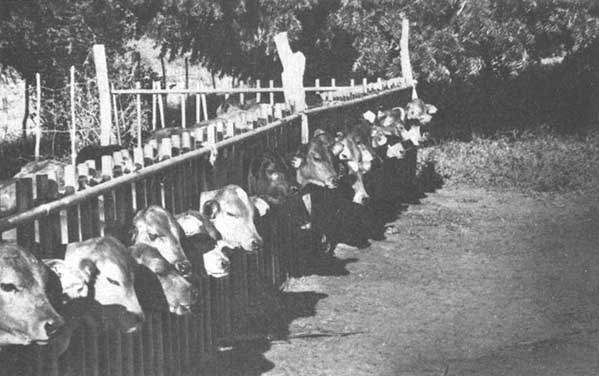
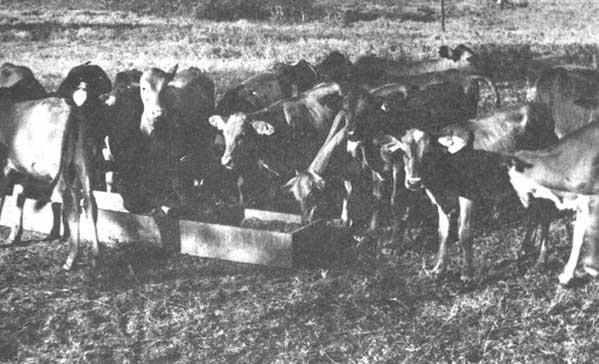
Heifers were first bred as they approached 2 years of age at a weight of about 270 kg. Calves were allowed to suckle for 1 or 2 days after birth, and were then trained to drink first colostrum and then whole milk from a pail. Male calves were castrated and all calves were weighed and given permanent identification within 36 hours of birth. The calves were bucket fed whole milk twice daily while running on pasture until they reached a weight of about 50 kg, which occurred when they were around 52 days old. From approximately 50 kg to approximately 90 kg, they were fed brewer's grains, maize bran and pelleted try-products from cereal milling in addition to good quality pasture. In general, supplementary feeding was terminated when calves reached about 90 kg, which they attained at around 122 days. The pasture provided to calves thereafter was generally of high quality.
Cows were placed in the milking herd when they produced their first calf. During lactation, they were provided supplemental feed at a level based on their production and on the condition of the pastures which they grazed. The supplemental feed consisted of brewer's grains and maize bran, and some sorghum silage was fed during dry periods when pastures were particularly short. Also, the fleshy part of sisal leaves was fed when available.
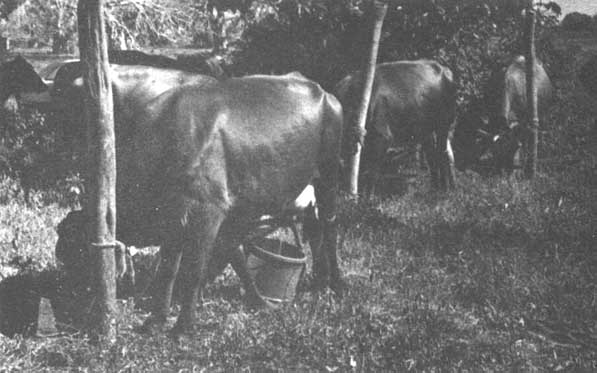
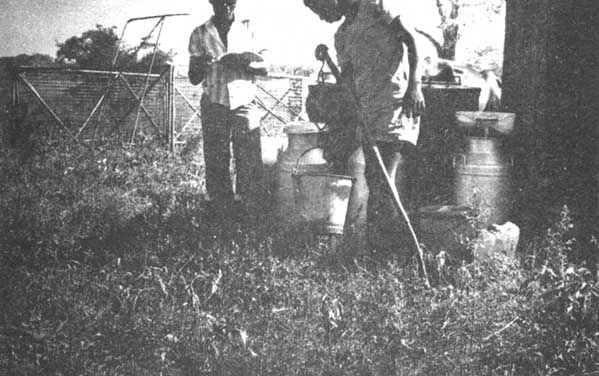
All cows were milked by hand twice daily. The day interval between milk-ings was approximately 11 hours and the night interval approximately 13 hours. All milking was done in the pastures in which the cows grazed. The cows were tied to posts, hobbled and given supplemental feed while they were milked. The milking site was moved at frequent intervals.
Cows had access to natural pastures with shade trees both day and night, and all animals were dipped at weekly intervals to control tick-borne diseases. The general level of husbandry would be classified as excellent. However, tsetse flies have been identified in the area and, according to the owner, a low level of trypanosomiasis is present in the herd on occasion.
All characters were analyzed by least-squares, fixed-model procedures (Harvey, 1972). The model used for all characters included the fixed effects of year of birth, month of birth, breeding group (2/3 Ayrshire - 1/3 Sahiwal or 1/3 Ayrshire - 2/3 Sahiwal) and sires within each breed. For characters relating to lactation and for calving interval, parturition number and the interaction of breeding group with year were included in the model. Sex and the interaction of breeding group with year were included in the model for the analysis of growth and viability characters. The residual mean square was used as the error term to test the significance of all effects evaluated.
2.2.1 Reproductive characters
2.2.2 Milk production
2.2.3 Growth characters
2.2.4 Viability
2.2.5 Index of cow productivity
2.2.6 General remarks
The mean age at first calving was 1031 days for the 945 dams retained for milk production that were born from 1968 through 1974. The effects of the dam's year of birth were important (P < .01), but month of birth did not have a significant effect on calving age. Age at first calving records were available for only 22 dams born in 1968 but these were on average 140 days younger when they produced their first calf than the mean age at first calving for all the females recorded. From 101 to 242 dams were born in each of the 6 other years and the constants for these years were au positive, ranging from 14 to 35 days, with age at first calving tending to increase slightly in each year.
The effects of individual sires were significant (P < .01) for both the Ayrshire and Sahiwal breeds. Thus, the additive genetic variation is large in both breeds for this character. Ayrshire-sired females averaged 23 days younger (P < .05) at first calving than Sahiwal-sired females (Table 1). The extent to which the older age at first calving was the result of older age at reproductive maturity in the Sahiwal-sired females is not known. However, Gregory et al (1979a) reported an older age of puberty in Sahiwal-cross females than in females of Bos taurus breeds, particularly in Bos taurus breeds that had been selected for milk production.
The mean calving interval for all 1661 observations was 394 days. The effects of year of calving were not important (P > .05), but month of calving had a significant effect on calving interval. Females calving in January, May and June had shorter than average calving intervals by 10, 9 and 14 days respectively, while those calving in September, October and November had longer than average calving intervals by 8, 8 and 15 days respectively. Females calving in the 6 other months varied from the mean calving interval of 394 days by only ± 3 days. The effects of parturition number (varying from 1 to 10) did not influence calving interval (P > .05).
The difference in the calving interval of their progeny was significant for Ayrshire sires (P < .01), but not for Sahiwal sires. The interaction of breeding group with year was important (P < .01) for calving interval, apparently largely because the Sahiwal-sired females had a 26-day shorter calving interval than the Ayrshire-sired females in the year with the lowest rainfall in the 4-month period after calving (188 mm), while the Sahiwal-sired females averaged a 12-day longer calving interval in the year with the second highest rainfall during the 4-month period after calving (411 mm). This result indicates that the Sahiwal breed is likely to be better adapted than the Ayrshire breed in terms of reproductive fitness in situations of limited feed supply due to low rainfall.
Overall, Sahiwal-sired females averaged 8-day shorter calving intervals (P < .05) than females by Ayrshire sires (Table 1). Again, this indicates an advantage in reproductive fitness for the Sahiwal breed relative to the Ayrshire in the climatic and feed environment in which these records were made.
Total milk production averaged 2753 kg for the 1661 lactations included in the analysis. Year of calving had an important effect on lactation yield (P < .01), ranging from a low of 2437 to a high of 3017 kg during the 6½ years included in the analysis. The 2 years with lowest milk production were 1973, with an annual rainfall of 1025 mm, and 1974, with an annual rainfall of 558 mm. Milk production was highest in 1976, when rainfall was below average (836 mm). The general practice was to provide supplementary feed based on the condition of the pastures and the level of milk production. Thus, it is likely that factors other than nutritive environment associated with rainfall levels were primarily responsible for the annual variation in lactation yields.
The effects of month of calving on lactation yield were also significant. Average lactation yields associated with month of calving ranged from 2517 kg for cows calving in June to 2893 kg for cows calving in November. Cows calving during the first 7 months of the year, except those calving in March, had below average lactation yields, while among cows calving from August through December, only those calving in December had below average lactation yields.
Parturition number had a significant effect on lactation yield. For the first and second lactations, cows had below average yields, producing 2391 and 2652 kg respectively. The variation in lactation yield was small from the third to the eighth lactation, averaging 2886 kg overall. Yields declined markedly for the ninth and tenth lactations, averaging 2582 kg. These results are consistent with most reports in the literature on the effects of age on lactation yield.
Breeding group differences were important (P < .01) for lactating yield. The progeny of Ayrshire sires averaged 181 kg more (P < .01) milk during each lactation than the progeny of Sahiwal sires (Table 1). Significant differences in lactation yield were also observed within breeds between the progeny of both the 16 Sahiwal sires and the 21 Ayrshire sires. Thus, a large amount of additive genetic variation for lactation yield is indicated for both breeds in the production environment under which these data were collected. The interaction of breeding group with year was not significant for lactation yield, however.
Annual lactation yield averaged 2560 kg for the 1661 lactation records analyzed. After adjusting milk production to a calving interval of 365 days, the effects of year of calving were significant (P < .01), but the effects of month of calving were less important than they were for lactation yield. Annual lactation yields were below eve rage for 1973 and 1974 and above average for the 4 other years. They averaged 2290 kg in 1973 and 1974, when annual rainfall over the 2-year period averaged 792 mm, and 2714 kg in 1975 and 1976, when annual rainfall over 2 years averaged 872 mm. Thus, factors other than rainfall seem to account for the significant year effects observed on annual lactation yield.
Parturition number showed similar effects on annual lactation yield as observed for full lactation yield: the first two lactations and the ninth and tenth lactations were below average, whereas the third through the eighth lactations were above average in annual lactation yield.
Significant differences in annual lactation yield were observed between the progeny of different sires within both breeds. As expected, this finding is consistent with the results on milk yield for the full lactation. The interaction of breeding group with year was not important (P > .05) for annual lactation yield, however.
The progeny of Ayrshire sires produced 113 kg more (P > .01) milk per year than the progeny of Sahiwal sires (Table 1), compared with an 181 kg difference for full lactations. The smaller difference in annual lactation yield reflects the 8-day shorter calving interval, on average, for the cows by Sahiwal sires.
2.2.3.1 Birth weight.
2.2.3.2 Average daily gain from birth to 50 kg.
2.2.3.3 Average daily gain from 50 to 90 kg.
2.2.3.4 Average daily gain from birth to 90 kg.
Birth weight records were analyzed for 1680 calves born from 1973 through 1977, including 874 calves by 6 different Sahiwal sires and 806 calves by 20 Ayrshire sires. The mean birth weight for all calves was 30.0 kg. The effects of year of birth on birth weight were important (P < .01): average birth weights ranged from 29.3 kg in 1975, with 907 mm annual rainfall, to 31.1 kg in 1973, with 1025 mm annual rainfall. Calves born from January through May were of below average birth weight, while calves born from June through December were above average. The heaviest average birth weights were recorded for October (30.9 kg) and the lightest for April (28.7 kg). Thus, the lightest calves at birth were born during and immediately following the season when temperatures were highest.
Male calves averaged 31.0 kg at birth, 2.1 kg heavier (P < .01) than female calves, which averaged 28.9 kg. This difference is consistent with published results (Gregory et al, 1979b). Differences between sires within breeds were significant for birth weight. This finding is consistent with published results showing substantial additive genetic variation for birth weight. The interaction of breeding group with year of birth was not important (P > .05) for birth weight.
Sahiwal sires produced calves that averaged 2.9 kg heavier at birth than calves by Ayrshire sires (Table 1). Gregory et al (1979b) reported gestation lengths averaging 7 to 10 days longer for calves sired by Bos indicus breeds than for calves sired by Bos taurus breeds. The same report indicated longer average gestations for calves by Sahiwal sires than for calves by Brahman sires, another Bos indicus breed. It is also well documented that increased gestation length results in increased birth weight (Gregory et al, 1978c). Thus, it is likely that the greater birth weight of calves by Sahiwal sires is associated with longer gestation length. Also, results from the Deloraine Estates data included in the current study (Chapter 3) show a large difference between the Sahiwal and Ayrshire breeds in maternal effects on birth weight: purebred calves with Ayrshire dams produced the heaviest calves at birth, followed by most types of Ayrshire cross dams and then purebred Sahiwal dams, while the effects of breed of sire on birth weight were not significant.
Overall, the calves included in this study averaged 52 days of age when they attained a weight of 50 kg. The average daily gain for all calves from birth to 50 kg was 378 g. The daily gain was significantly affected by year and month of birth (P < .01), but these effects did not follow a consistent pattern.
Male calves gained 13 g more (P < .05) per day than female calves. Differences between sires within each breed were significant for both breeds, reflecting substantial additive genetic variation in these two breeds for early postnatal growth rate when the postnatal maternal effect is removed at an early age. The interaction of breeding group with year was not significant.
Calves by Ayrshire sires gained 59 g per day faster (P < .01) than calves by Sahiwal sires from birth to 50 kg (Table 1). By contrast, the Sahiwal-sired cows are larger at maturity than the Ayrshire-sired cows and comparisons of the two breeds for growth characters in Chapters 3 and 4 show the Sahiwal superior in transmitted effects for growth. The higher weight gains of Ayrshire-sired calves from birth to 50 kg shown here are probably due to the fact that it is more difficult to train Sahiwal-sired calves to drink milk from a pail, according to observations of the owner and manager of Kilifi Plantations.
The average daily gain of all calves from 50 to 90 kg was 608 g. The effects of year and month of birth were important (P < .01), though no consistent pattern for the effects of year of birth was evident.
The average daily gain for calves born in 1974 and 1975 was above the overall average, while the average daily gain for calves born in 1973, 1976 and 1977 was below. The average daily gain was below the overall average for calves born in Aprils May, September, October, November and December and above for those born in the other 6 months.
The effects of sex were not significant for average daily gain from 50 to 90 kg. As was the case for birth weight and for gain from birth to 50 kg, differences between individual sires were significant for both breeds. The interaction of breeding group with year was not significant for gain during this period.
The progeny of Ayrshire sires gained 18 g (P < .01) more per day than the progeny of Sahiwal sires (Table 1). The magnitude of this difference is considerably less than was observed from birth to 50 kg. It probably reflects a positive correlation with growth rate in the earlier period related to a probable competitive advantage at the feed trough because of heavier weight achieved.
The average daily gain of all calves from birth to 90 kg was 494 g. Both year and month of birth had a significant effect on average daily gain during this period. Calves born in 1973 and 1977 gained 21 and 15 g less per day, respectively, than the average for all calves. Calves horn in 1974, 1975 and 1976 gained on average 12 g more per day than the overall average. Calves born in April, May, September, October, November and December gained less than the average for all calves, while calves born in the 6 other months gained more than the overall average.
The effects of sex were not significant for average daily gain from birth to 90 kg. This result is not consistent with reports in the literature, where the effects of sex on early postnatal growth rate generally approach 10%, as was observed for birth weight in the current study (Gregory et al, 1979b). However, the average daily gain from birth to 90 kg observed in this study is less than generally reported. The failure of sex effects to be expressed here in terms of average daily gain may be the result of a lower plane of nutrition than is generally provided in conventional beef production programmes where calves are usually suckled to an age of 6 months or more.
However, the plane of nutrition provided at Kilifi Plantations was apparently adequate to allow additive genetic differences in growth rate between sires to be expressed for both breeds (P < .05). These results are interpreted to reflect a large amount of additive genetic variation for growth rate in both Sahiwals and Ayrshires. The interaction of breeding group with year of birth was not significant.
Average daily gain from birth to 90 kg was 45 g greater for the Ayrshire-than for the Sahiwal-sired calves (Table 1). This finding is interpreted as due to a behavioural difference, resulting in greater difficulty in training Sahiwal calves to drink from a pail. The Sahiwal-sired calves most likely had a reduced milk intake at, and immediately after, 1 or 2 days of age, relative to the Ayrshire-sired calves. A low intake of colostrum resulting in low antibody levels and a suboptimal nutritive environment during this period likely have important direct or indirect carryover effects on feed consumption when supplemental feed is restricted in a group feeding situation; thus weight gains may be reduced for an extended period.
Of all calves born, 87% lived to reach a weight of 90 kg. Neither year nor
month of birth, sex, sire within breed, breeding group or the interaction of
breeding group with year had important (P > .05) effects on calf survival.
Cow mortality averaged less than 1% for the herd. There was no difference between breeding groups in this character.
The characters of reproductive performance, cow and calf viability, milk production, growth and cow weight are combined in Table 2 to build up an index of the total weight of 1-year-old calf plus the liveweight equivalent of milk produced, both per cow per year and finally per 100 kg of cow maintained per year. The cow productivity index is computed as the product of cow viability (%) × calving percentage (%) × calf viability (%) × calf weight at 1 year (kg) + cow viability (%) × calving percentage (%) × lactation milked-out yield (kg)/9. The lactation milked-out yield is divided by a factor of 9 based on results by Drewry et al (1959) showing one additional unit of calf gain for nine units of additional milk consumed.
Table 2. Productivity estimates of cows by breed group, Kilifi Plantations
|
|
Breed Group | |
|
Character |
2/3 Sahiwal-1/3 Ayrshire |
2/3 Ayrshire-1/3 Sahiwal |
|
Cow viability (%) |
99.0 |
99.0 |
|
Calving percentage (%) |
93.6 |
91.7 |
|
Calf survival (%) |
85.7 |
87.5 |
|
Calf weight at 1 year (kg)a |
104.7 |
104.7 |
|
Lactation milked-out yield (kg) |
2662 |
2843 |
|
Productivity indexb per cow per year (kg) |
357.3 |
370.0 |
|
Cow weight (kg) |
400 |
429 |
|
Productivity indexb per 100 kg of cow maintained per year (kg) |
81.2 |
86.2 |
aExcluding 60 kg growth from birth to 90 kg body weight when calves were artificially reared.
bTotal weight of 1-year-old calf plus liveweight equivalent of milk produced.
This final index is the most meaningful way to compare the actual productivity of the breed types, given the level of information available. Its merit lies in the fact that it relates all the more important production characters back to the actual weight of breeding cow that has to be supported, which is closely associated with cow maintenance costs. The Ayrshire-sired cows excelled the Sahiwal-sired cows in terms of the productivity index per cow per year by 3.6% and by 6.2% per 100 kg of cow weight maintained per year.
The average annual lactation yield of 2560 kg of milk for the herd on which this analysis is based is considered outstanding for a sea-level tropical environment with feed largely based on pastures. The relatively young age at first calving and the relatively short calving interval further attest to the general adaptability of both breeding groups of cattle to this climatic and feed environment. Also, the relatively high average annual lactation yield, the young age at first calving and the short calving interval indicate that a high level of husbandry has been achieved.
In a comprehensive review article on crossbreeding systems (Gregory and Cundiff, 1980), results were interpreted from crossbreeding experiments with cattle involving both dairy and beef characters to show that loss of heterosis in rotation crossbreeding systems is proportional to loss of heterozygosity. Thus, after the breed composition becomes stabilized at six generations (Dickerson, 1969 and 1973) with two-thirds of the genes from the breed of the sire and one-third from the breed of the maternal grand-sire, it is expected that two-thirds of the initial F1 heterosis for both maternal and individual characters will be retained because two-thirds of initial F1 heterozygosity is retained. Given the high level of heterosis reported for crosses between Bos indicus and Bos taurus cattle for both individual and maternal characters (Cartwright et al, 1974 and Koger et al, 1975), it appears the total performance of this herd benefited substantially as a result of heterosis.
Even though the results from this study show a higher level of additive genetic merit for milk production for the Ayrshire breed compared to the Sahiwal, the optimum relative contribution by the two breeds to genetic composition in this environment is not revealed because only two genetic groups are compared, one approximately 2/3 Ayrshire and 1/3 Sahiwal and the other 2/3 Sahiwal and 1/3 Ayrshire. Gregory and Cundiff (1980) have pointed out that the substantial variation between breeding groups in additive genetic composition in breed rotation crossbreeding systems, varying between two-thirds and one-third in a two-breed rotation crossbreeding system, may cause major variations in the optimum contribution by each of the breeds.
In the current evaluation, the 2/3 Ayrshire-1/3 Sahiwal breeding group appears sufficiently adaptable to the climatic and feed environment to be slightly superior to its reciprocal for most of the characters evaluated. This is reflected in the index of cow productivity as well as in the analysis of individual characters. However, the optimum additive genetic composition with these two breeds in this environment could well be some proportion of each breed between the extremes of two-thirds and one-third that characterize a two-breed rotation crossbreeding system, or perhaps even a higher proportion of Ayrshire and a correspondingly lower proportion (i. e. one-fourth) of Sahiwal may be sufficiently adaptable.
An alternative approach to rotation crossbreeding systems, that would allow the optimization of additive genetic composition based on attaining and maintaining specific percentages contributed by different breeds, may be the formation of composite breeds. This approach should allow the simultaneous use of predictable levels of heterosis with the maintenance of an optimum percentage contributed by each breed for the specific production situation. This possibility is discussed in detail in Chapter 8.
2. Pail feeding facilities, Kilifi Plantations
3. Calves at 50 to 90 kg on concentrate supplementation, Kilifi Plantations
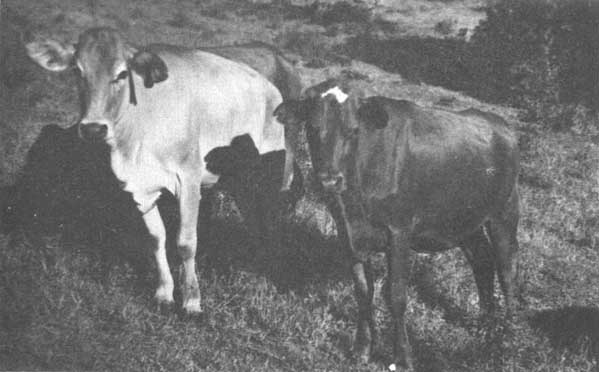
4. Replacement heifers, Kilifi Plantations
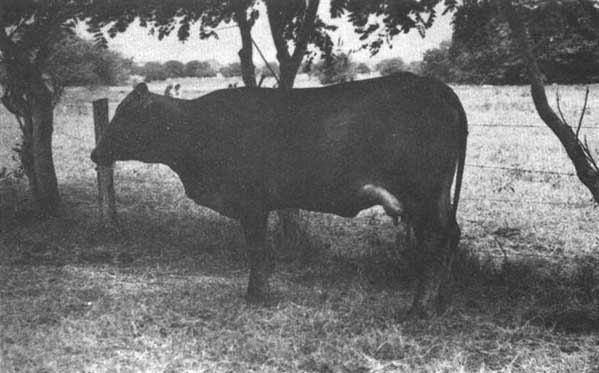
5. 2/3 Sahiwal - 1/3 Ayrshire cow, Kilifi Plantations
6. Field milking bail, Kilifi Plantations
7. 1/3 Sahiwal- 2/3 Ayrshire cow, Kilifi Plantations
8. 1/3 Sahiwal - ½ Brown Swiss - 1/6 Ayrshire cow, Kilifi Plantations
9. Field milk recording, Kilifi Plantations
10. 1/6 Sahiwal - ½ Brown Swiss - 1/3 Ayrshire cow, Kilifi Plantations