Deloraine Estates is a privately owned ranch of about 2000 ha between Nakuru and Eldoret in Kenya's Rift Valley Province. The ranch lies at an altitude of approximately 2100 m, ranging from 1860 to 2286 m, at 0.2º latitude south. About 20% of the ranch land is classified as arable, and cereal crops are grown. On the remaining pasture land, cattle are kept for commercial beef and milk production.
Annual rainfall from 1974 through 1977 averaged 1007 mm. During this period an average of less than 35 mm of rainfall was recorded in December, January and February and an average of less than 75 mm in March, June, September and October. Average rainfall was higher in the 5 other months.
Ayrshire cattle were introduced onto the ranch in 1934 and purebred Sahiwals were introduced in 1962. Subsequently, a grading up programme has been followed for the Sahiwals by continuously backcrossing to purebred Sahiwal sires starting from a Sahiwal × Ayrshire foundation. The breeding with Ayrshire sires has been predominantly by artificial insemination, with semen obtained from the Central Artificial Insemination Station at Kabete produced by bulls imported from the United Kingdom, Canada, Sweden and Finland. The breeding with Sahiwal sires has been by a combination of artificial insemination and natural service. Semen from Sahiwal sires used by artificial insemination has been obtained from the Central Artificial Insemination Station at Kabete. Sahiwal sires used by natural service were bred by the National Sahiwal Stud at Naivasha, by other Sahiwal breeders in Kenya or on the ranch, and one Sahiwal sire used by natural service was imported from India. Semen used from Simmental sires was either imported from Germany or was from sires bred in Kenya. The sires used appeared to be a representative sample of their respective breeds.
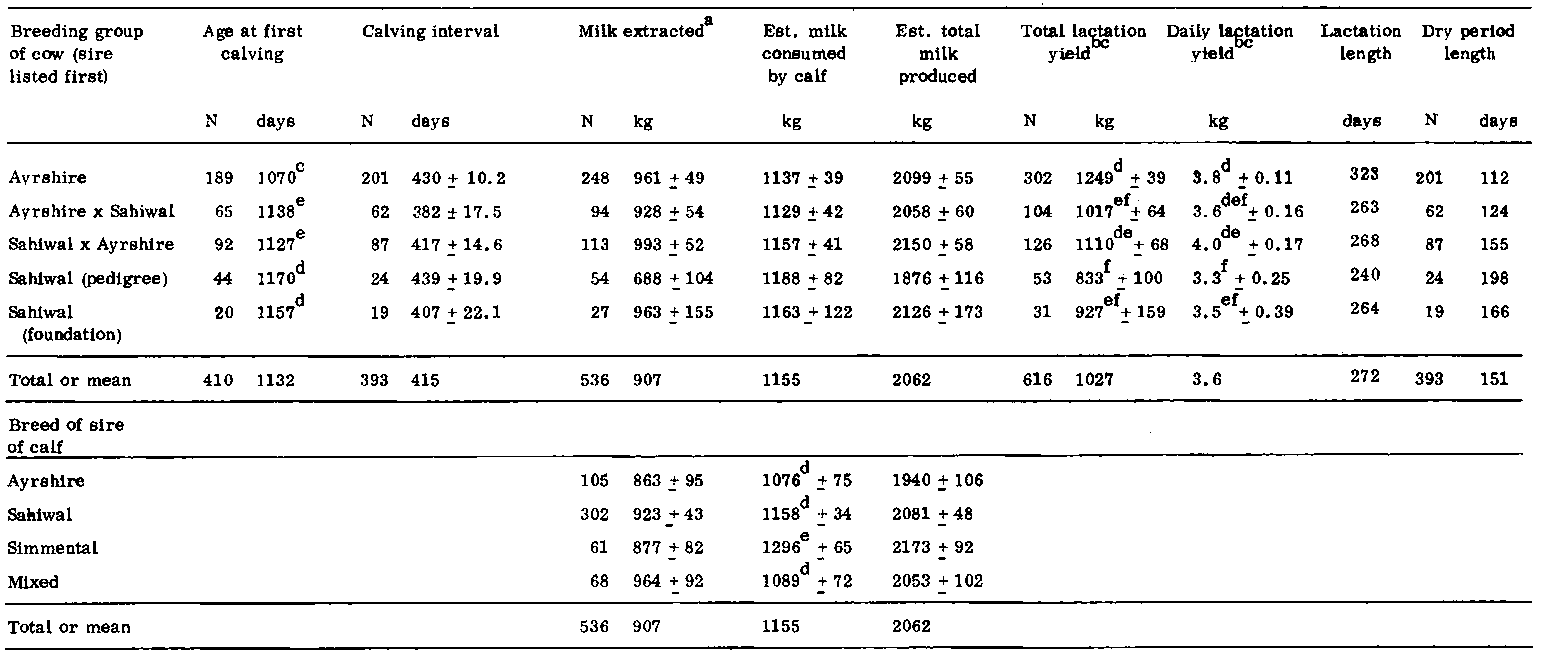
The 410 cows on which records were analyzed were born from 1970 through 1974, and produced 616 lactation records and 781 calves from 1974 through 1977. Thus, the cows in this study varied from 4 to 7 years old. Discrepancies in the number of observations between total lactation yields and amount of milk extracted (Table 3) are due to the death of 39 calves and the sale of 41 straightbred male Ayrshire calves when they were about 1 week old. The breeding groups of cows included in the study were unregistered Ayrshire, Ayrshire × Sahiwal (sire breed listed first), Sahiwal × Ayrshire, pedigree Sahiwal and foundation Sahiwal (Table 3). Foundation Sahiwal were at least seven-eights Sahiwal, while pedigree Sahiwal were fifteen-sixteenths Sahiwal or more. The sire breed groups with which these females were mated were Ayrshire, Sahiwal, Simmental and a group classified as mixed which included crossbred Sahiwal × Ayrshire and bulls with sires not known. A listing of the characters analyzed and the number of records included in the analysis of each character, for each sire and dam breed, is given in Table 3. Table 4 provides information for sub-classes of breed of sire and breeding group of dam on the characters of the calves that were analyzed.
The cows were grazed on both seeded and natural pastures. When grazing was particularly limited because of drought conditions, some hay was fed. Concentrate feeds were given in limited quantities to the straightbred Ayrshire cows and to the higher-producing Sahiwal-Ayrshire crossbred and straightbred Sahiwal cows. For the cows given concentrates, the objective was to provide 1 kg of concentrate feed for each 4 kg of milk extracted, but in practice the rate of concentrate feeding tended to be lower. Lower producing Sahiwal-Ayrshire crossbred cows and straightbred Sahiwal cows did not receive any concentrates. Both the owner and the manager stated that the Ayrshire cows received preferential treatment relative to the Ayrshire-Sahiwal crosses and the purebred Sahiwals: they had access to pastures that were considered superior and received hay earlier and in larger quantities during periods of drought. When the three breeding groups of cows were observed, the conditions of their pastures appeared similar. However, the Sahiwal cows normally graze pastures with steeper slopes that are thought to produce a high proportion of vegetation with a relatively low nutritional value. The purebred Ayrshire cows were the only group receiving supplementary feed in the form of hay at the time the herd was visited. The results of this study should be interpreted in light of the preferential treatment received by the straightbred Ayrshires. The owner stated that Sahiwals were introduced onto the ranch because of their ability to perform under conditions of nutritional and climatic stress.
a Prior to weaning of calf.
b Includes milk produced after calf was weaned.
c 41 straightbred Ayrshire male calves were sold shortly after birth; total lactation yield adjusted by 44575 kg for 302 lactations based on estimated gain of 120.8 kg per calf, Daily lactation yield was adjusted accordingly.
def Means having no superscript in common differ at the P <= .05 level, means having no superscripts did not show a significant breeding group difference in the analysis of variance
Table 4. Least-squares breeding group means and standard errors for calf survival and growth characters, Deloraine Estates
|
Breeding group of cow (sire listed first) |
Calf survival |
Birth weight |
Weaning weight |
Weaning weight of heifers kept postweaninga |
2-year weight of heifers kept postweaninga | ||||
|
|
N |
% |
N |
kg |
N |
kg |
N |
kg |
kg |
|
Ayrshire |
357 |
83 ± 3.8 |
170 |
32.0b ± 0.87 |
256 |
175 ± 4.8 |
87 |
169b ± 9.3 |
312 ± 10.4 |
|
Ayrshire × Sahiwal |
129 |
88 ± 3.8 |
73 |
29.5ce ± 0.86 |
106 |
174 ± 5.2 |
41 |
196c ± 9.5 |
328 ± 10.7 |
|
Sahiwal × Ayrshire |
157 |
87 ± 3.7 |
100 |
30.3be ± 0.88 |
127 |
176 ± 5.1 |
33 |
172bc ± 10.1 |
325 ± 11.4 |
|
Sahiwal (pedigree) |
95 |
99 ± 9.2 |
52 |
24.7d ± 1.56 |
79 |
174 ± 9.5 |
34 |
155b ± 10.9 |
318 ± 12.2 |
|
Sahiwal (foundation) |
43 |
91 ± 13.0 |
27 |
23.2d ± 2.13 |
29 |
154 ± 14.9 |
34 |
155b ± 10.9 |
318 ± 12.2 |
|
Total or mean |
781 |
90 |
422 |
28.0 |
597 |
171 |
195 |
173 |
320 |
|
Breed of sire of calf | |||||||||
|
Ayrshire |
171 |
93 ± 6.5 |
93 |
25.7 ± 1.92 |
109 |
164 ± 8.8 |
22 |
151b ± 11.4 |
295b ± 12.8 |
|
Sahiwal |
433 |
84 ± 3.2 |
214 |
28.4 ± 0.67 |
347 |
171 ± 4.0 |
130 |
166bd ± 5.2 |
326c ± 5.8 |
|
Simmental |
77 |
90 ± 7.1 |
47 |
28.8 ± 1.33 |
67 |
182 ± 7.9 |
34 |
178cd ± 8.2 |
341c ± 9.2 |
|
Mixed |
100 |
91 ± 7.2 |
68 |
28.9 ± 1.38 |
74 |
166 ± 9.1 |
9 |
197c ± 13.7 |
320bc ± 15.4 |
|
Total or mean |
781 |
90 |
422 |
28.0 |
597 |
171 |
195 |
173 |
320 |
a 30 pedigree and 4 foundation Sahiwal heifers were combined for the analysis of these two characters.
bcde Means having no superscript letter in common differ at the P £ .05 level; means having no superscripts did not show a significant breeding group difference in the analysis of variance.
Cows were hand milked twice daily while the calves suckled, with the intention of allowing the calves to consume about one-half of the milk produced. Calves were separated from their dams between milkings after they were 4 days old; they had access to pasture continuously and were weaned at 8 months. When pastures were poor because of drought conditions calves were offered hay of the highest quality available. The cows were dipped two times a week to control tick-borne diseases.
All characters were analyzed by least-squares fixed-model procedures (Harvey, 1972), The model used included the fixed effects of year of birth, month of birth and breeding group of cow for all characters. For most of the cow characters, including milk extracted, estimated milk consumed by calf and estimated total milk produced, and for characters evaluated in the calf, the model also included the effects of breed of sire, parturition number, sex of calf, and the interactions of breed of sire with breeding group of dam, breed of sire with year and breeding group of dam with year. The specific factors included in the model used will be evident when results are presented for each character analyzed. The residual mean square was used as the error term to test the significance of all differences evaluated. Linear contrasts of least-squares means were computed to determine the significance of differences between breeding groups of cows and breeds of sires for all characters where the difference among breeding groups was significant in the analysis of variance. More comparisons were made using the least-squares- means than there are independent degrees of freedom for the characters where the breeding group of cow or breed of sire differences were significant in the analysis of variance. Therefore, all of the comparisons are not independent and the error rate over the entire set of comparisons may be different from that indicated by the level of probability. Tests of significance associated with the linear contrasts, although not independent, can be taken as guides as to whether the observed values could have occurred by chance.
3.2.1 Reproductive characters
3.2.2 Milk production
3.2.3 Growth characters
3.2.4 Viability
3.2.5 Index of cow productivity
3.2.6 General remarks
The mean age at first calving for all the 410 cows was 1132 days. The effects of year of birth of cow were not important (P > .05), but month of birth had a significant effect. Cows that were calved in November-December, January-February and March-April produced their first calves when they were 8, 23 and 18 days younger, respectively, than the mean age at first calving for the whole sample, while cows that were calved in May-June, July-August and September-October were, respectively, 35, 14 and 1 days older at first calving than the overall average.
Differences between breeding groups in age at first calving were also important (P < .01). The Ayrshire cows produced their first calves when they were 62 days younger than the overall average and were significantly younger at first calving than all other breed groups; the Sahiwal-Ayrshire reciprocal cross cows were significantly younger at first calving than troth breed groups of Sahiwal cows, while the two groups of Sahiwal cows did not differ in age at first calving (Table 3). The earlier first calving age of the purebred Ayrshire cows was most likely the result of earlier reproductive maturity. As shown by Gregory et al (1979a), Bos taurus breeds, particularly those that have been selected for milk production, mature at a much younger age than Bos indicus breeds.
The mean calving interval for the 393 records analyzed was 415 days. The effect of year of calving was important (P < .01) though the pattern was not consistent: compared with the overall average, calving intervals averaged 1 day shorter in 1974, 54 days longer in 1975, 7 days longer in 1976 and 60 days shorter in 1977. The month of calving did not significantly affect calving interval, but the parturition number did (P < .05). Calving intervals averaged, respectively, 13 and 22 days longer than the overall mean for the first and second parturitions, and 29 and 5 days shorter for the third and fourth parturitions. This is consistent with numerous reports in the literature which show longer calving intervals for young cows that still have a nutritive requirement for growth.
There was not a significant difference in calving interval between breeding groups of cows, nor did the interaction of cow breeding group with year have a significant effect on calving interval. However, the calving interval of the straightbred Ayrshire cows was among the longest, even though they were given preferential feeding.
3.2.2.1 Milk extracted.
3.2.2.2 Estimated milk consumed by calf.
3.2.2.3 Estimated total milk production.
3.2.2.4 Total lactation yield.
3.2.2.5 Daily milk yield.
3.2.2.6 Lactation length.
3.2.2.7 Length of dry period.
To provide an estimate of total milk produced, milk consumption by each calf was estimated by assuming that 9 kg of milk were required to produce 1 kg of calf weight gain, based on results reported by Drewry et al (1959). Thus, calf weight gain during the suckling period was multiplied by 9 to obtain an estimate of milk consumed by each calf. Figures for total lactation yield and daily milk yield (Table 3) are based on the total milk extracted both before and after weaning.
For 536 lactations, an average of 907 kg of milk was extracted during the four years. The effects of year of calving on milk extracted were important (P < .01), with a major increase in milk extracted during the four years that data were recorded: from 691 kg in 1974 to 815 kg in 1975, 1041 kg in 1976 and 1079 kg in 1977. The effects of month of calving on milk extracted were also significant: an average of 941 kg of milk was extracted from cows calving in March-April and 1048 kg from those calving in May-June, while milk extracted from cows calving during the other 8 months was below the mean for this character. Parturition number also had a major effect on milk extracted (P < .01): an average of 745 kg was extracted from all first parturitions, 935 kg from the second, 1016 kg from the third and 930 kg from the fourth parturitions. No explanation is apparent for the higher level of milk extracted in the third parturition than in the fourth; a plateau would normally be expected, starting with the second parturition.
Neither sex of calf nor sire breed nor cow breeding group had a significant effect on milk extracted. The interactions of sire breed with year and cow breeding group with year also failed to have a significant influence. However, the interaction of sire breed with cow breeding group was significant.
Based on weight gains before weaning, an estimated average of 1155 kg of milk was consumed by all calves (Drewry et al, 1959). The year of calving had a major effect (P < .01) on the estimated milk consumed by calves. Based on weight gains during the suckling period, calves consumed on average an estimated 374 kg more than the overall mean in 1974, and 129, 62 and 183 kg less than the overall mean in 1975, 1976 and 1977 respectively. Month of birth also significantly influenced estimated milk consumption by calves: calves born from June through December were estimated to consume on average 236 kg less milk before weaning than calves born from January through June. Parturition number did not have a significant influence on estimated calf milk consumption, hut it was estimated that male calves consumed 109 kg more (p < .01) milk than female calves during the suckling period.
Calves by Simmental sires were estimated to consume significantly more milk than calves by the three other sire breeds (Table 3). Differences between cow breeding groups and the interaction of cow breeding group with year were not significant, but the interactions of sire breed with cow breeding group and sire breed with year were significant. The significant interaction of sire and cow breeds reflects heterosis effects on preweaning gain because calf milk consumption estimates were based on weight gains. A major shift in rank among sire breeds in terms of estimated calf milk consumption was evident during the four years.
Based on the milk extracted and the estimated milk consumed by calves, the estimated total milk produced from birth to weaning averaged 2062 kg for 536 cows. Estimated total milk production was 2220 kg in 1974, 1841 kg in 1975, 2134 kg in 1976 and 2051 kg in 1977 (P < .05). Month of calving had a significant effect on estimated total milk produced: cows calving from January through June averaged 345 kg more milk than cows calving from July through December, reflecting greater weight gains for calves born during the first half of the year. Estimated milk production during first lactations averaged 187 kg less (P < .01) than the mean production for four lactations. This result is consistent with numerous reports in the literature that show that milk production increases with age until maturity.
Cows suckling male calves were estimated to produce 126 kg more milk (P < .01) than cows suckling females. This is primarily due to the greater estimated milk consumption by male calves, based on their greater weight gains. The interaction of cow breeding group with year was not significant for estimated total milk produced, but the interactions of sire breed with cow breeding group and of sire breed with year were significant. The significant interaction of sire breed with cow breeding group is strongly influenced by the estimated milk consumed by calves, based on calf weight gains and thus reflecting heterosis effects on preweaning growth rate. Neither breed of sire nor breeding group of dam, taken alone, had a significant influence on estimated total milk produced (Table 3).
Total lactation yield included all milk extracted before and after weaning until the cow was dried out prior to subsequent parturition. Of the 616 cows for which data were analyzed, 80 did not suckle calves because 39 calves died and 41 were sold out, as previously mentioned. The total lactation yield for straightbred Ayrshire cows was adjusted (Drewry et al, 1959) to account for the 41 Ayrshire male calves sold out shortly after birth (Table 3).
The adjusted total lactation yield for the 616 lactations recorded during the 4 years was 1027 kg. The year of calving affected total lactation yields significantly (P < .01): yields increased progressively during the 4-year period from 721 kg in 1974 to 994 kg in 1975, 1180 kg in 1976 and 1332 kg in 1977. Total lactation yields averaged 350 kg less (P < .05) for cows calving in January-February, July-August and September-October than for those calving in the other 6 months, and were highest for cows calving in May-June (1190 kg). Parturition number significantly influenced lactation yield: first lactation yields averaged 913 kg, second averaged 1094 kg, third averaged 1166 kg and fourth averaged 1054 kg, which is consistent with the effects observed on milk extracted before weaning and on estimated total milk production.
Cow breeding groups differed significantly in terms of lactation yield (Table 3). Ayrshire cows averaged significantly higher total lactation yields than all other breeding groups except Sahiwal × Ayrshire crosses. However, this value for Ayrshire cows is biased upward because straightbred Ayrshire cows received preferential feeding. Sahiwal × Ayrshire crosses averaged significantly higher total lactation yields than pedigree Sahiwal cows, but not Ayrshire × Sahiwals or foundation Sahiwals (Table 3). The interaction of cow breeding group with year was not significant.
Daily milk yield is an average of the amount of milk extracted every day over a full lactation; for the 616 lactations included in the analysis the daily yield averaged 3. 6 kg. The daily milk yield of Ayrshire cows was adjusted to account for the 41 Ayrshire male calves disposed of shortly after birth. Daily milk yield was significantly influenced by year, month of birth of calf and parturition number, with similar effects in terms of magnitude and direction as those for total lactation yield. In addition, the interaction of cow breeding group with year was significant for daily milk yield as a result of the change in rank of cow breeding groups in different years.
Cow breeding groups differed significantly in daily milk yield (Table 3). Straightbred Ayrshire cows were significantly superior to all other breeding groups in this character except Sahiwal × Ayrshire and Ayrshire × Sahiwal crosses hut this difference reflects a certain amount of bias due to preferential treatment. Sahiwal × Ayrshire crosses had significantly higher daily milk yields than pedigree Sahiwals, but not Ayrshire × Sahiwal crosses or foundation Sahiwal cows (Table 3).
Lactation length averaged 272 days for the 616 lactations included in the study. For cows calving in 1974, the average lactation was 55 days shorter than that of cows calving in 1976. For cows calving in July-August, the average lactation was 17 days shorter than the overall average, while the lactations of cows calving in November-December and January-February averaged 11 and 7 days longer, respectively, than the overall mean. Lactation lengths in the other months did not deviate appreciably from the mean. Lactation lengths following the fourth parturition averaged 20 days shorter than the mean lactation length, while lactations for all other parturitions were on average longer than the overall mean. Straightbred Ayrshire cows averaged the longest lactations (323 days) and pedigree Sahiwals the shortest (240 days).
The length of dry period was recorded after 393 lactations and averaged 151 days (Table 3). Dry periods averaged 109 days shorter in 1977 than in 1974 and 97 days shorter in 1977 than in 1975. The dry periods averaged 148 days for cows calving in September-October and 133 days for cows calving in November-December, and averaged longer than 151 days for cows calving in all other months. Dry periods averaged 132 days after the third parturition and 167 days after the fourth. Straightbred Ayrshire cows averaged the shortest dry periods (112 days), while pedigree Sahiwals averaged the longest (198 days).
3.2.3.1 Birth weight.
3.2.3.2 Weaning weight.
3.2.3.3 Postweaning growth of heifers up to 2 years.
The average birth weight of 422 calves born from 1974 through 1977 was 28.0 kg (Table 4). Year of birth was not a significant influence, but calves born from January through August averaged 2 kg heavier (P < .01) than calves born from September through December (28.6 vs 26.6 kg). Calves born from first parturitions averaged 1.2 kg lighter (P < .05) than the overall mean, and male calves averaged 1.3 kg heavier (P < .01) than females. The interactions of breed of sire with year and breeding group of cow with year were significant for birth weight. However, the interaction of breed of sire with breeding group of cow was not significant.
The effects of breed of sire on birth weight were not significant (Table 4). However, straightbred Ayrshire cows produced calves that were significantly heavier than calves produced by Ayrshire × Sahiwal cross cows, pedigree Sahiwal cows or foundation Sahiwal cows, but not Sahiwal × Ayrshire cross cows (Table 4). Ayrshire × Sahiwal cross and Sahiwal × Ayrshire cross cows produced calves that were significantly heavier than pedigree Sahiwal or foundation Sahiwal cows. The average birth weights for different cow breeding groups compared with the averages for different sire breeds show major differences in maternal effects on birth weight between the Ayrshire and Sahiwal breeds (Table 4).
A mean weaning weight of 171 kg was calculated, adjusted to 8 months of age, for the 597 calves on which data were recorded (Table 4). Average weaning weights were 206 kg for calves born in 1974, 162 kg for 1975, 163 kg for 1976 and 151 kg for 1977 (P < .01), showing a marked decline over the four years. This decline may be largely due to an increase in the amount of milk extracted during this period. Calves born from January through June weighed 26 kg more (P < .01) at weaning than calves born from July through December (184 vs 158 kg). Parturition number did not have a significant effect on weaning weight. Male calves averaged 18 kg heavier (P < .01) at weaning than female calves: this difference of 10% in favour of the males is consistent with reports in the literature of situations where all the milk produced is consumed by calves (Gregory et al, 1979b). The interaction of cow breeding group with year was significant, hut the interaction of breed of sire with year was not.
Neither breed of sire nor breeding group of cow had a significant effect on calf weaning weight (Table 4). This result may indicate that the amount of milk extracted from a cow was likely determined by the general appearance of her calf, thus limiting the opportunity for the transmitted effects of breed of sire or the transmitted and maternal effects of breeding group of cow to be expressed. The interaction of breed of sire with breeding group of cow was significant, however, reflecting the importance of heterosis on this character.
The ranch managers retained 195 heifers until they were 2 years old, the offspring of all five cow breeding groups and all sire breeds. The heifers kept after weaning were a representative sample of all heifers produced in each breeding group because no sequential selection was practiced for growth rate. These provide a basis for characterizing the different cow breeding groups and sire breeds in terms of post-weaning growth. Only heifers born in 1974, 1975 and 1976 were included in this analysis because the heifers born in 1977 were not yet 2 years old when the data were analyzed. These heifers were all grazed together on both seeded and natural pastures after weaning. Their average adjusted 8-months wearing weighs was 173 kg.
For the heifers kept after weaning, the effects of year of birth on weaning weight followed the same pattern of decline with years as observed for all calves (P < .01): weaning weights averaged 192 kg for heifers born in 1974, 166 kg for those born in 1975 and 161 kg for those born in 1976. The pattern was similar for the effects of month of birth on weaning weight (P < .01): heifer calves born from January through June weighed on average 32 kg more at weaning than calves born from July through December. Parturition number did not have a significant effect on the weaning weight of this group, however. The interaction of sire breed with cow breeding group was significant for weaning weight, reflecting the effect of heterosis on this character. For heifers kept after weaning, both breed of sire and dam breeding group had a significant effect on weaning weight (Table 4). The heifer progeny of pedigree and foundation Sahiwal dams were combined in this analysis. The progeny of Ayrshire × Sahiwal cross cows were significantly heavier than the progeny of straightbred Ayrshire and purebred Sahiwal dams but not Sahiwal × Ayrshire cross dams (Table 4). The heifer progeny of straightbred Ayrshire and purebred Sahiwal dams did not differ significantly (P > .05).
Among heifers kept after weaning, the progeny of Simmental sires were significantly heavier at weaning than the progeny of Ayrshire, but not Sahiwal sires. The progeny of mixed breed sires were significantly heavier at weaning than the progeny of Ayrshire and Sahiwal, but not Simmental sires (Table 4).
The mean weight of the 195 heifers at 2 years was 320 kg. Year of birth had a significant effect on weight at 2 years: heifers born in 1976 averaged 34 kg heavier than heifers born in 1974 or 1975. The effects of month of birth observed in terms of weaning weight were not observed at 2 years (P > .05), nor did parturition number influence 2-year weights.
The effects of sire breed, but not breeding group of cow, were significant (Table 4). The progeny of Sahiwal and Simmental sires did not differ (P > .05) significantly; both were significantly heavier than the progeny of Ayrshire, but not mixed breed sires. The difference between the progeny of Ayrshire and mixed breed sires was not significant. The interaction of sire breed with breeding group of cow was significant, indicating the importance of heterosis on this character.
Of the 781 calves born in all breed groups from 1974 through 1977, 90% survived until weaning at 8 months. Year of birth had a significant effect on calf survival: among calves born in 1976, 6% fewer survived until weaning than the overall average. Calf survival rate was not influenced (P > .05) by month of birth, parturition number, breed of sire, breeding group of cow or the interaction of sire breed with cow breed.
Ayrshire and crossbred Ayrshire-Sahiwal cows were normally culled at 10 years. However, in order to increase the number of purebred Sahiwal females more rapidly, these cows were normally not culled until 12 years. As indicated in Table 5, the mortality rate for Sahiwal cows was higher than for Ayrshire or Ayrshire-Sahiwal reciprocal cross cows (9 vs 3%). Cows born from 1971 through 1973 were only 5 to 7 years old in 1978, so the older age at which Sahiwal cows were culled did not contribute to their higher mortality rate. According to the owner, the straightbred Sahiwal cows were grazed in a pasture adjacent to the ranch boundary where they contracted East Coast fever on four occasions from the neighbours' cattle. Thus, their higher mortality may be interpreted as due to chance.
Table 5. Cow mortality, Deloraine Estates
|
Breeding groupa |
Number of cows born 1971-1973 entering breeding herd |
Number of cow-yearsb |
Number of cow deathsb |
% deaths per year |
|
Sahiwal |
39 |
121 |
11 |
9 |
|
A × S and S × A |
77 |
245 |
7 |
3 |
|
Ayrshire |
90 |
326 |
10 |
3 |
a A = Ayrshire, S = Sahiwal sire breed listed first.
b Based on calculations through 1978.
The characters of reproductive performance, cow and calf viability, milk production and growth are combined in Table 6 to build up an index E the total weight of 1-year-old calf plus the liveweight equivalent of milk produced per cow per year. The cow productivity index is computed as the product of cow viability (%) × calving percentage (%) × calf viability (%) × calf weight at 1 year (kg) + cow viability (%) × calving percentage (%) × lactation milked out yield (kg)/9. The ½ Ayrshire - ½ Sahiwal breeding group had a 3.8% greater cow productivity index than the straightbred Ayrshire cows, even though the straightbred Ayrshire cows received preferential treatment.
Table 6. Productivity estimates of cows by breed group, Deloraine Estates
|
Character |
Sahiwal |
½ Ayrshire-Sahiwal |
Ayrshire |
|
Cow survival (%) |
91.0 |
97.0 |
97.0 |
|
Calving percentage (%) |
86.3 |
91.4 |
84.9 |
|
Calf survival (%) |
95.0 |
87.5 |
83.0 |
|
Calf weight at 1 year (kg) |
200.9 |
208.8 |
208.8 |
|
Lactation milked-out yield (kg) |
880 |
1064 |
1249 |
|
Productivity indexa per cow per year (kg) |
226.7 |
266.8 |
256.9 |
a Total weight of 1-year-old calf plus liveweight equivalent of milk produced.
The preferential treatment received by the purebred Ayrshire cows in this study is highly relevant to interpretation of the results reported. The owner of Deloraine Estates considered preferential treatment necessary for Ayrshire cows to function effectively in the given climatic and nutritive environment. The Ayrshire breed is clearly superior to the Sahiwal breed in transmitted effects for milk production characters (Table 3) provided that the environmental conditions are brought up to the level necessary for the Ayrshires to express their superiority. Their greater genetic potential for milk production is probably associated with a lower level of adaptability to marginal nutritive and climatic conditions. The extent to which superior nutritive environment can compensate for the effects of climatic stress is not known, but there is likely to be a relationship between nutritive and climatic environment which needs to be considered when assessing the adaptability to the total environment of different cattle populations with different production characteristics. Presumably the better than average nutritive environment provided to the Ayrshire cows at Deloraine may have resulted in their greater tolerance to climatic stress. Some modification of the natural nutritive environment is probably necessary in the tropics if Ayrshires are to achieve satisfactory total performance, and in particular satisfactory reproductive performance.
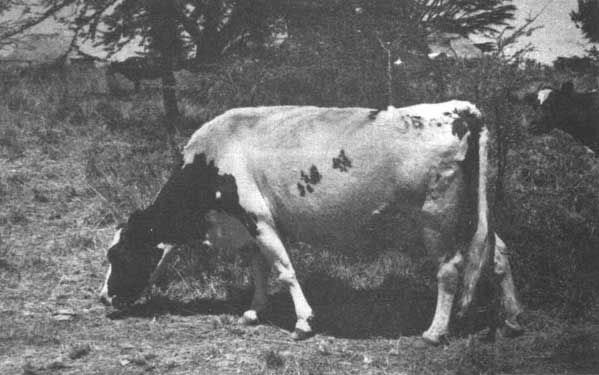
The general appearance of the purebred Ayrshire cows at Deloraine Estates was less favourable than that of the Ayrshire-Sahiwal reciprocal crosses or the purebred Sahiwal cows when observed in January 1980 during a period of poor grazing conditions and relatively high temperatures. This subjective evaluation was based on sleekness of haircoat and differences in whole body composition. For the characters relating to milk production, however, the purebred Sahiwals revealed some deficiencies, as shown in Table 3. The Sahiwal-Ayrshire crossbred cows seem to provide a more favourable additive genetic composition for milk production in the given nutritive and climatic environment.
When variable amounts of milk are extracted from cows in addition to the milk consumed by calves, it is not possible to characterize different breeding groups effectively for maternal ability based on the weaning weight of calves. The results presented in Table 4 do not show a significant difference between either breeding group of cow or breed of sire for calf weaning weight. This suggests that the amount of milk extracted from each cow may have been determined by the ranch managers according to the appearance of the calf. Such a practice would tend to minimize the expression of genetic differences. Results on breed of sire effects presented in Table 4 for weight of 2-year-old heifers show the Sahiwal breed to be superior to the Ayrshire in transmitted effects for growth in the environment under which these data were collected.
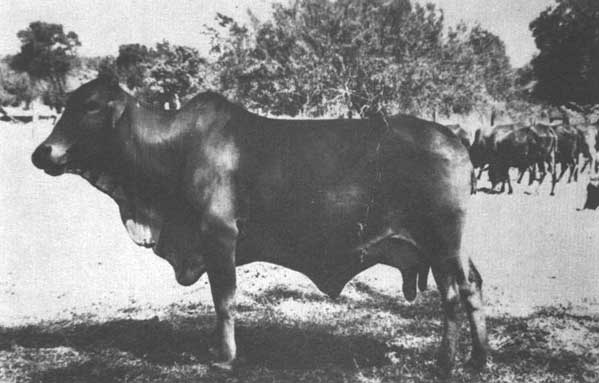
11. Sahiwal cow, Deloraine Estates
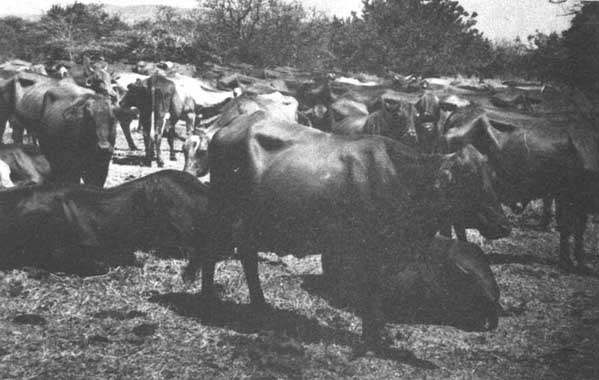
12. ½ Sahiwal - ½ Ayrshire milking herd, Deloraine Estates
13. Ayrshire cow, poorly adapted, Deloraine Estates