Cedarvale Farms is a privately owned ranch of 3000 ha in Kenya's Rift Valley Province near Nanyuki. The ranch is located on the equator in a lower-potential area of the Kenyan highlands. Elevation is about 2000 m, and annual rainfall from 1974 through 1977 averaged 682 mm, falling mainly from April through June. A herd of purebred Sahiwals is kept for the sale of breeding stock, and Sahiwal and Ayrshire crossbreds in varying proportions are kept for meat and milk production.
The records of 435 cows were analyzed, born from 1965 through 1974, including 401 lactation records kept from 1975 through 1977 and information on 799 calves produced from 1975 through 1977. The cow breeding groups on which data were analyzed included ¾ Ayrshire - ¼ Sahiwal (breed of sire listed first), Ayrshire × Sahiwal, Sahiwal × Ayrshire, ¾ Sahiwal ¼ Ayrshire, purebred Sahiwal and Sahiwal × Friesian. These females were mated to purebred Ayrshire and purebred Sahiwal sires to produce the calves on which records were analyzed. A list of the characters analyzed and the number of records included in the analysis of each character is given in Tables 7 and 8. Table 9 provides information on calf survival and weaning weight by breed of sire - breeding group of dam subclass.
The purebred Sahiwal population is based on the purchase of a small number of pedigree Sahiwal cows in 1962. Sahiwal sires have been used at Cedarvale Farms since 1952 by topcrossing them on predominantly Ayrshire cows, both by artificial insemination and natural service. Sahiwal sires have been bought in from the National Sahiwal Stud at Naivasha and from other Sahiwal breeders in Kenya, but a high percentage has been produced in the ranch's own pedigree Sahiwal herd. Semen from Sahiwal sires is collected and processed at the farm for artificial insemination and Sahiwal semen is also obtained from the Central Artificial Insemination Station at Kabete. Ayrshire sires have been used by artificial insemination, with semen obtained from the Central Artificial Insemination Station produced by bulls imported from the United Kingdom, Canada, Sweden and Finland. Breeding is carried out throughout the year except from April 15 until June 1. The sires used appear to be a representative sample of their respective breeds.
The cows are grazed on troth seeded and natural pastures during the day and are confined with no grazing at night. When grazing is particularly limited because of drought conditions some hay is fed, hut not concentrates. Cows are dipped either once or twice a week to control tick-home diseases.
Cows are hand milked twice daily. For lactation records, cows were divided into two groups according to the milking system practiced: those which were hand milked only with no suckling, and those which were hand milked either with or without suckling by the dam's own calf and later suckled by a variety of calves when the milk extracted dropped to the level where hand milking became economically unattractive. Thus, cows producing at a higher level were hand milked only and cows producing milk at lower levels were partially hand milked and partially suckled. In all, 288 lactations were recorded under the first milking system and 113 under the second. All pedigree Sahiwal cows suckled their own calves for 30 to 60 seconds prior to milking in order to stimulate the let-down of milk. After as much milk as possible was extracted by hand, the calf was allowed to return to its dam to suckle. Thus, pedigree Sahiwal calves probably received highly variable amounts of milk, depending on the level of let-down of their dams with hand milking.
Calves were reared under three systems: either their dam was primarily milked (and possibly later multiple suckled) and the calf suckled other cows throughout, or the dam suckled her own calf and others, or the dam suckled her own calf primarily, and suckled others or was hand milked a little. Out of 799 calves included in the analysis, 397 were reared under the first system, 271 under the second and 131 under the third.
All traits were analyzed by least-squares fixed-model procedures (Harvey, 1972). As appropriate for each character involved, the model was varied in regard to the factors included. However, the fixed effects of year and month of birth of cow, year and month of birth of calf, parturition number, breed of sire of cow and of calf, breed of dam of cow and of calf, milking system of cow, rearing system of calf, sires within breed of sire for each breed and interactions involving breed of sire of cow, breed of dam of cow, milking system of cow, rearing system of calf and year of birth were included in the model for the analysis of most characters. The means presented for breeding group of cow (Table 7) were computed from the interactions of the breed of sire of cow and breed of dam of cow. The specific factors included in the model for the analysis of each character will be evident when results are presented and discussed for the characters shown in Tables 7 end 8. Linear contrasts of least-squares breeding group means were computed to determine the significance of differences between breeding groups of cows (Table 7) and calf characters within breeding groups of dams (Table 8) for all characters for which the difference among breeding groups was significant in the analysis of variance. In each case where the breeding group of cow was significant for characters of the cow and the breeding group of dam was significant for characters of the calf, more comparisons were made using the least-squares means than the number of independent degrees of freedom. Therefore, au of the comparisons are not independent and the error rate over the entire set of comparisons may be different from that indicated by the level of probability. Tests of significance associated with the linear contrasts, although not independent, can be taken as guides as to whether the observed values could have occurred by chance. The residual mean square was used as the error term to test the significance of all differences evaluated.
Table 7. Least-squares breeding group means and standard errors for maternal characters, Cedervale Farms
|
Breeding group of cow
|
Age at first calving |
Calving interval |
- |
Lactation |
||||
|
|
|
|
total yield |
length |
daily yield |
|||
|
N |
days |
N |
days |
N |
kg |
days |
kg |
|
|
¾ Ayrshire - ¼ Sahiwal |
148 |
1071a ± 10.4 |
191 |
453a ± 12.3 |
148 |
1674ad ± 138 |
197 ± 17 |
7.4a ± 0.37 |
|
Ayrshire × Sahiwal |
40 |
1062a ± 15.0 |
105 |
445a ± 14.6 |
37 |
1952ac ± 193 |
220 ± 24 |
7.8a ± 0.51 |
|
Sahiwal × Ayrshire |
28 |
1105ab ± 18.9 |
122 |
386bc ± 15.5 |
27 |
1417af ± 266 |
186 ± 33 |
7.2a ± 0.71 |
|
¾ Sahiwal - ¼ Ayrshire |
150 |
1066a ± 12.3 |
143 |
396bc ± 12.6 |
139 |
1464df ± 141 |
191 ± 18 |
7.2a ± 0.38 |
|
Purebred Sahiwal |
45 |
1116b ± 15.2 |
94 |
450a ± 14.3 |
25 |
956bef ± 261 |
143 ± 33 |
5.2b ± 0.69 |
|
Sahiwal × crossbred Friesian |
24 |
1056a ± 19.7 |
62 |
412ac ± 17.7 |
25 |
1605af ± 209 |
190 ± 26 |
8.2a ± 0.55 |
|
Total or mean |
435 |
1079 |
717 |
424 |
401 |
1511 |
188 |
7.2 |
abcdef Means having no superscript in common differ at the P £ .05 level; those with no superscripts did not show a significant breeding group difference in the analysis of variance.
4.2.1 Reproductive characters
4.2.2 Milk Production
4.2.3 Growth Characters
4.2.4 Viability
4.2.5 Index of cow productivity
4.2.6 Heterosis and reciprocal effects
4.2.7 General remarks
The mean age at first calving was 1079 days for 435 cows from six breeding groups, born from 1965 through 1974. The effects of cow's year of birth were significant for this character, though the pattern was not consistent. The youngest average age at first calving was 1035 days for cows born in 1970, while the oldest age at first calving was 1142 days for cows born in 1972. Cow's month of birth also had a significant effect on age at first calving. Cows born from July through December were 108 days younger on average at first calving than cows born from January through June.
Cows with Sahiwal sires did not differ (P > .05) in terms of age at first calving from cows with Ayrshire sires. Breeding groups of cows differed significantly, however (Table 7). The purebred Sahiwal cows were significantly older (1116 days) on average at first calving than all other breeding groups except Sahiwal × Ayrshire crosses. The other breeding groups did not differ (P > .05) in this character.
The mean calving interval was 424 days for the six breeding groups of cows, based on 717 observations. Year of calving (1968 through 1975) influenced calving interval significantly (P < .01), though the pattern was not consistent. The shortest average calving interval of 377 days was for cows calving in 1975, while the longest (485 days) was for cows calving in 1971. Neither month of calving nor parturition number had a significant effect on calving interval.
Breed of sire of cow also significantly influenced calving interval. Cows by Sahiwal sires averaged a 26-day shorter calving interval (411 vs 437 days) than cows by Ayrshire sires. The difference between the 4 Ayrshire sires was not significant in terms of the calving interval of the progeny, but the difference between the progeny of the 10 Sahiwal sires was significant for calving interval.
Table 8. Least-squares breeding group means and standard errors for calf survival and growth characters, Cedarvale Farms
|
|
Calf survival |
Weaning weight |
Steer weights adjusted to constant age of: |
|||||
|
N |
% |
N |
kg |
N |
27 months |
30 months |
36 months |
|
|
|
|
|
kg |
kg |
kg |
|||
|
Breeding group of cow |
||||||||
|
¾ Ayrshire - ¼ Sahiwal |
220 |
90a ± 6.4 |
131 |
171 ± 10.7 |
25 |
351 ± 18.3 |
395 ± 20.6 |
451 ± 23.5 |
|
Ayrshire × Sahiwal and reciprocal |
119 |
86a ± 4.3 |
52 |
161 ± 8.6 |
34 |
354 ± 8.3 |
402 ± 9.4 |
471 ± 11.0 |
|
¾ Sahiwal-¼ Ayrshire |
292 |
80a ± 3.5 |
127 |
153 ± 8.0 |
51 |
351 ± 7.6 |
398 ± 8.6 |
457 ± 9.9 |
|
Purebred Sahiwal |
84 |
56b ± 6.8 |
31 |
160 ± 16.5 |
|
|
|
|
|
Sahiwal × crossbred Friesian |
84 |
85a ± 6.6 |
43 |
171 ± 10.8 |
17 |
365 ± 12.1 |
412 ± 13.6 |
491 ± 16.2 |
|
Sahiwal × Friesian |
|
|
|
|
14 |
354 ± 15.3 |
403 ± 17.4 |
468 ± 20.2 |
|
Total or mean |
799 |
79 |
384 |
163 |
141 |
355 |
402 |
468 |
|
Breed of sirec Ayrshire |
365 |
79 ± 3.9 |
165 |
164 ± 9.5 |
67 |
322a ± 11.0 |
369a ± 12.6 |
429a ± 14.6 |
|
Sahiwal |
434 |
83 ± 3.7 |
219 |
162 ± 6.5 |
74 |
386b ± 6.4 |
434b ± 7.2 |
505b ± 8.4 |
|
Total or mean |
799 |
80 |
384 |
163 |
141 |
354 |
402 |
467 |
ab Means having no superscripts in common differ at the P £ .05 level; those with no superscripts did not show a significant breeding group difference in the analysis of variance.
c Ayrshire sires were not mated to Sahiwal dams.
The difference between breeding groups of cows was also significant. Purebred Sahiwal, Ayrshire × Sahiwal and ¾ Ayrshire - ¼ Sahiwal cows had significantly longer calving intervals than Sahiwal × Ayrshire and ¾ Sahiwal ¼ Ayrshire cows, but Sahiwal × Ayrshire, ¾ Sahiwal - ¼ Ayrshire and Sahiwal × Friesian cows did not differ significantly (P > .05) in terms of calving interval (Table 7).
4.2.2.1 Lactation yield.
4.2.2.2 Lactation length.
4.2.2.3 Daily milk yield.
From 1975 through 1977, 401 lactations were recorded. The average lactation yield was 1511 kg for the six breeding groups of cows. The effects of year of calving on lactation yield were important (P < .01): there was a marked decline in lactation yield over the three years, with yields averaging 709 kg more in 1975 than in 1977. The effects of month of calving on lactation yield were also significant: cows calving in January-February and March-April produced on average 409 kg more milk per lactation than cows calving during the last eight months of the year. Also, the effects of parturition number on lactation yield were important (P < .01): yields following the first and second parturition averaged 597 and 8 kg less, respectively, than the average of the six parturitions included in the analysis. For unknown reasons, lactation yields following the fourth parturition also averaged 118 kg less than the overall average. Lactation yields of cows under the first milking system averaged 1416 kg greater than those of cows under the second milking system (see section 4.1).
Differences between sire breeds of cows were significant for lactation yield: the progeny of Ayrshire sires produced 602 kg more milk on average per lactation than the progeny of Sahiwal sires. Differences between sires within breed of sire were not significant for either Ayrshires or Sahiwals, however. None of the interactions involving year or milking system were significant for lactation yield.
Differences between breeding groups of cows were also significant (Table 7). The ¾ Ayrshire - ¼ Sahiwal cows produced significantly more milk than the purebred Sahiwal cows, and the Ayrshire × Sahiwal cows produced significantly more milk than ¾ Sahiwal - ¼ Ayrshire or purebred Sahiwals. Sahiwal × Friesian cows averaged significantly higher lactation yields than pure Sahiwals.
The mean lactation length for all the lactations recorded was 188 days. The effects of year of calving on lactation length were important (P < .05): there was a marked decline in average lactation length over the three years, with lactations averaging 70 days shorter in 1977 than in 1975. Month of calving had a significant effect on length of lactation: cows calving in January-February, March-April and September-October averaged 25 days longer lactations than cows calving in the other six months of the year. The effects of parturition number were also important (P < .01): lactations following the first and fourth parturition were shorter than the overall average, while lactations following the four other parturitions were longer.
As expected, the milking system had a significant effect on lactation length. The average length of the 288 lactations recorded under the first milking system was 172 days longer (P < .01) than the average for the 113 lactations recorded under the second milking system.
Neither cow's breed of sire nor cow's sire within either breed had a significant effect on length of lactation. The only significant interaction was milking system with breed of sire, because cows by Sahiwal sires averaged shorter lactations than cows by Ayrshire sires under the first milking system and longer lactations under the second. Differences in lactation length between breeding groups of cows were not significant (Table 7).
Daily milk yield averaged 7.2 kg for the 401 lactations recorded. Neither year nor month of birth of calf had an important effect on daily milk yield, but the effects of parturition number were significant (P < .01). Daily milk yield following first and second parturitions averaged 1.4 and 0.3 kg less, respectively, than the overall average. Cows under the first milking system produced on average 1.3 kg more (P < .01) milk per day than cows under the second milking system.
Cows by Ayrshire sires averaged 1.4 kg more milk (P < .01) per day than cows by Sahiwal sires, but differences between individual sires were not significant within either breed. None of the interactions involving year and milking system produced significant differences.
Differences between breeding groups of cows were significant, with purebred Sahiwal cows averaging significantly less milk per day than all other breeding groups (Table 7). This result was expected because the purebred Sahiwal cows which were milked also suckled their calves. The five other cow breeding groups did not differ significantly from each other in terms of daily milk yield (P > .05).
4.2.3.1 Weaning weight.
4.2.3.2 Steer weights adjusted to constant ages of 27, 30 and 36 months.
The mean weaning weight at 9 months for the 384 calves recorded in the survey was 163 kg. Although the effects of year of birth were not significant at the P < .05 level, average weaning weights declined over the 3-year period from 170 kg in 1975 to 164 kg in 1976 and 156 kg in 1977. Calves born in May-June and July-August were on average 15 kg lighter at weaning than calves horn during the 8 other months of the year. Calves from first and second parturitions averaged 7 kg lighter (P < .01) at weaning than calves from third and fourth parturitions. Male calves averaged 11 kg heavier (P < .01) at weaning than females. The rearing system also had a significant effect on weaning weight (see section 4.1): calves reared under the first system, which were not allowed to suckle their own dams, averaged 146 kg at weaning. Those reared under the second system, which suckled their own dams hut with a substantial proportion of the milk taken for others, averaged 167 kg, and those reared under the third system, which had nearly all the milk from their own dams, averaged 176 kg. These results indicate that calves which are allowed to suckle their own dams have an advantage over those which are not.
Neither breed of sire nor breeding group of dam had a significant effect on weaning weight of calf (Table 8), but differences between the nine Ayrshire sires were significant. Differences between the eight Sahiwal sires were not significant; neither were any of the interactions involving breeding group of dam, breed of sire, year or rearing system.
Although the interaction of breed of sire with breeding group of dam was not significant for weaning weight, because of interest in specific crosses, breed of sire - breeding group of dam subclass means and their standard errors are presented in Table 9 for weaning weight and calf survival.
Differences in the growth of the 141 steers kept after weaning were analyzed initially in terms of month of birth, breed of sire, breeding group of dam and the interaction of breed of sire with breeding group of dam. The effects of year of birth were then excluded from the model used for the final analysis because they had not been significant.
The evaluation of steer growth after weaning included 14 Sahiwal × Friesian steers, but purebred Sahiwal steers were not included. Neither breeding group of dam nor month of birth was significant (P > .05) for steer weights adjusted to 27, 30 and 36 months. However, the effects of breed of sire were significant: steers by Sahiwal sires averaged 64 kg heavier than steers by Ayrshire sires at 27 months, 65 kg heavier at 30 months and 76 kg heavier at 36 months (Table 8). The fact that major differences in growth rate were observed after weaning, while there was no significant difference at weaning (162 kg for Sahiwals vs 164 kg for Ayrshires) suggests that the nutritional environment provided before weaning may not have been adequate to allow expression of differences between the two breeds in terms of additive genetic merit for growth.
Table 9. Least-squares breeding group means and standard errors for calf survival and weaning weight by breed of sire-breeding group of dam subclass, Cedervale Farms
|
Breeding group of calfa |
Calf survival |
|
Weaning weight |
|
|
|
N |
% |
N |
kg |
|
Ayrshire × ¾ S - ¼ A |
234 |
82 ± 2.8 |
112 |
160 ±7.4 |
|
Ayrshire × ¼ S - ¾ A |
13 |
91 ± 11.4 |
5 |
174 ± 18.5 |
|
Ayrshire × S - A |
63 |
79 ± 5.2 |
24 |
159 ± 10.8 |
|
Ayrshire × S - crossbred Friesian |
55 |
75 ± 5.9 |
24 |
166 ± 14.0 |
|
Sahiwal × Sahiwal |
84 |
60 ± 6.1 |
31 |
159 ± 15.5 |
|
Sahiwal × ¾ S - ¼ A |
58 |
77 ± 6.3 |
15 |
146 ± 13.3 |
|
Sahiwal × ¼ S - ¾ A |
207 |
89 ± 4.3 |
126 |
169 ± 6.9 |
|
Sahiwal × S - A |
56 |
92 ± 6.9 |
28 |
162 ± 11.3 |
|
Sahiwal × S - crossbred Friesian |
29 |
96 ± 10.5 |
19 |
176 ± 13.7 |
a A = Ayrshire, S = Sahiwal; sire breed listed first.
Of the 799 calves horn during the period under analysis, 79% survived until weaning at 9 months (Table 8). The effects of year of birth, month of birth, parturition number and sex were not significant for calf survival until weaning. Rearing systems did have a significant effect, however (P < .01): 69% of the calves reared under the first system survived until weaning, 84% of those reared under the second system survived, and 85% of those reared under the third system. The effects of breeding group of dam were significant for calf survival, but the effects of breed of sire were not (Table 8). Also the interaction of breeding group of dam by rearing system was significant: 90% of the calves out of ¾ Sahiwal - ¼ Ayrshire dams survived under the first rearing system.
Only 56% of the calves out of purebred Sahiwal cows survived until weaning, which was significantly different (P < .01) from the overall average. Several factors probably contributed to this low survival rate. For one thing, the purebred Sahiwal calves were the only straightbred calves produced - Sahiwal females were bred only to Sahiwal males - while Gregory et al (1978b) have shown that individual heterosis has an influence on calf survival. Also, the purebred Sahiwal calves may have had relatively high coefficients of inbreeding which has an effect opposite of heterosis on calf survival. Further, the owner suggested that the large teat size of some of the purebred Sahiwal cows may have made it difficult for their calves to suckle immediately after birth and thus they may have had a low nutrient intake and may not have received enough colostrum to provide adequate antibodies. Among Sahiwal calves that lived, the level of nutrition provided during the preweaning period was probably comparable to that of other breeding groups: their weaning weights averaged 160 kg compared to an average of 163 kg for all calves.
Deficiencies in udder and teat anatomy are a problem of the Sahiwal breed that may reduce its usefulness for both milk and beef production programmes. However, Sahiwal crossbreds with breeds that have desirable udder and teat conformation seem to be generally acceptable in terms of these anatomical characteristics.
The interaction of breed of sire by breeding group of dam was significant for calf survival. This is due to the low survival rate of 56% for calves by Sahiwal sires out of Sahiwal dams, while the overall survival rate for all progeny of Sahiwal sires was 7% higher than for the progeny of Ayrshire sires across all breeding groups of cows (Table 8).
Data on cow mortality from Cedarvale Farms are presented in Table 10. Obviously, the standard errors on percentage of cow mortality are large for the five breeding groups of cows. Thus it does not seem appropriate to attempt to draw inferences from the results observed for this character.
Table 10. Cow mortality, Cedarvale Farms
|
Breeding group of cow |
Number of cow years |
Number of deaths |
Cow mortality |
|
¾ Ayrshire - ¼ Sahiwal |
148 |
2 |
1.4 |
|
Ayrshire × Sahiwal and reciprocal |
64 |
3 |
4.7 |
|
¾ Sahiwal - ¼ Ayrshire |
139 |
1 |
0.7 |
|
Purebred Sahiwal |
25 |
0 |
0 |
|
Sahiwal × crossbred Friesian |
25 |
5 |
20.0 |
The characters of reproductive performance, cow and calf viability, milk production, growth and cow weight are combined in Table 11 to build up an index of the total weight of 1-year-old calf plus the liveweight equivalent of milk produced, both per cow per year and per 100 kg of cow weight maintained per year. As already described, the cow productivity index is computed as the product of cow viability (%) × calving percentage (%) × calf survival (%) × calf weight at 1 year (kg) + cow viability (%) × calving percentage (%) × lactation milked-out yield (kg)/9.
Table 11. Productivity estimates of cows by breed group, Cedarvale Farms
|
Character |
Sahiwal |
¾ Sahiwal-¼ Ayrshire |
Sahiwal-Ayrshire |
¼ Sahiwal-¾ Ayrshire |
|
Cow viability (%) |
100 |
99.3 |
95.3 |
98.6 |
|
Calving percentage (%) |
81.1 |
92.2 |
87.7 |
80.6 |
|
Calf survival (%) |
55.5 |
75.8 |
81.8 |
85.8 |
|
Calf weight at 1 year (kg) |
187.2 |
180.2 |
188.2 |
198.2 |
|
Lactation milked-out yielda (kg) |
1050 |
1458 |
1635 |
1626 |
|
Productivity index per cow per yearb (kg) |
178.9 |
273.3 |
280.5 |
278.7 |
|
Cow weight (kg) |
418 |
437 |
413 |
408 |
|
Productivity index per 100 kg of cow maintained per yearb (kg) |
42.8 |
62.5 |
67.9 |
68.3 |
a Adjusted to the proportions of animals actually maintained under each rearing and milking system.
b Total weight of 1-year-old calf plus liveweight equivalent of milk produced.
The lactation milked-out yield values included in the cow productivity index for Cedarvale Farms (Table 11) differ from the total lactation yield values presented in Table 7 because the values used in the cow productivity index were adjusted to reflect the proportion of animals actually maintained in each milking and rearing system. The productivity estimates of cows by breed group show little difference between the Sahiwal - Ayrshire and the ¼ Sahiwal - ¾ Ayrshire breeding groups. It appears that milk production and other components of the index are reduced for cows which are more than one-half Sahiwal The low rate of calf survival is a major factor, in addition to low milk production, contributing to the low indices of the purebred Sahiwal cows.
Among Ayrshire-Sahiwal reciprocal cross females, those with Sahiwal dams averaged 43 days (P > .05) earlier at first calving (Table 12). Cows with Ayrshire dams averaged a 59-day shorter calving interval, or 386 days compared with 445 (P < .01), but cows with Sahiwal dams averaged 34-day longer lactations and 0. 6 kg greater daily milk yields (P > .05). It seems likely that the shorter calving interval of the Sahiwal × Ayrshire cows is related to their shorter lactations and lower daily milk yields. In the same nutritive environment, calving interval is generally increased as milk production increases.
A comparison of the average values for maternal characters of the reciprocal Sahiwal and Ayrshire backcrosses with the F1 reciprocal crosses provides an estimate of heterosis (Table 12). Such a comparison should indicate that the reciprocal backcrosses and the F1 reciprocal crosses achieve the same level of additive genetic merit, while the reciprocal backcrosses have lost one-half of the level of heterozygosity of the F1 reciprocal crosses. In a comprehensive review article, Gregory and Cundiff (1980) concluded that the loss of heterosis in rotation crossbreeding systems is proportional to the loss of heterozygosity for both individual and maternal characters in cattle. Thus, heterosis is expected to be equal to the difference between the mean for the F1 reciprocal crosses and the mean for the reciprocal backcrosses, multiplied by a factor of 2 because of expected loss of heterozygosity in the backcrosses.
Estimates of heterosis computed on this basis are presented in Table 12. The reciprocal backcross cows calved at a younger age than the F1 crosses, however, so there is no basis for presenting an estimate of heterosis for this character. Based on differences between the reciprocal crosses and the reciprocal back-crosses, heterosis effects resulted in a reduced calving interval of 16 days, an increased lactation yield of 230 kg, an increased lactation length of 18 days, and an increased daily milk yield of 0.4 kg.
Table 12. Difference between reciprocal crosses and heterosis for maternal characters, Cedarvale Farms
|
Breeding group of cow
|
Age at first calving |
Calving interval |
Lactation |
|||||
|
N |
days |
N |
days |
N |
Total yield kg |
Length days |
Daily yield kg |
|
|
Mean of Ayrshire × Sahiwal and reciprocal crosses |
68 |
1084 |
227 |
416 |
64 |
1684 |
203 |
7.5 |
|
Mean of ¾ Ayrshire - ¼ Sahiwal and ¾ Sahiwal - ¼ Ayrshire |
298 |
1068 |
334 |
424 |
287 |
1569 |
194 |
7.3 |
|
Difference between reciprocal crosses and reciprocal backcrosses |
|
16 |
|
-8 |
|
115 |
9 |
0.2 |
|
Heterosis (difference × 2) |
|
|
|
-16 |
|
230 |
18 |
0.4 |
|
Difference between reciprocal crossesa Ayrshire-Sahiwal Sahiwal-Ayrshire |
|
-43 |
|
59a |
|
535 |
34 |
0.6 |
a P < .01.
The differences in milking and rearing systems carried out at Cedarvale Farms make it difficult to interpret the results of this study of production characters. However, the influence of different management systems and other environmentally related variables was estimated in the analysis, and adjustments in the breeding group means were made accordingly. There were significant differences among the six breeding groups of cows in age at first calving, calving interval and total and daily lactation yields (Table 7), as well as differences between sire breeds in post-weaning growth rate of their steer progeny (Table 8).
The evidence presented shows that Sahiwals probably reach reproductive maturity at a later age than Ayrshires, based on age at first calving, that Sahiwal-sired cows tend to have shorter calving intervals than Ayrshire-sired cows, and that the Ayrshire breed has superior additive genetic merit for characters relating to lactation performance. The Sahiwal breed most likely excels the Ayrshire breed in additive genetic merit for growth when the nutritive environment is adequate to allow differences in additive genetic merit to be expressed.
A primary role of the Sahiwal breed may be to contribute germ-plasm, either through organized crossbreeding systems and/or through the formation of composite breeds, to-obtain the benefits of heterosis and to achieve a more favourable production response capability in different climatic and nutritional environments. A more comprehensive discussion of the potential for forming composite breeds is presented in Chapter 8.
The low rate of survival of the purebred Sahiwal calves in this situation suggests that purebred Sahiwals may he lacking in vigour at birth. However, the transmitted effects for survival revealed by breed-of-sire means for calf survival indicate that the Sahiwal breed is a least equal to, and possibly slightly superior, to the Ayrshire breed in this character (Table 8). The general environment under which this herd is maintained would be classified as fairly harsh for dairy programmes, and breeding systems to utilize heterosis with some germ-plasm contributed by Bos indicus cattle seem essential for achieving an acceptable response level under these conditions.
Even though the data are not the most appropriate for providing estimates of heterosis for maternal characters, indications are that heterosis is of importance for most characters that contribute to maternal performance. There was a significant difference between the Ayrshire-Sahiwal cross and its reciprocal in calving interval, though a biological basis for this reciprocal effect is not apparent.
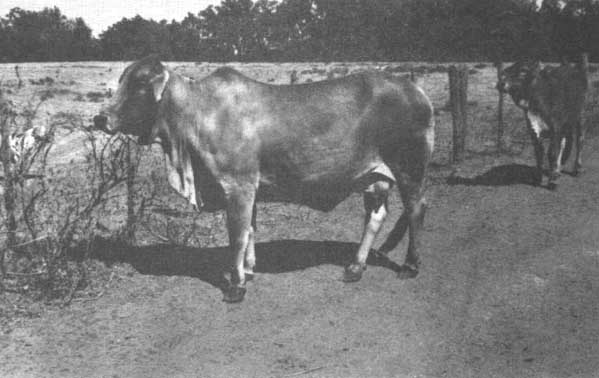
14. 10-year-old Sahiwal cow, Cedarvale Farms
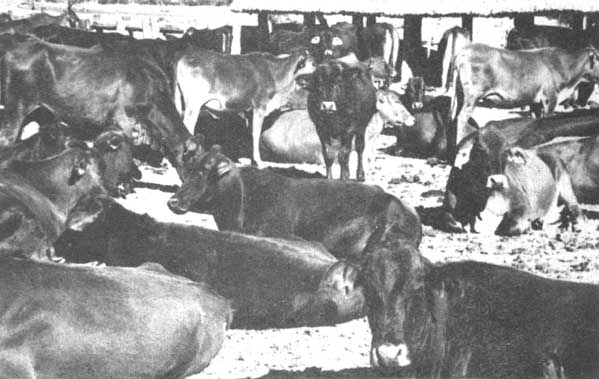
15. ¾ Sahiwal- ¼ Ayrshire cow herd, Cedarvale Farms
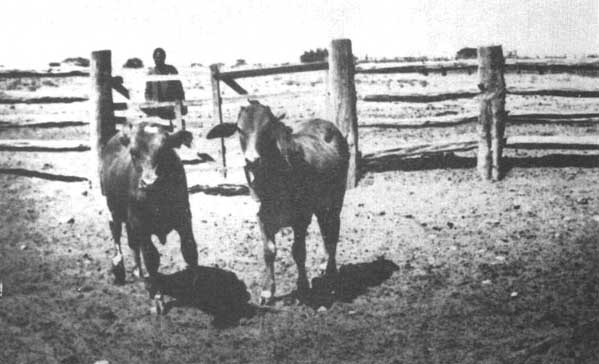
16. ¼ Sahiwal- ¾ Ayrshire and ¾ Sahiwal - ¼ Ayrshire calves at 8 months, Cedarvale Farms