El Karama Ranch is located on the equator in Kenya's Rift Valley Province near Nanyuki. The ranch comprises about 4800 ha at an elevation of approximately 1800 m. Annual rainfall averaged 691 mm from 1972 through 1978, but a severe drought occurred in the area during this period, beginning in late 1974 and continuing through early 1976. Ordinarily, rainfall occurs in a bimodal pattern, with the main rainy season from April through June and a shorter rainy period from October through November.
The data analyzed were collected from populations of pedigree Boran and pedigree Sahiwal cattle. The ranch is managed primarily to produce bulls of both breeds to sell for breeding purposes in predominantly beef production programmes, both domestically and for export. Both herds were established in 1963. The Boran herd was started with foundation females that were typically Boran but lacked ancestoral records. Foundation sires for the Boran herd were obtained from pedigree breeders in the Kenya highlands. Boran bulls used subsequently have come from the same or similar sources or from the ranch's own herd. The Sahiwal herd was graded up by the use of pedigreed Sahiwal sires on an initial female population of Boran crosses with Red Poll and Hereford. Sahiwal sires have been obtained from the National Sahiwal Stud at Naivasha and from other Sahiwal breeders in Kenya and in recent years some Sahiwal sires have been produced on the ranch. The sample of sires used for both breeds is believed to be a representative sample of these breeds in Kenya.
Generally, feeding is restricted to natural grazing and no supplements are given. Herds of troth breeds are grazed on the open range during the day under the care of a herdsman and are confined at night with no grazing. The predominant grasses are Themeda and Brachiaria species, with acacia trees scattered over the grasslands at varying densities. In addition to the cattle herds, the rangelands support large populations of zebra, giraffe, many species of antelope and some cape buffalo. The ranch owner estimates the carrying capacity at about 4. 8 ha per livestock unit. The cattle must walk up to 7 km to water during much of the year and a similar distance to be dipped twice a week.
All breeding has been by natural service and the cows are exposed to bulls continuously. Thus, calves are born in all months of the year. Calves are weaned at 8 months and male calves are castrated after weaning. After weaning, heifer calves of both breeds are grazed together until they reach about 275 kg at an average age of 660 days, at which time they are exposed for breeding. Bull calves of both breeds are run together with steers and with older bulls after they are weaned. The management programme is the same for both breeds except some Sahiwal cows are milked once a day, primarily for domestic consumption. Milk is extracted in the morning when the calf is brought back to its dam after being separated overnight.
A subjective system of evaluating Sahiwal cows for milk production was used. On the basis of this system, 40% were classified as 'good' milkers, 32% as 'average' milkers and 21% as 'poor' milkers; a further 7% produced no milk beyond that consumed by the calf. Thus, some milk was extracted from 93% of the Sahiwal cows.
All traits were analyzed by least-squares fixed-model procedures (Harvey, 1972). The model for all traits included the fixed effects of year of birth, month of birth, breed, and sire within breed. In addition, for the characters of calving interval and weaning weight, the model included parturition number and the interaction of breed with year. Sex of calf was included in the model for weaning weight. The residual mean square was used as the error term to test the significance of all differences evaluated.
5.2.1 Reproductive characters
5.2.2 Growth characters
5.2.3 Viability
5.2.4 Index of cow productivity
5.2.5 General remarks
The mean age at first carving was 1209 days for the 329 reproducing females included in the study. The effects of cow's year of birth were important (P < .01), with a general trend towards a lower age at first calving over the period of the study from 1964 through 1974. The one exception was cows born in 1973, as they were first exposed to breeding during the severe drought from late 1974 until 1976. Cows born in all years after 1969, except 1973, calved on average at an earlier age than the overall average, while cows born from 1964 through 1968 tended to calve at an older than average age. By contrast, month of cow's birth did not have a significant effect on age at first calving.
Breed differences in age at first calving were not significant (Table 13). Differences among cows sired by the 10 Sahiwal sires used were significant, while differences among cows sired by the 10 Boran sires were not. Thus, a large amount of additive genetic variation is indicated in the Sahiwal breed for this character.
The mean calving interval was 402 days for 990 observations from 1968 through 1977. The calf's year of birth had a significant effect on calving interval; cows calving in 1969, 1971, 1972, 1976 and 1977 averaged shorter calving intervals than the sample as a whole, while cows calving in 1970, 1973, 1974 and 1975 tended to have longer than average calving intervals. The longer calving intervals for cows calving in 1973, 1974 and 1975 are probably related to severe drought conditions which would have lowered the nutritive environment from late 1974 until 1976. The calf's month of birth did not significantly affect calving interval.
Table 13. Least-squares breeding group means and standard errors for maternal and growth characters, El Karama Ranch
|
|
Age at first calving |
Calving interval |
Calf survival |
Weaning weight |
Adjusted 660-day weight of heifers |
Adjusted 18-month weight of bulls |
Adjusted 24-month weight of bulls |
Adjusted 30 month weight of bulls | ||||||||
|
|
N |
days |
N |
days |
N |
% |
N |
kg |
N |
kg |
N |
kg |
N |
kg |
N |
kg |
|
Boran |
157 |
1223a ± 13.6 |
498 |
413a ± 8.1 |
585 |
94a |
292 |
170a ± 2.6 |
105 |
292a ± 4.7 |
53 |
308 |
32 |
388 |
17 |
446 |
|
Sahiwal |
172 |
1195a ± 15.3 |
492 |
390b ± 8,6 |
634 |
96a |
414 |
170a +2.6 |
122 |
266b ± 4.4 |
37 |
307 |
27 |
403 |
15 |
430 |
ab Means having no superscript letter in common differ at the P £ .05 level.
Parturition number had an important effect on calving interval (P < .01). The calving interval between first and second parturitions averaged 441 days, while the interval before the seventh (last) parturition averaged 429 days. For all other parturitions, the calving interval was shorter than the overall mean of 402 days. For the younger cows, the longer than average calving interval probably reflected higher nutritive requirements, because they still had a nutritive requirement for growth in addition to nutritive requirements for lactation and maintenance. The longer calving interval for the older cows is probably due to a reduced ability to cope with nutritional and other stress factors associated with the aging process.
The effects of breed on calving interval were significant: the calving interval for Sahiwal cows was 23 days shorter on average than for Boran cows (Table 13). As already mentioned, some milk was extracted from most of the Sahiwal females though the Sahiwal and Boran herds were kept under a similar nutritive environment. Thus, it appears that Sahiwal cows can return to estrus more quickly following calving than Boran cows, even though they produce more milk in a similar nutritive environment.
Differences in calving interval were not significant among cows by 19 Boran sires or those by 9 Sahiwal sires. The interaction of breed with year of birth of calf was significant for calving interval, however. This result is not readily interpretable: the Boran cows averaged a 35-day shorter calving interval in 1976, while the Sahiwal cows averaged a 36-day shorter calving interval in 1975, both of which were drought years. This reversal between the two breeds in the two years accounts for the significant interaction, but the pattern is not interpretable based on the effects of drought. The ranch owner suggested that the Boran may have been better able to cope with adverse conditions than the Sahiwal, but the data on calving interval do not confirm this view.
5.2.2.1 Weaning weight.
5.2.2.2 Adjusted weight of heifers at 660 days.
5.2.2.3 Adjusted weight of hulls at 18, 24 and 30 months
The mean weaning weight at 8 months was 170 kg for the 706 calves on which records were analyzed. Year of birth had a significant effect on weaning weight: the average weaning weights for calves born in 1972, 1973 and 1974 were below the overall average, while weaning weights for calves born in 1975, 1976 and 1977 were higher on average than for the sample as a whole. This pattern is not consistent with what would be expected during the drought period. Month of birth also had an important effect on weaning weight (P < .01): calves horn from July through December averaged 7 kg lighter at weaning than the overall average, while calves born from January through June averaged 7 kg heavier at weaning than the group as a whole. Calves born from January through April averaged 9 kg heavier at weaning than the overall average.
Parturition number did not have a significant effect on weaning weight. This is an interesting result in view of the fact that calving intervals were longer on average for the first and the last parturitions. These results indicate that lactation yields are maintained, even at the expense of subsequent reproductive performance. Thus, during periods of inadequate nutrition, reduced reproductive performance, as reflected by increased calving interval, would be expected before a decline in weaning weight.
The influence of sex of calf was important for weaning weight (P < .01): male calves averaged 18 kg heavier at weaning than females. This difference is consistent with reports in the literature (Smith et al, 1976b; Gregory et al, 1978b, 1978c and 1979b). Differences among the 10 Boran sires were not significant for the weaning weight of calves, but differences among the 15 Sahiwal sires were significant.
The interaction of breed with year was important (P c. 01) for weaning weight: Boran calves averaged 19 kg heavier at weaning than Sahiwal calves in 1975 and slightly heavier in 1976 and 1977, while Sahiwal calves averaged 13 kg heavier than Boran calves in 1972 and 1973. Overall, however, the two breeds did not differ in terms of weaning weight: they both averaged 170 kg (Table 13).
The average age at which heifers entered the breeding herd was 660 days. At this age, their average weight was 279 kg. Heifers were not removed from either breed group for any reason, other than death, prior to this age. Thus, no bias has been introduced as a result of sequential culling or selection, and the 660-day weight of heifers is the most appropriate indicator of differences between the Boran and Sahiwal breeds in terms of additive genetic merit for growth.
Year of birth had a significant effect on the weight of heifers at 660 days: Heifers born in 1972 and 1973 averaged 26 kg lighter and heifers born in 1974 averaged 6 kg lighter than the group as a whole, while heifers born in 1975 and 1976 averaged 29 kg heavier. These results do not seem to be associated with the 1974-1976 drought period. The effects of month of birth were also important (P < .01): in contrast to the effect of month of birth on weaning weight, heifers born during the first six months of the year were 13 kg lighter on average at 660 days than the group as a whole, while heifers born from July through December averaged 13 kg heavier. Heifers born in March and April averaged 26 kg lighter at 660 days than the overall average, and heifers born in September and October averaged 25 kg heavier. Thus, the seasonal effect associated with month of birth which influences weaning weight in one direction influences the 660-day weight of heifers in the opposite direction. This observation reflects the importance of seasonal effects on postweaning growth.
Boran heifers were 26 kg heavier (P < .01) on average in terms of adjusted 660-day weight than Sahiwal heifers (Table 13), while there was no difference between the two breeds in weaning weight at 8 months. This implies that the Sahiwal cows were superior to the Boran cows in maternal ability as reflected in weaning weight even though some milk was extracted from most of the Sahiwals. This superiority was apparently sufficient to offset the superiority of the Boran in additive genetic merit for growth as reflected in greater postweaning gains.
Some bull calves were culled at weaning according to weaning weight, pedigree, colour and muscular and skeletal anatomy. Also, some bulls were culled on a continuing basis between weaning and 30 months based on performance characters as we'll as other criteria which could affect their marketability as breeding animals. Thus, the adjusted weight records for bulls (Table 13) are subject to differential selection bias for the two breeds and should be interpreted accordingly.
Of all the calves born, 95% survived until weaning at 8 months (Table 13). Though year of birth did not have a significant effect on calf survival, a trend was discernible towards an increasing rate of survival over the period for which data were collected. The effects of month of birth on calf survival were also not significant. Though the effects of parturition number were not significant, there was a tendency towards greater calf survival in later parturitions. The effects of sex of calf were not significant for survival to weaning, but survival was 2% greater for Sahiwal calves than for Boran (P < .05).
From 1968 through 1977, 1% of the Boran cows died and 2% of the Sahiwals. This is considered an unusually low level of cow mortality for both breeds.
The characters of reproductive performance, cow and calf viability, milk production, growth and cow body weights are combined in Table 14 to build up an index of the total weight of 1-year-old calf plus the liveweight equivalent of milk produced, troth per cow per year and per 100 kg of cow weight maintained per year.
As for the other production situations, the cow productivity index is computed as the product of cow viability (%) × calving percentage (%) × calf survival (%) × calf weight at 1 year (kg) + cow viability (%) × calving percentage (%) × lactation milked-out yield (kg)/9.
Table 14. Productivity estimates of cows by breed group, El Karama Ranch
|
Character |
Sahiwal |
Boran |
|
Cow viability (%) |
97.7 |
99.1 |
|
Calving percentage (%) |
93.6 |
88.4 |
|
Calf survival (%) |
96.0 |
94.0 |
|
Calf weight at 1 year (kg) |
205.6 |
211.9 |
|
Lactation milked-out yield (kg) |
90 |
- |
|
Productivity index per cow per yeara (kg) |
190.5 |
174,5 |
|
Cow weight (kg) |
418 |
414 |
|
Productivity index per 100 kg of cow maintained per yeara (kg) |
45.6 |
42.2 |
a Total weight of 1-year-old calf plus liveweight equivalent of milk produced.
The Sahiwal cows exceeded the Boran by 9.2% in terms of the productivity index per cow per year and by 8. 0% in terms of the productivity index per 100 kg of cow maintained per year. These figures take account of the milk which was extracted from the Sahiwal cows.
This study provides comparative information on relevant beef production characteristics of the Sahiwal and Boran breeds as purebreds under the extensive conditions typical of many higher-potential sites in Africa's arid to semi-arid ecological zones. This comparative information provides a basis for making informed decisions on the use of these breeds in organized crossbreeding systems or as contributors to composite breeds to achieve a more favourable additive genetic composition for beef production in such environments. Both approaches would involve the use of heterosis. The Boran has been the Bos indicus breed used most widely as a standard of comparison for beef production programmes in many of the high-elevation arid to semi-arid areas of eastern Africa, These results show that the Sahiwal breed is also adapted to beef production programmes and may be used to complement the Boran, either in crossbreeding systems or as a contributor to composite breeds.
The advantage of Sahiwals shown in this analysis in terms of calving interval, combined with equal calf and cow survival rates and weaning weights, indicates the adaptability of this breed to more extensive beef production environments in terms of fitness-related characters. The shorter calving interval and equal weaning weight were achieved by Sahiwal cows even though some milk was extracted. Thus, it appears that the Sahiwal breed has higher additive genetic merit than the Boran for calving interval and maternal ability under the extensive beef production systems represented in this analysis, while the Boran has greater additive genetic merit for growth, as shown by the greater weight of Boran heifers at 660 days. The Sahiwals appear to compensate for inferior additive genetic merit for growth by superior merit for maternal ability, resulting in equal calf weights at weaning. The index of cow productivity which takes account of the estimated milk extracted from the Sahiwal cows, shows an advantage of the Sahiwal over the Boran breed in estimated net merit, based on the estimated weight equivalent of 1-year-old calf produced.
Given the heavier weight of Boran heifers at 660 days, mature Boran cows would be expected to be heavier than Sahiwals. However, cows of the two breeds did not differ significantly (P > .05) in terms of mature weight (Table 14). As only 32 cows of each breed were weighed, this discrepancy may be explained by sampling error, particularly as the ranch owner expressed the view that his Boran cows were normally fatter than the Sahiwals. It is likely that Boran cows tend to be heavier at maturity than Sahiwals, in spite of the results from this sample.
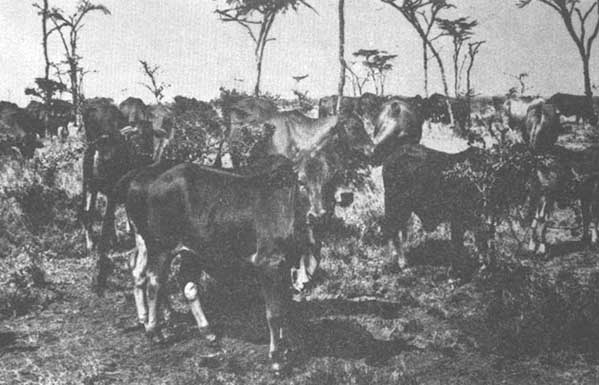
17. Sahiwal cow and calf herd, El Karama Ranch
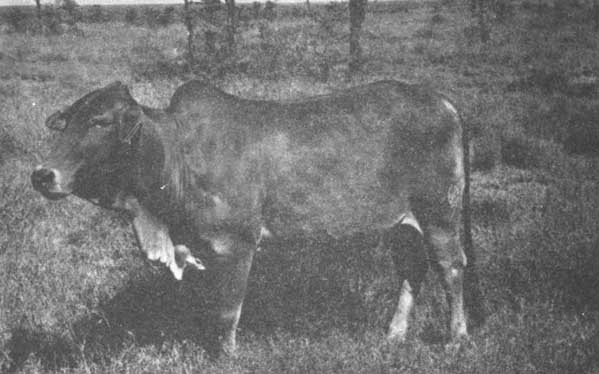
18. Sahiwal cow, El Karama Ranch
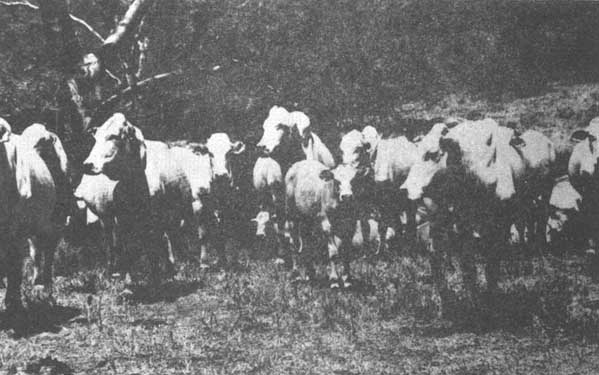
19. Boran cow and calf herd, El Karama Ranch