The zone
The symposium
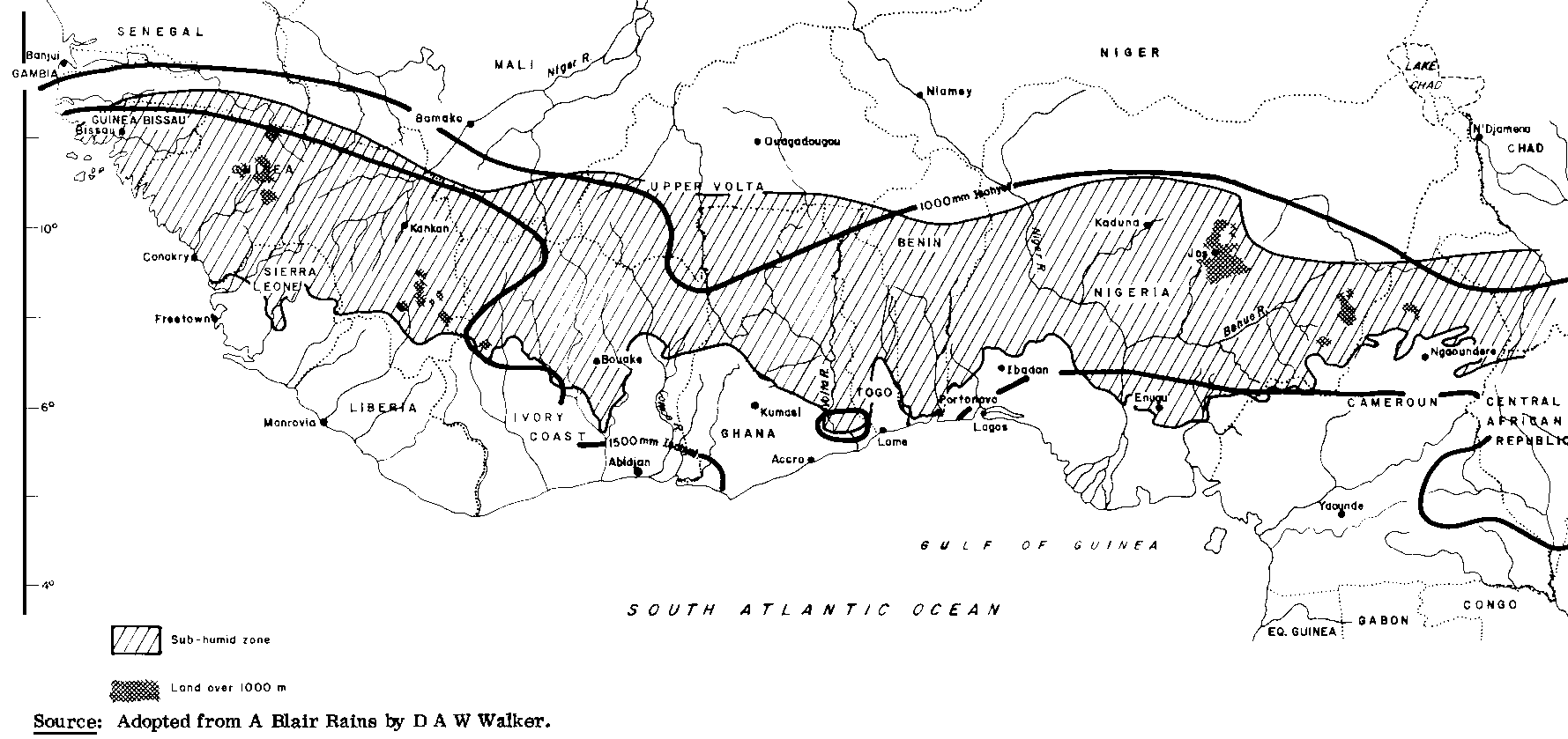
The sub humid zone of West Africa forms a continuous belt, extending roughly parallel to the Equator between latitudes 6° and 12° N, including portions of Senegal, Guinea-Bissau, Guinea, Sierra Leone, Mali, Ivory Coast, Upper Volta, Ghana, Togo, Benin, Nigeria and Cameroon, as shown in Figure 1. This designation includes most of the northern and southern Guinea savannas plus the derived savanna zone (forest savanna mosaic), as defined by Keay (1959) for anglophone West Africa, and the secteur sud-soudanien of the zone sahélo-soudanienne plus the entire zone sudano-guinéenne, as defined by Boudet (1975a) for the francophone countries of the region.
Table 1 shows the extent of the sub humid zone in each of the 12 countries through which it extends. The importance of the zone from a national perspective varies widely: it accounts for 90% of the total area of Guinea and Guinea-Bissau and only 5% of Mali and Senegal, with the remaining countries falling somewhere in between. In all, it covers approximately 1.3 million km2, roughly 35% of the total West African region.
The sub humid zone has been defined in various ways by a number of research workers. Though there is general agreement on the parameters which should be included in a definition, no single factor appears to be sufficient to define the zone or distinguish it clearly from the semi-arid areas to the north or the humid region to the south. As the potential for livestock production in any area is determined by the available vegetation, the vegetation cover must be considered an important factor in any attempt to define a livestock zone. While the vegetation of the subhumid zone reflects climatic factors to a considerable extent, it is also modified by soils and relief and has been disturbed nearly everywhere by human activities.
The specification of exact geographic boundaries is not really necessary for a discussion of livestock development, but the factors which should be considered in characterizing the zone include:
- the climate particularly rainfall, expressed in terms of annual precipitation and the length of the rainy season and intensity of the dry season,- the length of the growing seasons, as determined by climate
- the soils,
- the topography, and
- the vegetation.
For the purpose of this report, the approximate boundaries of the zone, as shown in Figure 1, have been derived in the south from the southern limit of the derived savanna vegetation zone (called the zone pré-forestière in the francophone countries), extending from the coast in the west to about 1 000 m elevation in eastern Nigeria and Cameroon. In the north, the zone is defined by the northern limit of the area with a growing season of at least 180 days.
The importance of the zone in terms of livestock production lies in its abundant grass cover (Rattray 1969), its potential for forage and grain production, and the feet that it has so far been underexploited and carries a relatively low human and livestock population. The rainfall tends to be more reliable and the ecosystem less fragile than in the semi-arid areas to the north, where large-scale cattle production has traditionally been focused. If the risk of trypanosomiasis can be reduced or removed, the subhumid zone has considerable potential for a substantially improved and expanded livestock industry (Humphreys, 1977).
Table 1. The subhumid zone of West Africa
|
Country |
Total Area (km2) |
Approximate Area Subhumid Zone (km2) |
Subhumid Zone as % of Total Area |
|
Senegal |
192 000 |
9 600 |
5 |
|
Guinea |
245 860 |
221 300 |
90 |
|
Guinea-Bissau |
28 000 |
2 500 |
90 |
|
Sierra Leone |
71 620 |
32 200 |
45 |
|
Ivory Coast |
318 000 |
174 900 |
55 |
|
Mali |
1 220 000 |
61 000 |
5 |
|
Upper Volta |
237 800 |
71 300 |
30 |
|
Ghana |
230 020 |
138 100 |
60 |
|
Togo |
53 600 |
42 900 |
80 |
|
Benin |
110 620 |
83 000 |
75 |
|
Nigeria |
910 770 |
455 400 |
50 |
|
Cameroon |
469 400 |
46 900 |
10 |
|
Total |
4 087 730 |
1 339 100 |
33 |
Sources: Total areas from FAO (1977a). Areas in subhumid zone estimated by ILCA from Figure 1.
The International Livestock Centre for Africa (ILCA) was established in 1973 at the initiative of the Consultative Group on International Agricultural Research with a mandate:
to assist national efforts which aim to effect a change in production and marketing systems in tropical Africa so as to increase the sustained yield and output of livestock products and improve the quality of life of the people of this region.
ILCA's interest in the subhumid zone of West Africa has been stimulated by the potential of this underexploited region for expanded and improved livestock production. An expanded livestock industry in this zone would serve not only to increase the overall supply of livestock products in West African countries, but would also serve to reduce the pressure on the more densely populated and more heavily grazed semi-arid zone to the north, which has been particularly affected by the droughts of the early 1970s. At the same time, it is hoped that livestock producers who use the subhumid zone more intensively will enjoy an improved standard of living.
The National Animal Production Research Institute (NAPRI) was established in 1977 as the successor of the much older Animal Research Section of the Institute of Agricultural Research (IAR), affiliated to Ahmadu Bello University at Zaria. NAPRI has inherited the facilities of the earlier institution at Shika, near Zaria on the northern edge of the subhumid zone, and a long-standing interest in the animal production problems of the region.
ILCA established contact with NAPRI and other research institutes of Ahmadu Bello University and initiated a research programme on livestock production in the subhumid zone in 1978, centred at Kaduna, about 80 km from Zaria. It was recognized that considerable information had already been generated concerning livestock production in the subhumid zone, but this information needed to be brought together so that remaining gaps could be identified for further research. For this reason, ILCA and NAPRI agreed to co-sponsor a Symposium on the Intensification of Livestock Production in the Sub-Humid Tropics of West Africa.
The Symposium was held in Kaduna, Nigeria from 23 to 30 March 1979, with 72 participants. Topics covered included ecology and fodder resources, livestock production and health, tsetse and trypanosomiasis, social aspects and experiences of sedentarization, and land-use administration and extension services for the pastoralists. In addition to formal discussions, field trips were conducted to the Kachia Grazing Reserve and the area around Abet where ILCA is carrying out research, as well as to NAPRI headquarters at Shika. A list of participants and events is appended to this report.
Although discussion was emphasized at the Symposium rather than the presentation of scientific papers, 16 papers were commissioned by ILCA or otherwise contributed. The present report has been prepared by ILCA staff members under the co-ordination of D A W Walker based on these background papers and the discussion which took place. Authors of individual papers are cited at the beginning of each chapter and specific references are made to published sources. An extensive bibliography oh the subhumid zone is also included, broken down by subject categories, based on the reference lists provided by the authors of the background papers. The report was edited by S B Westley and typed by G Maloba.
Because the report is based mainly on material available from the Symposium, the emphasis throughout is on work in Nigeria on ruminant livestock. This emphasis is not wholly inappropriate, however, as Nigeria has the largest area in the subhumid zone of any country in the region and a great deal of livestock research and development work has been concentrated in Nigeria's subhumid zone over several decades.