* Based on background papers presented by A Blair Rains, P N de Leeuw and J C Bille and discussion led by R Rose Innes.
Climate
Relief and soils
Vegetation zones
The most important climatic feature in the subhumid zone is rainfall. The duration and intensity of precipitation are determined by the movement northwards, and then back southwards, of the Intertropical Convergence Zone (ITCZ) between the dry northeasterly and the wet southwesterly air streams of the region. Total rainfall generally decreases from south to north, although it is difficult to define the boundaries of the zone in terms of rainfall alone. Most definitions of the zone fall within the areas receiving 1 000 to 18 000 mm mean annual rainfall, while, for the purpose of this report, most of the areas under consideration receive annual rainfall averaging 1 000 to 15 000 mm. It must be emphasized, however, that these figures are only averages around which variation may be considerable. For instance, in an area with an average annual rainfall of 1 200 mm, precipitation in particular years may easily vary from 600 to 1 900 mm.
There are a number of modifications to the general rainfall pattern. Rainfall is generally greater in areas of higher elevation and also in the western part of the region, including the Casamance region of Senegal and Guinea. There is a drier zone in central Ivory Coast and southeastern Ghana and the adjacent area in Togo. North of the eighth parallel, the rainfall distribution is usually unimodal, with the rainy season occurring from late March or early April until the middle of October. The rains in the south occur from early March to early November, but often in a biomodal pattern with a short dry period near the middle of the season.
The length and intensity of the dry season have a strong influence on the development of vegetation and the distribution of plant species, particularly in the drier northern parts of the zone. De Leeuw estimates annual potential evapotranspiration at 1 560 mm in Nigeria at the northern edge of the zone and 1 300 mm at the southern limit, with the number of months with average precipitation greater than potential evapotranspiration ranging from four to six.
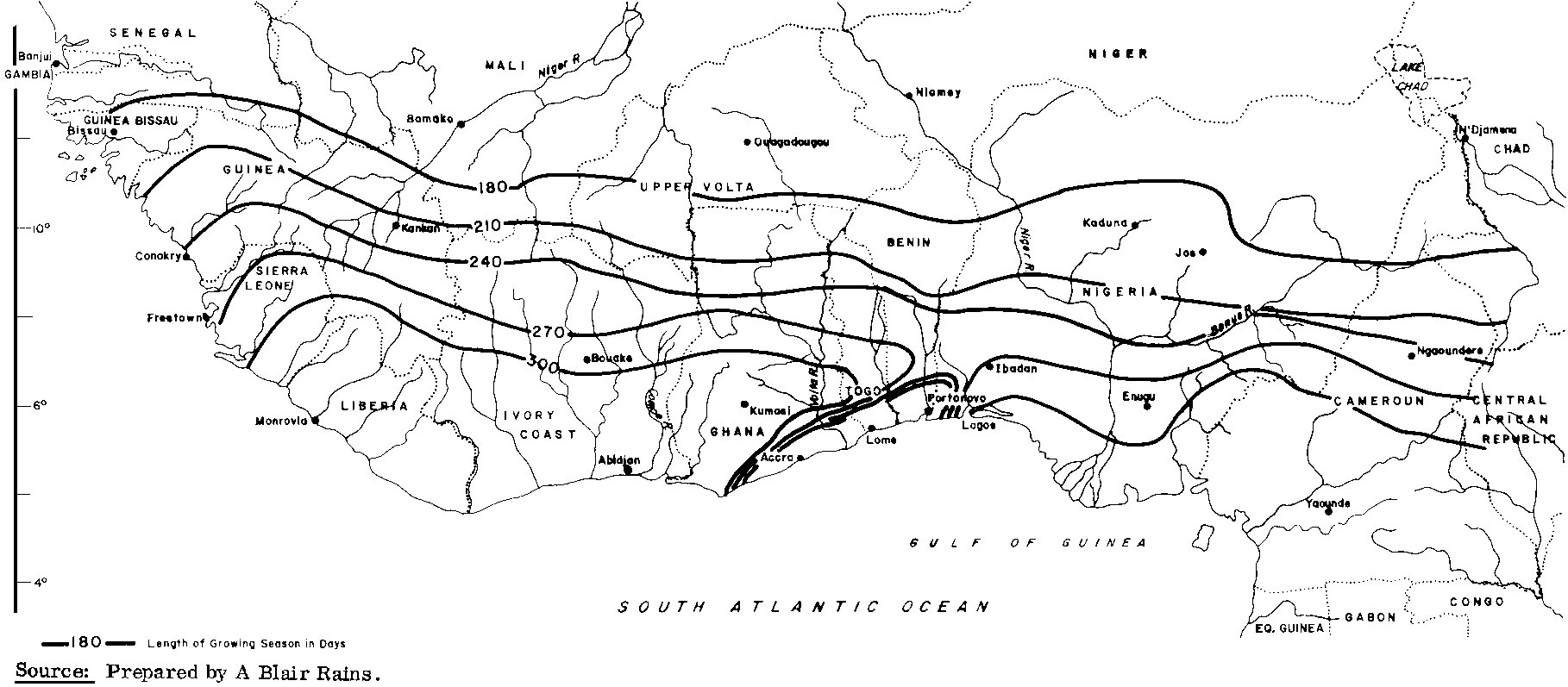
The length of the growing season in the West and Central African region is depicted in Figure 2. The period of active plant growth is estimated by reference to soil moisture. It begins with the rains, as soon as there is adequate moisture in the soil, and continues beyond the rainy season as long as soil moisture is sufficient. De Leeuw calculates the growing season by adding 60 days to the length of the rainy season where soil storage capacity is high (in deep loamy soils, for instance, where storage capacity reaches 200 mm) and only 30 days where storage capacity is low (around 100 mm). As a response to rainfall, the period of plant growth becomes shorter towards the north. Different authors have defined the subhumid zone differently in terms of the length of the growing season, but, for the purpose of this report, the growing season is considered to extend from 180 days in the north to around 270 to 280 days in the south. The climatic parameters derived by de Leeuw for the subhumid zone in Nigeria are shown in Table 2.
Climate also influences the incidence of disease among both human and livestock populations. Climatic factors, such as humidity and temperature, affect the distribution of disease vectors, most notably the different species of tsetse flies which carry human sleeping sickness and animal trypanosomiasis. High temperatures, high relative humidity and exposure to the sun also affect the behaviour of grazing animals and can adversely affect productivity, particularly when animals are maintained outside their usual environment.
Figure 2. Length of the growing season
Table 2. Climatic parameters of the subhumid zone in Nigeria
|
|
North |
South |
|
(11° N) |
(7° N) |
|
|
Mean annual rainfall in mm (P) |
950 |
1 435 |
|
Potential evapotranspiration in mm (Et) |
1 560 |
1 300 |
|
Number of months P greater than Et |
4 |
6 |
|
Length of rainy season (days) |
140 |
225 |
|
Length of growing season (days) |
170 |
255 |
|
Relative humidity less than 30% at 16 00 h (months) |
5-6 |
0-1 |
Source: Derived by P N de Leeuw from Kowal and Knabe (1972).
The subhumid zone consists of extensive platforms and plains generally at an altitude of 200 to 500 m above sea level. Exceptions are the troughs of the Niger and Benue Rivers, the basin of the Volta and parts of Ivory Coast, Guinea Bissau and the Casamance region of Senegal which lie below 200 m, and the Guinea-highlands, the Fouta Djallon and Jos plateaux and the upland areas of eastern Nigeria and Cameroon which lie above 500 m. Certain of the upland areas extend above 1 000 m and are sufficiently distinctive to be excluded from descriptions of the subhumid zone. They are free of tsetse and have supported substantial cattle populations since the beginning of the century or earlier.
Soil Types
D'Hoore (1964) identifies 10 main soil groups in West Africa, but only four of these are of importance in the subhumid zone, comprising together 84% of the surface area. The iron-bearing ferruginous tropical soils which contain iron and aluminium in free form, and the lithosols, which consist of rocks, debris and ferruginous crusts, cover most of the zone, together with transitional types. The distribution of soil types is shown in Table 3.
Table 3. Distribution of soil types in the Guinea and derived savannas of West Africa
|
Soil Type |
Deeper Soils |
Shallow Soils |
Total | |
|
Ferruginous tropical soils |
38 |
23 |
61 | |
|
|
- on sandy parent material |
8 |
- |
8 |
|
|
- on crystalline acid rocks |
27 |
- |
27 |
|
|
- on undifferentiated parent material |
3 |
- |
3 |
|
|
- weakly developed soils on ferruginous crusts and other parent material |
- |
23 |
23 |
|
Ferralitic soils |
7 |
3 |
10 | |
|
Lithosols |
- |
10 |
10 | |
|
Transition soils |
4 |
4 |
8 | |
|
Hydromorphic soils |
5 |
|
5 | |
|
Eutrophic brown soils |
1 |
2 |
3 | |
|
Vertisols |
2 |
1 |
3 | |
|
Total |
57 |
43 |
100 | |
Source: Adapted from Jones and Wild (1975).
The ferruginous tropical soils occur most commonly in the savanna areas below the 1 200 mm isohyet (Jones and Wild, 1975). These soils tend to be shall - often less than 150 cm - and they are characterized by a sandy, often strongly compacted surface horizon which is low in organic matter and base exchange capacity, which may impede drainage.
The ferralitic soils underlie most of the forest zone and the southern edge of the derived savanna. They tend to be deeper, more porous and better drained than the ferruginous tropical soils. When derived from alkaline base material, they are of medium fertility (Davies, 1973).
The transition soils combine properties of the ferruginous and the ferralitic types. They often have the favourable physical characteristics of the ferralitic soils, but are less subject to leaching and thus tend to be more fertile. Lithosols over ferruginous crusts cover large parts of ®al, Guinea, Ghana and Nigeria (Davies, 1973; Jones and Wild, 1975). As Table 3 indicates, these and other shallow and weakly developed soils cover over 40% of the subhumid zone. Descriptions of the less important soil types in the zone may be found in Jones and Wild (1975) and Ahn (1970).
Organic Matter and Soil Nutrients
Savanna soils are characterized by low levels of organic matter. Jones and Wild (1975) analyzed the surface horizon, to a depth of 15 cm, of 245 ferruginous soils and reported an average organic matter content of 1.2%. Organic matter in forest areas tends to be considerably higher. Nye and Greenland (1960), for example, report 4 to 6% organic matter in samples of forest soils taken from Ghana and elsewhere.
Jones (1973) has hypothesized that organic matter in the soils of West Africa is positively correlated with annual rainfall, as expressed in the following formula:
% carbon = 0.137 + 0.000865 xwhere x = annual rainfall in mm.
The carbon content can be related directly to organic matter, since organic matter contains approximately 50% carbon.
Several elements play a role in plant growth and animal nutrition, but the most important is probably nitrogen. In tropical grasslands with a growing season of 150 days or longer, the main limiting factor is not moisture, but probably the availability of soil nitrogen. Nitrogen occurs in several forms, but it is only assimilated by plants as nitrates (NO3) which are found in association with some metals. Organic matter consists of about 5% nitrogen, but the rate at which this nitrogen is converted into nitrates varies under savanna and forest conditions. This process is difficult to examine under natural conditions, but Greenland and Nye (1959) estimate an annual rate of decomposition of organic matter of 0. 5 to 1.2% in grassland savanna soils and 2.5% in forest soils. Charreau and Fauck (1970) estimate an annual decomposition rate of 4.7% in dense savanna woodland. The relatively high yields of herbage obtained in the derived savanna and forest zones reflect the higher levels of organic matter in these soils and its more rapid mineralization, resulting in higher levels of available nitrogen.
In addition to decomposed organic matter, nitrogen is derived from rain water and the fixation of atmospheric nitrogen by symbiotic and free-living bacteria and blue-green algae on the soil surface and in root nodules of legumes. It is estimated that 7 kg/ha of nitrogen are obtained annually from rainfall, about one-third of which is nitrate nitrogen fixed by lightning. The amount of nitrogen contributed by bacterial and algal fixation is more variable, and pasture legumes, with their well-known ability to convert atmospheric nitrogen into nitrates of direct use by other plants, have been introduced as part of pasture improvement strategies only very locally.
Most of the nitrogen ingested by grazing cattle is returned to the soil in urine, but under systems of extensive pastoralism it is estimated that only 5 to 6 kg/ha of urinary nitrogen are returned to the soil annually. Much of this nitrogen is often lost to savanna pastures because animals are penned on arable land at night in order to increase fertility in the soil near homesteads. Total annual increments of nitrogen to the savanna soils have been estimated by Greenland and Nye (1959) to vary from 6 to 12 kg/ha, including nitrogen derived from roots, litter and animal remains and fixed from the atmosphere. At Ejurain in Ghana, however, they estimated an annual increment of 40 kg/ha.
Mineralization and nitrification of organic matter are most rapid following the wetting of the soil after a period of drying: the more severe the drying, the greater the subsequent formation of inorganic nitrogen (Harmsen and Kolenbrander, 1965). But whereas there are marked seasonal fluctuations in the levels of ammonium nitrogen under grassland, the level of nitrate nitrogen remains low throughout the year. This has been attributed to the inhibition of nitrifying bacteria and the competition for ammonia between the bacteria and the plants. Nitrate nitrogen is almost totally absent from Andropogon and Hyparrhenia grassland, even months after land formerly under these grasses has come under cultivation.
As would be expected, the nitrogen and crude protein in the vegetation reflect the level of available soil nitrogen. Thus, most of the nitrogen in plants appears to be absorbed early in the growing season, as a result of the higher levels of nitrogen available in the soil in a wet period following a period of drying. The seasonal decline in nitrogen in herbage is especially marked in the subhumid zone since the grasses are very quick maturing.
In many soils the level of available phosphorus is also low, and this is reflected in the low levels of this element in the herbage. Moreover, in some areas the soils have been permanently damaged by uncontrolled fires and overgrazing. Where sheet erosion has occurred, the sub-surface horizon has sometimes been exposed and hardened irreversibly. In the moister parts of the zone, however, overgrazing tends to lead to hush encroachment rather than to soil denudation.
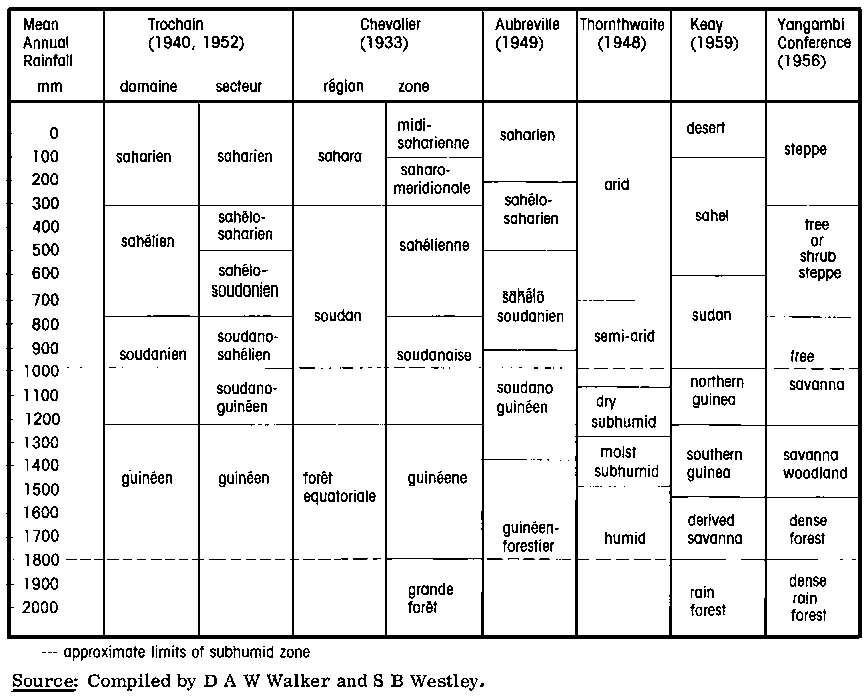
The vegetation of the subhumid zone is determined by a number of environmental factors. These include climate, in particular the amount and distribution of rainfall, or inversely the intensity and duration of the dry season. Vegetation is also influenced by the depth and texture of soils and the availability of soil nutrients, as well as human activities such as burning and cultivation. Because of the dynamic nature of the vegetation cover and its continuing disturbance by man, it is difficult to formulate a general classification of vegetation zones. French and English botanists have also used a variety of descriptive terms. Figure 3 presents two English and three French classifications, together with categories agreed upon at the Specialist Meeting on Phytogeography held in Yangambi, Zaire in 1956.
The woody vegetation ranges from semi-deciduous forest along streams in the savanna zone and in some undisturbed areas of the derived savanna to open tree savanna dominated largely by isolated trees. Tree savanna is very common in the more densely populated areas of Nigeria, Benin, Togo and Ghana. However, in most of the subhumid zone savanna woodland predominates, in particular where shallow soils and tsetse infestation have prevented arable farming. In these areas there are usually 10 to 30 larger trees per ha trees 10 to 15 m tall and more than 30 cm in diameter at breast height), which form a discontinuous upper canopy over small tree and shrub strata which are much denser. Most species are resistant or tolerant to fire (Rose Innes, 1971). They can regenerate from seed or stumps or from underground roots and produce dense coppice regrowth after cutting (Lawson, 1975).
The distinction between the northern and southern sectors of the subhumid zone is better defined in Nigeria than in Ghana or the countries further west. The transition between the two sectors (Keay's northern and southern Guinea zone) is recognized by the relative occurrence of the woody species Daniella oliveri, Prosopis africana and Butyrospermum paradoxum in the south and by Isoberlinia tomentosa, I. doka, Monotes kerstingii and Uapaca togoensis in the north. Grasses are mainly tussocky perennials, especially Andropogon tectorum, Beckeropsis uniseta, Hyparrhenia smithiana and Schizachyrium sanguineum in the south. In the north perennial Andropogon species are common, such as A. gayanus, A. ascinodis and A. schirensis, as well as Loudetia flavida, L. simplex and Elyonurus hirtiflorus.
Figure 3. Classification of vegetation zones in West Africa
Under severe grazing pressure, the perennial species will be replaced by annuals, including Andropogon pseudapricus, A. fastigiatus and, depending on soil conditions, Hyperthelia dissoluta and Loudetia simplex. Local variations also reflect water availability and shade.
The northern boundary of the derived savanna zone is considered by most workers to represent the limits of the original forest, reduced to savanna by shifting cultivation and fire. Remnants of the original forest are now largely confined to forest reserves, although isolated trees are also preserved on farm land. Species include Chlorophora excelsa, Elaeis guineensis and Dialium guineense. Smaller shrubs and trees include Combretum grandiflorum, C. paniculatum and Allophylus africanus, whilst common grasses are Andropogon tectorum, Imperata cylindrica, Pennisetum purpureum and Loudetia arundinacea. A number of other trees of wide ecological range are preserved by farmers because of their edible fruit. These include Parkia clappertonia and Butyrospermum paradoxum. Other species, such as Cussonia barteri, Crossopteryx febrifuga and Bridelia ferruginea, tend to remain because they are relatively fire tolerant.
Overgrazing has already led to ecological degradation to the north of the subhumid zone and the relief of these areas by allowing the pastoralist herds to move further south for longer periods is one of the primary advantages of tsetse eradication and other development programmes in the subhumid zone. Purely pastoral exploitation of the savanna grasslands is unlikely to lead to the same sort of environmental problems, because in the subhumid zone overgrazing leads to bush invasion, rather than pasture denudation, and this in turn makes the area progressively less attractive to pastoralists.
Most of the subhumid zone is also considered suitable for arable farming, and as the population pressure increases and the areas of tsetse infestation are reduced it is to be expected that a substantial proportion of the land now under natural vegetation will come under cultivation. The principal agricultural crops in the northern part of the zone are cereals, particularly sorghum and millet, together with grain legumes and groundnuts. These crops are of major importance for livestock production, as sorghum, late millet and the haulms of the legumes provide valuable fodder for stock. In the south, root crops such as yams, cassava and cocoyams are cultivated, generally on smaller farms. The root crops produce fewer residues which can be used as fodder.
In most areas, farmers are becoming more aware of the value of their crop residues for feeding their own stock or for sale to pastoralists. At the same time, the expansion of cultivation often obstructs the movement of stock to grazing land or water. Damage to growing crops and, in some countries, the unauthorized use of residues frequently result in disputes and litigation. The cultivation of flood plains further reduces valuable grazing land, and the more valuable of the natural grasses are slow to reestablish after cultivation. As cultivation expands in the subhumid zone, strategies must be devised for protecting the soils and the more useful natural plant species and for achieving the closer integration of arable cropping and livestock production.