


A. Abate, D. Kayongo-Male and M. Wanyoike
Department of Animal Production, University of Nairobi
P.O. Box 29053, Nairobi, Kenya
Abstract
Introduction
Types of fodder
Nutritive value
Non-conventional sources of fodder
Factors limiting increased use of fodder crops
Conclusion
References
Fodder crops that are or could be used in the high-potential areas of Kenya for purposes of maximizing animal production are identified and discussed in terms of their nutritive value and efficient utilization by animals. The DM productivity of most of the fodder crops was found to be about five times that produced by a common pasture species such as Rhodes grass (Chloris gayana). Data on in vivo digestibility, intake and performance of livestock when fed fodder are lacking, however, and information on chemical composition is scanty. It is suggested that feed resources be expanded to include crops other than the now well established Napier grass (Pennisetum purpureum) and that the defoliation practiced on maize be tried on other cereal crops. In a multi-disciplinary approach, it was recommended that research be directed towards evaluation of food crops which also double as fodder, and to multipurpose trees and shrubs, for the benefit of farmers in the high-potential areas.
The high-potential areas of Kenya comprise about 15% of the total area of the country. They lie between 1,800 and 3,000 m above sea level and on average receive at least 1,200 mm of rainfall per annum spread in a bimodal pattern (Figure 1). Kikuyu grass (Pennisetum clandestinum) and star grass (Cynodon dactylon) predominate in the natural grass cover. Agricultural activity is intense in holdings that constitute about 55% of the smallholder areas of Kenya (Stotz 1979). Mixed farming is common on farms that average less than 4 hectares. The major crop enterprises include coffee, tea, maize, pyrethrum and horticultural crops. Dairying is important to the extent that about 82% of all the grade dairy cattle in Kenya are kept in the high-potential areas. In addition, there is a sizeable amount of sheep farming.
Increasing population pressure, coupled with a bias towards cash and food-crop production, has seriously limited the amount of land under grazing in these areas. This has led to the development of intensive systems of livestock production which include:
(a) Grazing animals by day and stalling or enclosing them at night to be fed fodder crops and farm by-products in a system known as semi-zero grazing;(b) Feeding animals entirely on fodder crops and crop residues in stalls or enclosed areas in a cut-and-carry system or zero-grazing.
Figure 1. DISTRIBUTION OF THE HIGH POTENTIAL AREAS. (1200-2000 mm rain p.a.) OF KENYA
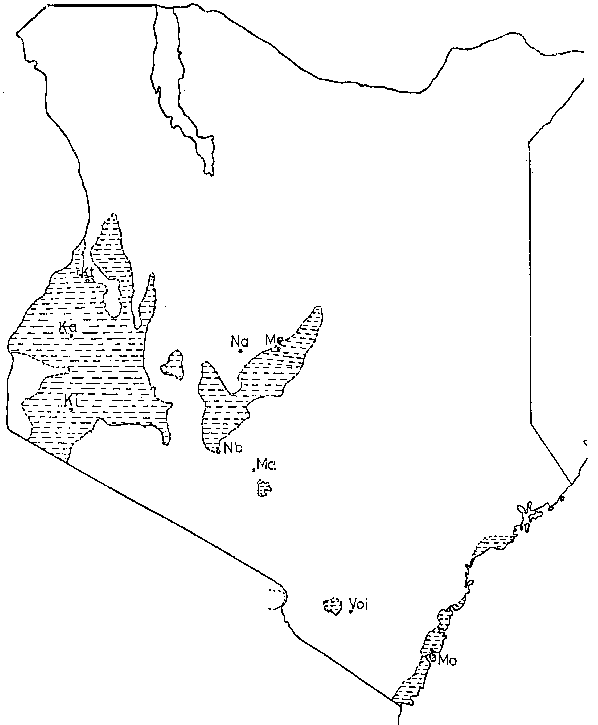
Key
Kt - Kitale
Ka - Kakamega
Na - Nanyuki
Me - Meru
Nb - Nairobi
Ma - Machakos
Mo - Mombasa
Fodder, therefore, is that forage that is fed to animals in confinement. It is the intention of this presentation to examine those fodder crops that are or could be used in the high-potential areas for the purpose of maximizing animal production.
In the classification given in Table 1, an attempt has been made to distinguish between crops that are grown primarily for fodder and those whose contribution to fodder is secondary. Accordingly, we have the following main classes:
Table 1. Productivity and nutritive value of fodder for the high-potential areas of Kenya
|
|
Productivity (tonnes DM ha-1 y-1) |
Crude protein (g kg-1 DM) |
Crude fibre |
Ca |
P |
(MJ kg-1 DM) |
|
|
Pure fodder cross |
|||||||
|
|
Napier grass |
12.6a |
128 |
354 |
3.6 |
1.8 |
6.7 |
|
|
Bana grass Sudan grass |
9.0a |
127 |
394 |
5.2 |
4.2 |
- |
|
Tree legumes |
|||||||
|
|
Leucaena leucocephala |
- |
260 |
233 |
- |
- |
- |
|
|
Sesbania sp. |
- |
280 |
172 |
- |
- |
- |
|
|
Gliricidia sp. |
- |
260 |
- |
- |
- |
- |
|
Other fodder crops |
|||||||
|
|
Green maize |
20-26 |
180 |
580 |
- |
- |
- |
|
|
Forage sorghum |
- |
78 |
161 |
0.5 |
3.4 |
10.4 |
|
|
Pigeon peas |
15-18 |
200 |
262 |
8.7 |
8.2 |
- |
|
|
Cassava tops |
10-30 |
270 |
240 |
2.6 |
1.8 |
- |
|
|
Banana leaves |
- |
160 |
200 |
5.8 |
1.8 |
9.6 |
|
|
Sugarcane tops |
- |
47 |
303 |
- |
1.5 |
6.8 |
|
|
Sweet-potato vines |
14-16 |
234 |
169 |
14.2 |
3.3 |
8.9 |
a Per havest
Pure Fodder Crops
The Ministry of Agriculture recognized the highly productive nature of Napier grass (Pennisetum purpureum) and launched a scheme for its popularization (Cinema 1984). Napier grass has now become the key fodder crop among smallholders practicing stall feeding. It is intercropped with coffee and grown in all areas unsuitable for grazing and/or production of food and cash crops, including road sides and river banks. The other fodder crops have received less attention, but some, such as Sudan grass (Sorghum sudanense), have shown potential under similar production conditions. Available-data in Kenya suggest an annual increase of area under fodder of about 17.0% (MLD 1978).
Multipurpose Trees/Shrubs
The multipurpose trees and shrubs identified so far are the legume trees. The practice has been to use them as hedgerows dividing cultivated fields, to cultivate them as shade trees and windbreaks around homesteads, and to grow them specifically to provide firewood.
Recently, however, farmers have become aware of the high fodder-producing potential of tree legumes and have been particularly keen on feeding Leucaena leucocephala leaves and pods to sheep and dairy goats (Russo 1984).
Other Fodder Crops
The crops in this category are grown primarily for human-food production, but their ability to produce forage in the form of leaves and pods is considerable. Sorghum and maize may be harvested before ear formation and fed as such or after ear formation and conserved by ensiling, except that in smallholder farms scarcity of resources does not allow for conservation even in periods of plenty. Pigeon peas and cassava plants have the added advantage of being drought-resistant. Sweet-potato vines are already widely fed, while banana leaves and pseudostems alleviated the severe shortage of feed in the last drought period of 1984.
The nutritive value of feed for livestock is determined by its content of dry matter, crude protein and crude fibre, digestibility of organic matter and the voluntary intake of ME and the other nutrients (Abate et al 1984). For milking animals, the concentration of calcium and phosphorus is also important (Underwood 1979).
Table 1 gives some of these data for some of the fodder crops listed earlier. It shows that the dry-matter productivity of most of the fodder craps is about five times that of a common pasture species such as Rhodes grass (Chloris gayana). Except for sugarcane tops and forage sorghum, the crude-protein content is well above the 7% level known to limit the intake of tropical forage (Milford and Minson 1966). The concentration of macro-elements seems sufficient to support lactation if the fodder is appropriately supplemented with minerals.
There is hardly any information on in vivo digestibility, intake and performance of livestock when fed fodder. There is, therefore, a great need to investigate these parameters to provide more data.
The non-conventional methods of obtaining fodder have been developed as a result of efforts to integrate crop and animal production with benefits to both. The methods that have been tried or seen to be practical by farmers in the high-potential areas are mainly with maize varieties of the 500 and 600 series. The methods of interest include topping, thinning and defoliation.
Topping involves cutting off the top of the maize plant above the ear. It is known to be practiced by some farmers in the Central Province of Kenya but definitive scientific data are lacking-. There are suggestions that maize plants should be topped at 3.5-4.5 months of growth but the effect of the material so harvested on animal production is not known. It has, however, been reported that topping reduces grain yield by 15%, a figure which is biologically, socially and economically substantial (Russo 1984).
Thinning is reduction of a high population of maize plants per unit area. The recommended plant population for the 500 and 600 hybrids is about 44,500 per ha. Farmers who practice thinning achieve higher plant densities either by closer spacing or by planting more seeds than the usual two per hole. When plants are knee high, or between 4 and 6 weeks old, the excess plants are removed and fed to animals. The dry-matter content of thinned maize plants is low (1012%) and this could lead to digestive problems or scouring. Moreover, a farmer would thin only once, and therefore would have to face the problem of storing a bulky material with a high moisture content.
To defoliate is to deprive a plant of leaves prematurely. With maize, our experience has been that systematic picking of one leaf per plant once a week produced between 1.0 and 1.2 tonnes of dry matter per ha in a season. The best times to start plucking the leaves varies from 90 to 120 days post-emergence depending on location, but generally can be said to be about 30 days after silking. Since a large proportion of maize in Kenya is grown in the high-potential areas, defoliation is an attractive method of increasing animal resources. The cost of labour involved in collecting the material is also minimal. In one hour an individual can collect about 7.0 kg dry matter which can feed six mature sheep in a day.
The quality parameters of fresh maize leaves are given in Table 2. The data show that maize leaves posses nutritional characteristics that can support ruminant animal production better than the commonest fodder crop in the high-potential areas (Table 3).
Table 2. Average quality of defoliated maize leaves
|
Parameter |
Mean (%) |
|
Crude protein |
12.6 |
|
Acid detergent fibre |
43.0 |
|
Acid detergent lignin |
7.4 |
|
Dry-matter digestibility |
56.8 |
Table 3. Performance of sheep and cattle when fed fresh maize leaves or Napier grass
|
|
Sheep |
Cattle |
|
|
Fresh maize leaves |
Napier grass |
Fresh maize leaves |
|
|
Initial weight (kg) |
20.2 |
21.0 |
68.3 |
|
Final weight (kg) |
29.8 |
24.9 |
87.2 |
|
DMI, gd |
890.0 |
690.0 |
2,660.0 |
|
ADG, g |
136.0 |
48.0 |
336.0 |
|
FCE |
6.5 |
14.0 |
7.9 |
Defoliation has not been widely adopted by farmers in the high-potential areas, probably because there are certain problems associated with it. These are:
(a) Defoliation causes loss in grain yield. By some estimates, up to 25% of the yield may be lost if defoliation is not properly done. Thus the time to start defoliating and frequency of defoliation need precise definition by location and variety in order to minimize grain loss.(b) There seems to be a relationship between defoliation and increased lodging. The factors contributing to this have not been quantified but appear to be a combination of poor root development, stem elongation, poor stem lignification and force exerted on the plant during defoliation. However, research at the Department of Animal Production, University of Nairobi seems to support these physical factors as being connected with lodging.
(c) Like everything that depends on rain for its growth, fresh maize leaves are available only during the growing season when grazing is also plentiful. Methods of preserving excess material, therefore, need to be developed. In the Department of Animal Production, the following methods of conservation have been tried on a pilot basis: sun drying, shed drying, and blanching coupled with sun drying. The first two methods would be appropriate for the smallholder in the high-potential areas. Blanching has an energy requirement and would be expensive.
Excepting Napier grass, the use of fodder in the high-potential areas of Kenya has not been widely practiced. A number of constraints can be invoked to explain this.
Population Pressure
In the smallholdings, a high population density of 8-10 persons per 12 ha implies that the demand for food far outweighs the desire of farmers to meet the feed requirements of their stock. The situation is aggravated by sub-division of land into ever smaller plots which means the space that could be used for growing fodder is progressively diminishing. We foresee even smaller holdings due to the high population growth rate, quoted at 4% per annum (Republic of Kenya 1981); and a shifting of the small-scale farmer's attention-towards growing dual-purpose food crops and multipurpose trees and shrubs, leaving pure fodders to the large-scale farmers.
Research Information
The volume of past research on the agronomic aspects of high-potential-area fodders is small. But more important, the limited information available is not being disseminated to the farmer quickly enough and in a form that he can immediately utilize. Research needs to identify the type of material to plant in accordance with the climatic and soil properties and the fertilization practices of a given locality. Equally, optimum harvesting time needs investigating so that harvesting is done when dry matter and the nutritive value of the forage are at their optimum. The dry-matter producing capacity of materials planted on the small-scale farms should be quantified. Factors such as cutting height, frequency of cutting and methods of feeding require studying as they affect the acceptability and efficiency with which the fodders can be utilized. Appropriate intermediate technology needs to be developed for the small-scale farmer to enable him to process his fodder and ensure maximum intake or to allow him to conserve it for dry-season use. The results of such research should then be communicated to the array of agricultural extension workers in the field.
Labour
Labour on a mixed farm in the high-potential areas would be required to cut and carry forage, manage the animals and ensure an adequate water supply, among other requirements. The demand for labour is particularly intense in the zero-grazing system during planting and weeding of fodder, which also coincides with the peak labour requirements for other crops.
The labour constraint to the use of fodder is very much tied to the farm size. Studies undertaken in Kenya suggest that zero-grazing was justifiable only where the returns to increased output of surplus family labour were greater than the would-be income from off-farm employment. This phenomenon obtained in the small farms but capital inputs were frequently lacking. For larger holdings, zero-grazing was less attractive because labour resources were in short supply (Stotz 1979).
Management Problems
In many cases forage yields from planted fodder crops are low because repeated harvesting depletes the soil of nutrients which are then not replenished. Farmers should, therefore, be educated on the value of fertilizer application for increasing crop production and be advised to practice it either using chemical fertilizers, or more appropriately, manure which would also improve the texture of the soil.
In addressing ourselves to problems of fodder production in the high-potential areas of Kenya, we have taken note of the positive contribution of Napier grass. Its dry-matter productivity is phenomenal. But there are gaps to be filled in terms of agronomic practices that would go a long way towards ensuring even higher practices that would go a long way towards ensuring even higher productivity and more efficient utilization by animals. We have also been careful to point out that availability of land may not favour the growing of pure fodder crops especially if the present annual population growth rate of 4% is maintained. We are suggesting, therefore, a fresh look at potential fodder-producing crops and an aggressive research commitment to their evaluation. This is in line with Government policy as spelled out in sessional Paper No. 4 of 1981 on national food policy which urges an intensification of land utilization for food and livestock production so that energy and protein in excess of the national average per caput nutritional requirement may be produced. In particular, we mentioned food crops which also double as fodder, and multipurpose trees and shrubs. There is also need to popularize the defoliation, topping and thinning practices that have been applied on maize and to extend them to other cereal crops. Such an approach would, we believe, benefit farmers in the high-potential areas of Kenya and beyond in the wider context of agricultural development in Africa.
Abate, A., Kayongo-Male, H., Abate, A.N. and Wachira, J.D. (1984). Chemical composition, digestibility and intake of Kenya feedstuffs by ruminants: a review. Nutrition Abstracts and Reviews 54: 1-13.
Chema, S. (1984). Milk production in Kenya. In: J.A. Kategile (ed.). The potential for small-scale milk production in Eastern and Southern Africa. Proceedings of a workshop held in Nairobi, Kenya, 19-21 September.
Kenya, Republic of. (1981). Sessional Paper No. 4 on National Food Policy. Government Printer, Nairobi.
Milford, R. and Minson, D.J. (1966). Intake of tropical pasture species. Proceedings of the 9th International Grassland Congress, Sao Paulo, pp. 815-822.
MLD (Ministry of Livestock Development). Animal Production Division Annual Report. Government Printer, Nairobi.
Russo, S. (1984). Feed production research for smallholder agriculturists in Western Kenya. In: Report of a networkshop on draught power and animal feeding in Eastern and Southern Africa. Ezulwini, Swaziland, 4-6 October 1983.
Stotz, D. (1979). Smallholder dairy development in past, present and future in Kenya. Ph.D. Thesis, University of Hohenheim.
Underwood, E.J. (1979). The Mineral Nutrition of Livestock (2nd ed.) Commonwealth Agricultural Bureau.
