


J.F.M. Onim, P.P. Semenye and H.A. Fitzhugh
Winrock International Institute for Agricultural Development
SR-CRSP, P.O. Box 252, Maseno, Kenya
M. Mathuva
Ministry of Agriculture & Livestock Development
P.O. Box 252, Maseno, Kenya
Abstract
Introduction
Materials and methods
Results and discussion
References
The paper discusses the history of land-ownership patterns and agro-ecological zonation which have provided the basis for the complex smallholder farming sector in Kenya. Evidence is presented for the availability and costs of feeds being major constraints to improvement in levels of production, both per animal and nationally, for all livestock classes. Specific detailed consideration is given to the feeding of dairy cattle on the prevailing small, mixed farms, due to the national policy of expansion of local milk production to raise the level of human nutrition in general, and school children in particular. The difficulties associated with the high densities of population of both people and livestock, low feed availability and competition for resources with arable enterprises are among the constraints discussed in relation to possible feeding systems. The second half of the paper contains details of the latest available data on on-farm availability and possible future options and trends for ruminant feed supply on the small farm in Kenya. Fodders and pastures, on-farm and industrial by-products, bought-in roughages and concentrates are discussed in turn.
The relevance of the recent Kenya experience to future trends in smallholder livestock production systems in other countries of sub-Saharan is emphasized.
Small-scale farmers in Kenya own between 1 and 4 ha of land (Jaetzold and Schmidt 1982). The land use is divided among food and cash crops and livestock. The livestock on these farms may include cattle, sheep, goats, donkeys and poultry. The main sources of feeds for small-scale farmers are:
1. Communal grazing land;
2. Fallow land on farms;
3. Feeds from food-feed crops; and
4. Crop residues (Onim et al 1984).
Due to very high population densities, up to 900 people/km² in some areas (such as western Kenya), sub-division of farms has substantially reduced pasture and fallow lands to the extent that cattle populations in those areas are diminishing rapidly (Russo et al 1983). Lack of adequate grazing land has led to intensive management methods such as tethering and zero-grazing. This situation has also led to more farmers reverting to small ruminants instead of cattle because smallstock require less forage and are therefore more adapted to the scarce and erratic feed supplies on small-scale farms.
Several methods have been developed to improve feed supplies on small-scale farms. These include estimating feed values of common plant species consumed by goats (Otieno et al 1984), total feed production capabilities of pastures and small-scale farms (Onim, Hart, Russo, Otieno and Fitzhugh 1984), potential of intercropping food with feed crops to increase livestock feeds (Onim, Hart, Otieno and Fitzhugh 1984) and the potential of food-feed crops (Onim et al 1984).
This paper reports results of experiments and surveys on the potential of simplified hay baling, roadside and fallow-land pastures, sugarcane tops and sesbania (Sesbania sesban var. nubian) as sources of livestock feeds under intensive management in small-scale farms.
Productivity and Pasture Quality of Roadside and Fallow Lands
In order to estimate forage productivity and quality of roadside and fallow lands in western Kenya, forage sampling and analyses were done. A quadrat measuring 80 x 80 cm was randomly thrown on to representative parts of the pasture. The enclosed vegetation was clipped and weighed fresh. Later oven-dry weights were recorded. Sub-Locations, Locations, Districts and altitudes of the sites where the samples were collected were recorded. This survey was conducted from Kapsabet town at an altitude of 2,000 m to Asembo Bay on Lake Victoria at 1,190 m. A similar procedure was used to sample farms in three research areas once a month for 12 months.
Other feed resources on the farms were also estimated. These included crop residues, fence and hedgerow cut-and-carry, and crop thinnings and leaf strippings. The samples were analysed for neutral detergent fibre (NDF), acid-detergent fibre (ADF), acid-detergent lignin (ADL), hemicelluloses (HC), and crude protein (CP).
Goats have also been observed while grazing or tethered in the same pastures and the plants that they ate were recorded. Plant parts that they consumed were clipped and analysed for CP.
Simplified Hay Baling for Small-Scale Farmers
The extra feed produced from the new feed interventions and during the rainy season is often grazed down as soon as supplies begin to become scarce. It is important, therefore, that farmers find a suitable preservation method that could help them to carry over the surplus feeds to the periods with deficits. Since attempts to devise successful silage-making techniques for small-scale farmers in western Kenya have not been successful at Maseno, a hay-baling experiment was initiated.
Several high-yielding forage legume and grass species that are grown by the SR-CRSP respondent farmers in western Kenya were used. These included Sesbania (Sesbania sesban var. nubian), pigeon pea (Cajanus cajan), leucaena (Leucaena leucocephala), bane grass which is a cultivar from a cross between Pennisetum purpureum and P. typhoides, Sudan grass (Sorghum sudanense) and mixed grasses from fallow land and pastures. The mixed grasses mainly comprised star grass (Cynodon dactylon), couch grass (Digitaria scalarum), congo signal (Brachiaria ruziziensis), Rhodes grass (Chloris gayana) and a few minor forage legumes such as Glycine spp. and Desmodium spp.
Except for Sesbania and leucaena the other forages were cut in the morning from around 8.00 a.m. and allowed to dry in the field. Sesbania and leucaena were cut and the branches were placed on polythene sheets onto which drying leaflets dropped. The average air temperatures in the sun were taken at 10.00 a.m., 12 noon and 2.00 p.m. Fresh sub-sample weights of each forage were determined as soon as it was cut, and thereafter every 2 hours for 10 hours. Wooden baling box measuring 85 cm x 55 cm and 45 cm deep was used for making bales. These dimensions were chosen in order to make a well pressed bale that weighs 20 kg. This is the average weight of a commercial grass-hay bale. Sisal twine strings were placed lengthwise and crosswise in the baling box. The number of strings placed varied according to the nature of the hay to be baled. The short-straw grasses, for example, needed more lines of twine than long-straw types. The hay was placed over the strings in the baling box until it was full. The hay was then compressed by one man jumping on it. With the help of an assistant, the strings were tightly tied. The finished bale was then pulled out and stored in a bale barn for six months.
Crude protein (CP) of fresh forages in this experiment were estimated. CP values were again estimated six months later.
Supplementation with Energy and Protein Sources
In western Kenya, farmers supplement the forages that the livestock consume in pastures and under tethering with cut-and-carry and purchased forages. Experiments with various legume fodders have been conducted.
Experiments with Legume Fodders as Supplements
Intercropping pigeon pea (Cajanus cajan) and Sesbania (Sesbania sesban var. nubian) with maize (Zea mays) was tried in four sites, Kaimosi, Hamisi, Maseno and Siaya, in 1983 and 1984. DM yields and CP contents of these forages were estimated. Leucaena (Leucaena leucocephala) and gliricidia (Gliricidia sepium) were planted in pure stands at Maseno Research Station and the same parameters were estimated.
Purchased Fodders as Supplements
Zero-grazing is a common practice in densely populated areas of Central, Nyanza and Western Provinces. When farmers are short of planted fodder they often purchase from the open market. A survey was therefore conducted around Maseno to determine which fodders were sold and at what prices.
Market fodders were purchased and weighed before the plant parts that could be consumed by sheep and goats were separated and reweighed. These were then dried in an oven before DM was recorded. Quality analyses for the market samples will be done later.
Productivity and Pasture Quality of Roadside and Fallow Lands
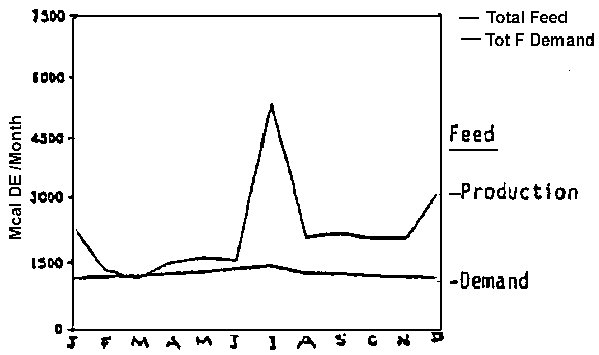
Feed production figures for a 1.5 ha farm in Masumbi, Siaya District taking into account communal grazing, fallow land, crop residues and hedgerow cut-and-carry forages are presented in Figure 1.
The demand line represents feed requirements of the livestock of an average household (e.g. three cows with calves, four sheep and three goats). The production line represents digestible-energy (DE) fluctuations through the year. These results show that feed deficits occur from January to May. Surpluses are realized during the rainy season from May to December.
The dominant plant species that the goats consumed in roadside and fallow-land pastures are given in Table 1.
Table 1. Crude-protein content of promising feeds consumed by goats in western Kenya
|
Forage/feed |
CP % |
|
|
Grasses |
||
|
|
Sorghum sudanense |
14.1 |
|
|
Brachiaria brizantha |
16.2 |
|
|
Digitaria scalarum |
13.2 |
|
|
Cynodon dactylon |
21.7 |
|
Mean |
16.3 |
|
|
Common weeds |
||
|
|
Bidens pilosa |
21.0 |
|
|
Lantana camera |
24.1 |
|
|
Galinsoga sp. |
14.4 |
|
|
Amaranthus sp. |
32.5 |
|
|
Commelina sp. |
26.3 |
|
|
Argemone mexicana |
18.3 |
|
|
Leonotis mollisim |
25.2 |
|
|
Tagetes minute |
26.8 |
|
Mean |
23.6 |
|
Figure 1. An average year-round feed production and demand on a 1.5 ha farm in Masumbi, Siaya, western Kenya
Source: Onim, Hart, Russo, Otieno and Fitzhugh (1984)
The grasses had a mean CP of 16.3%, with star grass showing a high value of 21.7%. Common weeds had an average CP level of 23.6%, with several individual species having very high levels. These included Amaranthus (32.5%), Tagetes minuta (26.8%), Leonotis mollisima (25.2%), Lantana camera (24.1%) and Bidens pilosa (21.0%). These protein values indicate that when livestock graze in these pastures and get enough DM to consume, they get adequate CP and DE.
The effect of altitude on fibre and CP content of roadside and fallow-land pastures in western Kenya is shown in Table 2. There were no altitudinal effects on NDF and ADF, but ADL increased by an average of 1% with every 20 m drop in altitude. This indicates that plant species in lower altitudes had a higher lignin content and hence were of poorer quality as forage. However, RC increased with altitude at the rate of 1% CP for every 60 m. These results indicate that lower areas in western Kenya have poorer pastures than higher ones. We have also shown that food-crop DM yields are five times greater at an altitude of 1,800 m compared to 1,200 m. Rainfall seems to be the main factor here.
Table 2. Effect of altitude on the mean fibre and CP content of roadside and fallow-land pastures in western Kenya
|
Sample size
|
District
|
Altitude (m) range
|
Fibre (%) |
||||
|
NDF |
ADF |
ADL |
HE |
CP |
|||
|
3 |
Nandi |
1,865-1,965 |
67.3 |
24.3 |
4.6 |
42.7 |
16.0 |
|
1 |
Nandi |
1,765-1,865 |
77.0 |
30.8 |
11.8 |
46.2 |
20.7 |
|
12 |
Kakamega |
1,665-1,765 |
80.8 |
32.2 |
11.6 |
41.9 |
12.2 |
|
2 |
Kakamega |
1,565-1,665 |
68.3 |
34.3 |
7.9 |
36.5 |
7.5 |
|
2 |
Kakamega |
1,465-1,565 |
57.9 |
26.7 |
10.1 |
31.2 |
12.7 |
|
4 |
Siaya & Kisumu |
1,365-1,465 |
63.8 |
33.4 |
12.0 |
30.4 |
10.3 |
|
1 |
Siaya & Kisumu |
1,265-1,365 |
74.3 |
35.3 |
14.5 |
39.0 |
15.4 |
|
2 |
Siaya & Kisumu |
1,165-1,265 |
75.3 |
37.3 |
12.6 |
38.3 |
10.0 |
Simplified Hay Baling for Small-Scale Farmers
The rate of moisture loss by the various grasses varied. The three legumes - leucaena, sesbania and pigeon pea - dried fastest. On average, these three lost moisture at the rate of 66% in the first four hours of drying compared to 46% for Sudan grass and mixed grasses. This difference was caused by differences in leaf sizes and structure. The legumes have compound leaves, while both sesbania and leucaena have compound bipinate leaves and pigeon pea has simple trifoliate leaves. The leaflets in both sesbania and leucaena are small and thin, while those in pigeon pea are larger and thicker. The stems and twigs of the legumes were not considered part of the hay being made. However, the legumes were not considered part of the hay being made. However, in the grasses, leaves and stems were dried as hay. Since stems were thicker than leaves, they slowed down drying in grasses. Slow drying was most marked in bane and Sudan grasses which had thick stems. It was interesting to note, however, that although Sudan grass did not have as thick stems as bane, it had the slowest drying rate.
Since the moisture content of hay should be around 15%, these results indicated that the three legumes should be dried for six hours, bane and mixed grasses for eight hours and Sudan grass for more than ten hours. These drying times will increase on days when sunshine is inadequate.
The CP values and percentage changes in CP of the fresh forages and six-month-old hays are presented in Table 3. These results show interesting differences between grasses and legumes. The CP of Sudan grass did not change from fresh to six-month-old hays. That of bane grass showed a slight increase (11.1%) and that of mixed grasses showed slight decrease (8.7%). The changes in the three legumes are, however, much larger. Leucaena showed a CP drop of 27.4% in six-month-old hay as compared to the fresh forage. Jones and Megarrity (1983) have reported that the poisonous protein mimosine constitutes between 3 and 5% dry weight of leucaena. This protein is believed to disintegrate upon drying, rendering dry leucaena less poisonous. It is possible that these changes may be associated with the observed reduction of CP in leucaena hay after six months of storage.
CP in both pigeon pea and sesbania increased by more than 30% fresh forage to six-month-old hay (Table 3).
Table 3. Crude-protein content of forages and their hays
|
Species |
% CP in fresh forage |
% CP in 6-month-old hay change |
% CP + - |
|
Sudan grass |
13.8 |
13.4 |
-2.9 |
|
Bana grass |
14.4 |
16.0 |
+11.1 |
|
Mixed grasses |
10.3 |
9.4 |
-8.7 |
|
Leucaena |
26.6 |
19.3 |
-27.4 |
|
Pigeon pea |
28.2 |
36.7 |
+30.1 |
|
Sesbania |
26.9 |
36.0 |
+33.8 |
This increase indicates that some changes occurred in the plant tissue as it dried or during storage that favoured increased synthesis of CP. Fungal growth could be a plausible explanation, but both hays dried fast and maintained a moisture content of only 4% throughout storage, thus minimizing this possibility. This observation requires further investigation, perhaps with the inclusion of other legumes. It would be beneficial to livestock not only to be fed the hays during the dry season but also to be able to utilize a better quality feed even than that used during the wet season.
Supplementation with Cut-and-Carry and Purchased Forages
Farmers in western Kenya do not only supplement their livestock with cut-and-carry forages from hedges and planted fodders, but also with forages purchased from the markets. Some of the weeds and planted forages that farmers use as cut-and-carry were presented in Table 1. The results show that if livestock consume adequate DM, then their protein requirements will also be supplied. It is interesting to note that farmers specifically select and cut forages that are liked by the livestock and these are usually those with high protein levels. An example of such a species is Leonotis mollisima.
Another interesting species is sesbania. Farmers in western Kenya save it when they are weeding their food crops. The leaves which are 26% CP, are consumed by goats, sheep and cattle and are also believed to have medicinal uses. Sesbania roots fix up to 600 kg N/ha/yr and the stems provide fuel wood estimated at 40-60 t/ha. Sesbania leaves make an excellent protein supplement for livestock.
The types of forage purchased from the markets near Maseno are presented in Table 4.
Table 4. Partitioning of DM of purchased forages into consumable and unconsumable portions of small ruminants
|
Date
|
Types of forage
|
Total DM (kg)
|
% DM of purchased sample |
|||
|
Cattle |
Sheep and goats |
|||||
|
Consumable |
Unconsumable |
Consumable |
Unconsumable |
|||
|
17.10.85 |
Sugarcane tops |
5.08 |
2.45 |
2.63 |
34.44 |
17.89 |
|
17.10.85 |
Sugarcane tops |
4.10 |
1.82 |
2.28 |
27.96 |
17.26 |
|
17.10.85 |
Napier grass |
1.49 |
0.92 |
0.57 |
30.58 |
14.19 |
|
6.11.85 |
Napier grass |
2.45 |
1.97 |
0.49 |
16.97 |
10.63 |
|
17.10.85 |
Green maize stover |
4.14 |
3.38 |
0.76 |
19.99 |
10.75 |
|
6.11.85 |
Green maize stover |
4.05 |
2.86 |
1.19 |
24.46 |
15.85 |
|
6.11.85 |
Green maize stover |
4.28 |
2.68 |
1.60 |
25.16 |
16.97 |
|
17.10.85 |
Mixed riverside grasses |
1.57 |
1.57 |
- |
2.35 |
- |
|
24.10.85 |
Mixed riverside grasses |
4.01 |
4.01 |
- |
28.64 |
- |
|
23.10.85 |
Mixed riverside grasses |
4.16 |
4.16 |
- |
33.31 |
- |
For small ruminants, the consumable portion of the purchased green maize stover, Napier grass, and sugarcane tops constitutes approximately 50%. For cattle, the whole sample can be consumed if it is chopped up. All mixed riverside and roadside grasses can be consumed by both smallstock and cattle. DM in the leaves about twice that in the young stems of maize, Napier grass and sugarcane tops.
Prices that the farmers pay for DM/tonne of the purchased forages are presented in Table 5.
Mean prices for portions consumable by small ruminants of sugarcane tops, Napier grass, green maize stover and mixed grasses were Sh 2,394, 3,443, 1,599 and 2,270 tonne DM, respectively. Although few farmers purchase fodder from the market, those who do so pay very dearly for it. These prices make such fodder crops attractive to grow, although there is only a small market for them at the moment.
Since sugarcane is widely grown in western Kenya and the tops are not utilized for livestock feeding, we felt it would be useful to estimate feed values of 10 top commercial sugarcane varieties. The results, presented in Table 6, show that most of the varieties have a very high fibre content.
Table 5. Costs of purchased forages on DM basis
|
Type of forage
|
Sample DM (kg)
|
Price of sample (Sh)
|
Price/tonne (KSh) |
|
|
Consumblea |
All |
|||
|
Sugarcane tops |
5.08 |
5.00 |
2,040.80 |
984.25 |
|
Sugarcane tops |
4.10 |
5.00 |
2,747.25 |
1,219.50 |
|
Mean |
5.50 |
5.00 |
2,394.00 |
1,101.90 |
|
Napier grass |
1.49 |
4.00 |
4,347.80 |
2,684.60 |
|
Napier grass |
2.45 |
5.00 |
2,538.10 |
2,040.80 |
|
Mean |
1.97 |
4.50 |
3,442.95 |
2,462.70 |
|
Green maize stover |
4.14 |
4.00 |
1,183.40 |
966.20 |
|
Green maize stover |
4.05 |
5.00 |
1,748.25 |
1,234.60 |
|
Green maize stover |
4.28 |
5.00 |
1,865.70 |
1,168.20 |
|
Mean |
4.16 |
4.67 |
1,599.12 |
1,123.00 |
|
Mixed riverside grasses |
1.57 |
3.00 |
1,910.80 |
1,910.80 |
|
Mixed riverside grasses |
4.01 |
10.00 |
2,493.80 |
2,493.80 |
|
Mixed riverside grasses |
4.16 |
10.00 |
2,403.85 |
2,403.85 |
|
Mean |
3.25 |
7.67 |
2,269.50 |
2,269.50 |
a By sheep and goats
Table 6. In vitro digestibility, fibre and CP content of the top 10 commercial sugarcane varieties in western Kenya
|
Variety
|
Fibre (%) |
|||||
|
NDF |
ADF |
ADL |
HC |
IVD (%) |
CP (%) |
|
|
EAK7076 |
70.0 |
40.5 |
11.1 |
29.5 |
49.3 |
7.4 |
|
CO421 |
75.5 |
41.1 |
5.5 |
34.1 |
42.6 |
7.4 |
|
EAK69-40 |
92.5 |
57.6 |
7.9 |
34.9 |
47.7 |
8.7 |
|
EAK71-183 |
75.8 |
37.4 |
8.9 |
38.3 |
45.5 |
8.0 |
|
EAK7079 |
74.8 |
37.8 |
5.4 |
36.9 |
41.7 |
8.7 |
|
CO421 |
78.3 |
46.9 |
9.0 |
26.4 |
54.8 |
7.0 |
|
CO617 |
74.6 |
43.9 |
7.0 |
30.7 |
42.0 |
9.3 |
|
EAK6941 |
73.1 |
37.5 |
3.7 |
35.7 |
38.9 |
6.7 |
|
EAK71-420 |
73.1 |
39.2 |
3.6 |
33.9 |
46.6 |
6.7 |
|
CO1148 |
74.5 |
43.8 |
6.5 |
30.7 |
36.4 |
6.0 |
Their IVD values are also very low, and variable. In this regard it would seem that varieties 00421, EAK7076 (49.3%) and EAK69-40 (47.7%) may have some potential as fodder. CP levels of 7.6% were fairly low. However, because of the abundance of cane tops in western Kenya, they can be supplemented with cheap energy sources such as molasses and protein-rich sesbania to constitute an excellent feed not only for small-scale farmers even for fattening and in feed-lots.
Jaetzold, R. and Schmidt, H. (1982). Farm Management Handbook Vol. II National Conditions and Farm Management Information. Part A, West Kenya (Nyanza and Western Provinces), pp. 267-357.
Onim, J.F.M., Hart, R., Russo, S., Otieno, K. and Fitzhugh, H.A. (1984). Potential of intercropping forage crops with maize in western Kenya. Proceedings of the Third SR-CRSP Kenya Workshop, Kabete, Nairobi, 5-6 March, pp. 65-74.
Onim, J.F.M., Mathuva, M., Otieno, K., Hart, R. and Fitzhugh, H.A. (1985). Potential of food-feed crops in western Kenya. Proceedings of the Fourth SR-CRSP Kenya Workshop. Kakamega, Kenya, 11-12 March (in press).
Otieno, K., Onim, J.F.M., Hart, R. and Fitzhugh, H.A. (1984). Botanical composition and crude protein content of forage grazed and grazing behaviour of goats at Maseno Farm and SR-CRSP Clusters. Proceedings of the Third SR-CRSP Kenya Workshop, Kabete, Nairobi, 5-6 March, pp. 75-79.
Russo, S., Hart, R., Otieno, K., Owino, J. and Onim, M. (1983). Feed production research for small-holder agriculturalists in western Kenya. Paper presented at CIMMYT Network on Animal Feeding in Small Farm Systems, 4-6 October, Mbabane, Swaziland, p. 10.
