


B.H. Dzowela
National Research Coordinator for Livestock and Pastures
Department of Agricultural Research, Chitedze Research Station
P.O. Box 158, Lilongwe, Malawi
Abstract
Introduction
Materials and methods
Results and discussion
Conclusion
Acknowledgements
References
A simple technology which integrates maize grain production with improved forage/pasture legumes is being tested in Malawi using the on-farm-/adaptive and station research concepts. This work focuses on the enhancement and more efficient utilization of maize stover, a cheap and widely available small-scale livestock feed resource as a byproduct of the national maize grain production system. Results of this work which is currently undertaken are discussed.
In Malawi, agricultural crop production has reached unprecedented levels in recent years (Appendix 1). More importantly, maize grain production between 1974 and 1984 rose from 65,470 to 296,292 tonnes, an increase of 353%. Maize is the most widely grown crop, occupying some 1.0 million hectares of a total 1.7 million hectares devoted to smallholder agricultural production (Dzowela and Johnson 1984). It is the major cereal grain used for human consumption along with other cereal grains, rice (9,771 tonnes), wheat (960 tonnes) and minor cereal grains such as sorghum and millet. Since cereal-grain production has surpassed local demand by the country's human population of 7.2 million, some surpluses, particularly of maize, are being exported.
Recent estimates put the cattle population at about 1 million with an annual growth rate of 5%. The majority of these cattle belong to smallholders, with only about 4% of the total herd being on commercial estates (Booker Agriculture International 1983). Smallholder ownership is generally at the level of a few head per family and only about 11% of all households own cattle. Associated with this ownership pattern, therefore, is the problem of management, and especially improvement of feed resources.
In spite of high national cereal grain production, the use of cereal grain for animal small feed in the smallholder situation, a practice commonly associated with commercialized livestock establishments, risks a corresponding diminution of grain resources available for direct human consumption. The importation of animal feedstuffs is a further drain on national foreign-exchange reserves. The most logical course of action is to improve the management of natural forage/fodder resources, and especially the efficient utilization of crop by-products. The recent increase in national maize production of 296,292 tonnes represents enormous amounts of maize stover (Appendix 2).
Cattle Production Systems in Malawi
There are two systems of smallholder cattle production. The first one is based on zero-grazing in which animals (dairy or beef) never leave the pen and fodder/crop residues are taken to them throughout the year. This system is common amongst dairy and stall-fattening beef farmers. It has resulted in increasing amounts of high quality meat and milk produced from low cost-diets and is based primarily upon crop residues. The system makes negligible demands on land and utilizes waste materials and crop by-products such as maize stover and groundnut haulms. It blends very well with arable cropping and helps to provide a sufficient cash income for the smallholder. It also helps the rural farm economy and spreads the concept that cattle ownership can be profitable. Furthermore, the value of the dung from stall-fed cattle as a manure for crop production, particularly in view of the cost of organic fertilizers.
The other system is one of summer grazing and winter stall-feeding and grazing. It is less labour-intensive than exclusive stall-feeding. However, under this system, feed resources are so limited during the dry (winter) season that animal liveweight gains and milk production are curtailed. The situation is aggravated by bush fires which can wipe out all feed resources in the vicinity of farmsteads.
Improved Pasture Technology
Improved pasture technology in Malawi has been an extension effort throughout the dairy development areas. All smallholder dairy farmers are encouraged to establish Rhodes grass, Napier grass, buffelgrass or staff grass pastures occasionally with a forage legume such as Stylosanthes spp., Desmodium spp. or Leucaena leucocephala. Adoption of this technology is good for as long as the farmers are repaying the loan for the cost of the dairy cows and milking equipment. After this period, however, adoption is comparatively slow. The reasons advanced for this low adoption are:
(a) The high cost of seed and other planting materials. For example, Rhodes grass seed costs MK 6.50 per kg and one would require some MK 45 for seed just to establish one hectare of pure Rhodes grass sward.(b) The high cost of fertilizer required to sustain sufficient forage production with annual applications of inorganic N-fertilizer. At current Agricultural Development and Marketing Corporation prices, inorganic N-fertilizer costs MK 1.67, MK 1.50 and MK 2.05 per kg N as ammonium sulphate (21% N), calcium ammonium nitrate (26% N) and 20:20:0 compound fertilizer (20% N), respectively.
Integrated Maize/Fodder Production
An increasing demand for dairy and meat products has prompted efforts to integrate maize production with fodder production. Maize stovers with groundnut tops are an important feed resource during the dry season on which the smallholder steer-fattening and dairy schemes depend (Mtukuso, Gray and Pervis 1983; Addy and Thomas 1976; Mtimuni 1982; Balch 1977; Kategile 1982). Addy and Thomas (1976) recorded feed protein values of 5.43 and 8.35% for maize stover and groundnut tops respectively. National Research Council (1976) proximate-analyses values intended for beef cattle show that maize stover has a metabolizable energy (ME) content of 2.13 Mcal/kg DM, marginally above the 2 Mcal/kg DM threshold value for meeting maintenance requirements. Addy and Thomas (1977), however, reported an ME value of 1.09 Mcal/kg DM for maize stover.
Maize stover is low in nutritive value. As a consequence, there have been numerous attempts to enhance the availability of energy, mainly through chemical-treatment procedures (Kategile 1982; Said 1981; Kategile and Frederiksen 1979; Kiangi 1981; Kategile et al 1981; Edelsten and Lijongwa 1981). This chemical-based technology, although successful in appreciably enhancing availability of energy, may not be appropriate for the Malawi smallholder livestock producer who may not have adequate finance handling resources.
Following the technique of work of Thomas and Bennett (1975a; 1975b) and Thomas (1975) the undersowing maize with forage legumes has been advanced in Malawi under this system, there is no deleterious effect on productivity of the maize crop. If anything, it results in the production of a crop by-product (maize residue) with a high legume content which could be utilized with the maize stover. The common practice in Malawi is to graze the maize stover in situ after the ears have been removed. The presence of an improved pasture, such as a forage legume, provides extra dry matter and crude protein essential for animal production during the dry season. Where maize is a cash crop, the cost of pasture establishment is absorbed by the maize crop enterprise.
The present paper discusses some research avenues in forage-legume establishment and production in maize crops. The primary objective is to enhance the utilization of maize stover in Malawi.
On-farm Pasture Improvement Study
These pasture-improvement systems were tested in conjunction with the Adaptive or On-farm Research Team in the Kasungu Agricultural Development Division in which the target group was smallholder dairy farmers who wanted to improve their pasture resources as a pre-fallow operation following a maize crop. The pasture systems were:
(a) A pure Rhodes grass cv. Boma pasture undersown in a maize crop after the first weeding in January;(b) A mixed Rhodes grass-Desmodium uncinatum pasture undersown in maize after the first weeding in January;
(c) A mixed Rhodes grass-Centrosema pubescens pasture, also undersown in maize after the first weeding.
The legumes were drilled on top of the maize ridges which were spaced 90 cm apart. The legume seed rate was 2.5 kg/ha, a rate of 5 kg/ha. The maize varieties used were either NSCM41, MH whereas the Rhodes grass was broadcast along the ridge furrows at 12 or local, all depending on individual farmers' choice. The maize was planted following standard cultural practices with respect to plant population and fertilization. Quantification of components of maize yield (stover and grain) was done in early May, but that of the forages was done early in June.
Main-station Maize Undersowing Study
Three blocks of a maize crop MH 12 were grown following standard cultural recommendations. Forage legumes, (Macrotyloma axillare, Neonotonia wightii and Centrosema pubescens) were undersown in the maize crops immediately after the first weeding when the maize was about 30 cm high. The legumes were drilled along the maize ridges. To encourage legume establishment and growth, maize leaves below the cob were stripped from the maize at the anthesis/pollination stage of growth onwards. One leaf was removed each week. Work conducted at Muguga in Kenya (Abate, personal communication), shows that removal of maize leaves below the cob contributes an important animal feed resource for the small-scale livestock producer without appreciably affecting grain yields. The physiology of the maize plant is such that only the leaves above the cob contribute effectively to grain-filling after anthesis and pollination.
Within the three forage-legume undersowing treatments, seven leaf-stripping treatments were superimposed and these were replicated three times. Components of yield (maize grain and stover) and forage dry-matter (stripped maize leaf and forage legumes) were measured. A chemical analysis of forage samples was done for crude protein values.
In the on-farm study, the amount of forage produced was very small. This was largely due to it being an establishment year because of the smothering effect of the maize crop on the undersown forage. Yield differences in maize grain and stover between the three pasture systems were not significant. Discounting the maize-grain and stover yields which the farmers could have realized from a pure maize stand, the differences in the extra amounts of forage from these systems were considerable. Assuming that a mature 450 kg dairy cow consumes 3% of its own body weight in dry matter per day (i.e. 13.5 kg DM/day) then the pure Rhodes grass sward was capable of providing 92 extra days of feed. The Rhodes grass-Desmodium sward on the other hand, provided 66 days and the Rhodes grass-Centrosema sward 144 days.
Table 1. Yield components of the pasture undersowing systems
|
Pasture system |
Maize grain yield (kg/ha) |
Maize stover yield (kg/ha) |
Forage yield (DM) (kg/ha) |
|
Maize-pure Rhodes grass |
6,100 |
4,403 |
1,240 |
|
Maize - Rhodes grass + Desmodium |
5,479 |
4,605 |
887a |
|
Maize - Rhodes grass + Centrosema |
5,770 |
4,503 |
1,950b |
a Of the total forage DM produced only 9% was contributed by the legume component.
b Of the total forage DM produced only 7% was contributed by the legume component.
Indications from other studies (Dzowela 1985) are that grass-legume swards have much higher crude-protein values than pure grass swards Even so, the advantages of a mixed sward over a pure maize-stover feed resource are great in terms of crude-protein values (Table 2). Although the differences between the maize stover samples from the different pasture systems were not significant, the fact that the maize - pure Rhodes grass system not only provided extra feeding days but also an extra feed resource of higher protein value than a pure stover feed made this a very worthwhile intervention. There was an even better forage by-product from the maize-Rhodes grass-legume systems. This is further supported by work from ILCA (Table 3). The higher protein values of the pasture system in which a forage legume was included would certainly result in much better fodder utilization and better animal performance than those from a system in which maize stover was the only feed resource available.
Table 2. Crude protein values (% of DM) of forage components
|
Pasture system |
Maize stover |
Rhodes grass (hay) |
Legume forage (hay) |
|
Maize-pure Rhodes grass sward |
3.75 |
6.80 |
- |
|
Maize - Rhodes grass + Desmodium sward |
4.69 |
7.50 |
8.80 |
|
Maize - Rhodes grass + Centrosema sward |
4.12 |
7.65 |
9.69 |
In the maize undersowing study conducted on the maize station, the significant differences in maize grain yields between the three different forage legume systems were probably incidental (Table 4). A heavy storm affected maize on the station and lodged most of the maize in the Neonotonia and Centrosema-based blocks. This was because of their location far away from the Gmelina aborrea tree wind-breaks. This was most obvious in the form of poorly filled maize grains from these two systems. Although the more intense maize stripping treatments (5 to 7) resulted in lower grain yield, these reductions were not statistically, significant.
There were no differences in maize stover yields resulting from the forage-legume and maize-stripping treatments (Table 5). As expected, the amount of stripped maize leaf forage increased with the intensity of stripping from 1 to all 7 leaves below the cob (Table 6). However, the actual forage-legume treatments had no appreciable effect on the amount of maize leaf yield. There were differences between forage-legume treatments in dry-matter production (Table 7). Because of its very slow establishment Neonotonia wightii produced the least forage dry-matter. Contrary to expectations, the maize-stripping treatments did not appear to have any effect on forage-legume dry-matter production. It would appear that this maize stripping effect was nullified by the storm that lodged most of the maize. Light relationships in the maize crop canopy were not affected by the stripping of leaves because of the lodging which took place.
Table 3. Grain and fodder yields of sorghum when sown with forage legumes
|
Crop mixture |
Grain yield |
Crop residue |
Legume DM (kg/ha) |
Total fodder |
Total CP |
|
Sorghum alone |
1,296 |
4,467 (2.7)a |
- |
4,467 |
126 |
|
Sorghum + S. hamata |
313 |
1,685 |
2,278 (11.4) |
4,463 |
363 |
|
Sorghum + S. guianensis Cook |
388 |
1,555 |
2,063 (12.8) |
3,618 |
326 |
|
Sorghum + C. pascuorum |
1,019 |
2,981 |
1,296 (14.2) |
3,407 |
241 |
|
Sorghum + Alicecarpus vaginalis |
1,092 |
2,519 |
926 (10.8) |
3,445 |
168 |
|
Sorghum + M. lathyroides |
1,297 |
2,761 |
1,481 (16.5) |
4,222 |
316 |
a Figures in parentheses are % CP of fodder crop
Source: ILCA Report, 1984
Table 4. Yields from undersowing trials: maize grain (kg/ha)
|
Pasture system
|
Maize leaf stripping intensity |
|||||||
|
1 |
2 |
3 |
4 |
5 |
6 |
7 |
Means |
|
|
Macrotyloma axillare |
5,466 |
6,750 |
7,890 |
7,614 |
7,435 |
7,080 |
5,792 |
6,861 |
|
Neonotonia wightii |
6,548 |
6,920 |
6,428 |
6,775 |
5,352 |
5,812 |
5,291 |
6,161 |
|
Centrosema pubescens |
6,212 |
4,845 |
4,962 |
5,557 |
4,415 |
5,088 |
5,074 |
5,164 |
|
Means |
6,075 |
6,171 |
6,427 |
6,647 |
5,734 |
5,993 |
5,386 |
|
S.E. of legume means ± 226**
S.E. of stripping treatment means ± 335 NS
S.E. of legumed x stripping means ± 597 NS
Table 5. Yields from undersowing trails: maize stover (kg/ha)
|
Pasture system
|
Maize leaf stripping intensity |
|||||||
|
1 |
2 |
3 |
4 |
5 |
6 |
7 |
Means |
|
|
Macrotyloma axillare |
4,717 |
3,649 |
4,418 |
3,938 |
4,506 |
4,309 |
4,094 |
4,233 |
|
Neonotonia wightii |
3,782 |
3,936 |
4,450 |
4,185 |
3,449 |
3,560 |
3,902 |
3,895 |
|
Centrosema pubescens |
4,804 |
4,419 |
3,282 |
3,412 |
3,612 |
4,382 |
3,277 |
3,884 |
|
Means |
4,434 |
4,002 |
4,050 |
3,845 |
3,790 |
4,150 |
3,758 |
|
S.E. of legume means ± 203 NS**
S.E. of stripping treatment means ± 310 NS
S.E. of legumed x stripping means ± 597 NS
Table 6. Yields from undersowing trails: maize leaf (DM kg/ha)
|
Pasture system
|
Maize leaf stripping intensity |
|||||||
|
1 |
2 |
3 |
4 |
5 |
6 |
7 |
Means |
|
|
Macrotyloma axillare |
86 |
235 |
442 |
687 |
1,077 |
1,470 |
1,788 |
187 |
|
Neonotonia wightii |
126 |
279 |
500 |
751 |
1,075 |
1,420 |
1,712 |
838 |
|
Centrosema pubescens |
128 |
289 |
491 |
726 |
1,169 |
1,578 |
1,877 |
894 |
|
Means |
113 |
268 |
478 |
721 |
1,107 |
1,490 |
1,792 |
|
S.E. of legume means ± 113 NS
S.E. of leaf stripping treatments means ± 162**
S.E. of legumed x stripping means ± 533 NS
Table 7. Yields from undersowing trails: forage legume (DM kg/ha)
|
Pasture system
|
Maize leaf stripping intensity |
|||||||
|
1 |
2 |
3 |
4 |
5 |
6 |
7 |
Means |
|
|
Macrotyloma axillare |
176 |
304 |
152 |
218 |
179 |
103 |
173 |
187 |
|
Neonotonia wightii |
177 |
31 |
34 |
47 |
30 |
27 |
20 |
47 |
|
Centrosema pubescens |
161 |
144 |
182 |
186 |
231 |
187 |
117 |
173 |
|
Means |
158 |
160 |
123 |
150 |
146 |
106 |
104 |
|
S.E. of legume means ± 17**
S.E. of leaf stripping treatment means ± 26 NS
S.E. of legumed x stripping means ± 45 NS
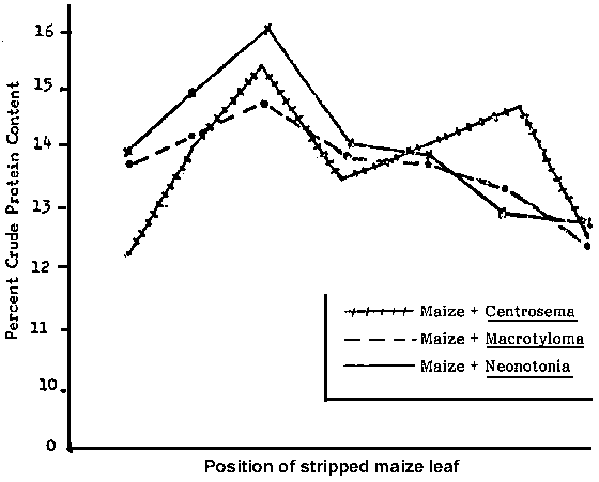
The stripped maize leaves had adequate amounts of crude protein from the first to the seventh leaf stripped (Figure 1). The protein values were well above 12%. While in the first four weeks the maize-Neonotonia system had the highest protein values, during the last three weeks the maize-Centrosema system ranked first in this respect. No adequate explanation could be advanced for this switch. The adequate amount of crude protein in these maize leaves does indicate their value as a feedstuff. Thus a byproduct from the maize crop, which is usually wasted, could provide an extra source of feed in smallholder livestock production enterprises.
The need to provide sufficient amounts of cereal grain for direct human consumption precludes the possibility of channeling these feed resources to livestock production in small-scale farming situations. It is logical, therefore, that efforts be made to improve the management of natural forage/fodder resources, and especially the efficient utilization of crop by-products. While attempts have been made to enhance the availability of nutrients in these feedstuffs through chemical treatment, there is still a dearth of technology for these small-scale livestock producers.
The Malawi experience of undersowing forage legumes in maize crops shows that there is a possibility of improving the quantity and quality of feed resources available to small-scale livestock producers during the dry season. This simple technology is cheap and makes few demands on labour and land as it involves an integration of arable crop, forage legume and livestock production. It is a good chance of improving the utilization of low-quality waste products such as maize stover. Research efforts in this area continue with a wide range of tropical forage-legume species.
The work covered in this paper was undertaken with logistic support from the Ministry of Agriculture in Malawi. I would like to thank the Chief Agricultural Research Officer of the Ministry for permission to publish this paper.
Figure 1. Crude protein values (% of DM) of stripped maize leaf from different positions below the cob
Addy, B.L. and Thomas, D. (1976). The utilization of crop residues, Madeya and Leucaena for winter feeding in Lilongwe District. Research Bulletin No. 2/76. Ministry of Agriculture, Lilongwe, Malawi.
Addy, B.L. and Thomas, D. (1977). Intensive fattening of beef cattle on Rhodes grass pasture on the Lilongwe Plain, Malawi. Tropical Animal Health and Production, 9: 99-106.
Balch, C.C. (1977). The potential of poor quality agricultural roughages for animal feeding. National Institute for Research in Dairying, Reading, U.K.
Booker Agriculture International Limited. (1983). Livestock and meat study, Final Report, Vol. I: Malawi.
Dzowela, B.H. (1985). Value of a forage legume component in summer beef fattening systems in Malawi. Paper presented at the workshop on Potentials of Forage Legumes in Farming Systems of sub-Saharan Africa, 16-19 September, 1985, Addis Ababa, Ethiopia.
Dzowela, B.H. and Johnson, W.H. (1984). Agricultural research resource assessment in SADCC countries. Malawi country report, Vol. 11. Devres Inc., Washington, D.C.
Edelsten, P. and Lijongwa, C. (1981). Utilization of low quality roughages - economical considerations in the Tanzania context. In Kategile, J.A., Said, A.N. and Sundstrol, F., (eds.) Utilization of low quality roughages in Africa. AUN-Agricultural Development Report 1, Aas, Norway, pp. 107-112.
Kategile, J.A. (1982). Utilization of low-quality roughages with or without NaOH treatment. In Kaflewahid, B., Potts, G.R. and Drysdale, R.M. (eds.) Proceedings of a workshop on By-Products Utilization for Animal Production, Nairobi, Kenya, pp. 37-48.
Kategile, J.A. and Frederiksen, J.H. (1979). Effect of level of sodium hydroxide treatment and volume of solution on the nutritive value of maize cobs. Animal Feed Science and Technology, 4:1-15.
Kategile, J.A., Urio, N.A., Sundstol, F. and Mzihirwa, Y.G. (1981). Simplified method for alkali treatment of low quality roughages for use by smallholders in developing countries. Animal Feed Science and Technology, 6:133-143.
Kiangi, F.M.I., Kategile, J.A. and Sundstol, F. (1981). Different sources of ammonia for improving the nutritive value of low quality roughages. Animal Feed Science and Technology. 6: 377-384.
Mtimuni, J.P. (1982). Proximate analysis of local feedstuffs. Research Bulletin. Bunda College of Agriculture, Lilongwe, Malawi. Vol. 3, p. 68.
Mtukuso, A.P., Gray, R.C. and Pervis, D.W. (1983). The utilization of groundnut tops for beef production in Malawi. Ministry of Agriculture. (Mimeo.) Lilongwe, Malawi.
National Research Council. (1976). Nutrient requirements for beef cattle. National Academy of Sciences, Washington, D.C.
Said, A.N. (1981). Sodium hydroxide and ammonia-treated maize stover as a roughage supplement to sheep and beef feedlot cattle. In Kategile, J.A., Said, A.N. and Sundstol, F. (eds.) Utilization of low-quality roughages in Africa. AUN. Agricultural Development Report 1, Aas, Norway, 107-112.
Thomas, D. (1975). Grass-legume establishment under maize - a new technique for the tropics. Span, 18(2).
Thomas, D. and Bennett, A.J. (1977a). Establishing a mixed pasture under maize in Malawi. I. Time of sowing. Experimental Agric. 11: 257-263.
Thomas, D. and Bennett, A.J. (1975b). Establishing a mixed pasture under maize in Malawi. II. Method of sowing. Experimental Agriculture II. 273-276.
Appendix 1
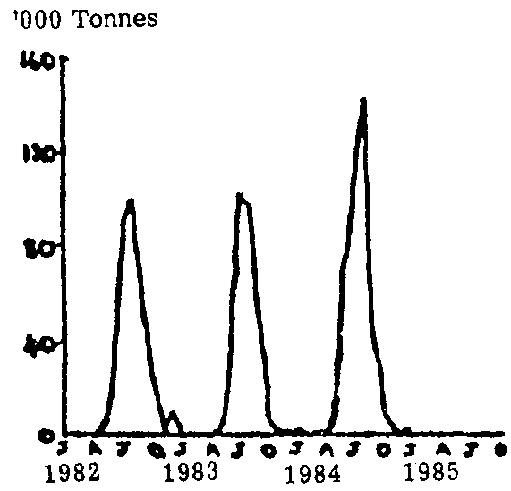
Figure A1. Agricultural Development and Marketing Corporation Domestic purchases of agricultural crop produce
Source: National Statistical Office Monthly Statistical Bulletin, January 1985
Appendix 2
Table A1. Maize grain and stover production (tonnes)a
|
Period |
Grain |
Stoverb |
|
1974 |
65,470 |
65,470 |
|
1981 |
136,647 |
136,647 |
|
1982 |
246,062 |
246,062 |
|
1983 |
244,937 |
244,937 |
|
1984 |
296,292 |
296,292 |
Source: National Statistical Office, 1985, Zomba, Malawi.
a Represents only grain quantities
b Using a 1:1 grain to stover ratio.
