


Gilead I. Mlay
Department of Rural Economy, Sokoine University of Agriculture,
Morogoro, Tanzania
Abstract
Introduction
Conclusions and recommendations
References
This paper presents a cost-returns analysis of smallholder dairy production in Hai District, Tanzania. The use of gross-margins analysis to assess the economic impact of proposed technologies is demonstrated. The data used were obtained during a 1984 household survey of 150 randomly selected farmers keeping dairy cattle.
The results indicate that dairy production is economically attractive for smallholder farmers in both the short run and long run. The high internal rate of return (over 50%), while suggesting an overestimation of enterprise costs, explains the high demand for dairy cattle by smallholder farmers despite the present critical shortage of feedstuffs.
The comparison of gross margins per cow and per man day with existing feeding technology, and an improved technology that incorporates the use of an urea-molasses mixture, shows that productivity can be improved with these inputs. While merely reorganizing resources is unlikely to raise farmers' income substantially, technologies that can make existing resources more productive do have this potential.
Smallholder dairy production in Tanzania is concentrated in the highland areas of Kilimanjaro, Arusha and Mbeya. The increased demand for fresh milk in urban centres in recent years has resulted in an expansion of smallholder dairy production around these centres. Until recently, Government policy on dairy development focused mainly on large-scale State-owned farms. The new Tanzania livestock policy gives due emphasis to the development of the smallholder sector through increased supply of upgraded cattle, animal feeds and other production inputs, including extension services (Ministry of Livestock Development 1983).
The emphasis on smallholder dairy production in Tanzania calls for increased efforts towards the development of locally tested technology that will increase productivity given farmers' present resources. Available information about peasant farmers indicates that they are good decision makers, given their experience and resources, and that a mere reallocation of their resources will not appreciably increase incomes (Stevens 1977). Assuming that smallholder farmers allocate their resources to maximize profit or expected utility of profit, subject to satisfying their subsistence needs, new technologies will only have a chance of success if they effect an improvement in standard of living. There is, therefore, a need to understand the economics of current smallholder production systems and the potential impact of proposed new technologies before making definite recommendations.
This paper reports on the results of a study of the economies of smallholder dairy production in Hai District. The work is part of an ongoing project on smallholder dairy feeding systems whose main objective is to design innovations that will increase productivity. The data used in this paper are based on a household survey conducted in February/March 1984 on a randomly selected sample of 150 households keeping dairy cattle.
Farming Systems in Hai District
Land use in the District is based on kinship structures which are basically patrilineal as far as patterns of land ownership and inheritance are concerned. Farmers own farms in two distinct zones: the highlands, where they live in permanent homesteads, and the lowland zone.
The highland zone has relatively more rainfall and the cropping pattern is coffee with bananas. The lowland zone is cropped with maize and beans. The survey conducted in 1984 indicated that the median farm size in the highland zone is 1.01 hectares, while in the lowland zone it is 1.2 hectares. The average distances from the homestead to the lowland farms is 18 km (Urio and Mlay 1984). These statistics suggest that land in the District is a critical constraint and that agricultural production can only be increased through intensive land-use measures.
Crop Production
In the highland zone, coffee intercropped with bananas are the main crops. Vegetables are also growing in this zone. Maize and beans are the main crops in the lowland zone, either as pure stands or intercropped. Tractor utilization during land preparation is a common practice in the lowland zone. While coffee is the main cash crop in the District, production has been falling in recent years due to the high incidence of coffee berry disease. Falling production coupled with declining real producer prices have resulted in a growing tendency towards diversification.
Livestock Production
Livestock production is an integral part of the farming system in the District. Land scarcity has contributed significantly to the high degree of dependence between the crop and livestock sub-systems. Stall feeding is the rule, and crop by-products are extensively used as feed, while the manure from the livestock is, in turn, used on the banana/coffee plots to maintain soil fertility.
According to the 1978 national census, cattle are the most numerous livestock in the District, followed by sheep, goats and pigs, as shown in Table 1.
Table 1. Numbers of domestic animals in Hai District, 1975
|
Type |
Number |
Average per household |
|
Cattle |
132,000 |
4.0 |
|
Sheep |
28,200 |
0.9 |
|
Goats |
9,000 |
0.3 |
Source: Adapted from M.E. Mlambiti et al 1982.
The rapidly increasing demand for milk as reflected in the parallel market price of Sh. 20 per litre compared with the official price of Sh. 10 per litre coupled with declining income from coffee has seen a rapid growth in commercial milk production by smallholder farmers in the District. The relatively unproductive local Zebu is being replaced by improved breeds.
Land constraints and the scarcity of commercial feeds pose special problems for livestock feeding. The main sources of feed are crop byproducts (mainly banana leaves and pseudostems), maize stover and bean straw. Some farmers have also established pasture leys (Pennisetum purpureum, Tripsacum laxum and Setaria spp.) along farm boundaries, footpaths, and on any patches of land unsuitable for crop production, the use of commercial feeds is limited and erratic, and reflects availability rather than ignorance on the part of farmers. On the basis of the survey conducted in 1984, only 58% of sampled farmers used commercial feeds and all indicated that the levels used were below the recommended rates (Urio and Mlay 1984).
Analytical Procedures
Three main analytical procedures are used. These are gross-margin analysis, production-function analysis and returns to investment. Important measures of technical and economic efficiency of resource utilization can be derived from these three analyses.
Gross-Margin Analysis
Gross margins are widely used in farm planning. They can be used to prepare partial budgets for minor changes in the farm programme, or to prepare completed budgets for major changes in farm programmes (Styrrock 1971). Gross-margin analysis involves determining all variable costs and revenue associated with an enterprise. The difference between revenue and total variable costs is the gross margin for the enterprise, and, in essence, this is the return to capital, management and risk.
Several efficiency measures can be calculated from the general analysis and compared with standards to identify areas of potential improvement. Such efficiency measures include gross margin per unit of the enterprise, gross margin per unit of a scarce resource, and gross margin per unit of an investment. In addition, the potential effects of introducing a new technology on the above efficiency measures can be assessed before resources are committed to production.
Production Function Analysis
A production function shows the technical relationship between inputs and output. The general form of the relationship is presented in equation 1.
Y = f (X1, X2 ... Xn) ......... (1)
where X1, to Xn are the production inputs and Y is output.
While several function forms have been used to study the productivity of agricultural inputs, the Cobb-Douglas production function is the most commonly used (Welsch 1965). It has the following form:
Y = A II Xii Bi ......... (2)
where Bi (i = 1, 2..., n) are the partial elasticities of production.
Each measures the degree of responsiveness of output when the corresponding input is changed by 1%. The magnitudes of these coefficients can be used to assess the productivity of the inputs.
The data required for the analysis are cross-sectional, collected across households. Detailed records on outputs and levels of use of the identified inputs are necessary. With appropriate logarithmic transformation and assumptions, estimates of the elasticities can be obtained by the least-squares method. This approach is not used in this paper due to lack of suitable data.
Return to Investment
The returns-to-investment method allows direct comparison with alternative
enterprises. This method is particularly useful in cases where loans are to
be sought for establishing or expanding an enterprise. The measure proposed
here is the internal rate of return whose formula is as follows:
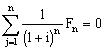 ......... (3)
where
n = number of years for which the internal rate of return is relevantFn = Net cash flow for year n, and
i = an internally calculated rates of interest that makes the discounted present value of the flow of costs equal to the discounted present value of the flow of returns at a point in time.
The observed returns to investment can be used to explain the observed returns to investment can be used to explain the observed investment behaviour by the farmers.
Results and Discussion
Gross Margins
Table 2 presents results of gross margin analysis based on current production organization in the District. The prices used are those that prevailed in the market when the survey was conducted.
Table 2. Gross margins for a smallholder dairy farmer in Hai District
|
Animal numbers and performance |
|
|
|
|
Average herd size excluding calves |
4 |
|
|
Average number of calves |
1 |
|
|
Average number of cows in milk |
2 |
|
|
Average milk yield per cow per day (litres) |
7.4 |
|
|
Average lactation length in months |
10 |
|
Revenue (TSh) |
|
|
|
|
Milk (2,220 x 2) litres @ Sh. 10 |
44,400a |
|
Variable costs (TSh) |
|
|
|
|
Concentrates |
1,755.00b |
|
|
Mineral supplements |
824.20 |
|
|
Purchase and transport of crop residues |
988.50 |
|
|
Maintenance of cattle shed |
750.00 |
|
|
Veterinary expenses |
320.00 |
|
Total variable costsc |
4,637.70 |
|
|
|
Gross margin (revenue-costs) (TSh) |
39,762.30 |
|
|
Gross margin per cow (TSh) |
9,940.58 |
|
|
Labour in man days per yearc |
220.00 |
|
|
Gross margin per man day (TSh) |
180.74 |
a The revenue on milk sales assume that all milk is sold.b Accurate data on concentrate feeding rates were not available.
c Only family labour is used, and the figure of 55 man days per cow per year is adapted from Mlambiti 1983.
One of the innovations currently being tested in the District is the use of a molasses-urea mixture. Apart from improving the intake of maize stover, it is intended to improve feed quality by providing nitrogen. Since data are still being collected, the results presented below are based on created data to illustrate the use of gross margins in assessing the potential economic impact of a new technology. It is assumed that 13 man days will be required to collect the molasses-urea mixture from the selling centres and that the feeding rate is 2 kg per animal per day. The milk yield is assumed to increase by 10% when all other factors are maintained at their present levels.
Table 3. Gross margin analysis incorporating molasses-urea mixture
|
Revenue |
|
|
Milk sales (2,442 x 2) litres @ Sh. 10 |
48,840.00 |
|
Variable costs (TSh) |
|
|
Original cost (Table 2) in TSh |
4,637,70 |
|
Molasses urea (2 kg x 4 x 365) kg @ 0.60 (TSh) |
1,460.00 |
|
Total variable costs |
6,097.70 |
|
Gross margin (revenue costs) |
42,742.20 |
|
Original labour in man days |
220 |
|
Additional labour in man days |
13 |
|
Total labour in man days |
233 |
|
Gross margin per cow in TSh |
10,685.50 |
|
Gross margin per man day in TSh |
183.44 |
The results in Table 2 indicate that, in the short run, smallholder dairy production under the existing production system is economically viable. The enterprise covers all the variables in costs and has a large positive return to capital, management and risk. The long-run viability of the enterprise is dependent on it being able to cover all production costs. The gross margin per cow and per man day can only be assessed in the presence of other figures for comparison.
The cash-flow results indicate that, with the exception of the first year, the net benefits from the dairy enterprise are positive. The apparently high positive net benefits suggest that costs have been underestimated, in particular the cost of feeds. The exclusion of costs of family labour have also contributed to the under estimation of costs. In computing the internal rate of return, a figure of over 50% was obtained, again suggesting that enterprise costs have been underestimated. However, the high demand for dairy heifers, as reflected by the high parallel market price of Sh. 15,000-18,000 compared with an official price of Sh. 6,000 per heifer, suggests that the enterprise has high returns to investment.
Table 4. Cash-flow analysis of a typical smallholder dairy enterprise in Hai District (TSh)
|
OUTFLOW
|
YEAR |
||||||||||
|
1 |
2 |
3 |
4 |
5 |
6 |
7 |
8 |
9 |
10 |
||
|
Capital expenditure |
|||||||||||
|
|
Heifers |
45,000.00 |
0 |
0 |
0 |
0 |
0 |
0 |
0 |
0 |
0 |
|
|
Construction of shed |
25,000.00 |
0 |
0 |
0 |
0 |
0 |
0 |
0 |
0 |
0 |
|
|
Subtotal |
70,000.00 |
0 |
0 |
0 |
0 |
0 |
0 |
0 |
0 |
0 |
|
Operating expenses |
|||||||||||
|
|
Maintenance of shed |
0 |
350.00 |
450.00 |
550.00 |
650.00 |
750.00 |
750.00 |
150.00 |
750.00 |
750.00 |
|
|
Concentrates |
1,755.00 |
1,755.00 |
|
|
|
|
|
|
|
|
|
|
Crop residues |
988.50 |
988.50 |
983.50 |
988.50 |
988.50 |
988.50 |
1,755.00 |
1,755.00 |
1,755.03 |
1,755.00 |
|
|
Veterinary costs |
320.00 |
320.00 |
320.00 |
320.00 |
320.00 |
320.00 |
988.50 |
988.50 |
988.50 |
988.50 |
|
|
Mineral supplements |
824.00 |
824.00 |
824.00 |
824.00 |
824.00 |
824.00 |
320.00 |
320.00 |
320.00 |
320.00 |
|
|
Subtotal |
3,887.50 |
4,237.50 |
4,437.50 |
4,437.50 |
4,537.50 |
4,637.50 |
824.00 |
824.00 |
824.00 |
824.00 |
|
|
Total outflows |
73,887.50 |
4,237.50 |
4,437.50 |
4,437.50 |
4,537.50 |
4,631.50 |
4,637.50 |
4,537.50 |
4,631.50 |
4,637.50 |
|
|
INFLOW |
|
|
|
|
|
|
|
|
|
|
|
|
Sales of milk |
0 |
3,120.00 |
35,400.00 |
40,200.00 |
94,400.00 |
44,400.00 |
44,400.00 |
40,200.00 |
35,400.00 |
31,200.00 |
|
|
Sales of calves |
0 |
1,500.00 |
1,500.00 |
1,500.00 |
1,500.00 |
1,500.00 |
1,500.00 |
0 |
0 |
0 |
|
|
Sales of culls |
0 |
0 |
0 |
0 |
0 |
0 |
0 |
0 |
0 |
0 |
|
Total inflows |
0 |
0 |
3,200.00 |
36,900.00 |
45,900.00 |
45,900.00 |
45,900.00 |
40,200.00 |
35,400.00 |
46,200.00 |
|
|
Net benefit |
-73,887.50 |
28,462.50 |
32,562.50 |
37,262.50 |
41,362.50 |
41,262.55 |
41,262.50 |
35,562.50 |
30,162.50 |
41,567.50 |
|
This paper has demonstrated the application of gross-margins analysis and internal rate of return to assessing the economics of smallholder dairy production in the Hai District. The results indicate that, both in the short and the long run, dairy production is a viable economic activity under smallholder conditions.
Work done by other researchers in the District has shown that a mere reallocation of resources through enterprise reorganization will not increase farmers' income appreciably (Mlambiti 1983; Msechu 1979). This suggests that an increase in farmers' incomes will come from improved technologies that will make the existing resources more productive. As indicated by the results on potential use of molasses-urea mixture, the gross margins per cow and per man day can be changed if livestock are made more productive.
It is recommended that researchers involved in developing or tasting technologies for use by smallholder farmers first obtain detailed base-line data on current farming practices and resource utilization and then use them to assess the economics of those enterprises without improved technologies. Alternative technologies should then be subjected to economic analysis and the results compared with those of the traditional practices. This will allow us to make more rational choices and technology recommendations, which are, therefore, more likely to be adopted by farmers.
Ministry of Livestock Development (1983). Livestock Policy of Tanzania, Government Printer, Dar es Salaam.
Mlambiti, M.E. (1983). Agricultural sector analysis for Kilimanjaro Region: a basis for decision making and planning. Unpublished Ph.D. dissertation, University of Dar es Salaam.
Mlambiti, M.E. et al (1982). Economic analysis of the traditional farming systems of the Kilimanjaro Region, Tanzania. IAF, No. 85, West Virginia University.
Msechu, A.R.M. (1979). An economic analysis of the small scale coffee-banana holdings in Moshi rural district, Tanzania. Unpublished M. Sc. thesis, University of Nairobi.
Stevens, R.D. (ed.) (1977). Tradition and Dynamics in Small Farm Agriculture. Ames: Iowa State University Press. pp. 3-24.
Sturrock, F. (1971). Farm accounting and management London: Pitman Press pp. 139-180.
Urio, N. and Mlay, G. (1984). "Progress report on diagnostic survey among small holder dairy farmers in Hai District, Tanzania". Mimeo., University of Dar es Salaam, Morogoro, Tanzania.
