Marcelino Avila
IDRC Project Advisor & FSR Team Leader
Department of Research and Specialist Services
Ministry of Lands, Agriculture and Rural Development, Zimbabwe
Abstract
Overview of FSR
Methodological guidelines and issues
Types of on-farm research trials
The FSR unit in Zimbabwe
References
FSR is not really a new practice. However, there are institutional bottlenecks in it. Interfacing research, extension and other support service institutions, usually separated by commodities or broad disciplines, to focus their attention on farmers is a major problem for implementing FSR. Nevertheless, FSR is receiving increased attention and the trend will continue because efforts to improve small-farmer production systems have made researchers recognize the strong linkages between farming activities and the environment, the household and community. Consequently, there is an obvious need to study, learn from and exploit those linkages to the benefit of the farm households.
The objectives of this paper are to present an overview of farming systems research (FSR), review key methodological guidelines and issues, and briefly describe the organization and operation of the FSR Unit in Zimbabwe.
Farming systems research is an approach for generating appropriate technologies for studying existing farming systems and involving the technology users - usually the small farmers in the planning and evaluation process. The approach is justified on the basis of three vital considerations. Firstly, the farmer and his family are rational in their decision-making. Given their available resource base, circumstances, opportunities and knowledge, they typically manage a combination of crops, animals, and other on-farm and off-farm activities to satisfy basic physical, financial and social needs. Secondly, the production systems of small farmers embody an integrated set of husbandry practices that have developed over centuries so that these systems are stable, complex and very sensitive to the ecological, biological and socio-economic environment. Thirdly, a farming system belongs to the goal-setting and purposeful category of systems and its direction is determined by the farmer and his family. The decision to introduce changes or adopt any innovation depends entirely on how the household assesses the relative advantages and disadvantages in terms of its own perceptions and priorities. Because of these considerations, FSR is an interdisciplinary, integrative, problem-oriented and farmer-centred approach.
The research experience on cropping systems in the developing countries has resulted in a progressive refinement of FSR concepts and methodologies (Harwood 1979; Byerlee et al 1980; Gilbert, Norman and Winch 1980; and Zandstra et al 1981). Similarly there are research experiences on livestock production (Li Pun and Zandstra 1982; Fine and Lattimoer 1982; CATIE 1983; Gryseels and Anderson 1983; Ruiz and Li Pun 1983) and mixed production systems (McDowell and Hilderbrand 1980; Fitzhugh et al 1982; Huxley and Wood) which have successfully applied FSR approaches and methodologies. State-of-the-art reviews have also been carried out at the request of donors (Dillon, Plucknet and Vallaeys 1978; Shaner, Philipp and Schmehl 1982; Simmonds 1984).
At first glance the review of the wide range of experiences tends to suggest a state of confusion in FSR. There appear to be differences in terminologies, approaches and methods and these are sometimes intentionally exaggerated by FSR proponents for personal or institutional reasons. Upon careful analysis, however, these differences can be explained on the basis of the following characteristics of research programmers the primary objective (system description and analysis, technology development or methodology development), the type of farming system/environment interaction under study (maize production in humid areas, lowland and upland rice production, savannah livestock production, agroforestry in semi-arid areas, etc.) and the composition/leadership of research teams (economic, agronomic, land-use planning, plant protection, or other bias). Furthermore, it is interesting to note that crop FSR generally tends to have its roots in the "Green Revolution" and studies of adoption patterns, livestock FSR in systems analysis and modelling, and agroforestry FSR in resource conservation and ecology. To a large extent these schools of though determine how the practitioners perceive and analyse a given farming system.
In spite of such varied experience and schools of thought, there is a consensus on FSR philosophy and strategy. To improve a farm system, it must be studied and understood. FSR is an interactive stepwise process that has three actors - the researchers, extension agents and farmers - in the conduct of the four basic phases:
1. Characterization involves an understanding of the structural and functional relationships of current farming systems in specific geographical areas and an identification of the endogenous and exogenous constraints to achieving farmers' goals;2. Design of technological alternatives involves an x-ante evaluation and selection of strategic interventions, components, inputs and/or practices that results in a well defined and effective agenda for follow-up research with respect to farm monitoring, component experimentation and/or technology testing;
3. Testing involves evaluation, on farmers' fields and under partial or exclusive farmer management, of the assumptions, decisions and expected performance of the technological alternatives as designed in the previous phase;
4. Diffusion usually refers to the dissemination of tested innovations to credit and extension personnel or to small groups of farmers, usually through intensive assistance. Large-scale adoption ad impact on productivity is more difficult to achieve.
Although extension to farmers is an intrinsic activity of FSR, there is not much experience of this phase mainly because international centres consider it the responsibility of national programmers However, national programmers are unable to effectively transfer such results due to their own resources constraints or lack of infrastructural support and incentives for farmers.
This section will highlight some of the more critical research steps in FSR. More emphasis will be given to livestock FSR.
Analysis of the Farming Systems and its Sub-systems
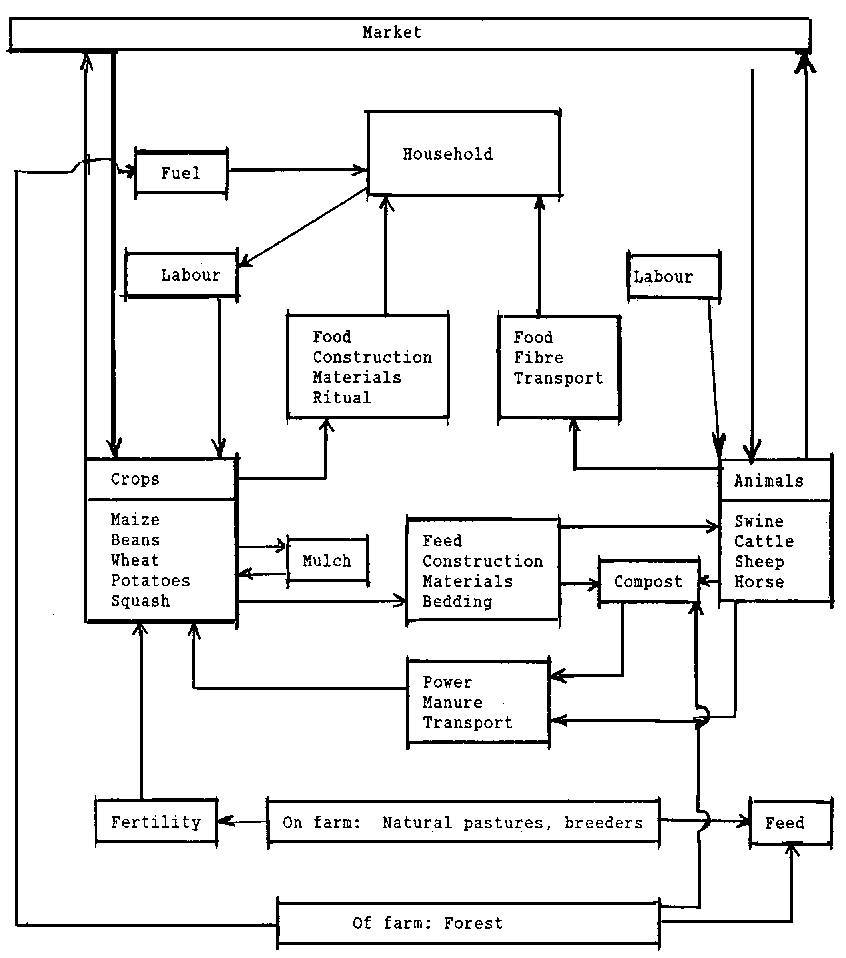
Understanding how a system works implies knowing the parts and how they relate to each other and to the environment (Dillon, Plucknet and Vallaeys 1978; Roundtree 1977; Van Dyne and Abramsky 1975). From a pragmatic viewpoint, one begins with an identification of the components of the farming system as illustrated in Figure 1. An inventory of crops with the cropping components, species within the animal component, and other on- and off-farm activities, is used to illustrate the major interactions of these components with each other, with the household component and with the outside market. This diagram provides a global picture of the farming system which can be improved with a quantitative description of the components and their interactions. Such a semi-quantitative model is extremely useful to ensure that one does not unintentionally exclude important parts of the system, or to select, on a preliminary basis, specific parts for further analysis.
As a second step, one must understand how these parts are related to one another, with respect to space and time. To do so, one must know how the land is used and managed on different production enterprises during the course of the year. Cropping patterns are examples of this type of relationship and could likewise be extended to livestock production as follows:
(a) Maize/sorghum: intercropping of maize and sorghum;
(b) Sorghum-beans: cropping of beans after harvesting sorghum;
(c) Pasture/cattle/goats: pastures grazed by cattle and goats together;
(d) Maize-cattle: cattle grazed on maize field after harvest.
If present in a given farming system, these can be called sub-systems or agro-ecosystems (Hart 1981).
Figure 1. The identification of components and their interactions in a mixed farming
Source: McDowell and Hilderbrand 1980
As a third step, one must describe, quantify and interpret the input-output relationships, that is, the flows of energy, materials, information, and so forth. With respect to both inflows and outflows of a sub-system, one must ask and answer the following questions:
|
What? |
Water, labour, seed, fertilizer, draught power and technical advise are examples. |
|
Why? |
The reasons for conducting certain activities could be social, economic, etc. |
|
How much? |
Quantitative and qualitative measures are essential to estimate their value or opportunity cost. |
|
When? |
This should be done at least on a monthly basis. |
|
From where and to where? |
Other on-farm sub-systems or storage deposits and off-farm sources or buyers/beneficiaries should be identified |
Although there are different levels of specificity and detail to deal with these questions, it should be borne in mind that this analysis should provide the basis for:
(a) Understanding the specific roles of each crop or animal species in the farming system;(b) Determining the types (direct or indirect and technical or administrative) and levels (low, high, etc.) of existing functional interactions among sub-systems; and
(c) Determining technical and economic performance, the positive and negative effects, and the advantages and disadvantages of each sub-system.
It may be decided to proceed with distinct levels of analysis for different sub-systems as a way of streamlining the analysis of the total farming system.
Identification of Constraints
Identifying constraints is a continuous process of discovering opportunities or potential for change - at the region/community, family, farm or subsystem level - that could improve the performance of the farming system. As knowledge of the structural properties of the system improves through the implementation of the various phases of farming systems research, constraints are progressively refined and redefined.
Although constraint identification is one of the main objectives of the characterization phase, it is very much a function of who does it. Is it the farmer or the researcher? If it is the researcher or a research team, then care must be taken to avoid disciplinary biases (Zandstra in Fitzhugh et al 1983). Even when interdisciplinary teams are used, differences occur because of:
1. The criteria of evaluation applied. Researchers generally use physical or economic productivity criteria within the short-term context (Perrin and Anderson 1976; Dillon and Hardaker 1980; Banta 1982), whereas farmers may consider these as means rather than ends for achieving family objectives, or as of secondary importance within a broader set of criteria and a longer term context;2. The scope of analysis. Researchers focus on enterprises or, at best, on sub-systems and perceive their range of decision variables as being confined to the biological and technological aspects of the production systems. Farmers assess opportunities in terms of how they fit in with on-farm and off-farm conditions. Their perceptions of decisions or manipulable variables may differ substantially from the researchers.
3. The analytical methods used. The researchers use simple descriptive statistics, regression functions, analysis of variance, optimization and simulation models, basically quantitative approaches. The farmers use their experience, common sense and intuition, basically qualitative approaches. What assumptions concerning risk and uncertainty are made and how they can he considered in these two general approaches is certainly a major issue. Farmers tend to act conservatively because they are faced with unpredictable factors such as fluctuating weather conditions, disease and parasitic attacks, uncertain input availability and costs, and unstable product outlets and prices. Farmers do not assume favourable conditions as researchers do.
Thus the basic question to be addressed is what present conditions, when changed, would have the largest net effect in the quickest time on the relevant performance criteria. Answering this question requires symbiotic interaction among social and natural scientists and direct and continuous discussion with farmers.
Ex-Ante Analysis
The design phase is a process of identifying, fitting and screening technological innovations (components, inputs and/or management practices) into the traditional system, that should solve the farmers' problems. Design objectives pertain to particular levels of desired performance, income generation or welfare, defined in conjunction with farmers. For example, they-could be stated as maximizing yields per hectare, yield per dollar of cash input, yield per unit of moisture, gross income per hectare, family net income per labour day, or an index of living standard. In addition to these, the researchers may define other objectives, such as applying existing experimental results, designing transfer "packages", or setting priorities for the research organization. The definition of the type and levels of these objectives determines the intrinsic characteristics and expected performance of the interventions and the time required to complete the task.
Technologies to be considered in the modelling exercise can be procured from farmers, from the existing body of information from past research, or developed by conducting component research. Some farmers in the same geographical area or farmers from other areas have agricultural practices that overcame similar constraints and are worthy of consideration. Past independent research on specific components provides technologies that may be suitable. The need for component technology research, that is trials managed mainly by researchers following experimental station procedures, may arise due to a conspicuous lack of information, for example on the range productivity of natural species of grass, appropriate stocking rates and utilization potential of various crop by-products and residues.
Fitting technological innovations within the traditional system involves identifying conflicts with the endogenous and exogenous conditions of the system which are created by the requirements and impacts of the proposed technologies. The analysis has to be conducted in a series of progressive steps, summarized as follows:
1. The ecological and physical environment. Soil capabilities, rainfall patterns, temperature levels and their relationships are the basic determinants of technological design;2. The socio-economic environment. Technologies are determined and do affect social customs, religious beliefs and values, age and sex occupational roles, forms of social or communal organizations, credit policies, input markets, product markets, etc.
3. The family goals and objectives. Although the definition of design objectives is based on these considerations, the introduction of a particular technology may interfere with other goals and objectives;
4. The sub-systems. Conflicts may be intensified or reduced with respect to the management of other sub-systems;
5. The farm resources. New technologies directly affect the use or replacement of locally existing resources, tools or techniques. They may be too difficult or complicated for the farmer to manage.
At each stage the number of technological options to achieve the design objectives would progressively diminish.
From the view point of the farmer, the ex-ante evaluation procedure of technological options includes a quantification of:
1. The magnitude of the real benefit in terms of the design objectives, that is, physical, economic or financial benefits;2. The predictability of benefits (levels of risk), at least in terms of favourable, unfavourable and normal conditions;
3. The requirement of resources, particularly labour and cash costs;
4. The length of time required to implement recommended changes and to obtain acceptable levels of success.
From the viewpoint of research scientists the ex-ante evaluation usually includes one additional concern, transferability. These are questions related to the divisibility of the designed alternative (can the farmer apply a part of the "whole package"?), the scope of application (how widely can the designed alternative be applied?), and the expected impact on other key sectors of the society (who will be the beneficiaries or losers among leaders, input suppliers, product intermediaries and buyers, etc?). For this reason, it is important to define, from the beginning of the design phase, the endogenous and exogenous environment of the farming systems within which the technological alternative is being modelled. A precise description of the target farmers, decisions and assumptions made with respect to the key determinants of the expected performance of the interventions, vis-a-vis the traditional practices, results in a clear statement of what the proposed technological change is, what type of farmers and production system it is designed for and what conditions (ecological, physical and socio-economic) it is suitable for. These are the basic hypotheses to be evaluated in the testing phase, and which are particularly significant for extension purposes. Consequently extensionists can make an effective contribution in addressing these issues and understanding their broader implication.
It is common that for the same geographical area several target groups of farmers are identified because of particular endogenous and exogenous characteristics of the farming systems and that for the same target group several interventions are designed because of particular decisions and assumptions made in the ex-ante evaluation.
The results of the design process set the stage for and define the terms of reference for the following activities:
(a) Further analysis of existing systems (complementary single-visit surveys, farm monitoring or case studies);(b) Technology testing under farmer conditions and management (on-farm farmer-managed trials);
(c) Component technology development under farmer conditions but under the shared management researchers and farmers (on-farm researcher and farmer-managed trials);
(d) Component technology development under farmer conditions but under the exclusive management of researchers (on-farm research-managed trials);
(e) Component technology development on experimental stations (on-station researcher-managed trials); and it is conceivable to have
(f) Component technology development on experimental stations but under partial management of researchers (on-station researcher and farmer-managed trials).
Accordingly, there are three types of on-farm trials: researcher-managed (RM), researcher and farmer-managed (RFM) and farmer managed (FM). These are compared in terms of design and evaluation criteria based on the experience of cropping systems research (Table 1).
In RM trials, the farm is used as the experimental unit or laboratory, primarily to find out the characteristics of the area and its ecological/physical potential, to screen available or high-risk, technologies and to learn from farmers. In FM trials, on the other hand, testing is aimed at evaluating how the proposed technology fits into the farming systems, permits assessment of the impact on farmers' performance criteria, the easiness or difficulties of management and adoption potential, in addition to providing guidelines for needed infrastructural support and appropriate extension strategies. Field days with participating farmers in FM trials can be used as an effective method to obtain feedback on collective issues and priorities.
In RFM trials, research focuses on exploring alternative treatments with respect to the key determinants of the proposed technology in FM trials. For example, if the performance of the technology being tested is sensitive to the proposed level of fertilization, the researcher may design an experiment (with the proposed, the farmer's and optimal level) to be conducted on the same fields as the FM trials and with some prearranged degree of farmer involvement. Similarly, RM trials may be designed to identify key biological and physical determinants of technologies for FM trials under more controlled conditions.
Table 1. Comparison of on-farm cropping systems research trials in terms of design and evaluation criteria
|
Criteria |
Researcher |
Researcher and farmer |
Farmer |
|
|
Design: |
||||
|
|
Field design1 |
CR, RCB, RIB, SP |
CR, RCB, RIB |
CR, RIB, PT |
|
|
No treatment combinations |
5-20 |
4-6 |
2-4 |
|
|
No replications |
4-5 |
2-4 |
1-2 |
|
|
Plot size, M² |
15-25 |
15-100 |
50-1000 |
|
|
Precision (farms, land types) |
within farm |
across farm/farmer |
across farmer |
|
Characteristics for selection of site |
||||
|
|
Evaluation |
|
|
|
|
|
Objective |
Generation |
Verification |
Acceptance |
|
|
Level of performance |
Higher |
Intermediate |
Lower |
|
Variation of performance indicators |
||||
|
|
Loss of experiments |
Moderate |
High |
Very high |
|
|
Loss of experiments |
Moderate |
High |
Very high |
|
|
Risk consideration |
Biological |
Management |
Economic |
1 Complete randomized (CR), randomized complete block (RCB), randomized incomplete block (RIB), split plot (SP) and paired treatments (PT).Source: Adapted from Shaner, Philip and Schmehl p. 101, 1982.
A crucial aspect of evaluation concerns the analysis of risk. Risk refers to the expected levels of performance depending on the probability of occurrence of certain events and acts. There are risks associated with biological (climatic conditions, pest and disease attack, etc.), management (understanding by the farmer, sequencing of activities, compatibility with available resources, etc.), and economic factors (availability and prices of cash inputs, availability of markets and prices of products, opportunity cost of resources and services, etc.). These considerations have obvious implications for the different types of on-farm trials, particularly with respect to the level and variation of performance indicators and the loss of experiments. Thus in RM trials, biological risk is the major source of performance variability since the other factors are under control, whereas in FM trials farmers always tend to act more conservatively because they are confronted with the entire array of unpredictable factors. Consequently, it is critical to identify the specific circumstances and causes of variation and loss when it occurs.
Usually the three types of on-farm trials are conducted simultaneously in order to gain time. However, the decision to implement one or the other first depends on the relative stage of technological development and complexity of farming system in the particular area. If component technology research is at an advanced stage (or results can be extrapolated from ecologically analogous areas) and the farming systems comprise monocropping sub-systems with minimal interactions with animals or their farm enterprises, on-farm research could focus on FM trials. On the other hand, if component technology research is at a very early stage (which is usually the case in areas with multiple cropping systems and strong crop/animal interactions), FM trials may he premature and therefore extensive RM trials are necessary to achieve a better understanding of real farming systems constraints.
On-farm research trials with animal production systems are extremely difficult to implement particularly RM trials with traditional experimental designs. Experimentation requires many animals with comparable weight and sex characteristics. The required experimental period (a minimum of 4 months for feeding trials or 3 to 4 years for cattle grazing experiments) makes it almost impossible for farmers to agree to provide their animals and facilities. Even when negotiations with farmers are successful, the probability of losing experiments is extremely high because of the lack of appropriate facilities and conditions in traditional production systems. Because of the enormous cost of animal production research ($1,000-5000 per experiment in cattle production), the number of treatments and replications on FM and RFM trials has to he reduced. Unlike cropping systems research, the farmers cannot he asked to provide a small plot or part of their herd for experimentation. Thus statistical evaluation of RM trials usually leads to ambiguous results because of the inability of researchers to control non-treatment variables. System experimentation (livestock or whole-farm) may be more suitable for on-farm research but logical analysis and farmer assessment are more relevant evaluation methods. Here modelling is recommended as a helpful tool but it must he practically oriented to reflect how the farmers manage the system. Usually, in livestock system experimentation, it is the cost, troth investment and operational, which limits the type of interventions. This is a blessing in disguise since it is also a very important criterion from the farmers' perspective.
Organization of the Unit
The specific objectives of the Farming System Research (FSR) Unit in the Department of Research and Specialist Services (DR & SS) are to study mixed crop and livestock production systems in the communal areas, to adapt, develop and test on-farm improved crop and livestock production technologies and systems; and to provide information for the formulation of agricultural development policies for the communal areas (FSR 1985).
The FSR staff consists of one agricultural economist (team leader), two livestock scientists, two agronomists, eight research assistants and four field hands under the overall co-ordination of the Deputy Director of DR & SS. The five-member core team, which is stationed at DR & SS Head Office in Harare, is technically responsible for designing or adapting research strategies, methodologies and programmes of work and for guiding, supporting and participating with the field teams in the implementation. One member of the Head Office team has also been assigned the task of co-ordinating technical and resource inputs for and monitoring the activities in each of the two selected communal areas.
A field team, consisting of a research technician, two agricultural assistants and two field hands, has been permanently assigned to each area. Their duties include selecting suitable research sites and farmers, conducting farming systems surveys and monitoring studies, and implementing research trials as well as continuous liaison with farmers to obtain feedback on proposed interventions and, as they develop competence, participating in the analysis and interpretation of research results.
The contribution of institute or station research scientists of DR & SS to the FSR Programme has been substantial in that they have provided reviews of past research on key topics or problem areas, have assisted in assessing farmer situations and identifying research opportunities in situ, have participated in designing research trials, and are planning to establish on-station trials which have been identified as priorities for component technology development. The close interaction between the FSR staff and staff scientists in the various DR & SS activities has resulted in a better understanding of FSR philosophy and strategies and in a mutually beneficial working relationship.
An interesting feature of the model is the active participation of the extension staff and organized communal groups in the research programme. Extension staff usually help with designing and carrying out diagnostic activities. Additionally, to cover a large number of households while saving on travelling time and costs, trial sites in each research area are clustered on the basis of extension workers and their farmer groups, given particular soil climatic and farmer characteristics. Extension staff participate in discussions on farmers' problems, research progress and research diagnosis, extension workers accept responsibility for establishing and monitoring farmer-managed trials and conducting pre-planting demonstrations for farmers before the start of the cropping season. An added dimension of extension participation in FRS is the contribution of the social science experts in planning and implementing household and community decision-making studies.
The international research centres, ILCA, CIMMYT and IDRC have a special role to play in terms of providing experienced scientists whose aim is to complement and build on FSR in the Department of Research and Specialist Services (DR & SS). They provide technical expertise in methodological approaches and subject matter-staff training and documentation services. The participation of all these organizations has been co-ordinated to focus almost exclusively on the felt needs and priorities of the FSR Programme.
Methodological steps
The FSR Unit carried out the following activities in 1984 which demonstrate the methodological steps followed in designing the 1984/85 programme:
1. Organization FSR;
2. Review past research;
3. Selection of areas;
4. Informal survey;
5. Screening interventions;
6. Formal surveys;
7. FSR meetings.
A summary of the specific objectives pursued and procedures employed in each activity follows.
Review of past research
This review covered a series of specific topics: national development policies and priorities, the role and ownership patterns of livestock, communal grazing practices and schemes, nutrition and supplementation, as well as health conditions and management, genetic potential of local breeds and crosses, and livestock marketing and markets. Although livestock production systems were particularly emphasized because of the general lack of information in this regard, information on crop productivity and constraints was reviewed, particularly the previous FSR work under the Agronomy Institute. For the FSR meeting in September, station researchers prepared three research review papers on topics of critical importance to the communal-area production systems: veld management, cattle manure utilization for crop production, and moisture harvesting and conservation techniques.
Area Selection and Description
Three major sets of area selection criteria were identified and used, namely: the ecological and physical conditions of communal areas in the country, the biological and economic potential for both crop and livestock production systems, and the managerial or logistic conditions for setting up a research base. From a total of four suggested areas, Chibi and Mangwende were selected, representing low- and high-potential areas, respectively.
Informal Survey
A one-week informal survey was conducted in each area. Crop and livestock research and extension specialists familiarized themselves with the areas and interviewed and discussed with a wide diversity of farmers to obtain a broad view of the existing farming systems. The specialists worked intensively in small inter-disciplinary teams and rotated on a daily basis to provide ample opportunity to discuss and analyse critical problems faced by the farmers from different personal (within discipline and disciplinary (across disciplines) perspectives). Their findings resulted in a tentative list of research proposals defining potential technological interventions within all the major components of the farming systems.
Screening/selection of Technological Interventions
To evaluate the technical and economic feasibility of specific interventions resulting from step 3 above, the FSR would be attempting to overcome and the target group of farmers likely to benefit from such interventions. They were classified into constraints at the levels of the household, crop component and livestock component. Within and across class, they were organized into a cause and effect hierarchy. For example, within the livestock component, poor digestibility of feeds results in insufficient consumption of feeds and this results in low animal weight gains. Another example, across components, is that inadequate quantity and quality of feeds causes low calving rates which causes small herd sizes which causes poor access to draught and low quantity of manure for crop production, and both results in low productivity of land, thereby resulting in the household problems of cash shortage, unstable cash hierarchical levels within the farming systems becomes the initial method of analysing technical options.
The previous exercise sets the stage for identifying the opportunities to intervene in the system, which constitutes the fundamental objective of this exercise. Firstly, the FSR Team attempted to describe on which constraints and in what manner (direct or indirect) each research intervention (if results were satisfactory and applied successfully) should be having an impact (positive or negative). Secondly, for each research intervention, the probable advantages (benefits for farmers) and disadvantages (conflicts) were identified. The team gave special attention to conflicts with existing on-farm (objectives of farmers, on- and off-farm enterprises, resources), community (tenure arrangements, organization) and exogenous conditions (markets for inputs and products, availability and prices of inputs) which would likely arise from effecting the proposed changes. Thus far, no quantification of these aspects had been done (see Table 2).
Formal Surveys
A special purpose survey of 76 farmers, approximately two-thirds of whom were well aware of the crop-trial programme, was conducted in Mangwende to assess crop production technologies that were tested for the area, namely tine and herbicide use for maize production.
Another survey was conducted to consult farmers on more appropriate technological interventions and important assumptions made for the analysis in step 4, and to determine to what extent their reactions are conditioned by selected farmer characteristics, available resources and productive activities. A five-page pre-tested questionnaire was used to interview 131 and 108 farmers in Chibi and Mangwende, respectively. The farmers were selected following a stratified (extension-worker areas, village within area, and households within village) and systematic (every unit) or random procedure which was considered appropriate for drawing a representative sample from the entire geographical area.
FSR meetings
A total of 36 Mangwende workers participated in a four-day meeting to evaluate the results of the crop production trials of the 1983/84 season and to plan a preliminary programme for the 1984/85 season It was proposed that maize, groundnut, soyabean, sunflower, sorghum, and finger millet trials be established in 66 sites in Mangwende and that extension workers be directly involved in roughly 50% of these trials.
A meeting with DR & SS researchers, AGRITEX officers, and other Zimbabwean and international organization researchers was held in Harare. The purpose of the meeting was to set out the on-farm research proposals, and to analyse them in detail to obtain feedback from the participants. Specific suggestions for improving proposed designs, the identification of other on-farm and on-station research, and relevant information from past research and/or other projects were being sought. During the deliberations the need to consider at all times farmer's priorities and conditions was emphasized.
Farmer Target Grouping and Policy Recommendations
At every step in the process described above, decisions and assumptions were being made on the basis of the actual on-farm, community and exogenous conditions or on the basis of possible changes that could be effected therein. It was essential to record them for two reasons. Firstly, such decisions and assumptions define the target group of farmers (e.g. farmers with and without draught cattle, farmers with and without fallow arable land) for whom each technical intervention is being designed and therefore with whom interventions should be tested. Results of the testing phase will further refine the definition of the target groups. Secondly, the set of "possible" changes which is assumed in the design phase and becomes necessary to promote adoption after successful testing, defines the basis for interphasing FSR with the political or policy setting entities. In other words, researchers can also be very precise as to what non-technical elements need to be asessed or changed (credit, markets, roads, etc.) to promote particular innovations among farmers. These should be formulated into policy recommendations for communal area development.
This particular model of FSR in DR & SS was negotiated and defined according to the peculiar circumstances prevailing in Zimbabwe, namely the strength and tradition of the agricultural research organization, the DR & SS commitment to FSR, the objective/commitment of the international centres and the present socio-economic and organizational conditions in the communal areas.
Table 2. Identification of possible positive and negative effects of introducing fodder legumes on arable land into the farming system
|
Affected resource or activity
|
Farmers with permanent cropping practice |
Farmers with fallow practice (fallow = uncultivated arable land) |
||
|
Positive |
Negative |
Positive |
Negative |
|
|
Labour
|
Less labour required for land preparation at establishment |
|
|
Labour required for establishment |
|
No labour required for harvesting (grazing) |
|
|
|
|
|
Land use/soil |
Nitrogen/root enrichment of soil |
|
Unused land properly covered (reduced erosion danger) |
|
|
Draught power use/requirement |
Reduced draught power through use of minimum tillage at establishment |
|
|
Draught power required for land preparation in year of establishment |
|
Crop production
|
More labour input available for crops (e.g. quicker planting, better weeding) |
Reduced crop area |
Higher yield of crop in year 1 after cultivation due to better soil fertility |
Draught labour input available for crops in year of establishment |
|
Higher yield of crap in year 1 of recultivation (better soil fertility) |
|
|
|
|
|
Animal production |
More supplementary protein feed available for cattle and other ruminants, donkeys (stronger animals, reduced mortality, increased conception rates, increased milk production) |
Less crop residues |
More supplementary protein feed for cattle and other ruminants donkeys |
|
|
Cash income/expenses
|
No cash requirements for seed (and fertilizer) in year 2+3 |
Less cash income from crop due to reduced crop area |
More cash income from higher yields in year 1 of recultivation, or |
Cash expenses for fertilizer and seed required |
|
More cash income from higher yields in year 1 or recultivation cc less cash requirement for fertilizer in year 1 of recultivation due to soil fertility |
|
Less cash expenses in year 1 of recultivation for fertilizer due to better soil fertility |
Additional cash expenses for draught power in year of establishment for farmers with no draught power |
|
|
No cash requirement for draught power in year 2+3 for farmers with no
draught power |
|
Possibly more cash income better fed animals |
|
|
|
Food supply to family |
More milk available due to better cow nutrition |
It is assumed that the reduced crop area will not affect the subsistence food supply |
More milk available |
|
|
Community |
More draught animals available due to increased herd sizes/reduced mortality |
Increase of herd sizes/stocking rates, denudation of grazing land if off-take is not increased to the same extent |
More draught animals available due to increased herd sizes/reduced mortality |
Increase of herd sizes/stocking rates and increased denudation of grazing land it off-take is not increased to the same extent |
Source: FSRU, Animal Report, 1984. Farming Systems Research Unit, Department of Research and Special Services, Ministry of Lands, Agriculture, and Rural Development, Harare.
Banta, G.R. (1982). Asian cropping systems. Research Microeconomic evaluation procedures. IDRC, Ottawa, Canada.
Byerlee, D. (1980). Planning technologies appropriate to farmers concepts and procedures. CIMMYT, Mexico.
Centro Agronomico Tropical de Investigacion y Ensentanza (CATIE). (1983). Investigacion en Sistems de Produecion Animal: Informe Tecnico Final 1979-1983 del Proyecto CATIE - BID. Turrialba, Costa Rica.
Dillon, J.L., Plucknet, D.L. and Vallaeys, G.J. (1978). A review of farming system research at the International Agricultural Research Centres CIAT, IITA, ICRISAT and IRRI. CGIAR-FAO.
Dillon, J. and Hardaker, B. (1980). Farm management research for small farm development. FAO Agricultural Services Bulletin 41, Rome, Italy.
Farming System Research Unit (FSRU). (1985). FSRU Annual Report 1983/84. Department of Research and Specialist Services. Ministry of Lands, Agriculture and Rural Development, Harare, Zimbabwe.
Fine, J.C. and Lattimore, R.C. (1981). Livestock in Asia: Issues and policies. IDRC, Ottawa, Canada.
Fitzhugh, H.A., Hart, R.D., Moreno, R.A., Osuji, P.O., Ruiz, M.E. and Singh, L. (eds.). (1982). Research on crop-animal systems (Proceedings of a workshop). Centro Agronomico Tropical de Investigacion y Ensenanza, Caribbean Agricultural Research and Development Institute and Winrock International, Morrilton, Arkansas.
Gilbert, E.H., Norman, D.W. and Winch, F.E. (1980). Farming systems research: A critical appraisal. MSU Rural Development Paper No. 6, Department of Agricultural Economics, Michigan State University, East Lansing, Mich.
Gryseels, G. and Anderson, F.M. (1983). Research on-farm and livestock productivity in the central Ethiopian highlands: Initial results, 1977-80. ILCA, Addis Ababa, Ethiopia.
Hart, R.D. (1981). Las bases conceptuales del Sistema Agro-Silvo-Pastoril. Presentado en el Seminario sobere Sistemas Agroforestales, del Pegueno Productor, VIII Reunion de ALPA, Republic Dominicana.
Huxley, P.A. and Wood, P.J. (undated). Technology and research considerations in ICRAF's "Diagnosis and Design" procedures. Working Paper No. 26. ICRAF. Nairobi, Kenya.
Harwood, R.R. (1979). Small farm development: understanding and improving farming systems in the humid tropics. Westview Press, Boulder, Colorado.
Li Pun, and Zandstra H. (eds.). (1982). Informe del II Taller de Trabajo sobre Sistemas de Produccion Animal Tropical. IDRC Manuscript Reports, 62s. Bogota, Colombia.
McDowell, R.E. and Hilderbrand, P.E. (1980). Integrated crop and animal production: Making the most of resources available to small farms in developing countries. Working paper Series. The Rockefeller Foundation, New York.
Perrin, R.K. and Anderson, (1976). From agronomic data to farmer recommendations: an economics training manual. CIMMYT, Mexico City.
Roundtree, J.H. (1977). Systems thinking - Some fundamental aspects, Agricultural Systems 2: pp.-247-254.
Ruiz, M.E. and Li Pun, H. (eds.). (1983). Informe de la III Reunion de Trebajo sobre Sistemas de Produccion Animal Tropical. IDRC Manuscript Reports 90s. Bogota, Colombia.
Shaner, W.W., Philipp, P.F. and Schmehl, W.R. (1982). Farming Systems Research and Development: Guidelines for developing Countries. Boulder, Colorado: Westview Press.
Simmonds, N.W. (1984). The state of the art of farming systems research. Consultant's Report for Agriculture and Rural Development Department, World Bank. Washington, D.C.
Van Dyne, G.M. and Abramsky, Z. (1975). Agricultural systems models and modelling: An overview. In G.E. Dalton (ed.). The Study of Agricultural Systems. London: Applied Science Publishers.
Zandstra, H.G., Price, E.C., Litsinger, J.A. and Norris R.A. (1981). A methodology for on-farm cropping systems research. The International Rice Research Institute, Los Banos, Philippines.