4.3.1. Summary of the MTP Proposal
4.3.2. Interim Commentary and Programmatic Issues
4.3.3. Centre Response
4.3.4. Evaluation
4.3.5. Recommendations
CIAT's MTP proposal reflects the implementation of its strategic plan which was discussed by TAC and the CGIAR in 1991. The proposals comprise an integrated strategy for research on germplasm development and natural resources management in selected agroecosystems of Latin America and the Caribbean, and global and regional responsibilities for germplasm development work on beans, rice, cassava and pastures in the tropics. Since the development of the strategic plan, CIAT's budget has been reduced in real terms by well over 20%, and the Centre considers that its MTP proposal reflects the minimum input level required to implement the broad directions of its strategic plan.
CIAT's primary proposal to implement the Centre's strategic plan was based at 119% of the resource envelope tentatively assigned by TAC for 1998. At this level, a total of 90 senior staff would be required, 50 for germplasm development research, 27 for resources management research, 3 for research support, 5 for institutional development and 5 for management and administration.
In addition to the 119% scenario, CIAT presented a second scenario, labelled the "minimum critical mass programme", which was based on the funding at 110% of the TAC indicative resource envelope, and which would require 79 senior staff positions. This scenario was arrived at by shifting core activities in the primary proposal to the complementary budget. At this level, germplasm development research would account for a total of 46.5 senior staff positions, of which 13 would be assigned to the Bean Programme, 10 to the Cassava Programme, 6 to the Rice Programme, 10.5 to the Tropical Forages Programme, 3 to the Biotechnology Unit, 2 to Virology, 1 to Genetic Resources and 1 to Research Management. Natural resources management research would account for 20.5 senior staff positions, and would be implemented by Agroecosystems Programmes focused on forest margins (4 positions), hillsides (4) and savannas (5.5), a Land Use Programme (5) and Research Management (1). In its original proposal, CIAT projected a complementary programme at a total of US$ 7.7 million including 21 senior staff.
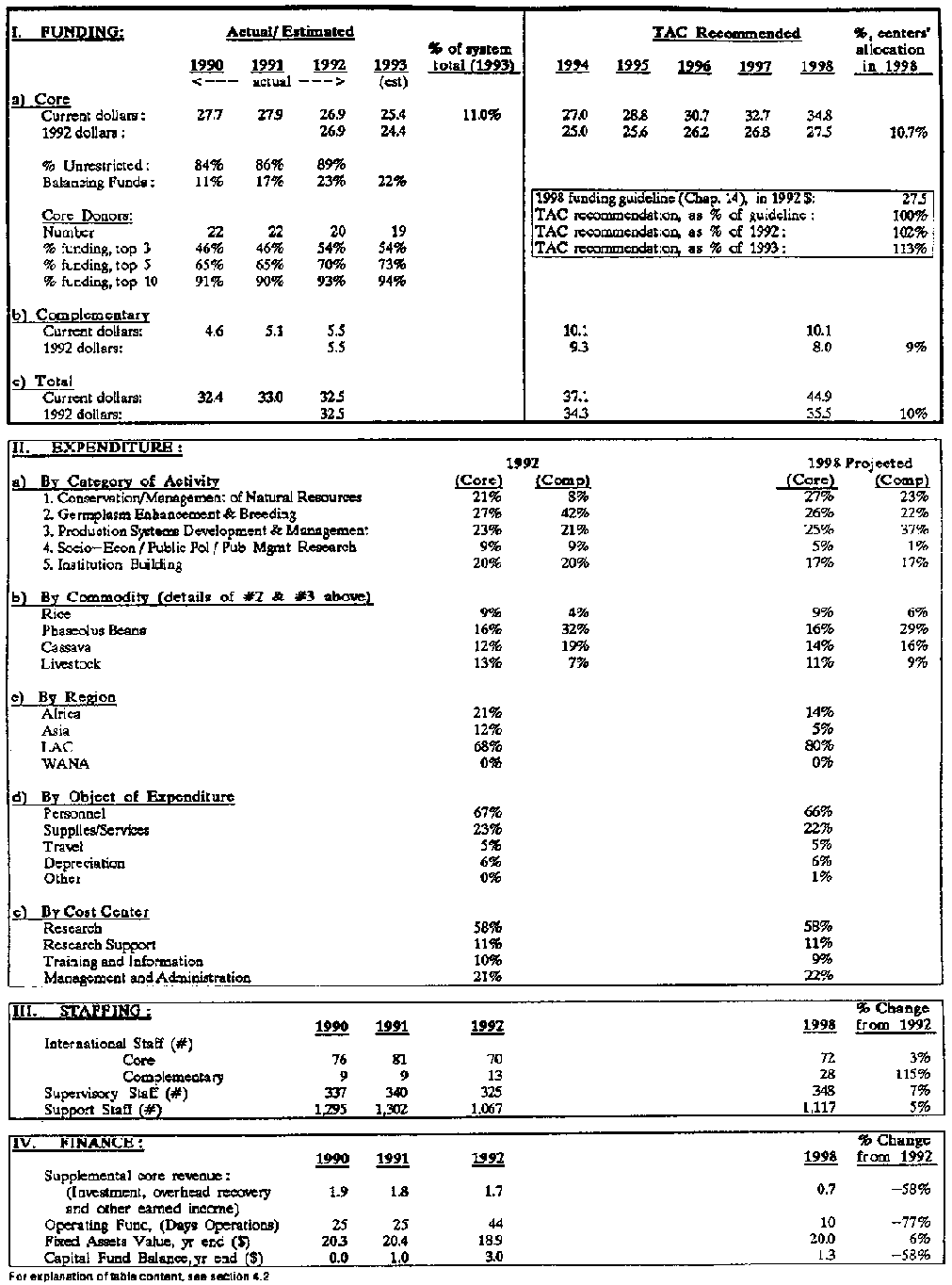
CIAT's proposed allocation of core resources by category of activity was: 27% to research on the conservation and management of natural resources, 26% to germplasm enhancement and breeding, 25% to production systems, 5% to socioeconomic and policy research, 17% to institution building.
TAC commended CIAT for its rigorous and balanced response to the financial crisis faced by the Centre since 1991, which had resulted in a substantially leaner CIAT at the start of this medium term planning process.
TAC requested CIAT to submit Board-approved supplementary information on the implications of a budget allocation at the levels of 90% and 100% of the tentative resource envelope. TAC also sought additional information on the consequences of a reduction of resources on the balance of effort between germplasm development and natural resources management research. TAC further noted that close collaboration with other institutes would be vital for the achievement of critical mass in many important areas of CIAT's proposed natural resources management research, and clarification was requested on CIAT's relationships with other Centres whose global mandate crops were important components of the ecosystem studies.
CIAT submitted additional Board-approved tentative plans on how the Centre would cope with funding at the level of the resource envelope and at 90% of that level.
At the 100% level, 7 senior staff positions would be eliminated from the staffing proposed at the 110% level. Reductions include 3 of the 4 positions in the Forest Margins Programme, with the remaining position kept to uphold existing institutional and donor commitments. Furthermore, 1 position in the Hillsides Programme, 2 in the Bean Programme and 1 in the Tropical Forages Programme, would also be eliminated.
The Centre provided a rationale for the eventual reductions, and stressed that substantial social benefits would be forgone, and why, if these scenarios were to be implemented.
CIAT's resource management proposals focus on high-priority ecosystems within agroecological zones. The multicommodity perspective of the ecoregional approach to research would be provided through collaborative arrangements with other centres and institutes.
TAC considered that on the basis of priority considerations, the amount of resources tentatively assigned to CIAT should be maintained. In determining the level of the tentative envelope, TAC had already incorporated an increase for the Centre's work in the area of conservation and management of natural resources, and for its focus on Latin America.
CIAT's proposals were sound and consistent, and were developed on the basis of a transparent and coherent priority-setting mechanism. The programmes are of a strategic character and have a good potential for breakthrough.
TAC attached a high priority to CIAT's proposals for resource management work which focus on important ecosystems. The three ecosystems under study are of vital importance to the future of resource-poor farmers in Latin America: the hillsides programme is particularly important for equity reasons; the savanna programme offers tremendous scope for productivity increases; and the forest margin programme addresses many of the major sustainability issues that are of vital importance.
The Committee considered that, if CIAT were to be funded below the 110% level, then commodity programmes should be scaled down first. The strong reduction in the scale of the resource management programmes should only occur at the 90 % funding level. CIAT's proposals are ambitious and the success of their implementation will depend upon the effectiveness of a wide set of collaborative arrangements with NARS, NGOs, other IARCs, advanced research institutes and bilateral programmes. The proposed cuts in staff at the base level and the 90% level may be compensated by strengthening such collaborative arrangements.
CIAT has performed very well in the past and this is likely to continue in the future. The Centre is well managed, and has a healthy institutional environment and effective mechanisms for collaboration with NARS and other institutions.
TAC recommends that CIAT be assigned core resources in 1998 in the amount of US$ 27.5 million in 1992 dollars which is equivalent to 100% of the tentative envelope. The Committee considers that the level of the tentative envelope adequately reflects CIAT's potential contribution to the achievement of System priorities. TAC encourages CIAT to maintain the main features of its forest margin programme at the expense of scaling down its commodity programmes within this funding level. CIAT has also been identified as the convening centre for an ecoregional programme for the humid and sub-humid tropics and subtropics in Latin America for which US$ 750,000 of core resources by 1998 is recommended. At the US$ 280 million vector, TAC recommended an additional US$ 750,000 to enable CIAT to maintain its commodity research which, at the US$ 270 million vector, is projected to decrease in favour of the forest margin programme. At the US$ 280 million vector, TAC also recommends an increase of US$ 200,000 of the funding of the Systemwide LAC ecoregional initiative.
For 1998, CIAT projects complementary funding of US$ 8 million (in 1992 values), representing 29% of CIAT's recommended core funding for that year.
For 1994, TAC recommends a core funding for CIAT of US$ 25.0 million in 1992 dollars, or US$ 27.0 million in current values. Together with complementary funding at US$ 10.1 million, total funding of CIAT in 1994 would amount to US$ 37.1 million.
CIAT: FINANCIAL HIGHLIGHTS (US$ Million & percentages)