4.4.1. Summary of the MTP Proposal
4.4.2. Interim Commentary and Programmatic Issues
4.4.3. Centre's Response
4.4.4. Evaluation
4.4.5. Recommendations
CIFOR's broad mandate, as enunciated in its MTP proposals is to respond to rising international concerns about the problems caused by increasing deforestation and resource degradation. CIFOR plans to contribute to poverty alleviation and income generation through socioeconomic and policy research to improve land use, and the development of techniques for optimum management of forests, trees and degraded lands, including the better utilization of wood and non-wood products with emphasis on multiple-end use.
CIFOR's MTP proposal focuses on partnership with a broad range of research institutions in developing countries so as to "strengthen national capacity for research to support optimal use of forest and forest lands; to improve the worldwide scientific basis for decisions influencing forests and forest lands; and develop technologies so that yields of forest goods and services are increased, their sustainability is assured and the resulting benefits are equitably distributed to all sectors of society." CIFOR also foresees close collaboration with advanced institutions. Technology, from the viewpoint of CIFOR, includes legislation and policies as well as science-based techniques.
CIFOR has placed the highest priority on policy research as a fundamental basis for identifying the gaps in knowledge which must be overcome to improve economic and financial production functions for making meaningful predictions of the results of alternative land use options. These will in turn influence the agenda for biological and technological research.
The MTP document presents four research programmes and one research support programme. The research programmes consist of policy development (Programme 1), management and conservation of natural forests (Programme 2), reforestation of degraded lands (Programme 3), and products and markets (Programme 4). Each research programme is subdivided into research activities, and the latter are broken down into two or more problems or study areas. CIFOR research activities composing the programmes are in effect research 'thrusts' or subprogrammes which will serve as a basis for developing field projects. The MTP proposal lists 63 problem/study areas. Exceptionally, Activity 3.2 - matching tree species/genotype to bio-physical site conditions and management systems - contains three distinct major problem areas which are further broken down into 14 study areas.
The MTP is built around two priority components 'a' and 'b', and one complementary component 'c'. CIFOR's basic proposal, Priority 'a' activities, would require resources at a level of US$ 7.6 million, equivalent to the base resource envelope. The preferred funding level would be a combination of Priorities 'a' and 'b', which requires a total of US$ 9.4 million or about 123% of the level of the envelope.
CIFOR's Board and Management have undertaken wide-ranging consultations and have come to the conclusion that the Centre's research agenda should be guided by six main factors: a continental/regional planning matrix; an agroecological/systems approach; the local geographical scale of particular problems; research activity clusters; partnership with NARS, and collaboration with IARCs and advanced institutions; and dynamic research priority-setting. The last factor is of crucial importance as programmes have been formulated without participation of Centre scientists who are as yet to be recruited.
In summary, CIFOR's proposed activities will attempt to develop research-based technologies which show how production of goods and services from the remaining tropical forest systems can be improved and sustained; how the mosaic of forest and non-forest land use can be stabilized; and how degraded forest systems, or forests replaced by less sustainable and beneficial land uses, can be rehabilitated.
TAC considered CIFOR's MTP proposal to be ambitious. The proposal reflected the Centre's appreciation of the wide range of issues mentioned under Agenda 21 of UNCED. TAC commended the interactive process CIFOR had followed in formulating the MTP. The Committee was of the view that the large list of proposed research topics would need to be reduced to a manageable list of inter-related problems for CIFOR's work. TAC recognized, however, the difficulty of developing a medium-term plan before a Board-approved strategic plan, and key staff are in place. TAC's comments would have to be taken in a similar sense as being tentative and subject to review and change as CIFOR's programme actually evolves.
CIFOR's emphasis on policy and socioeconomic research was noted. The Centre needs to clarify its relationship to IFPRI and the type and extent of independent capacity in policy research which CIFOR would develop within the plan period. There was also a need to develop further its priority-setting process, in view of the large number of research topics listed in its plan. A further clarification was also required on CIFOR's procedure for selecting collaborators. TAC wished to be informed of the specific issues that CIFOR would address in reproductive biology and genetics, and the extent to which the work would be done in-house.
TAC was concerned about the timing of the build-up of the various programmes and the intended rate of expansion of a Centre only at the point of developing basic infrastructure. CIFOR was asked to indicate alternative scenarios if growth was slower than currently planned. Other issues related to the nature and intended operations of the matrix management approach implied in the MTP proposal, the impact criteria and targets CIFOR would be adopting, the specifics of the links to be developed with ICRAF, and the manner in which CIFOR would accomplish the donor-suggested balance of resource allocation of 30% at headquarters and 70% in the regions.
CIFOR agreed that the list of research topics in the MTP proposal was long. The wording in the final plan would be modified to indicate that there would be a degree of selection from among the list of activities proposed.
On its relationship with IFPRI, CIFOR reported the completion of a series of three workshops with IFPRI to examine forestry policy issues in the three regions. IFPRI staff would visit CIFOR in Bogor early in 1994 to draw conclusions from these meetings and plan for a future collaboration which would lead to a harmonious and synergistic relationship between the two Centres.
CIFOR noted TAC's comments on the priority-setting process, but favoured a gradual evolution of the process as more staff and quantitative information became available for the evaluation of the cost and benefits of options. As far as the selection of collaborators was concerned, CIFOR would adopt a flexible approach and a modality of collaboration most appropriate to any particular venture or partner. It was essential to avoid the danger of a too formalistic approach to partnership arrangements which could draw CIFOR into providing an institutional support function to the NARS.
CIFOR intended to have in-house expertise in reproductive biology and had already recruited a scientist to work on the issues involved. CIFOR's reaction to the consequences of slower growth would be pragmatic. If available resources were to become limited, CIFOR would move slowly in taking on new activities. If available resources were to fall far short of expectations, CIFOR would not trim from each activity, but would rather delay the start-up of some.
The extent to which more formal matrix management systems might be required in the future would depend largely on CIFOR's rate of growth. Initially inter-programme interaction would be encouraged through staff selection and evaluation procedures, but there would be no cross-matrix line management functions to avoid overload among the small set of scientists to be recruited during the plan period.
With the collaboration of ISNAR and the US Forest Service, CIFOR would undertake research on techniques for the evaluation of the impact of forestry research. Details would be provided in the revised MTP. Apart from cross-Board membership, CIFOR shared facilities with ICRAF's office in Bogor and several of CIFOR's planned activities would involve ICRAF. There was a conviction that ICRAF's central activities were quite distinct from those of CIFOR.
In terms of the allocation of resources between Headquarters and non-Headquarters activities, much of CIFOR's research would be conducted in and for countries other than Indonesia. However, to attain a rapid critical mass at the Headquarters more senior members of the team would initially be located in Indonesia; there would be a minimum of full-time staff outposted and no geographic coordinators.
As far as the budget was concerned, CIFOR would prefer TAC to approve categories 'a' and 'b' activities as the outer core budget, which constituted a fully integrated 'package', to give a core programme of US$ 9.4 million with the core activities in category 'b' (calling for US$ 1.8 million) funded from complementary sources.
TAC commended CIFOR for putting together comprehensive medium-term proposals within months of its establishment as a Centre. The proposals are to some extent to be considered as preliminary, pending recruitment of staff.
The main thrust of CIFOR's MTP proposal is the policy development programme. This programme will consume about 29% of the entire MTP core resources - and 35% of the senior staff years - to the four research programmes. Even the biological and technological programmes are expected to produce data and knowledge contributing to the determination of policy options. This substantial allocation of resources to the policy research programme is in line with CIFOR's determination to make an early impact on the forestry policy domain.
However, the strong emphasis placed on policy research has inevitably led to a degree of overlap with IFPRI's research activities. As much as one third of its policy work may impinge on IFPRI's activities. Consequently, there should be a high degree of collaboration and consultation between the two Centres to ensure synergism and to minimize duplication of efforts. Similarly, care should be taken by CIFOR in respect of its activities in agroforestry, Imperata grassland rehabilitation and tree improvement to maintain strict complementarity with ICRAF's work in these areas.
TAC considers that CIFOR's research proposals are of a strategic character and is encouraged about the collaborative approach the Centre is taking in developing its research programme. CIFOR stands to benefit from the worldwide interest in the control of deforestation and the maintenance of biodiversity. Its Programme 2 (Management and Conservation of Natural Forests) fits very neatly into the provision of Chapter 11 of Agenda 21 of UNCED. With well-articulated projects, funding from complementary sources may be easily secured.
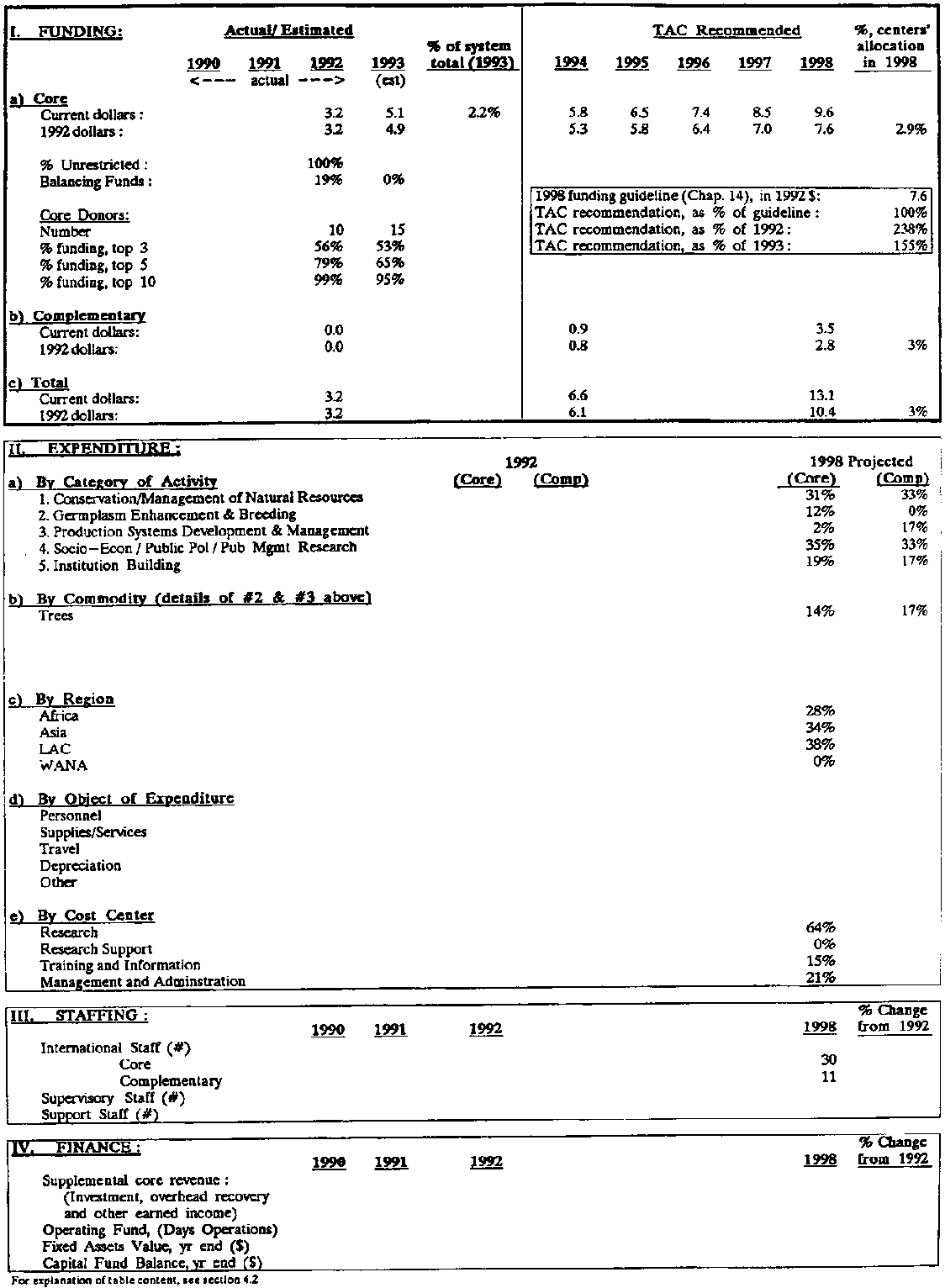
TAC recommends that CIFOR be assigned in 1998 core resources in the amount of US$ 7.6 million in 1992 dollars, which is equivalent to 100% of the tentative envelope. This level of funding is thought adequate at the stage of present development of the new Centre and the need to avoid a too rapid rate of growth. No addition is recommended at the US$ 280 million vector. However, the Centre would share in the funding recommended for the 'Alternatives to Slash and Burn' Systemwide initiative, for which ICRAF would serve as the convening centre, and also in other ecoregional initiatives.
For 1998, CIFOR projects complementary funding of US$ 2.8 million (in 1992 dollars) in 1998, representing 37% of CIFOR's recommended core funding.
For 1994, TAC recommends a core funding for CIFOR of US$ 5.3 million in 1992 dollars, or US$ 5.8 million in current values. Together with complementary funding at US$ 0.9 million, total funding of CIFOR in 1994 would amount to US$ 6.6 million.
CIFOR: FINANCIAL HIGHLIGHTS (US$ million & percentages)