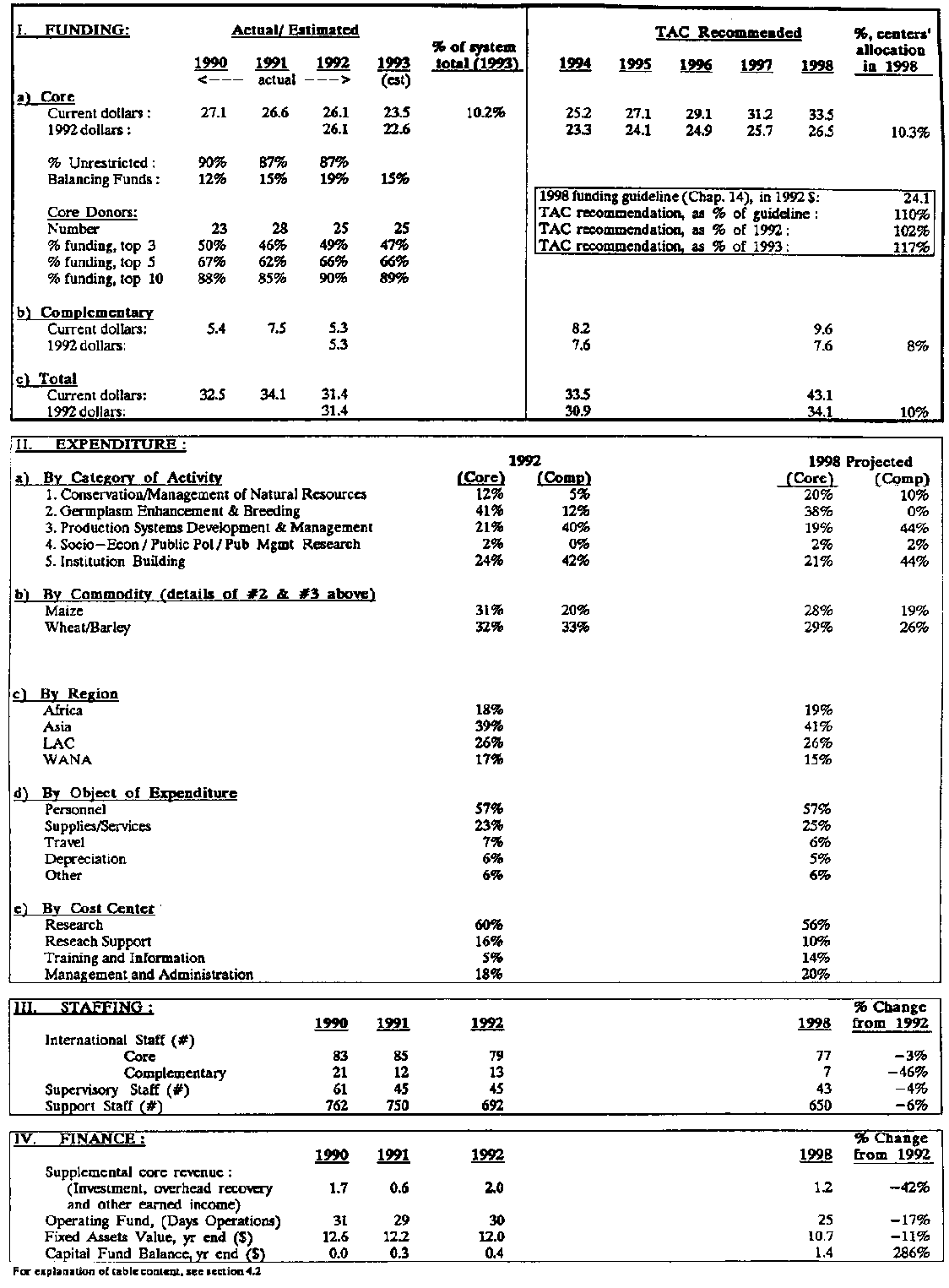
4.5.1. Summary of the MTP Proposal
4.5.2. Interim Commentary and Programmatic Issues
4.5.3. Centre Response
4.5.4. Evaluation
4.5.5. Recommendations
CIMMYT was founded in 1966 with the objective of increasing the production of maize and wheat in developing countries principally through research and research-related activities in germplasm enhancement and breeding.
In 1992, CIMMYT amended its mission statement to draw attention to the potentially negative effects of agriculture on the environment, and to highlight the importance of collaboration with national research systems. It now reads: "To help the poor by increasing the productivity of resources committed to maize and wheat in developing countries while protecting the natural resources. We do this through agricultural research and in concert with national research systems."
CIMMYT has essentially maintained the strategic direction envisaged in its 1989 Strategic Plan as modified through changing CGIAR priorities, in spite of the dramatic decline experienced in the number of senior and support staff, and significant reductions in core and complementary programmes since 1990. The downsizing of staff and programme activities was primarily due to financial stringencies in the CGIAR. Between 1989 and 1993, CIMMYT's core budget declined by about 25% in real terms, and by 13% in nominal terms between 1990 and 1993. During the same period, the number of senior international staff years in the core programme was reduced from 95 to about 75.
CIMMYT considers poverty to be the main underlying element in the nexus of problems associated with environmental deterioration and population increases. CIMMYT's role in alleviating these problems is to stimulate economic growth by developing new improved technologies that will increase productivity without degrading the natural resource base.
In view of the increased concern for natural resources management within the CGIAR, CIMMYT has decided to redeploy some of its core resources for research on natural resources management in two environments where maize and wheat cropping systems predominate. The Centre will concentrate on strategic research in natural resources management, particularly that of a long-term nature. Close collaboration is planned with NARS and other CGIAR Centres, in particular: CIAT, on maize based cropping systems in the hillside region of Central America; IIMI and IRRI on rice-wheat cropping systems in Asia; and IFPRI on public policy research.
The plan provides full programmatic details and financial requirements at the 110% level of the base resource envelope, requiring US$ 26.5 million in core resources to support 77.3 senior staff years (SSY) in 1998. Under this scenario, CIMMYT will devote a declining proportion of its core resources for maintenance breeding in wheat. A short narrative is also given on the impact of decreasing the budget to the level of the base resource envelope, which would require US$ 24.1 million to support 68.3 SSY in 1998, and of funding at 90% of the base resource envelope.
CIMMYT proposes to allocate 20% of its resources to conservation and management of natural resources, 38% to germplasm enhancement and breeding, 19% to production systems development and management, 2% to socioeconomic, public policy and public management research, and 21% to institution building. Maize and wheat research receive an approximately equal share of core resources, but research on wheat and barley benefit from a much greater share of complementary funds.
The programmatic issues on which TAC and the CGIAR asked CIMMYT to provide further information and clarification were: the status of the research on hillside maize cropping systems in Central America and the rice-wheat cropping systems in Southern Asia, including institutional mechanisms, relative to the ecoregional approach to research recommended by TAC; lowering costs through the use of consultants; the implications of the expected resource shifts towards natural resources research on CIMMYT's special advantage as a global commodity centre; and CIMMYT's advantage in maintenance research relative to the stronger NARS in developing countries.
CIMMYT considers the proposed hillside maize cropping system work in Central America to be a part of the broader ecoregional approach as defined by CIAT. CIMMYT's research activities will be in the biological/economic component of the ecoregional effort led by CIAT.
Regarding the rice-wheat irrigated cropping systems in South Asia, the work is expected to traverse more than one ecoregion. A broader range of issues normally associated with an ecoregion will be addressed through collaboration with IIMI, IFPRI and possibly ICRISAT. CIMMYT and IRRI plan to jointly identify a person to lead their effort in the region. Participating national programmes are expected to receive funding directly from bilateral sources. A regional organization of some type will be required to bring all interested parties together to share information and to foster cooperation.
With respect to maintenance research, CIMMYT argues that it is less costly to continue its maintenance breeding as at present than by devolution to the stronger NARS. CIMMYT believes that, in some circumstances, the use of consultants for its ecoregional activities will be a lower cost option for necessary inputs into the effort. Consultants will be used to obtain skills in areas such as modelling or computer-based simulation efforts which are required for periods too brief to justify a full-time position.
Because of financial stringencies, the growth in the activity of natural resources management research was at the expense of other activities, primarily TAC activity category 3 on production systems. Consequently CIMMYT believes that its principal role as a global commodity centre has not been compromised. Further, CIMMYT supports this redeployment of resources because it considers that the two natural resources management research projects are well focused. They fit and complement the Centre's goal of increasing productivity of resources committed to maize and wheat production. The research proposed is of a longer time frame but still focuses on systems based on maize and wheat and features extensive collaboration.
CIMMYT's MTP proposals are concise, transparent, and well reasoned. The priorities among and within programmes are clearly articulated and the objectives and targets have been well stated. Despite the reduced size of its staff and less funds than in the past, CIMMYT's MTP proposals provide an excellent scope for high quality research, achievements and impact. TAC recognizes that while CIMMYT has emerged from the MTP exercise with a more focused and more streamlined operation, the enforced downsizing has nevertheless affected the scale and scope of its operations and impact. If the downsizing were to continue, it would seriously affect the performance of the Centre. TAC considered that on priority considerations the tentative planning envelope assigned to CIMMYT should be readjusted upwards.
With respect to CIMMYT's planned activities in maintenance breeding, TAC notes a certain reluctance on the part of CIMMYT to relinquish some aspects of its germplasm enhancement and breeding activities. However, TAC notes that CIMMYT has devolved some of its training activities to selected national institutions in sub-Saharan Africa and Latin America. TAC would encourage CIMMYT to continue to devolve the routine aspects of breeding, including maintenance breeding, to the stronger national programmes.
TAC considered that CIMMYT's proposals were of a highly strategic character and with a very good potential for breakthroughs. CIMMYT has an excellent record in generating farm level impact and this is expected to continue. CIMMYT is well managed and has a healthy institutional environment. It collaborates well with NARS and other institutions.
On the basis of the additional information provided by CIMMYT and the views expressed by the Group at ICW'92, TAC found that there were convincing arguments for an increase in the resource envelope of US$ 24.1 million (in 1992 dollars) which had been tentatively assigned to CIMMYT. TAC recommends that CIMMYT be assigned for 1998 core resources in the amount of US$ 26.5 million which corresponds to 110% of the tentative resource envelope. With this level of funding at the US$ 270 million vector, TAC expects CIMMYT to strengthen its maize and wheat genetic enhancement work, biotechnology applications, natural resources management research, and research support services. This recommendation takes into account the importance of wheat and maize in developing countries, CIMMYT's impressive record of impact, and potential for future breakthroughs, and institutional health. CIMMYT will also benefit from funds recommended for Systemwide ecoregional and water management initiatives.
At the US$ 280 million vector CIMMYT would benefit from enhanced Systemwide activities in ecoregional research and water management.
For 1998, CIMMYT projects complementary funding at US$ 7.6 million (in 1992 values), which represents 29% of the Centre's recommended core funding for that year.
For 1994, TAC recommends a core funding of CIMMYT of US$ 23.3 million in 1992 dollars, or US$ 25.2 million in current values. Together with complementary funding of US$ 8.2 million, total funding of CIMMYT in 1994 will amount to US$ 33.5 million.
CIMMYT: FINANCIAL HIGHLIGHTS (US$ million & percentages)