4.6.1. Summary of the MTP Proposal
4.6.2. Interim Commentary and Programmatic Issues
4.6.3. Centre Response
4.6.4. Evaluation
4.6.5. Recommendations
CIP's primary MTP proposal reflects the implementation of its strategic plan, which was developed in 1991. The major thrusts of CIP's proposed activities are to continue research on potato and sweet potato, and to give greater emphasis to crop, soil and postharvest management. The most significant change proposed in the MTP is the creation and development of an ecoregional programme for the Andes region, which would expand CIP's mandate to include an ecoregional responsibility. CIP also proposed changes in the way it conducts research, by implementing a matrix management system composed of:
· 6 programmes: production systems; germplasm management and enhancement; disease management; insect and nematode management; propagation and crop management; and postharvest management and marketing· 33 projects
· 7 departments: breeding and genetics; genetic resources; nematology and entomology; physiology; pathology; social sciences; training and information
· 5 regional entities.
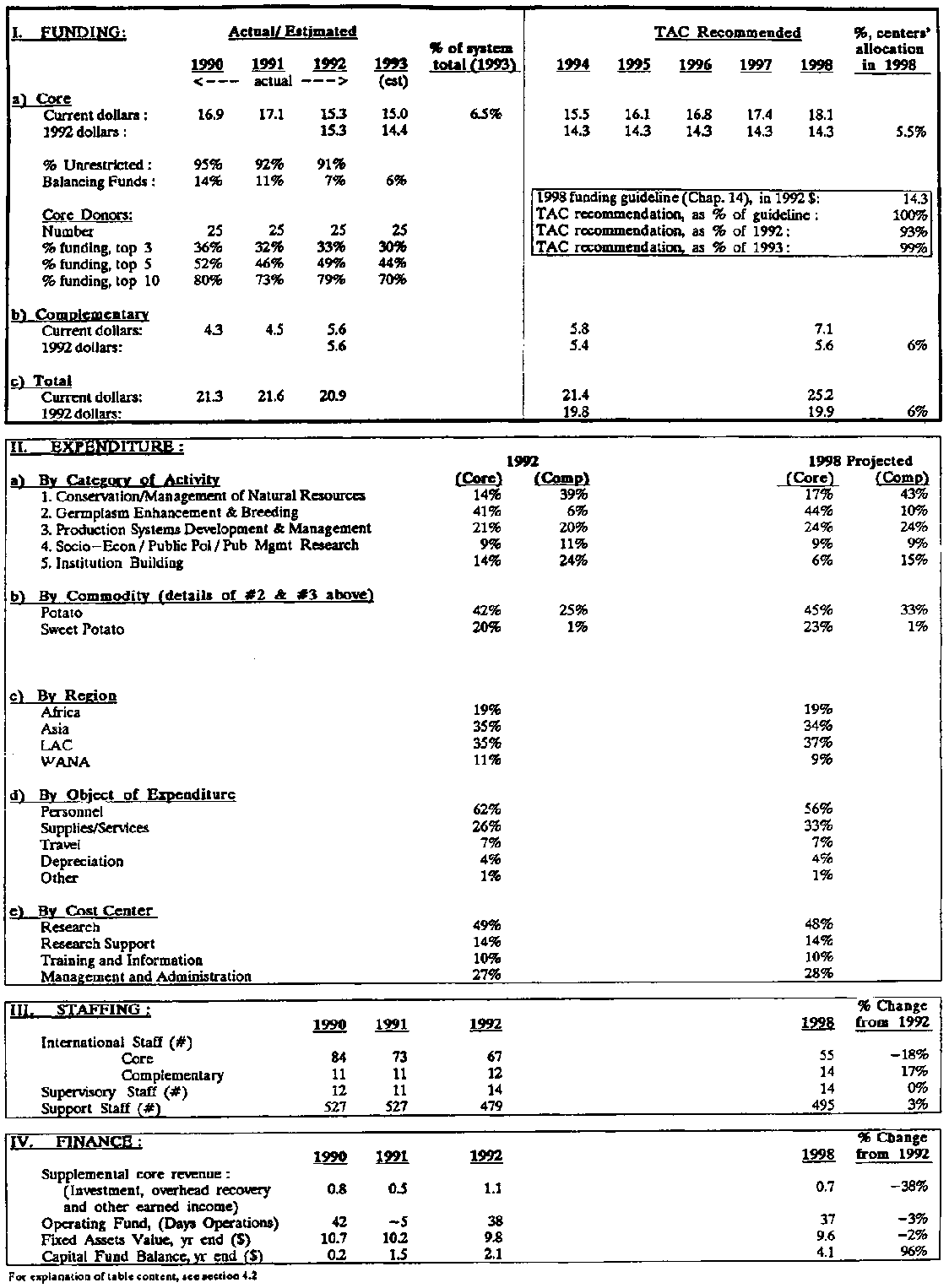
CIP's original primary MTP proposal was formulated at 127% of TAC's resource envelope, in which the allocation of resources by commodity amounted to 60% for potato and 40% to sweet potato. Approximately 5% of resources would have been allocated to conservation and management of resources, 41% to germplasm enhancement, 32% to production systems, 9% to socioeconomics and policy analysis, and 13% to institution building.
CIP's proposed activities in the Andes have grown out of a research network for Andean roots and tubers neglected by research, in which the Centre was already involved. CIP would expand this work by assuming a principal role in the coordination of research to develop sustainable systems for management of natural resources in the Andes. CIP's role would be primarily a catalytic one and would focus on activities in natural resources management and biodiversity. An international workshop has already been held with the collaborating partners, and responsibilities have been assigned.
TAC did not accept CIP's redefinition of its tentative resource envelope and requested supplementary proposals at the levels of 90%, 100% and 110% of the indicative resource envelope assigned by TAC. TAC was also concerned that CIP's global commodity responsibilities and its strategic germplasm work might be compromised by devoting increased emphasis on natural resources management research.
TAC asked for clarification of several aspects of the Andean initiative such as scope of the activity, role and contribution of the various partners, including CIP, the specific advantage CIP offers in this area, and the justification for the activity to be part of CIP's core programme. The Andes area is not considered a high-priority ecoregion in the review of CGIAR priorities and strategies. While CIP's priority-setting mechanism has been very methodological and rigorous, the new Andean Programme has not yet been incorporated in this analysis. Clarification was also requested about how the proposed activities in the Andean ecoregion could be reconciled with a proposed allocation of only 5% of CIP's resources to research on natural resources management.
CIP submitted a supplementary MTP proposal at the level of the base resource envelope, and at 110% and 90% of this level. The major implication of the lower budget levels (compared to the original MTP proposal) for CIP's programme would be the virtual elimination of the Andean Ecoregional Programme from the Centre's core activities. The total number of senior staff would amount to 55 positions at the base envelope level, and 60 at the 110% level.
At 100% of the envelope level, 57% of core resources would be allocated to potato research, 37% to sweet potato research and 6% to Andean activities. At this level which calls for core funding of US$ 14.3 million in 1998 (in 1992 values), CIP considers that it would be operating well below the critical mass required to operate effectively for a centre with its mandate. The core programme of the Centre at this level would consist of research on potato and sweet potato, while the Andean activities would be mostly part of the complementary programme. The only Andean activity to be continued at this level would consist of the Andean root and tuber germplasm research network to which two senior staff would be assigned, as a minimum effort required to fulfil CIP's mandate as specified in the founding agreement with the Government of Peru. At the base envelope level, CIP would also eliminate from its current core programme two senior staff posts at headquarters and two sets of regional activities; CIP's computer-based support and personnel management would be seriously eroded, as would its work in China and its support to African NARS for seed production systems.
At the 110% level, CIP would continue to operate more or less at current levels. Still, it would seek complementary funds to expand its activities beyond this level.
CIP has stressed the importance of a CGIAR involvement in the Andean ecoregion, particularly in view of the extent of rural and urban poverty, the importance for biodiversity, the rapid degradation of resources, the need to address the problems of migration effects on coastal and Amazonian ecologies, and the opportunities for spillovers from the research to other highland areas. The Andean initiative is strongly supported by donors and members of the CGIAR, several of which have expressed strong preference for core support to this activity. CIP's work on potato and sweet potato would not be seriously affected by the Andean Programme: TAC has been invited to carefully monitor the situation through CIP's detailed, project-based accounting system. CIP has submitted to TAC detailed information on the progress to date in implementing the Andean proposal, which involves participation of eight other CGIAR centres.
CIP considers that the high share of resources allocated to production systems and the low share for research on natural resources management is due to the confounding of cropping-systems work and land and water resources management. The objective of most of this cropping-systems work is to improve management of natural resources, but it requires community-level, participatory research. CIP has reclassified its activities in production systems and now estimates its allocation of resources as 24% to production systems development and management, and 17% to conservation and management of natural resources.
TAC saw no compelling reason on priority considerations to change the tentative level of resources assigned to CIP. The priority assigned to research on potato and sweet potato remains unchanged and TAC considers that the resource management aspects of the Andean Programme should be funded from complementary sources as the Andes are not considered as a high-priority ecoregion for the CGIAR. The Committee attaches high priority to the work on lesser-known roots and tubers in the Andes however. While the demand for potato in developing countries is growing rapidly, TAC also noted the substantial amount of research on this commodity in developed countries. With respect to sweet potato, TAC recalls that this commodity is predominantly grown in China and used increasingly as a livestock feed and for industrial purposes. CIP has a transparent, coherent priority-setting mechanism which, however, does not yet include the proposed Andean Programme.
TAC considers that CIP's proposals are of a strategic character and that they provide good potential for breakthroughs. CIP has performed well in the past and with its new impact-oriented strategy it is expected to do even better in the future. While the political situation in the host country is a continuing source of concern, some progress has been made lately. CIP is managed well and has demonstrated its ability to cope with difficulties related to host country situations, compounded by funding restrictions. CIP has excellent collaboration and partnership with national research systems around the world and has very innovative mechanisms for collaboration with advanced research institutes.
TAC recommends that CIP be assigned in 1998 core resources in the amount of US$ 14.3 million (in 1992 dollars) which is equivalent to 100% of the tentative envelope, under the US$ 270 million vector. TAC considers that the level of the tentative envelope adequately reflects the potential contribution of CIP to the achievement of System priorities. In a situation of more restrained funding, TAC would encourage CIP to maintain its applications of biotechnology which have proven to be successful in the past. CIP could also be a major partner in the proposed Systemwide ecoregional programme for the humid and sub-humid tropics and subtropics in Latin America for which CIAT will be the convening centre.
For 1998, CIP projects complementary funding of US$ 5.6 million (in 1992 dollars), which represents 39% of CIP's recommended core funding.
For 1994, TAC recommends core funding of US$ 14.3 million in 1992 dollars or US$ 15.5 million in current values. Together with a projected complementary funding of US$ 5.8 million, CIP's total funding in 1994 would amount to US$ 21.4 million. In addition to the core funding of US$ 15.5 million, TAC recommends to reinstate the one-time compensation of US$ 950,000 in 1994 to allow CIP to restore its working capital which was virtually depleted in 1989-92 as a consequence of difficult economic circumstances in its host country.
CIP: FINANCIAL HIGHLIGHTS (US$ million & percentages)