4.7.1. Summary of the MTP Proposal
4.7.2. Interim Commentary and Programmatic Issues
4.7.3. Centre Response
4.7.4. Evaluation
4.7.5. Recommendations
IBPGR's MTP proposal reflects the implementation of a new strategy which was adopted by its Board in 1992 and is written for the new institute - the International Plant Genetic Resources Institute (IPGRI) - which IBPGR will become, after ratification by the Italian Parliament of an agreement to locate IPGRI's headquarters in Italy.
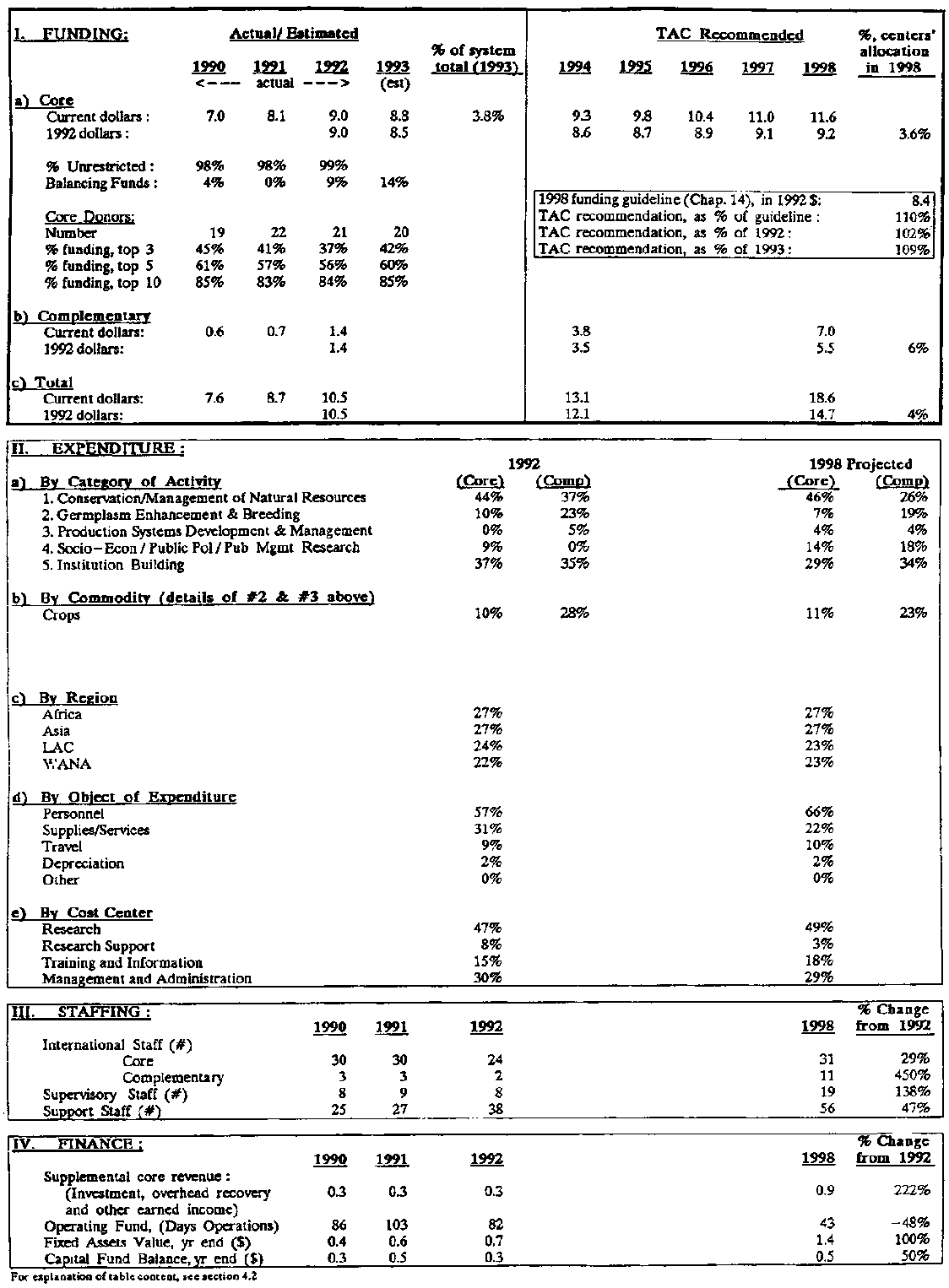
The primary MTP proposal and the new strategy take into account the implementation of Agenda 21, and the new funding opportunities likely to arise in response to new challenges for IBPGR in the follow-up to UNCED. The MTP proposal presents a 1998 core budget of US$ 9.2 million (110% of the base envelope and calling for 31 SSY) which IBPGR considers to allow for a minimum core programme, and permitting IBPGR to continue its 1993 programme and to implement its new strategy. The Plan presents three additional proposals in order of priority, i.e., forest genetic resources/biodiversity/in situ conservation/ethnobotany, calling for an additional US$ 1.9 million per year in core funding (scenario 2); activities on crops of ecoregional importance, which calls for an additional US$ 1.2 million per year (scenario 3); and a coconut genetic resources network, calling for an additional US$ 0.4 million per year (scenario 4).
IBPGR translates its mission into four operational objectives, to be pursued in collaboration with partners: (i) to assist countries, particularly developing nations, to assess and meet their needs for plant genetic resources conservation and to strengthen links to users (absorbing 30% of core resources); (ii) to strengthen and contribute to international collaboration in the conservation and use of plant genetic resources (20% of core); (iii) to develop and promote improved strategies and technologies for plant genetic resources conservation (30% of core); and (iv) to provide an information service on plant genetic resources (20% of core).
The Plan proposes to fulfil these objectives through five regional and three thematic programme groups. The regional groups are: sub-Saharan Africa, West Asia and North Africa (WANA), Asia, the Pacific and Oceania, the Americas and Europe. The thematic groups are: genetic diversity, germplasm maintenance and use, and documentation, information and training.
The regional, country and species/genepool priorities are set using aspects related to people and development, to genetic resources, and global partnership as the major guiding principles, and involves collaborative arrangements with CGIAR centres, FAO and other UN agencies, national and regional programmes, NGOs and the private sector.
Since plant genetic resources cross national and regional boundaries, their conservation has to be a truly global activity, and could not be confined to developing countries alone. In this context, IBPGR intends to allocate about 4% of it core resources to a regional programme in Europe in order to strengthen links and facilitate technology transfer between the extensive germplasm collections in Europe and the developing world, and to assist the management of plant genetic resources in Eastern Europe and the CIS Republics. For this reason the MTP proposal includes in its core programme a group leader for networking activities in Europe. While much of the work in Europe would continue to be undertaken through resources provided by the participating countries, IBPGR considers that one core staff position, with appropriate support, would be essential to provide a base for developing this networking approach. In particular, IBPGR will consider collaboration, through complementary programmes, with countries in Eastern Europe and the CIS Republics, where historic germplasm collections are under threat.
Of IBPGR's proposed 1998 core resources, 26% would be allocated to sub-Saharan Africa, 22% to WANA, 26% to Asia and the Pacific, 22% to the Americas, and 4% to Europe. By category of activity, the respective distribution would be: 46% to conservation and management of natural resources, 7% to germplasm enhancement and breeding, 4% to production systems development and management, 14% to socioeconomic, public policy and public management research, and 29% to institution building. Using explicit criteria to differentiate complementary activities from core, IBPGR proposes a budget for complementary activities which is equivalent to approximately 60% of the core budget, and most of the complementary project funding will be utilized for contracting out research, for training, and for funding network activities.
TAC commended IBPGR for the clarity of its MTP. TAC wanted to know the implications on the MTP proposals of including the additional proposals (scenarios 2, 3 and 4) at a budgetary level of the base envelope. TAC sought further details on IBPGR's research on socioeconomics and policy which are being worked out in collaboration with IFPRI, and on IBPGR's role in forestry relative to that of CIFOR, ICRAF and FAO. As a Systemwide issue, TAC asked whether there was a case for considering a separate funding mechanism to facilitate action on a Systemwide programme on plant genetic resources, and if so, what form it could take and what role IBPGR could play.
IBPGR considers that its primary core funding scenario of 110% of the indicative base envelope is the minimum needed to maintain a significant programme in ex situ conservation - the traditional area of strength of IBPGR. Under this scenario the major disciplines would be represented by one internationally-recruited scientist, with additional senior staff stationed in the regions to ensure close integration of the Centre's activities with those of national programmes and other relevant organizations. This funding level would allow only limited involvement in areas such as in situ and on-farm conservation, forest genetic resources and social science. Much of the urgently needed work in these areas would have to be funded from extra-core sources.
The effects of funding at the level of the indicative base envelope (US$ 8.4 million) would result in the loss of three SSYs (i.e. 10% of the current international staff) from the primary funding scenario and would seriously compromise IBPGR's ability to work in several key strategic and technical areas. Although it may be possible to maintain certain-high priority activities through special projects, areas in which significant programme reductions would occur are likely to include: the work on genetic diversity distribution (including the use of genetic and biochemical markers) and other key aspects of population genetics; seed and pollen physiology in relation to low-input drying and storage methods; social and cultural aspects of in situ conservation; and/or conservation strategy and technology development and support to national programmes in the Americas. Restructuring of the current thematic groups based at headquarters would also have to be considered.
Of the three additional proposals, IBPGR gives the highest priority to scenario 2, which calls for support for five additional SSYs (one at headquarters and four in the regions) to strengthen the activities on in situ and on-farm conservation, forest genetic resources and social science. These activities would significantly expand IBPGR's opportunities to contribute towards the achievement of the goals agreed at UNCED.
The focus of socioeconomics work is on the role of land-races in farming systems, from the perspective of both the conservation of genetic diversity (including in situ conservation systems) and the contribution that such materials can make to crop development. It will involve recording indigenous knowledge about species characteristics and their role in farming systems, and building on the complementarity between in situ and ex situ conservation methods. In addition to its involvement in the policy area concerning intellectual property rights, IBPGR, in partnership with other organizations such as FAO, IFPRI and ISNAR, will assist in the development of policy and management options for key players in agricultural development. This will involve looking at national genetic resources conservation policies, and links between conservation and use, as well as organizational and structural issues concerning plant genetic resources programmes within NARS.
IBPGR's main emphasis in forest genetic resources will be on the conservation of intra-specific genetic diversity. The programme will provide support to national programmes and conduct research and training in the development of appropriate conservation strategies, improvement of the scientific basis for in situ conservation, development of techniques for characterizing genetic diversity, improvement of methods for conserving recalcitrant seeds, development of improved phytosanitary procedures, development of an international information system, and integrating work on socioeconomics and cultural aspects in support of in situ conservation.
TAC considers that IBPGR's MTP proposal is clear and well thought through. It reflects the implementation of IBPGR's new strategic plan and its response to the recommendations of the Third External Review in 1991. The MTP document and the Centre response to TAC's interim commentary make a convincing case for IBPGR's vision of the minimum core programme required to implement its strategy, as well as the additional work that would be undertaken under a more favourable funding environment. IBPGR's regional and thematic priorities are realistic and forward looking, and the programmes are structured to ensure the required critical mass and scientific credibility.
TAC considers that IBPGR's programmes are catalytic and have a clear focus. The institution building activities and the strategic research work are an excellent response to the changing global perspectives on plant genetic resources, and the challenges and opportunities arising from the follow-up to UNCED. IBPGR's work is important because of the magnitude and the fundamental nature of the task, particularly in the traditional areas of ex situ conservation. However, some of the second generation problems - e.g., strengthening links to users; effective conservation strategies related to core collections and genepools; in situ conservation; and improving international collaboration - are of a long-term nature, and breakthroughs may be relatively difficult to achieve.
IBPGR has an excellent reputation at the international and national level, and is recognized as a lead player in the field of plant genetic resources. Its work has generally been of high quality and relevance. IBPGR has transformed itself in the recent past, and is equipped with high calibre staff and management to provide effective international leadership in the area of its mandate.
TAC considers that IBPGR's policy to promote activities throughout the world, including Europe, is appropriate, given the global nature of the work on plant genetic resources. IBPGR's collaborative arrangements reflect the recognition of the importance of national programmes in a coordinated global effort, and its role in providing scientific and technical expertise and information.
On the basis of the above and additional information provided by IBPGR, and in the light of UNCED and other recent developments in the global perspectives on plant genetic resources and biodiversity, TAC considered that the amount of resources tentatively assigned to IBPGR should be revised upwards. IBPGR's plan addresses issues of high priority to the CGIAR and forms an appropriate response to the changing global perspectives on the conservation and use of plant genetic resources, and the concerns for biodiversity. IBPGR's collaboration with NARS, other IARCs and advanced institutions is impressive, wide ranging and generally effective. It has always relied on linkages with partners, including development agencies, to achieve its objectives.
TAC recommends that, at the US$ 270 million vector, IBPGR's core resources for 1998 should be US$ 9.2 million (in 1992 dollars), which is equivalent to 110% of the tentative envelope. At this funding level, TAC expects IBPGR to include the Coconut Genetics Resource Network into its core programme. IBPGR will also be the convening centre for the implementation of a Systemwide initiative on plant genetic resources (see Section 3.1.2.). For that programme, TAC recommends that US$ 1 million be allocated from 1996 onwards at the US$ 270 million vector, and that this amount be increased to US$ 2 million at the US$ 280 million vector.
TAC recommends that IBPGR's own core resources (i.e. excluding the Systemwide initiative) should increase by US$ 1.5 million (in 1992 values) at the US$ 280 million vector. TAC expects that this would allow IBPGR to include in its core programme the work on forest genetic resources/biodiversity/in situ conservation/ ethnobotany (scenario 2), and on population genetics and the genetic structures of populations.
Also for 1998, IBPGR projects complementary funding of US$ 5.5 million (in 1992 values), which represents 60% of its recommended core funding.
For 1994, TAC recommends a core funding for IBPGR of US$ 8.6 million in 1992 dollars, or US$ 9.3 million in current values. Together with complementary funding at US$ 3.8 million, total funding of IBPGR in 1994 would amount to US$ 13.1 million.
IBPGR: FINANCIAL HIGHLIGHTS (US$ million & percentages)