4.8.1. Summary of the MTP Proposal
4.8.2. Interim Commentary and Programmatic Issues
4.8.3. Centre Response
4.8.4. Evaluation
4.8.5. Recommendations
ICARDA's MTP proposal is based on its long-term strategy entitled 'Sustainable Agriculture for the Dry Lands', prepared during 1989. The MTP proposal is presented at two levels of funding, i.e., the indicative base resource envelope (US$ 17.6 million) and 110% of that level, assigned by TAC. A supplementary scenario at 90% of the resource envelope has also been presented.
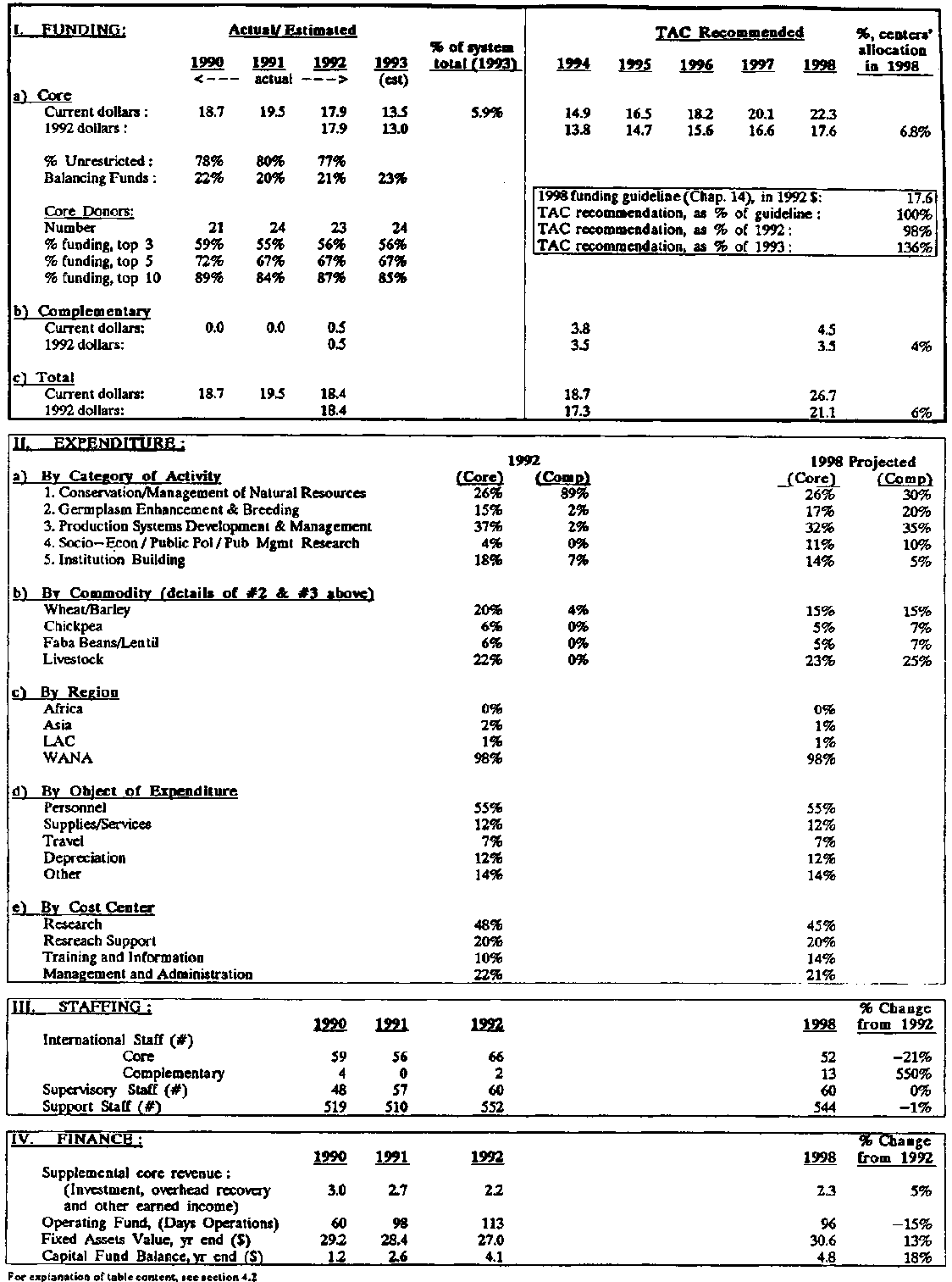
The MTP proposal follows a project-budgeting approach, based on a matrix of ICARDA projects structured within the categories of activity used in the CGIAR resource allocation process. A total of 23 projects were proposed: three in Conservation and Management of Natural Resources (accounting for 26% of core resources at the base resource envelope level); nine in Germplasm Enhancement and Breeding (17%); six in Production Systems Development and Management (32%); three in Socioeconomics, Public Policy and Public Management (11%); and two in Institution Building (14%). The projects will be carried out under four programmes: Farm Resource Management (30% of resources, at the base resource envelope level); Cereals (27%); Legumes (21%); and Pasture, Forage and Livestock (22%).
Since 1989, when the level of staffing was frozen at the then-filled senior staff positions (66 out of 72 authorized posts), four positions have been vacated. Out of sixty-two currently-filled positions, four posts would have to be cut at the 110% scenario, and six more at the base resource envelope. Core-funded staff would be reduced in administration and in all categories of activity except category 4 (socioeconomics and public policy); the greatest reduction would be in category 5 (institution building). Staffing of category 4 would be increased, as would research support at the 100% and 110% funding levels and throughout the MTP period.
If 1998 core funds were to be limited to the base envelope level, ICARDA states that it would have to reduce the magnitude of the proposed natural resources management research, including work on soil fertility and sustainability. It would also cause studies on the agronomy of the barley/livestock zone to be discontinued, the formation of a livestock network to be postponed indefinitely, and affect negatively ICARDA's joint research with CIMMYT.
ICARDA states that, even at the 110% scenario, cuts will be necessary in the ongoing cereal and legume work in North Africa and rangelands studies in Baluchistan. Training, and publications in Arabic and French would also have to be reduced.
TAC was pleased with the clarity of ICARDA's MTP proposal and the interactive process followed by ICARDA to develop it. TAC noted the significant reductions in senior staff positions, but requested clarification on the programmatic implications, and their nature, of the projected reductions. In view of the developments in ICARDA's mandate region and the consequent, possible increase in requests for ICARDA's assistance, TAC requested information on the likely programmatic and resource implications of an expanded geographical focus.
Also, TAC asked ICARDA for the rationale underlying the differentiation of its core from complementary activities, and to indicate the resulting proportion of complementary activities in ICARDA's total programme. The Committee sought further information on ICARDA's projected work in irrigation research, particularly vis-a-vis IIMI's role and also requested the Centre to elaborate on its current strategy on the devolution of lentil breeding activities. Finally, TAC requested that ICARDA elaborate on the implications of income from in-trust and complementary project funds and on the programmed reductions in World Bank support to its core programme.
ICARDA noted that its MTP proposal was transparent and specific with respect to reductions in senior staff positions. ICARDA's approach was based on the assumption that austerity is cyclical, and that for the next five years the aid climate may change for the better. ICARDA's strategy has therefore been, as far as possible, to maintain the integrity of its programmes.
ICARDA stated that it had used TAC's definitions of core and complementary activities. However, due to financial constraints, non-core sources are being sought to fund some core activities. Many of the activities financed with complementary funds are outreach. In concurrence with TAC's recommendation, ICARDA reported that it would devolve its lentil breeding activities in the longer term. However, in view of donor support for a strong legume programme at ICARDA, and the statement in the report of 1993 external review that "the remaining level of activity proposed in ICARDA's MTP is appropriate and irreducible", the Centre awaited advice from TAC.
ICARDA has participated in activities with NARS in the WANA region using complementary funds. In the light of the current and projected funding constraints, ICARDA has had to withdraw some of its staff in outreach to ensure critical mass at headquarters. ICARDA's irrigation activities will be limited to research on the use of irrigation water at the farm level, e.g., research on water-saving techniques and conservation strategies. ICARDA also participates in other irrigation projects with NARS in WANA, using complementary funds, and has recently signed a collaborative agreement with IIMI.
ICARDA's interest in the Central Asian Republics is based on the ecoregional continuity of the sub-regions within WANA. The Centre is seeking additional, non-core funds for work in these areas and has already submitted two project proposals to donors. Initially, however, priority is being given to formulating a strategy for intervention in the area. The Centre has recently negotiated a five-year, US$ 10 million project with the Government of Iran to expand its research on highland agriculture in the WANA region. ICARDA will continue to collaborate with individual scientists and institutions in the Central Asian Republics, but has no plans for a physical presence in these new areas.
ICARDA holds about US$ 1.85 million in trust annually (8% of the annual budget) for transmittal to designated beneficiaries in the countries of its mandated region. This generates about US$ 200,000 of earned income each year, and supplements core funding from other sources. The donor-of-last-resort contributions have fallen in accordance with an established formula, but together with other reductions in donor funding, this decline is having serious adverse effects on the Centre's programme.
ICARDA's MTP proposal is clear, has been prepared through an interactive process with its national programme partners, and reflects the implementation of the Centre's strategy. Its proposal is consistent with CGIAR priorities and strategies. The tentative resource envelope assigned to ICARDA reflected TAC's views on the priority of the WANA region, of the mandate commodities of the Centre and of ICARDA's increased emphasis on natural resources management and policy research. At TAC 61, the Committee saw no compelling reason on priority considerations to change the level of this tentative envelope.
TAC considered that ICARDA's proposals were generally of a strategic character with a good potential for breakthrough, taking into account the difficulties of making progress in arid and semi-arid environments. ICARDA has performed well in the past, and the recent external review has given firm indications that past management problems have been resolved and that the institute is institutionally healthy. TAC notes that one of ICARDA's strengths lies in its collaboration with national research systems and partnerships with other institutions, including other CGIAR centres. It sees the effectiveness of these linkages as a major advantage as the Centre expands its engagement in ecoregional activities.
TAC agrees with ICARDA's cautious approach about its involvement in the Central Asian Republics and with irrigated agriculture. The Committee would encourage ICARDA to study carefully the suggestions of the recent external review with respect to restructuring of programmes for a more effective use of resources. TAC also notes that ICARDA's future involvement in livestock research should be in accordance with the global CGIAR strategy for livestock research which, following the decisions taken at MTM'93, is currently under discussion for implementation. TAC urges ICARDA to pay particular attention to its fund-raising strategy, such that donor commitment would reach, as a minimum, the level of the core resource envelope.
TAC recommends that ICARDA be assigned in 1998 core resources of US$ 17.6 million (in 1992 dollars), equivalent to 100% of the tentative envelope. TAC considers that this level corresponds to the potential contribution the Centre can make to the achievement of System priorities. ICARDA has also been identified as the convening centre for a Systemwide ecoregional programme in WANA (see Section 3.1.2) (cool subtropics with winter rainfall), for which an amount of US$ 400,000 has been recommended by 1998 under the US$ 270 million vector; at the US$ 280 million vector, TAC recommends that this amount be increased by US$ 125,000.
ICARDA has also been identified as a participant in a Systemwide water management programme with IIMI as the convening centre, and for which US$ 1 million has been recommended at the US$ 270 million vector, and an additional US$ 1 million at the US$ 280 million vector.
For 1998, ICARDA projects complementary funding of US$ 3.5 million (in 1992 values), which represents 20% of ICARDA's recommended core funding for that year.
For 1994, TAC recommends a core funding for ICARDA of US$ 13.8 million in 1992 dollars, or US$ 14.9 million in current values. Together with complementary funding at US$ 3.8 million, total funding of ICARDA in 1994 would amount to US$ 18.7 million.
ICARDA: FINANCIAL HIGHLIGHTS (US$ million & percentages)