4.9.1. Summary of the MTP Proposal
4.9.2. Interim Commentary and Programmatic Issues
4.9.3. Centre Response
4.9.4. Evaluation
4.9.5. Recommendations
ICLARM's original MTP proposal reflected the implementation of its strategic plan, on the basis of which the Centre was admitted to the CGIAR in 1992. The strategic plan had been developed using elaborate priority-setting mechanisms and a set of guiding principles. In its original MTP proposal, ICLARM proposed three major research programmes: the Coastal Resource Systems Programme (CRSP); the Coral Reef Resource Systems Programme (CRRSP); and the Inland Aquatic Resource Systems Programme (IARSP). These programmes would be supported by the National Research Support Programme (NRSP) and the Information Division. The CRSP would focus on integrated coastal fisheries management, the dynamics of multispecies resources and the socioeconomics dimension of coastal fisheries. The CRRSP would aim at improving resource management and improving reef productivity. The IARSP would work on both fish productivity and integrated resources management. The NRSP is dealing with human resources development and activities related to strengthening national institutions. The Information Division has the responsibility for technical publication and dissemination, information services and information research (i.e., impact assessment).
The original proposal made by ICLARM required resources at a level of US$ 10.7 million, i.e., 224% of the level of the base resource envelope tentatively assigned by TAC in March 1992. It projected an annual increase in senior staff of 16.5% between 1994 and 1998. The proposed allocation of core resources by category of activity would have been 30% to resource management, 5% to germplasm enhancement, 20% to production systems, 22% to policy work, and 23% to institution building. The regional distribution of these resources would have been 70% to Asia, 22% to Sub-Saharan Africa, 5% to Latin America, and 3% to WANA.
ICLARM also presented, in general terms, implications of funding at the level of the indicative base envelope of US$ 4.8 million and at 90% and 110% of this level. At these levels, the number of senior staff (SSY) would amount to 19 SSYs, 17.5 SSYs, and 20.5 SSYs respectively - compared with 40 SSYs for the primary proposal (at 224% of the base envelope) - and each of these three scenarios would allegedly cause ICLARM to change its programme structure.
TAC considered ICLARM's MTP original proposal to be very ambitious, though it reflected the implementation of the Centre's strategic plan. ICLARM's programme proposals at 90%, 100% and 110% of the resource envelope level were presented only in very general terms. More definite, Board-approved information was required. In contrast with the strategic plan, ICLARM's MTP proposal was not accompanied by a summary of ICLARM's priority-setting mechanisms and outcome of their application. Clarification was also required with regard to the linkage between programme scenarios formulated for different funding levels and the priority-setting mechanisms. TAC expressed its concern about the proposed rapid expansion of staff in the first few years of the MTP period. This would have major implications for the management of human and physical resources and would not allow adequate time for building high quality research capacity.
TAC also required additional information about the strategic context of the proposed activities of the Coral Reef and the Coastal Resource Programmes, an issue already raised in its commentary on ICLARM's external review.
TAC noted that ICLARM intended to allocate approximately 22% of its 1998 core resources to socioeconomic and policy work. The nature, scope and context of this work, which would represent a major share of ICLARM's resources, needed to be clarified. Furthermore, TAC requested additional information about the proposed collaboration of ICLARM with WARDA and IITA in the inland valleys.
TAC considered that ICLARM's success would depend on the effectiveness of the very large number of collaborative arrangements it has. This raised the issue of the substantive quality of such arrangements and, in particular, additional information was required on the nature and modalities of ICLARM's working relations with advanced research institutes.
Finally, TAC was concerned that fisheries research should not be funded at the expense of ongoing agricultural research in the CGIAR. An updated assessment from ICLARM on the prospects of incremental CGIAR core funding for fisheries research, as well as information on ICLARM's resource mobilization and financial strategies were therefore requested.
In response to TAC's requests, ICLARM submitted a revised MTP proposal much more in the line with the guidelines on indicative envelopes and supplementary scenarios at 90 and 110% of the base envelope level. The major change in the revised proposal - compared to the original, primary proposal - was the restructuring of ICLARM's work into two major programmes only: the Inland Aquatic Resource Systems Programme would be retained, while the Coastal and Coral Reef Systems Programmes would be combined into one, and the National Research Support Programme would be reduced to a training unit. The proposed activities captured the main features of the original MTP proposal, but shifted a number of elements from the core into the complementary programme.
ICLARM submitted additional information on its priority-setting mechanisms. From this information, it appeared that the lower level scenarios of the MTP proposal were obtained by across-the-board reductions from the primary proposal. At the base envelope level, programmes were combined thus resulting in economies of scale.
ICLARM has considered the impact of different rates of staff growth. Under the revised proposal, it had imposed on itself a 20% limit on staff growth per year and would hire a human resources manager to assist ICLARM in dealing with a rapid expansion of staff.
ICLARM considered that the strategic context of the proposed research activities of the Coral Reef and Coastal Resources Systems Programmes reflected two approaches to strategic research, each with a different focus. With respect to the CRSP, the focus was on the development of methods and tools for assessing and managing harvestable resources. The focus of the CRRSP was on social and economic aspects of management of coral reef resource systems and the way in which productivity could be increased by aquaculture or fishery enhancement systems.
With respect to the high share of core resources intended for policy research, ICLARM noted that there had been an inaccuracy in the original classification of activities into categories; the share of resources which should be allocated to policy research was actually about 17%. This still high allocation to policy work reflected the recommendations from the Study on International Fisheries Research (SIFR) and the urgent need to evaluate fisheries management within a socioeconomic context.
Regarding collaborative efforts, ICLARM had major expectations for a large collaborative research project on rice-farming systems which was still awaiting clearance by IRRI and support from donors. ICLARM also proposed collaboration with WARDA and IITA in their Inland Valleys Programme, but the nature of this work was still under discussion. ICLARM has also provided TAC with a number of examples of how it worked with advanced strategic research institutes.
ICLARM stressed that "much of its funding comes from sources that are directly related to fisheries and cannot be tapped by the agricultural research sector". ICLARM considers that it has also been successful in tapping "green" funds, which should be incremental to the CGIAR traditional sources of core funding. Joining the CGIAR had made it easier for a number of donors to support the Centre with institutional support. ICLARM was confident that in the coming years, it would be able to increase its current funding, though at a more modest rate of increase than in the past few years.
TAC considered that the priority to be assigned to fisheries research had already been adequately reflected in the level of the tentative resource envelope assigned to ICLARM in March 1992. Fisheries research is a new venture in the CGIAR and the CGIAR should plan its involvement cautiously. ICLARM's revised MTP proposal is in tune with the 'CGIAR Guidelines for the Preparation of MTP Proposals', and is less ambitious than the original plan. TAC considered that the revised MTP proposal, at the level of the indicative resource envelope, reflected an appropriate level of effort required to implement the strategic plan for international fisheries research developed by ICLARM. Recent developments, such as UNCED, had stressed the importance of fisheries research for developing countries and there is increasing evidence that many of the major species are now over-fished.
TAC considers that the major challenge facing ICLARM during the forthcoming MTP period will be to transform itself from a project - to a programme-driven organization with institutional cohesion. ICLARM's success as a CGIAR institute will be dependent upon the implementation of a range of programme and management recommendations made by the External Review Panel.
TAC endorses the Inland Aquatic Resource Systems Programme which is of high priority to the CGIAR. The focus of the Coral Reef Systems Programme may be too broad. Furthermore, TAC considers that there is no convincing proof that the productivity of coral reef fisheries can be increased significantly by stock enhancement procedures. It urges ICLARM to first undertake research on this key question. TAC would encourage ICLARM to maintain the information activities even in a situation of budgetary restraint. As indicated earlier, TAC had considered ICLARM's original primary proposal at 224% of the base envelope to be too ambitious and involving too rapid rates of growth.
TAC considers that ICLARM's revised proposal is of a strategic character reflecting the implementation of its strategic plan. There are good chances for breakthroughs but the institutional health and the quality of governance and management -and their sustenance - will continue to be a source of concern to TAC. ICLARM collaborates well with other institutions particularly with NARS and advanced institutions. ICLARM also intends to collaborate closely with IFPRI, IITA, WARDA, IIMI, ISNAR and IRRI.
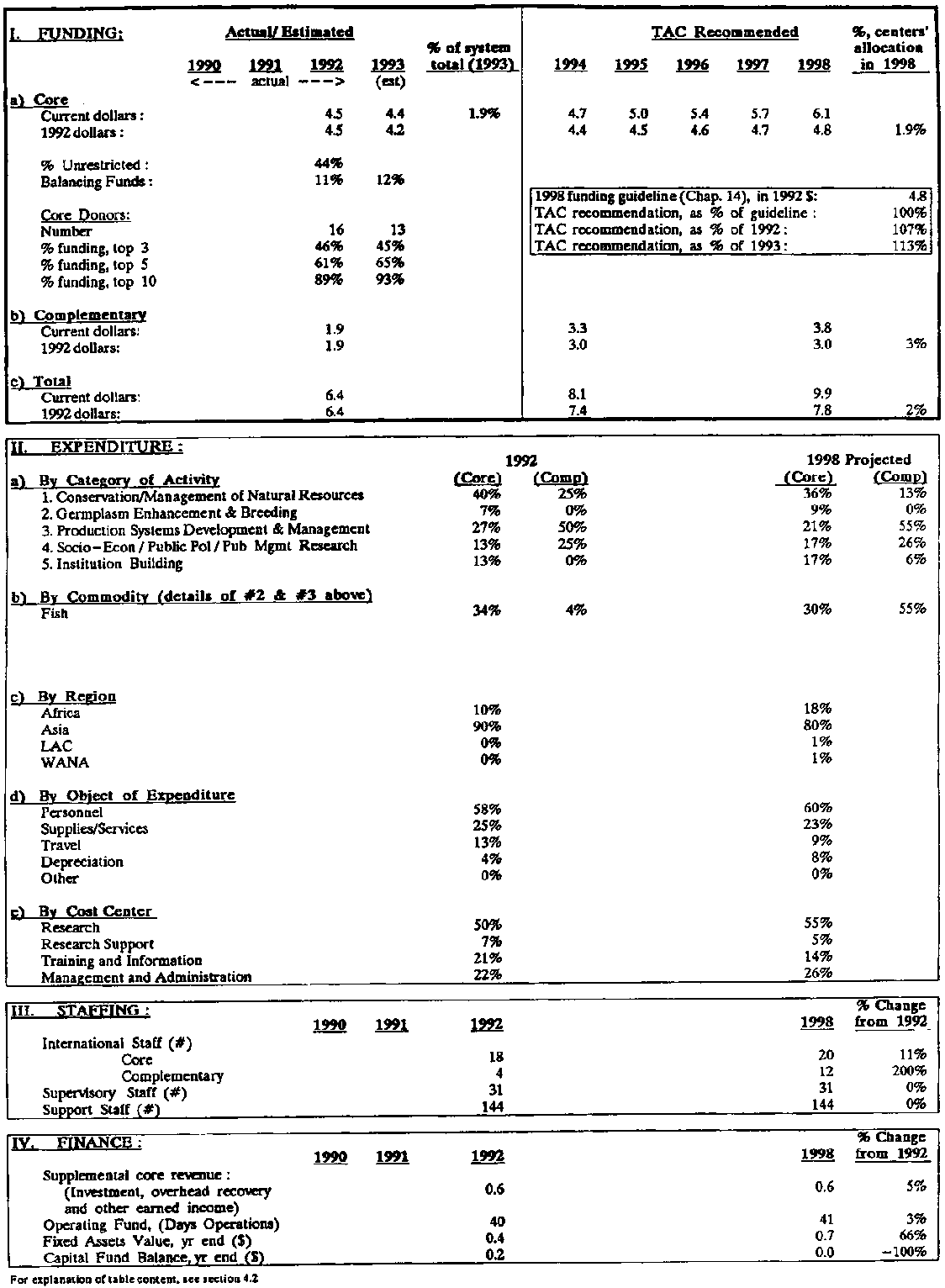
TAC recommends that ICLARM be assigned core resources in the amount of US$ 4.8 million (in 1992 dollars) in 1998, i.e., at the level of the indicative envelope. TAC has attempted to take a long-term perspective on ICLARM so as not to be unduly influenced by current problems of management and governance. If the Centre improves its institutional health and if the Mid-Term Review of ICLARM provides convincing evidence that its research programmes can be implemented effectively, a further US$ 500,000 will be added to the envelope during 1996 and another tranche of US$ 500,000 during 1997. These additional allocations, treated as a reserve, are intended for the natural resources management thrust of the Inland Aquatic Resource Systems Programme, and for research on the management of resource systems in a social context of the Coastal Systems Programme. If more resources were to become available to the CGIAR, TAC recommends that at the US$ 280 million vector, a further US$ 1 million be assigned to Systemwide fisheries research - for which ICLARM would likely be the convening centre - in support of ecoregional initiatives, particularly on inland valleys with WARDA and IITA, and for joint policy research with IFPRI and IIMI on common property resources and open access issues.
For 1998, ICLARM projects complementary funding of US$ 3.0 million (in 1992 values), equivalent to 63% of its recommended core funding for that year.
For 1994, TAC recommends core funding for ICLARM in the amount of US$ 4.4 million in 1992 dollars, or US$ 4.7 million in current values. With complementary funding projected at US$ 3.3 million, ICLARM's total funding in 1994 would amount to US$ 8.0 million.
ICLARM: FINANCIAL HIGHLIGHTS (US$ million & percentages)