4.10.1. Summary of the MTP Proposal
4.10.2. Interim Commentary and Programmatic Issues
4.10.3. Centre Response
4.10.4. Evaluation
4.10.5. Recommendations
The structure of ICRAF's MTP proposal is closely linked to its strategy and mandate. The admission of ICRAF into the CGIAR in 1991 transformed it from an organization which was development-oriented with a focus on adaptive research, into a Centre for global research on agroforestry. ICRAF's MTP proposal has an emphasis on strategic research and the links between environmental and human equity issues. While it is now a predominantly research-oriented institution, ICRAF has attempted to retain a highly practical and collaborative approach in its programmes. The research projects are designed to build on ICRAF's aim to establish agroforestry as a viable approach to address the crucial issues of rural poverty, land degradation, and sustainability of land-use systems.
ICRAF's initial focus was on undertaking research and dissemination activities in collaboration with NARS and other institutions. The resulting networks (Agroforestry Research Networks for Africa - AFRENAs) have gained in maturity and the associated adaptive research activities are to become the main responsibility of the national programmes. A further evolution is the gradual transformation of the AFRENAs into ecoregional mechanisms as, for example, ICRAF's contribution to the new Integrated Natural Resource Management Research Programme for the Highlands of East and Central Africa, which operates under ICRAF's leadership.
The MTP proposal presents 23 projects organized into 4 research and 3 dissemination programmes. The research programmes10 provide the basis for a strategic and applied research agenda aimed at understanding and interpreting basic biophysical and socioeconomic processes connected with the performance and adoption of improved and new agroforestry technologies. The associated studies are carried out on station11 and on farm12. They include improved fallows, contour hedgerows, indigenous fruit trees, multi-strata systems (for maintenance of soil fertility and control of soil erosion), fodder banks and systems with upper storey trees for wood production. The MTP proposal expands, for each programme, on their respective objectives, major activities, milestones and the expected impact, as well as the rationale for the relative allocation of resources.
10 Characterization and impact; Multipurpose-Tree Improvement; Component Interactions; and. Systems Improvements11 Mainly in Machakos, near Nairobi
12 For example, at Mbalmayo, Cameroon, and Maseno, Kenya
The primary MTP proposal presents resource-related data at 110% of the indicative resource envelope (US$ 17.4 million) as well as full details for the preferred scenario at 125% (US$ 19.7 million). However, in conformity with the CGIAR Guidelines, ICRAF produced a programme scenario at the level of the base resource envelope of US$ 15.6 million. This scenario will involve eliminating, from the 110% scenario, activities in the semi-arid lowlands of West Africa an one education project. In addition, ICRAF submitted information on the implications of the 90% funding scenario.
In its 110% scenario, ICRAF proposes to allocate 16% of its core resources to conservation and management of natural resources (category 1), 9% to germplasm enhancement and breeding (category 2), 42% to production systems (category 3), 11% to socioeconomic, policy and management research (category 4), and 22% to institution-building (category 5). In the same scenario and in terms of regional distribution, 82% of the core resources would benefit Africa, 8% South-East Asia and 9% Latin America.
TAC asked ICRAF to elaborate on a number of programmatic issues. TAC was concerned about rapid expansion at a time when there was an urgent need for building depth and quality into ICRAF's existing research programme. TAC suggested that there should be a relatively slow rate of growth, which would also be in conformity with MTP guidelines.
While agreeing with ICRAF that there was need for research to validate agroforestry technologies, TAC felt there also should be a critical review of alley farming or hedgerow intercropping. A further clarification of ICRAF's definition of core and complementary activities, and the division between restricted and unrestricted core funds was requested by TAC. TAC wished to have a clear indication of how the 'Alternatives to Slash and Burn Agriculture' initiative fitted into the funding picture, and on the role of ICRAF as the global coordinator of this initiative.
A reassessment was required on ICRAF's role in tree breeding in terms of strategic research on genetic variation, reproductive biology, and vegetative propagation to assist national programmes in devising strategies to produce good-quality germplasm for diffusion into farming systems.
ICRAF assured TAC that it would not put growth ahead of building depth and quality in its research programmes. The Centre would avoid making hasty recruitment and was determined to recruit the best people for the various positions. ICRAF argued that the transition from being a Council to a global agroforestry research Centre was driving a large part of its growth, the greater part of which was accounted for by activities outside Africa. ICRAF currently maintained the equivalent of 2 senior staff years (SSY) in South-East Asia and 3 SSYs in Latin America. By 1995 these numbers would rise to 5 SSYs in each region.
On validation of agroforestry technologies, ICRAF reported that a group of the Centre's scientists had carried out a synthesis of research on alley-cropping. Similar reviews were being planned for the technology involving improved fallows, and the work on improved, farmed parkland systems in the semi-arid regions of West Africa. In particular, the Technology Testing Project under the Characterization and Impact Programme and for which 3.7 SSYs were being allotted from 1994 onwards, would pool data from the biophysical and socioeconomic research into expert systems for identifying those conditions necessary for the adoption of specific technologies.
ICRAF had defined 'core' as "those activities that are essential to achieve our strategic objectives, and where the Centre has (or intends to gain) a comparative advantage in conducting the activity". Prior to 1992, the terms 'unrestricted' or 'restricted' were used to classify funds in accordance with the nature of donor contributions. But thereafter, activities had been partitioned into core and complementary by applying the criteria included in the MTP Guidelines.
The priorities of the programmes for the humid tropics of Africa, Asia and Latin America were closely related to those of the 'Alternatives to Slash-and-Burn Agriculture', which were considered as 'core'. The Global Environmental Fund (GEF) was one source of additional non-core funding which had been made available to the global consortium on 'Alternatives to Slash and Burn'. This global initiative set up by 17 national and international institutions in partnership with several NGOs was coordinated by a Global Steering Group chaired by ICRAF. One of its functions was to ensure that methodologies used to collect, analyze and present data, would be standardized across all benchmark sites. Results at each site would then be synthesized at regional and global levels for extrapolation to the appropriate agroecological zones for use by agents of change, farmers, policymakers and other relevant decision-makers.
ICRAF's tree breeding work would concentrate on eight multipurpose tree species which would focus on collections of the natural range of the test species, evaluate their genetic variation and analyze the heritable traits. Breeding strategy would concentrate on developing appropriate methods of multiplying desirable phenotypes at seed orchards. ICRAF's intention was to work closely with NARS to help them build capacity and obtain required germplasm.
ICRAF's MTP proposal is congruent with the Centre's long-term strategy and CGIAR's priorities and strategies for forestry/agroforestry. ICRAF has been forthright and transparent in addressing the various issues raised in connection with the MTP proposal. ICRAF's Board and management have indicated that the targets set in the proposed research programmes are realizable, but ICRAF has to maintain the momentum evident in its work since its admission into the CGIAR System as well as sustain the goodwill and support of its current and prospective donors.
ICRAF's leadership role in the 'Alternatives to Slash and Burn Agriculture' initiative in sub-Saharan Africa, South-East Asia and Latin America is appropriate. This project may be the precursor of many such research programmes for the realization of some of the objectives under Agenda 21 of UNCED.
ICRAF has repeatedly asserted that it can maintain scientific quality while at the same time expand the activities of the Centre. But scientific quality is not determined solely by the recruitment of high quality scientists; it also depends on the design of programmes, monitoring of programme development and field activities, as well as close interaction between Centre scientists and collaborators.
TAC considered ICRAF's proposal to be generally of a strategic nature with a good potential for breakthrough. ICRAF is well managed and, as indicated by the recent external review, is institutionally healthy. The Centre has a very good record for collaboration with NARS and other partner institutions.
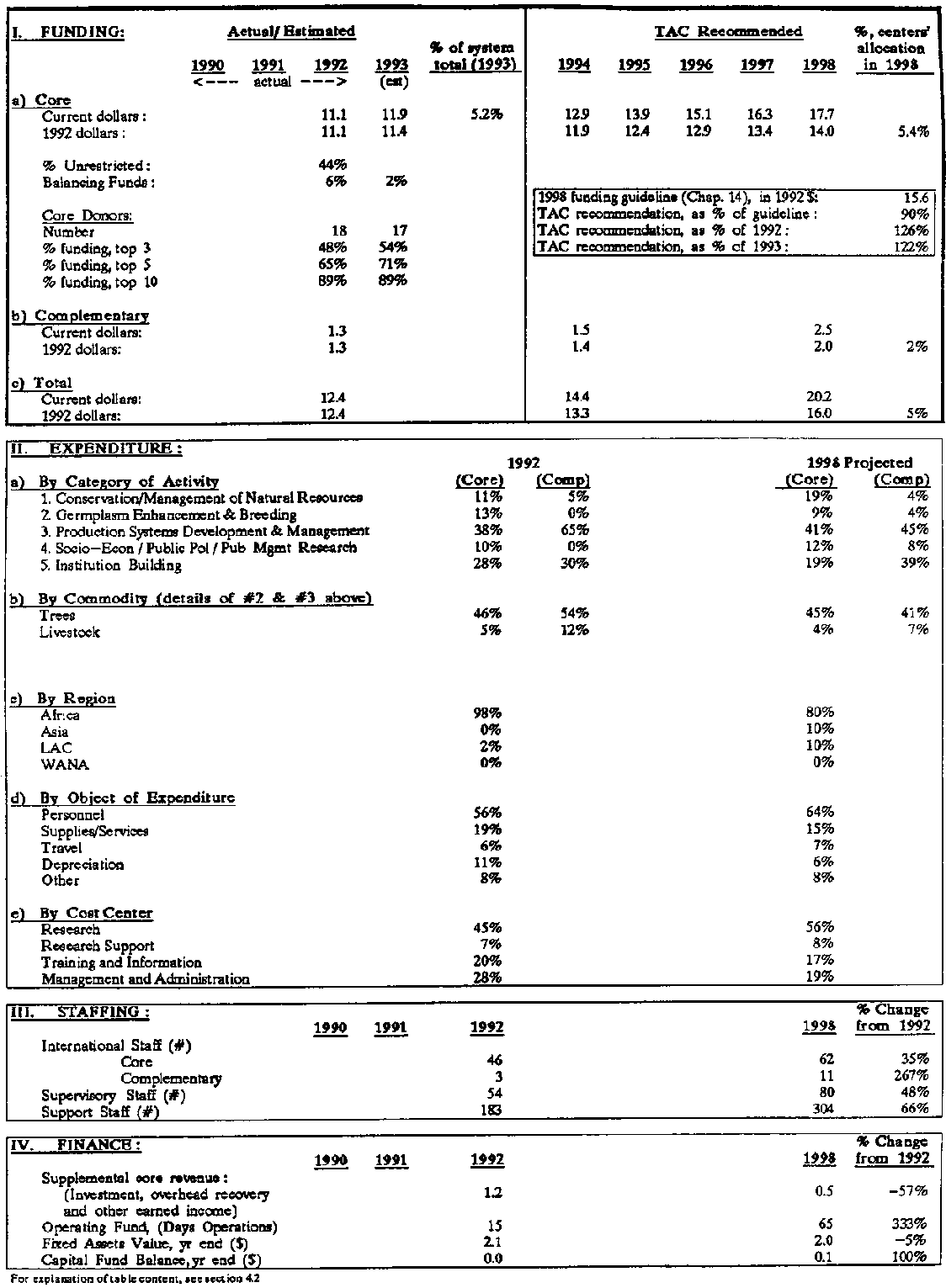
TAC recommends that ICRAF be assigned in 1998 core resources in the amount of US$ 14.0 million (in 1992 dollars), equivalent to 90% of the tentative envelope it was assigned in March 1992.
The cutback from the tentative envelope level was recommended, in part, due to concern for a too-rapid development of the Centre and, in part, due to a need for a less pronounced involvement in fully-fledged tree breeding activities. TAC considered that the tentative envelope level assigned originally to ICRAF had been too high. TAC shared the concern of the External Review Panel about the possibility of an adverse trade-off between scientific quality and a too rapid rate of expansion. The recommended envelope still represents an increase in constant terms of US$ 2.9 million - or 26% - over ICRAF's actual 1992 core funding.
TAC also recommends US$ 250,000 of funding to the Systemwide initiative on natural resources management research in the East and Central African highlands, and US$ 500,000 to the (currently ICRAF-led) Systemwide initiative on 'Alternatives to Slash and Burn', for both of which ICRAF will be the convening centre. Under the US$ 280 million vector, the funding of each of these Systemwide initiatives would be increased by US$ 500,000.
For 1998, ICRAF projects complementary funding of US$ 2 million (in 1992 values), representing 14% of ICRAF's recommended core funding for that year.
For 1994, TAC recommends a core funding for ICRAF of US$ 11.9 million in 1992 dollars, or US$ 12.9 million in current values. Together with complementary funding at US$ 1.5 million, total funding of ICRAF in 1994 would amount to US$ 14.4 million.
ICRAF: FINANCIAL HIGHLIGHTS (US$ million & percentages)