4.11.1. Summary of the MTP Proposal
4.11.2. Interim Commentary and Programmatic Issues
4.11.3 Centre Response
4.11.4. Evaluation
4.11.5. Recommendations
ICRISAT's MTP proposal reflects the outcome of an analytical priority-setting exercise, the implementation of its strategic plan, and the recommendations of the Centre's third External Review. ICRISAT's MTP proposal is based on a set of 110 research themes. These themes have been prioritized using a composite index, representing an amalgam of efficiency (net benefit/cost ratio), equity (poverty and gender), internationality and sustainability factors. Of the 110 themes, ICRISAT considers that 18 are suitable for complementary funding. The remaining 92 themes are presented in a ranked sequence based on the composite index, together with the cost associated with the implementation of each theme. The themes presented relate to research on ICRISAT's mandate crops, i.e., finger millet, pearl millet, sorghum, chickpea, pigeonpea and groundnut, and research on resource management. The research is currently implemented through three major programmes: cereals, legumes and resource management. The activities of these programmes would be complemented by the work of the research support, technology exchange and administrative units. An organization and management review is currently examining the value and desirability of a matrix mode of research management, which may have significant implications for ICRISAT's future structure and operations.
Most of the basic and strategic research proposed, as well as the advanced training, would be conducted at the ICRISAT Centre in Hyderabad, India. ICRISAT's African programmes are based in three locations: the ICRISAT Sahelian Centre in Niamey, Niger, is the regional centre for West Africa and focuses on long-term strategic research on resource management and on crop improvement research on millet, sorghum and groundnut; the ICRISAT Southern Africa Development Community Programme is based at Bulawayo, Zimbabwe for sorghum and millet research, and at Lilongwe, Malawi for groundnut research; and, the Eastern Africa Regional Cereals and Legumes Programme is based in Nairobi, Kenya. Furthermore, ICRISAT has a Latin American sorghum and millet improvement programme based at CIAT in Cali, Colombia.
The prioritized list of research themes led to the development of Plan A, ICRISAT's primary proposal, which requires core funding of US$ 29.6 million (in 1992 values) and is equivalent to 110% of the indicative resource envelope assigned by TAC in March 1992. ICRISAT's research themes are listed in priority sequence with a cut-off point according to the funding available. Plan B is similar to Plan A, although the 12 lowest-ranking themes have been removed to reduce the funding requirement to the level of the indicative base resource envelope (US$ 26.9 million). Plan C also removes themes to match funding requirements at the level of the base resource envelope but, in contrast with Plan B, with all pigeonpea themes being removed first regardless of their priority.
In comparison to its 1989-93 MTP, ICRISAT proposes in its primary proposal to increase the proportion of core resources allocated to resource management and groundnut research, reduce sorghum and millet allocations, and keep chickpea, pigeonpea and genetic resources at their current levels. Under this Plan A, the number of senior scientific staff years is projected to increase from 67 in 1992 to 76 in 1998, of which 46 would be posted at ICRISAT in Hyderabad and 30 in Africa. About 56% of ICRISAT's research themes are basically a continuation or a consolidation of ongoing activities; 22% involve a definite shift in focus of existing activities, while a further 22% are entirely new initiatives.
TAC commended ICRISAT for the transparent, structured and analytical process followed in setting programme priorities. One advantage of the approach was that it provided clear yardsticks against which progress can be measured. The Committee noted, however, that while the priority-setting process used by ICRISAT was transparent and systematic, it was very much dependent on qualitative and subjective judgements made by the scientific staff. There appeared to be a problem of lack of consistency of estimates across programmes and it was suggested that Board and management give greater consideration to the implications of the analysis for the balance of effort across programmes by commodity and research themes. It was noted that the priority-setting process was commodity based and the priority ranking of resource management themes had been estimated on their potential contribution to commodity improvement.
TAC noted that ICRISAT maintained the share of resources allocated to research on pigeonpea, despite its recommendation that its priority should be reduced. TAC encouraged ICRISAT to intensify its consultations with the Indian authorities on sharing responsibilities for pigeonpea research.
The pigeonpea issue raised the wider System level issue of what happens when the CGIAR perception of a priority of a commodity is substantially different from that of a Centre. In ICRISAT's priority-setting, pigeonpea research received a higher ranking than millet research, while at the System level, millet was given a higher priority than pigeonpea. TAC asked how the System- and Centre-level views could be reconciled in this regard.
TAC also welcomed clarification of ICRISAT's ecoregional initiatives, other than those of the ICRISAT Sahelian Centre. TAC also noted an overlap in responsibilities with IITA in the semi-arid and sub-humid tropical areas of sub-Saharan Africa.
ICRISAT considers that its priority-setting analysis evolved from a year-long, transparent, peer review iterative process involving scientists from within and outside the Institute, across all disciplines and programmes. The Centre believes that the judgements on which priorities have been based are the best available. It acknowledges that the cutoff point, in the event of constrained funding, should not be drawn arbitrarily as dictated by the priority listing. Final judgement will be made by management after further careful consideration.
ICRISAT stands by its arguments on the importance of pigeonpea research in relation to research on other commodities. It will intensify discussions with the Indian authorities on sharing responsibility for pigeonpea research. Review of progress in pigeonpea research will be made in 1997, prior to the start of a new five-year period and thus before making decisions on a future involvement of ICRISAT.
ICRISAT considers that research on both pigeonpea and pearl millet is important. It notes that TAC can avoid harsh decisions relating to these commodities by assigning funds at a 110% of the indicative envelope it assigned to ICRISAT.
On the ecoregional responsibilities ICRISAT has initiated discussions with IRRI resulting in an agreement to collaborate in the warm and semi-arid tropics, and the warm sub-humid tropics of Asia. This collaboration will relate to geographic information systems and research on the sustainability of production systems. ICRISAT has also initiated discussions with IITA and ILCA on characterizing production systems in the Sudano-Sahelian zones of Sub-Saharan Africa. The Centre will also contribute to the ICRAF-led initiative on integrated natural resource management for the highlands of East and Central Africa. ICRISAT also contributes to the savanna research programme of CIAT.
TAC saw no compelling reason on priority considerations to change the amount of resource envelope initially assigned to ICRISAT. The priority factors that work in favour of ICRISAT such as its activities in Asia, its focus on natural resources management, and its work on groundnut had already been reflected in determining the level of that envelope. While confirming its recommendation made in the Review of CGIAR Priorities and Strategies that ICRISAT should de-emphasize research on pigeonpea, TAC considered that it would take time to phase out research on that commodity. ICRISAT's proposal to continue pigeonpea research, building on the momentum of the success of the hybrid variety the Centre developed, and to assess its future involvement with the crop in 1997, was considered to be sensible. ICRISAT's priority-setting process is transparent and analytical.
TAC considers that ICRISAT's programme is of a strategic character and has good potential for breakthroughs. TAC appreciates the priority-setting methodology which has clear milestones against which progress can be measured. As indicated by its most recent External Review, ICRISAT has performed well in the past and there are firm indications that it will continue to do so. ICRISAT is well managed and is a healthy institution. It collaborates well with NARS and other organizations. ICRISAT has had a major impact on farm-level productivity particularly through its research on pearl millet. TAC is also pleased with the rapid progress made by ICRISAT and IRRI in developing proposals for an ecoregional approach in different agroecological zones of Asia.
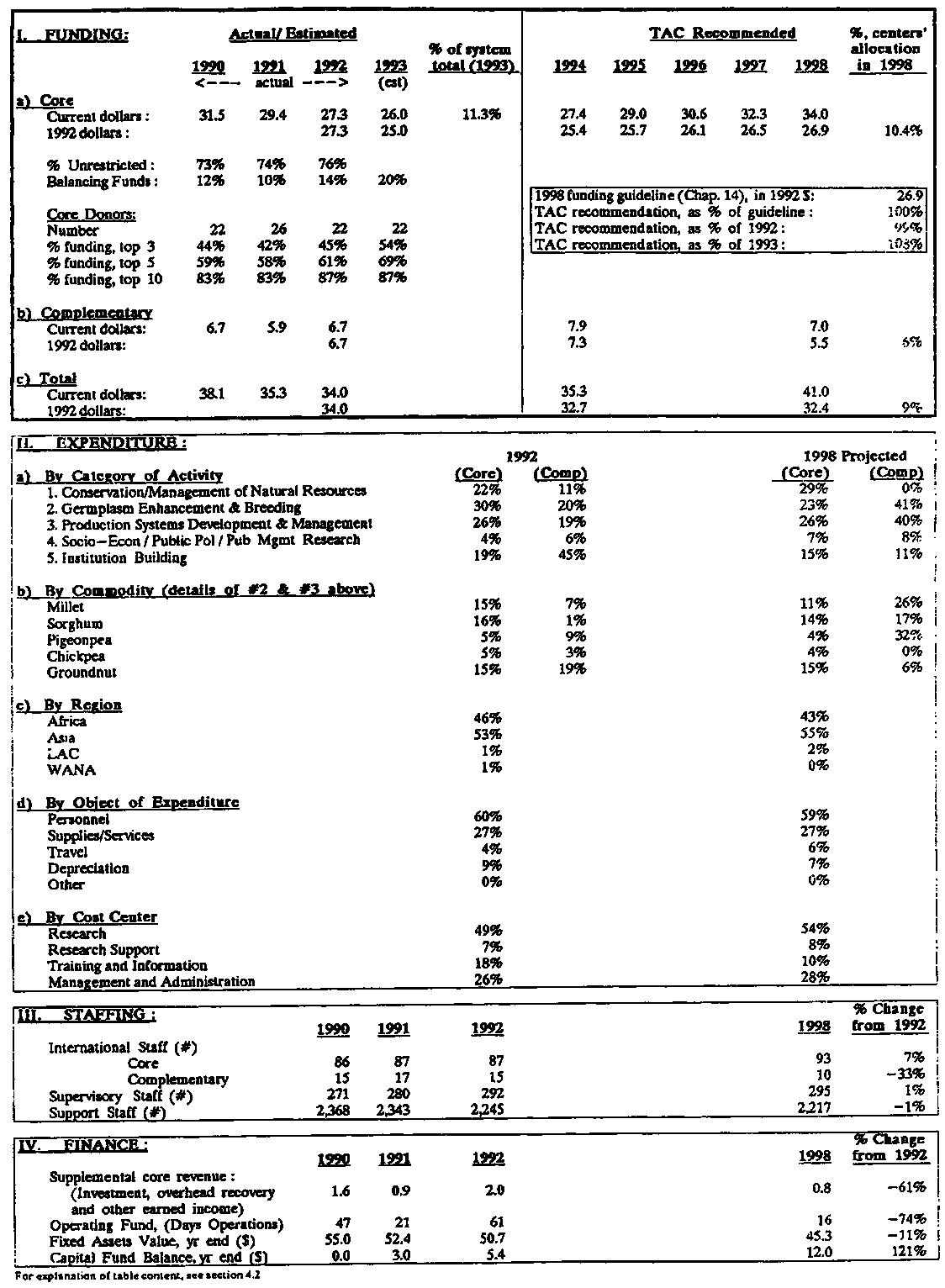
TAC recommends that for 1998 ICRISAT be assigned core resources of US$ 26.9 million (in 1992 values) which is equivalent to 100% of the tentative envelope assigned in March 1992. TAC specifically endorsed Plan B in the MTP proposal which, compared to ICRISAT's primary proposal, removes the 12 lowest-ranking themes to reduce the funding requirement to the level of the base resource envelope. TAC supports
ICRISAT's plan to intensify discussions with the Indian national research system on sharing responsibility for pigeonpea research.
In recognition of the importance of the needs of the warm arid and semi-arid tropics of sub-Saharan Africa, TAC also recommends an increase of US$ 1 million of ICRISAT's envelope at the US$ 280 million vector, so as to allow the Centre to strengthen its ecoregional role and activities on natural resources management in the Sahelian area.
ICRISAT has been identified as the convening centre for a Systemwide ecoregional programme for the arid and semi-arid zones in sub-Saharan Africa for which TAC recommends funding in the amount of US$ 500,000 by 1998. ICRISAT was also identified as the convening centre for a Systemwide ecoregional programme in the warm arid and semi arid zones of Asia for which TAC recommends US$ 400,000 in funding by 1998. This latter programme will also incorporate elements of the CIMMYT-IRRI rice-wheat programme. At the US$ 280 million vector, TAC recommends that funding of these initiatives be increased, in 1998, by US$ 150,000 and US$ 125,000 respectively.
For 1998, ICRISAT projects complementary funding at US$ 5.5 million (in 1992 values), representing 20% of its recommended core funding.
For 1994, TAC recommends core funding for ICRISAT in the amount of US$ 25.4 million in 1992 values, or US$ 27.4 million in current values. With complementary funding projected at US$ 7.9 million, ICRISAT's total funding in 1994 would amount to US$ 35.3 million.
ICRISAT: FINANCIAL HIGHLIGHTS (US$ million & percentages)