4.12.1. Summary of the MTP Proposal
4.12.2. Interim Commentary and Programmatic Issues
4.12.3. Centre Response
4.12.4. Evaluation
4.12.5. Recommendations
IFPRI's MTP proposal reflects the implementation of the Institute's strategic plan for the 1990s (issued in 1991) which had provided a broad outline of the needs for food policy research and outreach. The MTP proposes a major involvement in four areas of work: accelerated growth and transformation in agriculture; natural resources management policies; market economic reforms and trade policy; and household food security and nutrition. The proposed MTP would be implemented through an organizational structure consisting of five divisions which would undertake a total of 17 integrated multicountry research programmes. The five divisions are: Environment and Production Technology; Food Consumption and Nutrition; Markets and Structural Studies; Trade and Macroeconomics; and Outreach. Each of the multicountry programmes is focused on a policy issue for which IFPRI considers international strategic research is urgently needed and likely to have large benefits. IFPRI intends to enhance its activities in providing information to potential users of its research, and in contributing to the strengthening of policy research capacity in developing countries. IFPRI considers that about 90% of its total programme can be classified as core. However, only half of that programme will be supported by what are considered to be regular sources of core funding in the CGIAR, and the other half by sources of complementary funds.
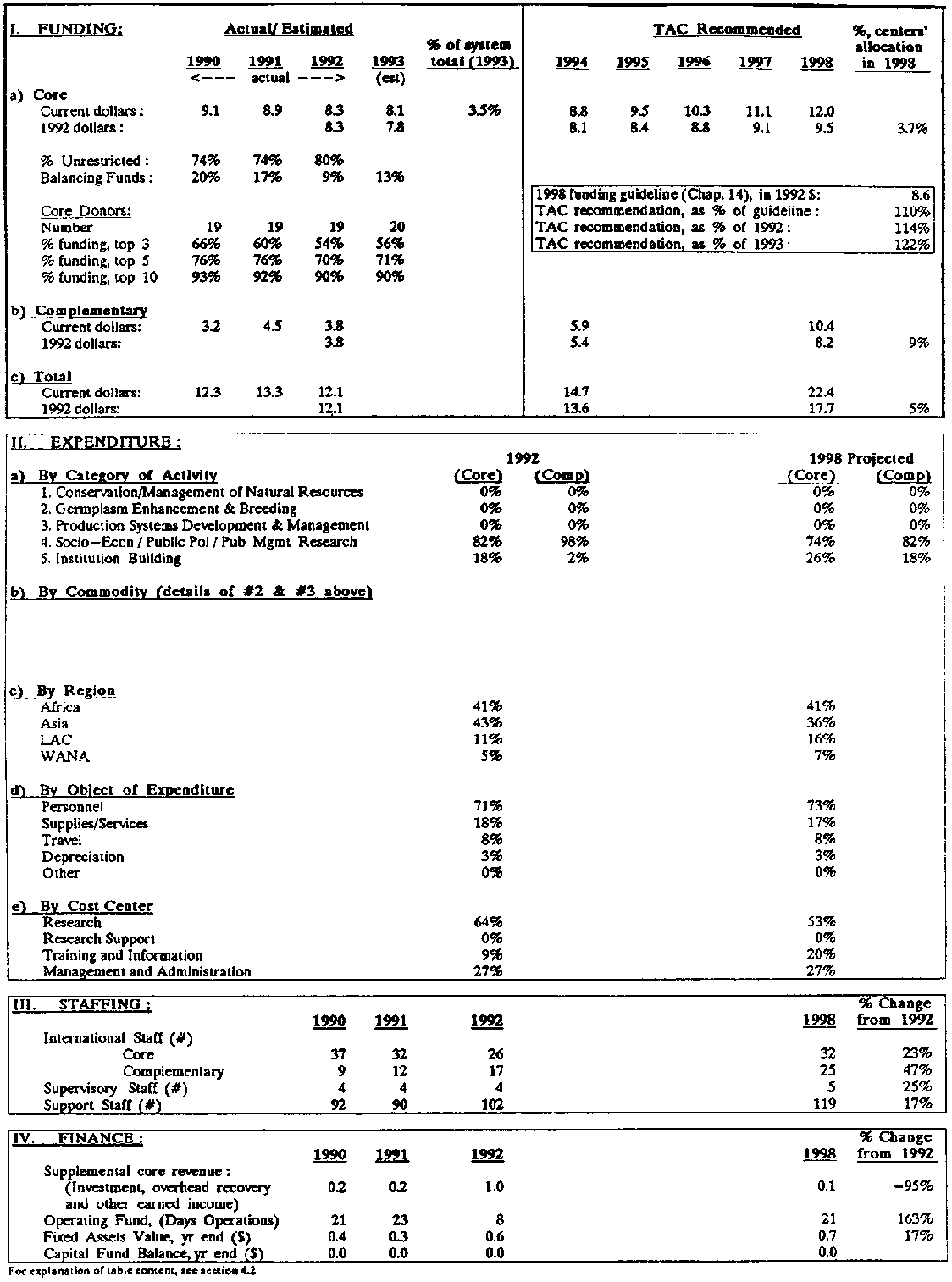
IFPRI's primary proposal has been prepared at the level of the base resource envelope for 1998, requiring core funding of US$ 8.6 million in 1992 dollars. In addition, approximately US$ 7.6 million in complementary funds are being projected for that year. Between 1994 and 1998, the number of senior staff in the core programme would increase from 27 to 30, and in the complementary programme, from 20 to 23. IFPRI's total budget under the primary MTP proposal would call for total operations of US$ 14.3 million and 47 senior staff in 1994. For 1998, this budget would call for total operations of US$ 16.3 million (in 1992 values) and 53 senior staff.
Under its primary MTP proposal, approximately 53% of IFPRI's core resources would be allocated to research, 20% to outreach and networks, and 27% to administration and operations. IFPRI proposes to allocate 73% of its resources to activity 4.2 of policy analysis, and 27% to category 5 of institution building. Within this latter category, training and conferences would account for 3% of the allocation of total resources, documentation, publication and information for 14%, and outreach/networks for 10%. Regionally, 41% of IFPRI's resources would be allocated to sub-Saharan Africa, 36% to Asia, 16% to Latin America and 7% to WANA.
Supplementary proposals at the levels of 90% and 110% of the base envelope have also been submitted. At the 110% level, IFPRI would particularly expand its work on input markets, property rights and forestry margins. In the 90% scenario, presented in IFPRI's MTP document, research on rural services would be reduced considerably, while the introduction of research on the implications of rapid urbanization for agriculture, food and nutrition would be delayed, as well as the appointment of a Deputy Director General.
TAC appreciated IFPRI's wide set of institutional relationships. These are necessary to achieve critical mass in the research proposed, and allow IFPRI to focus on its own area of expertise. TAC requested more information about the extent and modalities of collaboration with other IARCs, particularly in the area of natural resources management policies.
TAC noted the wide expansion of policy research activities in the CGIAR and the strong demand for collaboration with IFPRI. Almost every CGIAR centre included in its MTP a proposal for collaboration with IFPRI in the area of policy research. TAC understands that IFPRI can only engage in effective collaboration with other centres if their proposals fit within IFPRI's own priorities, and noted that IFPRI could not be expected to address all the policy research issues in the CGIAR. Members of the CGIAR raised the need for clarification on whether the adjustments at the 100% and 90% level would consist simply in transfers from core to complementary funding, or would be net additions or real decreases.
IFPRI's approach to inter-centre collaboration is to initiate discussions with centres where there is an obvious overlap of interests and capacities, and to view the approaches of other centres largely in terms of the degree to which the activities fit within its proposed research programme. IFPRI is not actively pursuing collaboration to help centres conduct policy research within their own mandates but on topics that are not of high priority for IFPRI. IFPRI's preferred model of collaboration with other centres in research on the management of natural resources is a jointly conceived and implemented research project in which the staff of the two centres work on an agreed plan and with coordination and direction appropriate to the specific topic. With some centres, such as IIMI and ICRISAT, it has joint staff appointments. The funding and implementation mechanisms under consideration vary considerably according to the circumstances. IFPRI is extremely careful not to commit itself to demands for collaboration beyond the extent to which it would no longer be able do a good job.
TAC considered that on priority considerations the amount of resources assigned to IFPRI should be revised upwards. In the Review of CGIAR Priorities and Strategies TAC recommended that the amount of core resources allocated to public policy research should be increased substantially. TAC considered that this was inadequately reflected in the amount of IFPRI's tentative envelope, assigned in March 1992. Recent developments, such as UNCED, had stressed the importance of policy factors in the process of resource and environmental degradation. IFPRI's MTP proposal reflects the increasing emphasis by the Institute on environmental and natural resources management issues which are of high priority to the CGIAR. IFPRI's programmes were well balanced and thought through, and the rationale for the Institute's priorities is well argued.
TAC considers IFPRI's MTP to be coherent, well argued and transparent. IFPRI's programme proposals are of a highly strategic character addressing the critical future policy research issues of international importance. There is substantial potential for breakthroughs through research for the development of alternative options for policy makers. IFPRI has a very good record of performance and the results of the recent Interim External Review, as well as of ongoing research programmes, give a clear indication that the Institute will continue to deliver high quality research in the future. IFPRI is well managed and is now institutionally healthy. It has excellent collaborations with national institutions and other organizations conducting policy work. TAC is impressed with IFPRI's new multi-country programmes and considers its work on natural resources management policies, particularly on property rights and communal action to be of very high priority.
IFPRI's core programme accounts for approximately 90% of the Institute's total activities. This core component has been defined on the basis of specific programmatic criteria, and not on a source of funds basis. Only part of this core programme will be supported by CGIAR core funding. IFPRI intends to implement the balance with funding considered as complementary by the CGIAR.
TAC has carefully considered the proposed balance between core funds and complementary funds, which is expected to evolve to an overall share of 53% core and 47% complementary by 1998. The Committee recognizes that the proposed share of complementary funding is high and would normally involve a danger of over-dependency on restricted funds. In the particular case of IFPRI, however, TAC considers that the proposed ratio is reasonable. IFPRI has a high cost per scientist, even though it does not have the fixed expenses associated with work in the natural sciences. The extra cost is due to the need to collect survey data. On the other hand, IFPRI is not committed to the maintenance of fixed structures, which in contrast with other centres gives IFPRI greater flexibility in managing its resources. Its dependence on complementary funding cannot, on balance, be considered imprudent. TAC also recognizes that scale is an important factor in IFPRI's differentiation between core and complementary activities. IFPRI's core programme should consist of a critical basket of activities by subject matter and region, beyond which more is appropriate but does not necessarily have to be funded with scarce core resources.
IFPRI has a wide set of effective collaborative arrangements with other centres. TAC considers it to be appropriate that IFPRI makes its involvement with other centres dependent on the degree to which the activities of that centre fit within its own priority research programme. IFPRI should not be expected to provide service functions in the CGIAR despite the fact - as recognized by TAC - that demand for policy research is far greater than IFPRI can supply. TAC will address this issue further during 1994 in the proposed strategic stripe review of public policy and public management research in the CGIAR.
TAC considered that both on priority and institutional considerations the amount of resources assigned to IFPRI should be revised upwards. In the Review of CGIAR Priorities and Strategies TAC recommended that the amount of core resources allocated to public policy research should be increased substantially. TAC considered that this was inadequately reflected in the amount of IFPRI's tentative envelope, assigned in March 1992. Recent developments, such as UNCED, had stressed the importance of policy factors in the process of resource and environmental degradation. The recent Interim External Review of IFPRI has also indicated that IFPRI will continue to deliver high quality research and is institutionally healthy.
Therefore, TAC recommends that IFPRI be assigned for 1998 core resources of US$ 9.5 million (in 1992 dollars) which is equivalent to 110% of the indicative resource envelope. The Committee expects that this will allow IFPRI to give greater attention to research on natural resources management. TAC would also encourage the Institute to give greater attention to macroeconomic studies with respect to sustainability. While this latter research is currently not within the 110% proposal, TAC considers this work to be of higher priority than the proposed work on input markets which are included in that proposal.
IFPRI is also expected to contribute to several of the proposed Systemwide ecoregional initiatives for which TAC recommends programme funding and IFPRI will share in the US$ 1 million allocated to the initiative on fisheries policy research assigned under the US$ 280 million System vector.
For 1998, IFPRI projects complementary funding of US$ 8.2 million (in 1992 dollars), representing 86% of its recommended core funding.
For 1994, TAC recommends core funding for IFPRI in the amount of US$ 8.1 million in 1992 dollars, or US$ 8.8 million in current values. With complementary funding projected at US$ 5.9 million, IFPRI's total funding would amount to US$ 14.7 million.
IFPRI: FINANCIAL HIGHLIGHTS (US$ million & percentages)