4.13.1. Summary of the MTP Proposal
4.13.2. Interim Commentary and Programmatic Issues
4.13.3. Centre Response
4.13.4. Evaluation
4.13.5. Recommendations
IIMI's mission is to foster the development, dissemination and adoption of lasting improvements in the performance of irrigated agriculture in developing countries. It does so by generating knowledge to improve irrigation management and policy making, strengthening national research capacity in the field of irrigation management, and supporting the introduction of improved management and policy making.
The Institute's core programme will focus on research and institution building activities that are generic in nature, designed to generate transnational rather than country specific results. The complementary programme will be made up of country-specific projects. IIMI has developed a concept of core add-on projects. These are core funded projects attached to country specific collaborative research projects to allow the Institute to generalize from country-specific projects, and thus contribute to the generic core programme.
IIMI's research approach during the MTP period will involve a combination of collaborative field research and thematic research. Research activities will be organized into five closely-related programmes:
· Assessing and improving the performance of irrigated agriculture;
· Sector-level management of irrigated agriculture;
· Improving public irrigation organizations;
· Toward the local management of irrigation systems; and
· Sustainable management of water delivery and disposal.
IIMI has also identified four cross-cutting themes: environment and health; choice and use of technology; gender issues; and, improving the global database on irrigated agriculture.
IIMI has presented its MTP proposal at three funding scenarios: the base resource envelope recommended by TAC; a level equivalent to 110% of the base resource envelope; and, a level at 90% of the base. At the base level, the estimated total manpower allocation for core research and research-related activities will be 12.5 senior staff years (SSY) in 1994 rising to 13.75 SSY in 1998. In 1994, the proposed manpower distribution by programme will be 5 SSY, 1 SSY, 1 SSY, 3 SSY and 2.5 SSY for the performance, sector management, public organizations, local management, and water management programmes respectively. Over the MTP period, training, information, and documentation will account for four SSY per year. The regional allocation of core resources will be based on the distribution of the areas under irrigation, i.e., 76% for Asia, 12% for WANA, 3% for SSA, and 9% for Latin America.
The issues raised by TAC and the CGIAR on IIMI's MTP proposal related to: (a) the agroecological research content of IIMI's MTP proposal; (b) the choice of programmes at the base resource envelope; (c) the focus and critical mass in the proposed core programme; (d) the regional allocation of resources and country selection criteria; (e) IIMI's response to UNCED Agenda 21; (f) collaboration with other centres and advanced institutions; and, (g) the staffing implications of the broadening IIMI's mission to irrigated agriculture, compared with the so far narrower focus on the management of irrigation systems.
IIMI argues that it has adopted an agroecological approach to research since its inception and will continue to do so during the MTP period. The Institute intends to complement and support consortia and other mechanisms of ecoregional activities by other centres in the field of irrigated agriculture.
With respect to the choice of programmes at the base resource envelope IIMI was requested to reconsider whether generic research activities in drainage and watershed management included in the MTP proposal under the 110% scenario should be part of the scenario at the level of the base resource envelope. The Institute feels that it does not presently have the advantage to undertake generic research in drainage and watershed management.
During the MTP period, IIMI management plans to monitor the issue of focus and critical mass on a regular basis and to recommend amendments to the MTP, as needed. The Institute considers the five programmes and four themes proposed in the MTP as components of an integrated whole. It plans to combine initially the sector management programme and the public organizations programme thereby overcoming critical mass issues by pooling manpower. It will also be flexible and pragmatic about the 'intellectual home' of the cross-cutting themes. Linkages between core and complementary activities will be strengthened and thus improve overall critical mass.
IIMI plans to respond to UNCED's Agenda 21 in two ways: through generic research, both conceptual and operational, oriented towards natural resources management; and country specific activities with a narrower focus on threats to the sustainability of irrigation systems. The generic work will be carried out under the cross-cutting theme 'Environment and Health'.
IIMI's management agrees with the need for close collaboration with other centres and with institutions in both developed and developing countries. This will apply principally to institutions that share with IIMI an interest in irrigation management and where, through collaboration, the parties can benefit from each others expertise. IIMI has prepared an inventory of its collaborative activities with other centres as well as with other institutions of excellence.
Finally, IIMI's management is aware of the need to review the composition of its senior scientific staff in order to respond to the challenges posed by the change in IIMI's mission. IIMI will strive to achieve an appropriate balance in disciplines, and in particular among the major disciplinary groupings of relevance to irrigated agriculture.
IIMI has prepared an analytical and a well reasoned MTP proposal which is based on its 'Strategic Plan for the 1990's' (issued in 1991) and on the major recommendations of the 1990 External Review.
TAC is broadly satisfied with the additional information provided by IIMI with respect to internal priorities, disciplinary balance, criteria for country selection and collaborative research with other centres and with advanced institutions. TAC is also satisfied with IIMI's criteria for country selection in respect of complementary and core-add-on projects.
TAC notes IIMI's arguments for the current and proposed distribution of effort between Asia, WANA, Sub-Saharan Africa and Latin America. While agreeing in principle that IIMI should concentrate on regions and countries where irrigation plays a major role in the agricultural sector, TAC considers that IIMI should also take into account alternative sources of research supply. Most of the developing countries with a large proportion of irrigated agriculture have relatively large and strong national research programmes. Further, IIMI should not only consider the area currently under irrigation but future irrigation needs and potential as well.
TAC is still concerned about the issue of programme focus with respect to the broadened mission, and critical mass, particularly with respect to the sector management and public organizations programmes. TAC notes that, by 1998, core and complementary activities will be virtually of equal importance. The high proportion of complementary activities, in relatively few countries, presents a major challenge to IIMI in ensuring effective support to its generic research and institution building activities. Finally, TAC is pleased about the collaboration IIMI has with national programmes and other research partners.
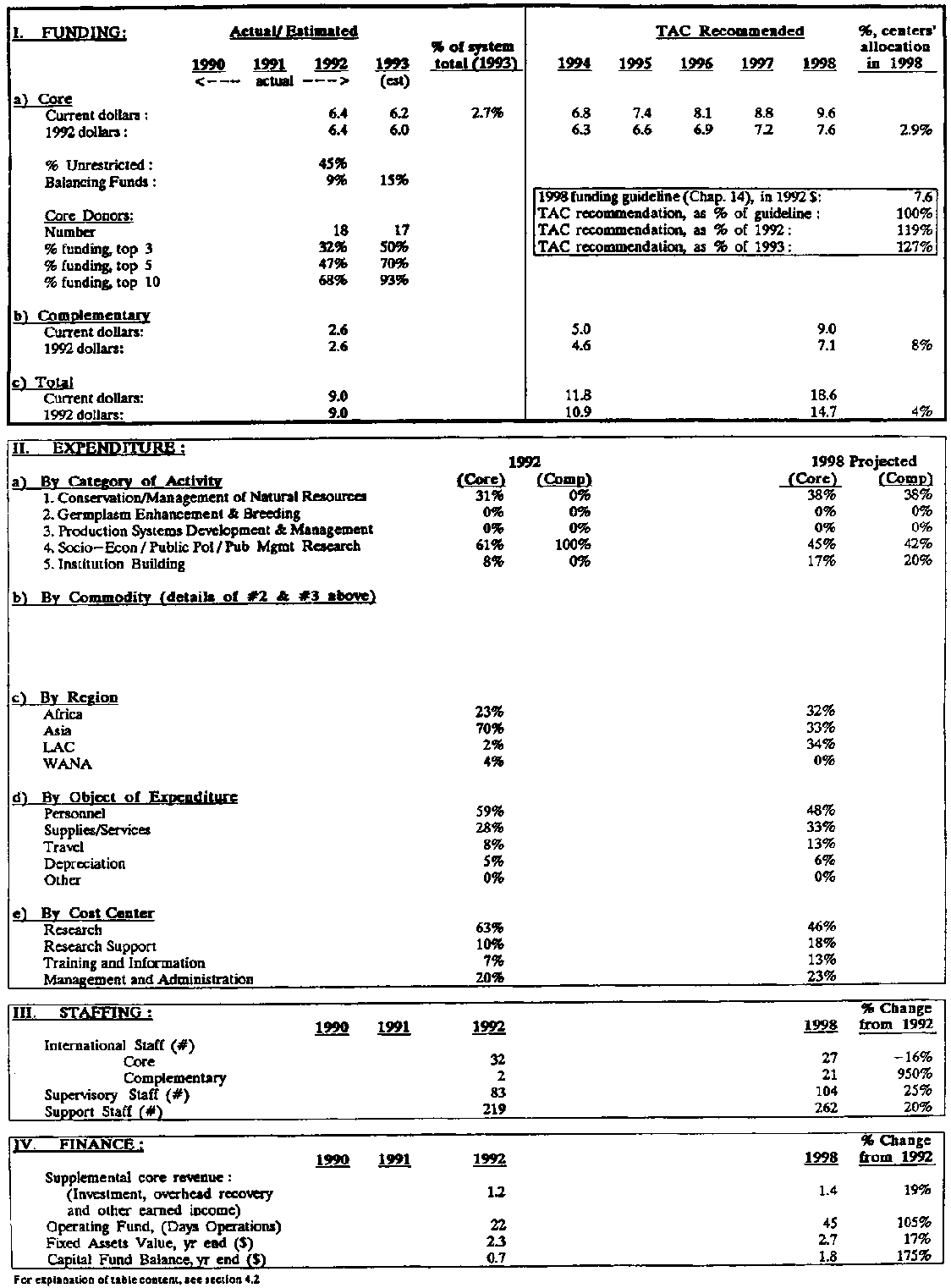
TAC recommends that IIMI be assigned core resources for 1998 of US$ 7.6 million (in 1992 values) which is equivalent to 100% of the tentative envelope assigned in March 1992. TAC thereby took into account the importance of irrigated agriculture and of managing water as a public good in developing countries. No increase was recommended at the US$ 270 million vector because IIMI is still in a stage of transition from a country-focused, project-led operation to an international research organization. TAC noted that two of the five research programmes are still not operational and that IIMI will be subject to an external review in 1994 at which time its programmes will be assessed in terms of their strategic orientation, relevance and resource needs.
IIMI has been identified as the convening centre for a proposed Systemwide initiative on water management research for which TAC recommends US$ 1 million of core resources by 1998 at the US$ 270 million vector. An additional US$ 1.0 million is recommended at the US$ 280 million vector for this initiative to augment inter-centre cooperation in irrigated cropping systems research, including watershed management, human health issues in irrigated areas, and downstream environmental problems created by irrigated agriculture.
For 1998, IIMI projects complementary funding of US$ 7.1 million (in 1992 values), which represents 93% of its recommended core funding.
For 1994, TAC recommends core funding for IIMI in the amount of US$ 6.3 million in 1992 values, or US$ 6.8 million in current values. With complementary funding projected at US$ 5 million, IIMI's total funding in 1994 would amount to US$ 11.8 million.
IIMI: FINANCIAL HIGHLIGHTS (US$ million & percentages)