4.14.1. Summary of the MTP Proposal
4.14.2. Interim Commentary and Programmatic Issues
4.14.3. Centre Response
4.14.4. Evaluation
4.14.5. Recommendations
The primary scenario in IITA's MTP proposal reflects the implementation of IITA's strategic plan and the recommendations of the 1990 External Review. It focuses on the development of sustainable production systems for the smallholder farmer in West and Central Africa within two ecological zones: the humid forest and moist savanna, with a smaller programme for the inland valley areas located within these broad zones. The MTP proposal is based on four operational programme objectives, namely: to develop systems for the management and conservation of natural resources for sustainable agriculture in the humid and sub-humid tropical zones; to increase performance of selected food crops that can be integrated into improved and sustainable production systems; to strengthen national agricultural research capabilities; and to improve quality characteristics and post-harvest technologies of food crops within IITA's mandate.
The MTP proposal presents three scenarios at different levels of core funding: the base scenario at the indicative resource envelope of US$ 22.2 million, and which calls for 99 senior staff (SSY); a scenario at 110% of the base, calling for US$ 24.4 million and 102 SSY; and, a scenario at 120% of the base, calling for US$ 26.5 million and 108 SSY. In the base scenario, the balance of effort among the five categories of activity in 1998 will be 24% for natural resource conservation and management, 22% for germplasm enhancement, 34% for production systems improvement, 2% for socioeconomics and public policy research, and 18% for institution building. Under the 110% scenario, the recurrent operating costs of the Biological Control Programme are reclassified from complementary to core. The 120% scenario incorporates the expansion of IITA's current core activities to include the mid-altitude savanna and woodland areas of Eastern and Southern Africa.
The MTP proposal strikes a balance between commodity and ecoregional responsibilities, and between research and strengthening national research programmes. Within each agroecosystem, the major activities will be the characterization of the farming systems, their constraints, and the opportunities for sustainable improvements. Across all zones, management of a wide range of plant genetic resources would be needed for future use in breeding or selection of appropriate genotypes. Post-harvest research will be conducted to ensure that crops are efficiently transformed into products that meet consumer requirements.
In the lowland humid forest zone, priority will be given to: improved cropping systems and fallow practices for sustainable management of fertility on acid soils; development of plant health management systems for the major crops of the zone; and germplasm improvement. In the lowland moist savanna zone, soil improvement will be a major priority with a strong effort on increasing the nutrient-use efficiency and yields of maize; and the diversification of cropping systems through the introduction of grain legumes and cassava. Plant health management research will focus on key pests, and special emphasis will be given to the reduction of losses through the development of integrated pest management programmes.
For the inland valley ecosystems, the emphasis will be on the characterization and improved practices for land development, water management, soil fertility, weed and pest management, and the development of adapted crop varieties. In the mid-altitude savanna and woodland zone, the main thrust will be germplasm improvement and plant health management to improve the productivity and sustainability of current cropping systems.
TAC considered that the process of establishing priorities and the rationale for internal priorities across programmes, commodities and activities was not always clear in IITA's MTP proposal. Further information on their rationale was sought, specifically on: IITA's plans for its future involvement with alley farming, in the light of achievements and impact to date, including the potential for greater collaboration with ICRAF; future strategic direction of the inland valley programme and the implications for collaborative work with WARDA and IIMI; and, IITA's future involvement with soybean.
In June 1991, TAC recommended to the Group approval of the strengthening of the biological control programme and its reclassification from complementary to core, but also recommended that the programme be integrated through shifts within IITA's then prevailing MTP. In the primary scenario of its MTP proposal, IITA proposes that the biological control programme be supported by non core funds as part of its complementary programme. TAC wanted to know the implications for IITA's MTP proposals of the integration of biological control programme in its core programme at the base envelope level.
The financial impact of IITA's proposals for expanding its activities in Eastern and Southern Africa are included in the 120% scenario. TAC was not clear whether the proposed expansion of IITA's mandate relates to strengthening of commodity activities or ecoregional responsibilities. Also, the implications of this expansion for collaboration with other centres such as CIMMYT and CIAT needed to be clarified.
There is an overlap in the agroecological zones to be covered by IITA and ICRISAT, particularly with respect to the semi-arid and sub-humid lowland zones. Further information was requested on IITA's future collaboration with ICRISAT and other organizations in these zones.
TAC considered that IITA's MTP proposal lacked clarity on the rationale for classifying the proposed activities as either core or complementary.
In its response IITA described its approach to priority setting across commodities and regions as one based on the relative importance to food security and future prospects for IITA's mandated commodities in the different regions of sub-Saharan Africa. It also provides an analysis of natural resources management and plant health constraints by agroecological zones as a basis for defining the priorities for research on resources management and plant health.
IITA will maintain its research effort on all the six mandated crops in accordance with TAC recommendations. Crop improvement work, apart from breeding, will address general production constraints that are responsible for low yields. Resource management research will emphasize the improvement of existing cultural practices and the development of new techniques to prevent soil degradation. Plant health management research will continue to aim for reduction in overall pest pressure through integrated pest management (IPM) approaches, including biological control and resistant germplasm.
Soybean offers an excellent opportunity for diversifying agricultural production in sub-Saharan Africa and for improving the nutritional status of people. Research at IITA has produced very promising new plant material and well adapted post-harvest technologies, but future attempts to increase efforts on soybean will be dictated by financial constraints.
The proposal to expand IITA's current mandate to mid-altitude and highland areas of Eastern and Southern Africa is primarily to strengthen commodity activities in which it considers it has a particular advantage. IITA sees this extension as logical in the light of the gradual expansion of IITA's mandate to all of the humid and sub-humid regions of sub-Saharan Africa.
Research on inland valleys will be carried out as an integral part of the moist savanna and humid forest research programmes. A proposal has been developed for the establishment of a consortium on inland valleys in West Africa, involving WARDA, IITA, IIMI and relevant national programmes. IITA and WARDA have agreed to extend the cooperation to other areas of joint interest. The consortium concept, as developed for the inland valleys programme, is regarded by IITA to be a useful mechanism to shift responsibilities to national programmes. IITA is considering the possibility of setting up a special programme for adaptive research collaboration with national programmes.
IITA and the other centres concerned (e.g., ICRISAT, CIMMYT, CIAT, WARDA) do not perceive any particular problem attributable to the overlaps noted by TAC. Within the development of the ecoregional concept, collaboration with all centres is effectively addressed by agreement at the management level, followed by the development of specific plans at the working level.
The integration of the operating costs of the biological control programme into core, at the base level, would require the elimination of four senior staff years in direct research and two positions from research support and administration. As a consequence, most of the affected crop improvement and crop protection work would be undertaken as complementary activities. The balance of effort by category of activity would then be 26% for category 1, 19% for category 2, 37% for category 3, 2% for category 4, and 16% for category 5.
IITA's programmes provide a good example of the integration of commodity improvement research with natural resources management activities within an ecoregional context. In this regard IITA proposes to conduct research on inland valleys as an integral part of the moist savanna and humid forest research programmes.
TAC was pleased with the response of IITA to the issues it had raised in its interim commentary. TAC considers that IITA's research programme is coherent, and focusing on the critical strategic issues. The potential for scientific breakthroughs and probability of success are high, particularly with cassava, banana, maize and soybean, and with integrated pest and nutrient management. There have been significant achievements in the past with crop improvement and in pest control. The Centre is well endowed with human and physical resources, and it is institutionally healthy. The Centre has extensive collaboration with national programmes, other centres and advanced institutions. More recently, the Centre has made special efforts to improve the sharing of responsibilities with national programmes, as well as other centres arrangements. The improved relationship between the Centre and the host country appears to provide a conducive environment for future success.
IITA is addressing issues of high priority in sub-Saharan Africa, and its strategic directions and target groups are in line with CGIAR priorities and strategies. IITA's revised proposals at the level of the indicative base envelope, provide compelling arguments for additional core resources if the biological control programme is to be fully incorporated into core, and if the work on banana and plantain, as well as on soybean is to be sustained and expanded.
On the basis of additional information provided by IITA and in view of the forthcoming reorganization of the banana and plantain research in the CGIAR, TAC considers that, on priority considerations, the amount of resources tentatively assigned in March 1992 to IITA should be revised upwards.
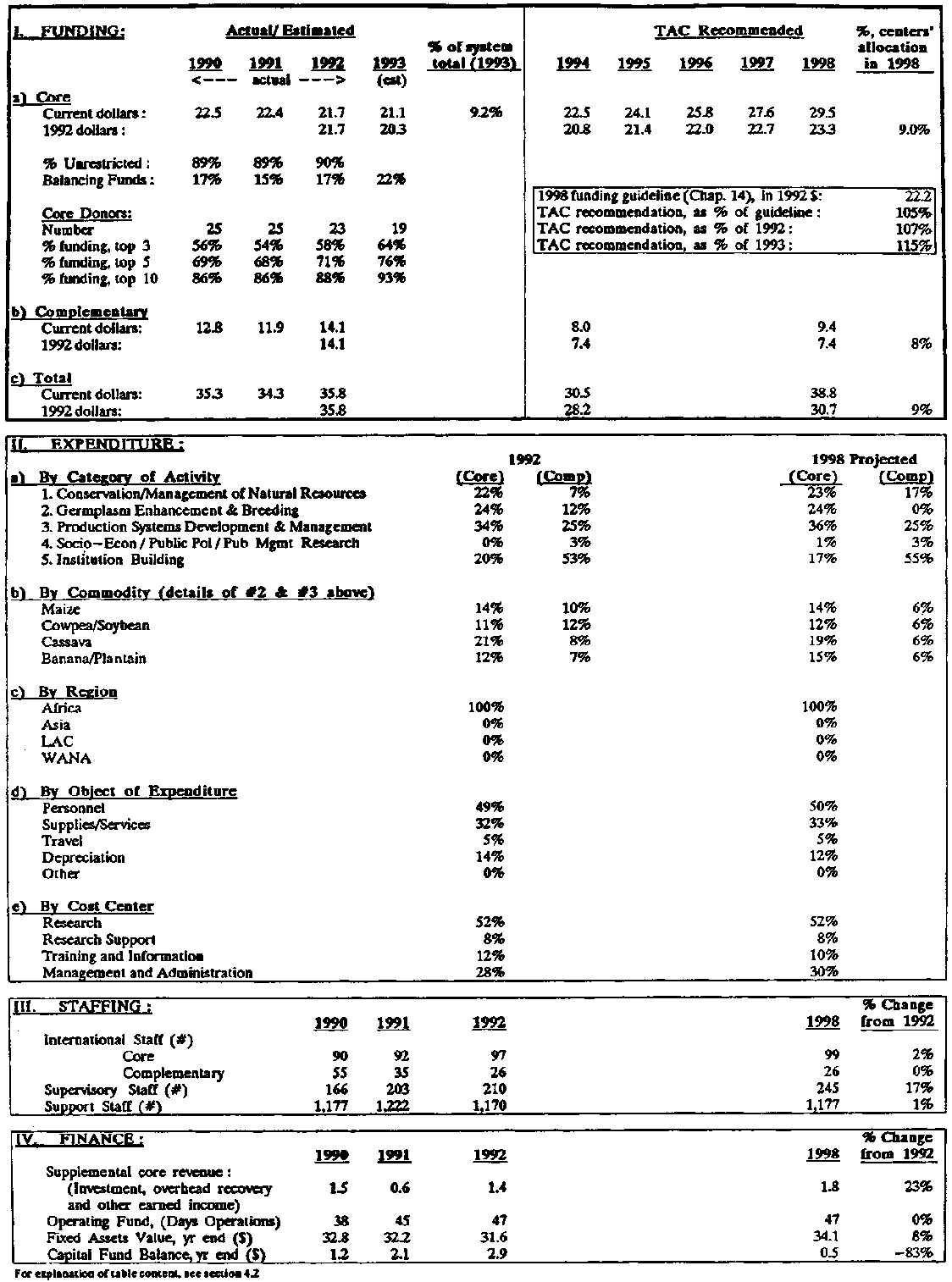
TAC recommends that IITA's core resources for 1998 should amount to US$ 23.3 million (in 1992 dollars), which is equivalent to 105% of the indicative resource envelope. TAC expects IITA to include, at that level of resources, the operational costs of the biological control programme, and to sustain and expand its activities on banana and plantain and soybean. In addition, TAC recommends that, by 1998, US$ 500,000 of core resources should be made available towards a Systemwide ecoregional programme for the warm humid and sub-humid tropics in sub-Saharan Africa, for which IITA would be the convening centre and would work in close collaboration with other centres, and with WARDA in particular for work on inland valleys. At the US$ 280 million vector, TAC recommends an increase of US$ 200,000 for this Systemwide initiative.
For 1998, IITA projects complementary funding of US$ 7.4 million (in 1992 values), which represents 32% of its recommended core funding for that year.
For 1994, TAC recommends a core funding for IITA of US$ 20.8 million in 1992 dollars, or US$ 22.5 million in current values. Together with complementary funding at US$ 8.0 million, total funding of IITA in 1994 would amount to US$ 30.5 million.
IITA: FINANCIAL HIGHLIGHTS (US$ million & percentages)